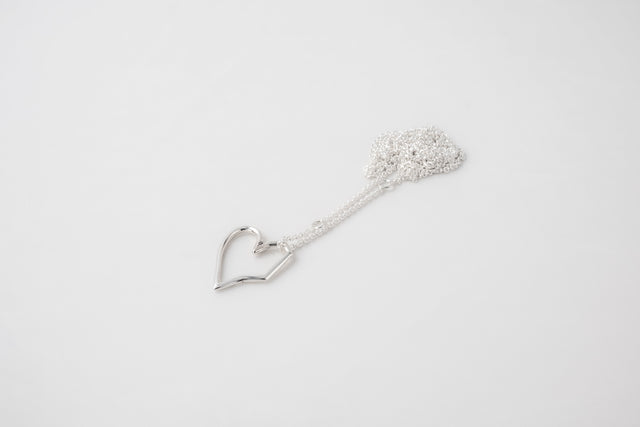
Earrings
An earring is the only piece worn on a part of the body that cannot rest. The ear is always at the edge of what you see, next to the face and next to the hand that pushes hair back. So the first question about an earring is not what it looks like on a table — it is what holds it, and what it does after eight hours.
- Fastening decides first: with a piercing or without
- Silhouette: what the shape does next to the face
- Weight and length — what the ear feels by evening
- Material — what the surface does over time
- How STRUGA makes earrings
- In short
- Frequently asked questions
Earrings are told apart by four things. By fastening — what keeps the piece on the ear, and whether a piercing is needed at all. By silhouette — what the shape does next to the face. By weight and length — what the lobe feels by evening. By material — what the surface does over time.
Fastening divides earrings into two families before anything else: pieces that go through a piercing — studs and threaders — and pieces that hold without one, cuffs and clips.
Silhouette gives the hoop, the drop, the single.
Weight is felt on the lobe within grams, and length multiplies it: a long earring works as a lever.
Material decides the surface — uncoated 925 silver darkens on its own, blackened silver was darkened at the bench, raw stone repeats in no two pieces.
The catalogue holds 54 live earrings: uncoated silver in 40, blackened silver in 13, tourmaline in 25 and aquamarine in eight. One earring weighs between 1.6 and 8 grams, and the median is 3.9.
At STRUGA earrings come from families as forms: BLADE, SIGNATURE, THORN, AMULET. Each is cast from a wax model and finished by hand; made to order takes about two weeks.
Fastening decides first: with a piercing or without
A stud sits on the lobe on a straight post. It is the quietest of all earrings and the one that disappears fastest into daily wear — what a stud is and how it differs.
A threader passes through the piercing and hangs. The piece moves with the head, and its character comes from that movement rather than from the outline.
A cuff needs no piercing at all: it holds by the shape of the metal on the edge of the ear. This is the family STRUGA has taken furthest — ear cuffs in full.
A clip closes on the lobe. Like the cuff, it comes off at the end of the day — earrings without a piercing.
Silhouette: what the shape does next to the face
A hoop is a closed line. It reads as geometry and gives the ear a fixed outline — hoops and huggies.
A drop hangs below the lobe and moves. The longer it is, the more of the neck it involves — drop and dangle earrings.
A single earring is a decision, not half a pair — what mono is and how it is worn. Two different earrings worn together are the same idea taken one step on: asymmetric and mismatched.
For choosing by face shape and by occasion, two longer reads: silver earring styles and cuffs against studs against hoops.
Weight and length — what the ear feels by evening
The lobe carries a few grams without noticing. Past that it starts to complain, and the exact point belongs to the ear rather than to the number — the same earring is unremarkable on one person and too much on another.
The catalogue gives the range a number. The lightest earring STRUGA makes is a stud — Signature Heart at 1.6 g; the heaviest is Signature Mushroom at 8 g. The median across 54 models is 3.9 g, and 35 of them stay under five. A pair of studs therefore sits near three grams on the two lobes together, which is why they are forgotten by noon.
Length multiplies weight. A long earring hangs as a lever, so the same grams pull harder the further down they sit. This is why a heavy drop is worn for an evening and a light stud for a decade.
Sensitive ears are a separate question, and it is usually about the metal at the post rather than about the piece: uncoated 925 silver is what most sensitive ears tolerate.
Material — what the surface does over time
Uncoated 925 silver darkens on its own. On earrings this is slower than on a bracelet, because the ear meets fewer surfaces — patina settles into the recesses while the ridges stay bright.
Blackened silver is the reverse: the surface was darkened at the bench, then taken back off the edges, so the relief comes forward from the first day.
A raw stone cannot repeat: two pieces from the same family differ because the crystals do — raw stone in silver.
How STRUGA makes earrings
An earring begins as a wax model. A silicone mould is taken from it, the piece is cast in 925 silver, then finished by hand: sprues cut away, edges smoothed, the surface worked to its final state. Posts and cuff bands are set by hand too, because the fit of an earring is decided in millimetres.
Families are forms, not collections. BLADE keeps machine-shop precision in every edge. SIGNATURE carries the asymmetric silhouette of the brand. THORN and AMULET work with growth and with raw crystal.
All earrings are made by hand by master silversmiths in Bali. Made to order takes about two weeks. The full range is in the earrings collection; single pieces live in mono.
In short
| Type | What sets it apart |
|---|---|
| Stud | straight post through the lobe, quietest of all |
| Threader | hangs through the piercing, character is in the movement |
| Cuff | no piercing — holds by the shape of the metal |
| Clip | no piercing — closes on the lobe |
| Hoop | closed line, a fixed outline for the ear |
| Drop | hangs and moves, involves the neck |
| Single | asymmetry as a decision, not half a pair |
| Raw stone | cannot repeat — the crystal decides |
Other sections of the Atlas: Rings · Ear cuffs · Bracelets · Cuff bracelets · Necklaces
Frequently asked questions
Didn’t find the answer — write to us, we reply personally.
Ask a question →01What are the main types of earrings?+–
By what holds them: a stud goes through the lobe on a post, a threader hangs through the piercing, a cuff grips the edge of the ear without one, a clip closes on the lobe. By silhouette: hoop, drop, single. Every other name is a variation on these.
02What earrings can I wear without a piercing?+–
Cuffs and clip-ons. A cuff holds by the shape of the metal on the edge of the ear and needs no hole at all; a clip closes on the lobe. Both come off at the end of the day, which is why they suit anyone testing a look before committing to a piercing.
03How heavy can an earring be before it becomes uncomfortable?+–
The lobe carries a few grams without noticing and starts to complain past that — the exact point depends on the ear, not on the number. For scale: STRUGA earrings run from 1.6 to 8 grams apiece, median 3.9, and 35 of the 54 models weigh under five. Length matters as much as weight: a long earring works as a lever, so the same grams feel heavier the further they hang.
04What is a single earring for?+–
For asymmetry as a deliberate choice. One earring reads as a decision rather than a missing pair, which is why mono pieces are designed as single objects and not as half a set.
05Will silver earrings darken?+–
Yes, if the silver is uncoated — and on earrings it happens slower than on a bracelet, because the ear meets fewer surfaces. Patina settles into the recesses and brings the relief forward; a silversmith can restore the original tone.