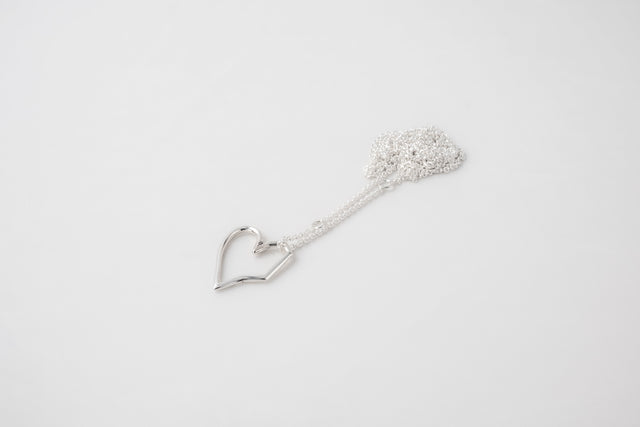
Necklaces
Of everything worn on the body, a neck piece is the one other people see first. It sits in the same frame as the face, moves when you speak, and shows above a collar whether you meant it to or not. So the question is not only what the piece is, but where on the neck it lands.
- A chain on its own — the weave is the piece
- A pendant — what the chain carries
- Length decides where the piece lands
- Material — what the surface does over time
- How STRUGA makes neck pieces
- In short
- Frequently asked questions
Neck pieces are told apart by two things, and the rest follows from them: what the piece is — a chain on its own or a chain carrying something — and where it sits, which is length.
A chain worn alone is an object in its own right; its character comes from the weave.
A pendant is the main object, and the chain carries it.
A choker sits high on the throat, at roughly 40 cm.
A collar lies flat on the collarbones, near 45.
Below them is 50, and the chest is 55 and longer — neck circumference shifts the whole scale, so length is measured rather than guessed.
At STRUGA neck pieces come from families as forms: SIGNATURE, BLADE, THORN, AMULET. Each is cast from a wax model and finished by hand; made to order takes about two weeks.
A chain on its own — the weave is the piece
A chain without a pendant is not an unfinished necklace. The weave decides everything: how the metal catches light, how the piece falls, how much of it you feel. A dense weave reads as a decision; a thin one waits for something to hang on it.
Curb, figaro, anchor, bismarck — each name is a different way of joining links, and each behaves differently on the neck. The weaves in full.
More: chains at STRUGA · blackened silver chains
A pendant — what the chain carries
A pendant is the main object of the piece. It is chosen first, and the chain is chosen to it: a heavy pendant needs a chain that can hold it without disappearing, a small one is lost on a wide weave.
A pendant differs from a charm in exactly this — the pendant is worn alone and needs no set to make sense of it — what a pendant is.
Forms with their own history: the cross, the heart, raw stone.
Length decides where the piece lands
The same necklace is a different object at 40 and at 55 centimetres. Around the throat it belongs to the face; on the collarbones it belongs to the shoulders; on the chest it belongs to the whole figure.
Neck circumference shifts the entire scale, which is why length is measured rather than taken from a chart. Layering shifts it again: two chains need a gap of several centimetres, or they read as one tangled line.
In full: chain and necklace size guide · chokers · collar necklaces
Material — what the surface does over time
Uncoated 925 silver darkens on its own. On a chain this is easiest to see: patina settles between the links, where surfaces touch, while the outer edges stay bright — and that contrast is exactly what brings a weave forward.
Blackened silver is the reverse: the surface was darkened at the bench, then taken back off the edges, so the relief comes forward from the first day.
A raw stone cannot repeat: two pendants from the same family differ because the crystals do.
More: blackened silver · meteorite
How STRUGA makes neck pieces
A chain begins as a wax model of one link; a pendant as a model of the whole form. A silicone mould is taken, the piece is cast in 925 silver, then assembled and finished by hand — sprues cut away, edges smoothed, the surface worked to its final state.
Families are forms, not collections. BLADE keeps machine-shop precision in the link. SIGNATURE carries the asymmetric silhouette of the brand. THORN and AMULET work with growth and with raw crystal.
All pieces are made by hand by master silversmiths in Bali. Made to order takes about two weeks, and the length is cut to your neck rather than adjusted afterwards. The full range: necklaces.
In short
| Type | What sets it apart |
|---|---|
| Chain alone | the weave is the piece, no pendant needed |
| Pendant | the main object; the chain is chosen to it |
| Choker | high on the throat, around 40 cm |
| Collar | flat on the collarbones, near 45 cm |
| Mid length | 50 cm — below the collarbones |
| Long | 55 cm and up, belongs to the whole figure |
| Blackened | relief forward from the first day |
| Raw stone | cannot repeat — the crystal decides |
Other sections of the Atlas: Rings · Earrings · Ear cuffs · Bracelets · Cuff bracelets
Frequently asked questions
Didn’t find the answer — write to us, we reply personally.
Ask a question →01What are the main types of necklaces?+–
Four, and they differ by what the piece is and where it sits. A chain worn on its own. A pendant hung on a chain. A choker that sits high on the throat. A collar that lies flat on the collarbones. Everything else is a variation of length or of what hangs.
02What is the difference between a pendant and a charm?+–
A pendant is the main object of the piece — the chain carries it. A charm is one of several small pieces, and its meaning comes from the set. A pendant is worn alone and does not need company.
03What length of chain should I choose?+–
By where you want it to sit rather than by the number. Around the throat is roughly 40 cm, on the collarbones 45, below them 50, on the chest 55 and longer. Neck circumference shifts all of it, which is why length is measured, not guessed.
04Can a chain be worn without a pendant?+–
Yes, and at STRUGA that is the usual case: the weave carries the character, so the chain is an object in itself rather than a holder. A heavy weave worn alone reads as deliberate; a thin one waits for something to hang.
05Will a silver chain darken?+–
Yes, if the silver is uncoated. On a chain patina settles between the links, where the surfaces touch, and stays bright on the outer edges — which is what brings a weave forward. A silversmith can restore the original tone.