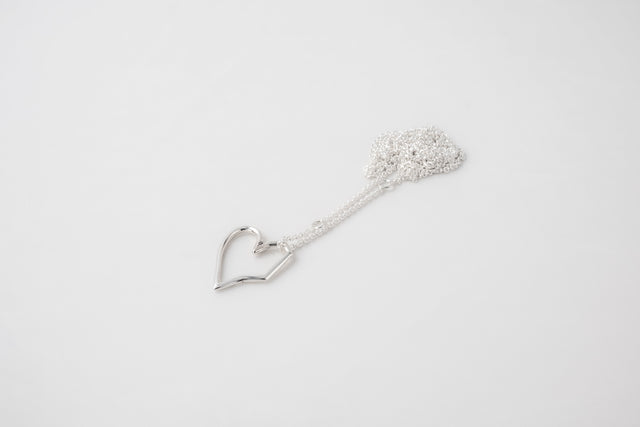
Cuff bracelets
A cuff is the one bracelet that holds without a clasp. There is no mechanism to fasten and nothing to lose: a rigid arc with a gap goes on from the side and stays by its own shape. That single fact decides everything else about it — how it is put on, how it is sized, and why some cuffs can be adjusted and others cannot.
A cuff is a rigid open arc with a gap, worn on the wrist and put on from the side.
The gap is what lets one size cover a range of wrists.
A bangle is the closed version of the same idea: it has no gap, so it has to pass over the hand.
Whether a cuff can be bent depends on how it was made — a thin sheet cuff can be opened once at a bench, a cast one cannot be bent at all and comes in graded sizes instead.
At STRUGA the rigid wrist form is the Big Thorn Bracelet: cast 925 silver with carbon inlays, five sizes from 16 to 23 cm, 45 to 95 grams.
What a cuff bracelet is: an arc with a gap, not a bracelet with a clasp
Three constructions live on the wrist, and they are told apart by what holds them. A chain follows the wrist and closes with a clasp. A bangle is a closed circle that slides over the hand. A cuff is neither: it is rigid like the bangle but open like nothing else, and the opening is the whole point.
That gap does two things. It lets the same piece sit on wrists of different size, because the arc bridges the difference rather than gripping it. And it lets the piece be turned — the gap can face down, where nobody sees it, or to the side, where it reads as part of the form.
More: bracelets by construction
A wrist cuff is not an ear cuff — the same word, two objects
The word travels badly. An ear cuff is a small piece that grips the edge of the ear without a piercing, and there the gap is measured in millimetres — 1.5 to 2.5 — and the metal is thin enough to be adjusted by hand.
A wrist cuff is the same principle at a completely different scale: centimetres instead of millimetres, tens of grams instead of fractions of one, and a cast body that does not flex. Advice written for one is wrong for the other, and the most common mistake is exactly this — treating a cast wrist cuff as if it could be squeezed like an ear cuff.
How to put a cuff on without breaking it
From the side, through the soft inner part of the wrist. Turn the gap toward the underside, slide the arc across the narrowest part, then rotate it into position. The whole movement takes a second and puts no load on the metal.
What breaks cuffs is the other route: pulling the piece over the back of the hand. The hand is wider than the wrist, so every pass forces the arc open and then lets it spring back. Silver tolerates that a few times and then remembers it.
Bending: what happens to cast silver you keep squeezing
Metal that is bent back and forth work-hardens. Each cycle makes it stiffer and more brittle in the same spot, and eventually the arc cracks at the point where it flexes most — usually just past the shoulder of the gap.
This is why the answer to «can I adjust it» is not a single yes or no. A thin sheet cuff has room for one careful adjustment at a bench: a jeweller opens or closes the gap once, evenly, and the piece keeps its life. A cast cuff has no such room. It is not a thinner version of the same thing — it is a different object.
Sizing itself is a separate question with its own numbers: bracelet size guide.
Two kinds of cuff: sheet you can adjust, cast you cannot
A sheet cuff is formed from flat stock. The metal is thin, the arc is springy, and the piece is usually made in one size with adjustment left to the wearer or the bench. Light, forgiving, and easy to deform by accident.
A cast cuff is poured as one solid form. Thickness varies across the arc by design, the piece holds shape absolutely, and it cannot be adjusted — which is why it comes in graded sizes. Heavier, permanent, and it behaves the same on the tenth year as on the first day.
The Big Thorn belongs to the second kind: cast in 925 silver from a wax model, fifteen carbon inlays set into the body, five sizes rather than one adjustable arc.
Mass: 45 grams and 95 grams are not the same object
Weight is what people underestimate about rigid bracelets. A cuff does not distribute across links — the whole mass sits as one piece and moves with the arm as a single object. You notice it when you type, when you lean on a table, when you put a jacket on.
Across our five sizes that runs from 45 grams at 16 cm to 95 at 23 — 52, 74 and 82 in between. The lighter end is a piece you forget; the heavier end is a piece you are aware of all day. Neither is better, but they are different decisions, and the difference is bigger than the numbers suggest.
Surface behaves as it does on any uncoated 925: patina settles into the recesses and wears back off the edges — living silver.
Rigid bracelets at STRUGA
The rigid wrist form at STRUGA is the Big Thorn Bracelet — cast 925 silver with fifteen CNC-cut carbon inlays, the most complex object the workshop makes. Five sizes, 16 to 23 cm, 45 to 95 grams. It comes from the THORN family of the CODEX world, where the form is growth stopped mid-motion.
Price follows mass. The 16 cm at 45 grams is $1,100; the 23 cm at 95 grams is $2,160. The gap is nearly double, and it sits in the silver: the form is the same across all five sizes, the amount of metal in it is not.
| Size | Mass | Price |
|---|---|---|
| 16 cm | 45 g | $1,100 |
| 17 cm | 52 g | $1,245 |
| 19 cm | 74 g | $1,700 |
| 21 cm | 82 g | $1,860 |
| 23 cm | 95 g | $2,160 |
The size is chosen by the wrist, not by the price: a cuff two centimetres too wide turns on the arm and sits where it was not meant to. The bracelet size guide gives the measurement to take.
Everything else on the wrist is built as links or chain: the bracelets collection and brutalist bracelets. For a rigid form in a size or a shape that is not in the catalogue, STRUGA makes it to order through Custom Order.
In short
| Type | What sets it apart |
|---|---|
| Cuff | rigid arc with a gap, goes on from the side, no clasp |
| Bangle | closed circle, must pass over the hand |
| Chain | follows the wrist, closes with a clasp |
| Sheet cuff | thin, springy, one careful adjustment at a bench |
| Cast cuff | solid, does not bend, graded sizes instead |
| 45 g | the light end — a piece you forget |
| 95 g | the heavy end — present all day |
| Ear cuff | same word, different object: millimetres, not centimetres |
Other sections of the Atlas: Rings · Earrings · Ear cuffs · Bracelets · Necklaces
Frequently asked questions
Didn’t find the answer — write to us, we reply personally.
Ask a question →01What is a cuff bracelet?+–
A rigid open arc with a gap, worn on the wrist. It has no clasp: it goes on from the side, through the softer inner part of the wrist, and holds by its own shape. A bracelet with a clasp is a different construction, and so is a bangle — a closed circle that has to pass over the hand.
02How is a cuff different from a bangle?+–
By the gap. A cuff is open, so one size covers a range of wrists and the piece can be turned to sit where you want it. A bangle is a closed circle: it has to pass the widest part of the hand, and its size is set by the hand, not by the wrist.
03Can I bend a cuff to fit my wrist?+–
It depends on what the cuff is made of. A thin sheet cuff can be opened or closed slightly — once, at a bench, by a jeweller. A cast cuff like the Big Thorn does not bend at all: the metal is thick and the form is solid, so it comes in graded sizes instead. Opening and closing any cuff repeatedly works the metal until it cracks.
04How do I put a cuff bracelet on without breaking it?+–
From the side, never over the top of the hand. Turn the gap to the inside of the wrist, slide the arc across the soft part where the wrist is narrowest, then rotate it into place. Pulling a cuff over the back of the hand forces the arc open every time.
05How heavy is a silver cuff bracelet?+–
Ours run from 45 to 95 grams depending on size — 45 g at 16 cm, 52 at 17, 74 at 19, 82 at 21, 95 at 23. That is a piece you feel all day: the mass sits as one solid object rather than spreading across links.