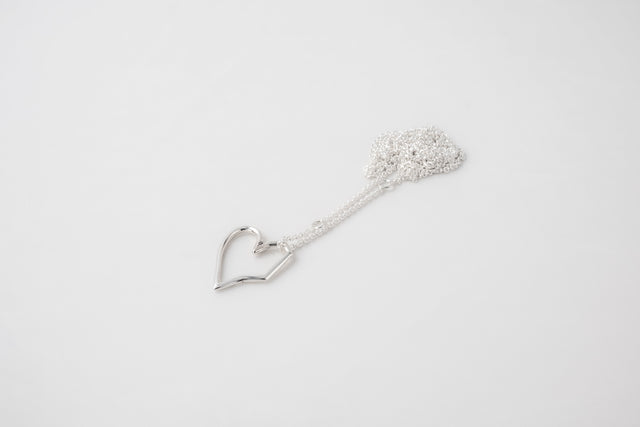
Asymmetric Jewelry & Mismatched Earrings
Asymmetry changes the relationship between parts of a piece: an angled edge, an offset link, two different outlines. Mismatched earrings work at the level of a pair. STRUGA’s first form, SIGNATURE ASYMMETRIC, carries the principle from a pendant to a link, a ring and a clasp.
See the outline in the Signature Link Medium earring: a flat frame narrows towards its base and hangs from a small hoop. The SIGNATURE ASYMMETRIC collection brings together other uses of the form.
- An asymmetric form remains within a single piece; mismatching comes from combining two different earrings.
- A single earring is worn in one ear. The object itself may still have a symmetrical shape.
- SIGNATURE ASYMMETRIC is STRUGA’s first numbered form, in the CODEX world.
- A combination can repeat a material, finish or line while changing length and outline. Weight and fit need separate checks.
- What asymmetry in jewellery means
- Why STRUGA shifts the form off the axis
- Which forms carry the shift
- How to choose and how to wear
- Asymmetry at a glance
- Frequently asked questions
What asymmetry in jewellery means
A form is asymmetric about a chosen axis when its parts do not match in a mirror reflection across that axis. One edge of an earring may run straight while the other slopes; an opening in a pendant may sit away from the centre of its outline. The difference concerns geometry and the arrangement of details. The two sides do not have to weigh different numbers of grams.
Mismatched styling brings together two independent pieces, such as a stud and an earring with a hanging link. Each can be symmetrical on its own while the combination does not form a mirrored pair. A single earring changes the composition another way: one ear carries jewellery and the other stays bare. Asymmetric, mismatched and single describe different properties.
What makes asymmetry a style? Repeating a metal, line or finish can connect different forms into one arrangement. A long earring and a small stud can share a colour or an outline. The Getty guide to composition describes visual balance through the distribution of shapes, colour, texture and space. This offers a useful distinction: visual weight is different from the physical mass of a piece.
Remove the second earring and look at the remaining piece on its own. Imagine an axis through its centre and compare the outline, openings and details on either side. Then bring the pair back together: this separates the structure of one form from the difference between two objects.
MERIT × Completedworks describes an asymmetric silhouette in a pair of earrings. This illustrates why the word “asymmetric” does not specify the set: check the number of pieces separately from their shape.
Why STRUGA shifts the form off the axis
The first form of the brand — and the form that began STRUGA’s central experiment: one form carried across different types of pieces, from a pendant to a carabiner. The aesthetic came from CNC-cut sheet material — sharp edges, even planes, recessed depth. It is the most widely represented form in the brand. In a chain, the link connects the neighbouring parts and moves with them.
Follow what repeats through that history. A pendant gives the form an independent outline; in a chain, that outline becomes a link; in a clasp, it takes part in connecting the components. The family name ties these uses together while size, attachment and position on the body change. SIGNATURE ASYMMETRIC belongs to the CODEX world.
On the Signature Link Medium earring, the form appears as a flat frame that narrows towards the bottom. A crossbar divides the opening into two gaps of different size. The frame hangs from a small hoop and moves on it. A second earring is not needed to reveal the construction of this outline.
The early carbon pendants with inserts, the move into silver and the development of clasps are covered in the story of SIGNATURE ASYMMETRIC. The principle here is the transfer of a recognisable form from one object to another. It helps connect pieces without treating every kind of asymmetry as the name of one family.
Which forms carry the shift
The Signature Link Medium earring places the link on the ear. Its silver frame swings freely from a hoop with a click closure. The earring is sold singly, with a listed weight of 4.68 g. It requires a pierced lobe.
The Signature Links V.2 ring arranges moving links around an open band. Here several repetitions of the form surround the finger. The model comes in sizes 16–22. An open band still needs the right size: check the fit of the specific model instead of assuming every open ring should be squeezed into place.
The Signature Asymmetric Pyramid necklace takes the outline into volume: the faces of the pyramid repeat the SIGNATURE ASYMMETRIC pattern. The form is read across the pendant while the chain holds it against the chest. This is another way to show the same motif.
The family collection brings these uses together. To build a mismatched combination, start with all earrings: the pieces do not have to belong to one family. The asymmetric ring has its own Atlas chapter, while wearing one earring is covered in the chapter on single earrings.
How to choose and how to wear
First decide where the difference should appear: inside one object or between two earrings. For one object, examine its outline and attachment. For a pair, place photographs side by side and compare length, width, surface and position on the ear. Start with one shared feature, such as light silver or a repeated link.
Weight helps compare pieces but does not promise the same feeling on different ears. Length, the point of suspension and the fastening also affect the fit. A 4.68 g earring does not set the correct weight for its partner. Studs sit close to the lobe, but protruding details and contact with hair or clothing still need checking.
The visible tone also contributes to the combination. Compare the surfaces described on the particular product pages. Sharing a metal does not guarantee the same shade or the same care needs.
Before ordering, check whether the listed price covers one earring or a pair. If you need another size or are unsure about a combination, discuss it with STRUGA. Changes to the form go through Custom Order; feasibility and timing are confirmed after discussion. Arrangements with several earrings and cuffs are covered in the ear-styling guide.
Asymmetry at a glance
| Aspect | Meaning |
|---|---|
| Asymmetric form | Parts of one piece do not match in a mirror reflection. |
| Mismatched earrings | Two different objects form one composition. |
| Single earring | One earring in one ear; the object may be symmetrical. |
| What connects a combination | Material, finish, line or a repeated detail. |
| What needs a separate check | Size, mass, fastening and fit of the actual pieces. |
| STRUGA example | SIGNATURE ASYMMETRIC: a form carried from a pendant to a link, a ring and a clasp. |
Frequently asked questions
Didn’t find the answer — write to us, we reply personally.
Ask a question →01What is asymmetry in jewellery?+–
Parts of a form do not match in a reflection across a chosen axis: the outline, angle, opening or position of a detail differs. A link frame, for example, can narrow towards one end and have a crossbar dividing two unequal openings. This describes its geometry, not necessarily a difference in the mass of its sides.
02Do asymmetric earrings mean two different earrings?+–
Mismatched earrings form an asymmetric combination, although each may be symmetrical on its own. In an asymmetric design, the difference already exists inside the single object. Look at one earring separately to distinguish the shape of the piece from the way a pair is assembled.
03How do you wear a single earring?+–
Wear it in one ear. It can remain the only earring or sit opposite a different one in the other ear. Before buying, check the quantity on the product page: a single earring and a ready-made pair are different sets.
04How can mismatched earrings feel connected?+–
Choose one shared feature: material, finish, outline or a repeated link. The two earrings can differ in length and size while keeping that connection. Compare them side by side and on yourself; a form does not dictate one compulsory combination.
05Can I choose a second earring by weight alone?+–
Weight helps with comparison but does not determine the whole fit. Consider length, fastening and suspension point as well. Check each model separately when choosing two different earrings; one number cannot promise the same feeling on the ear.