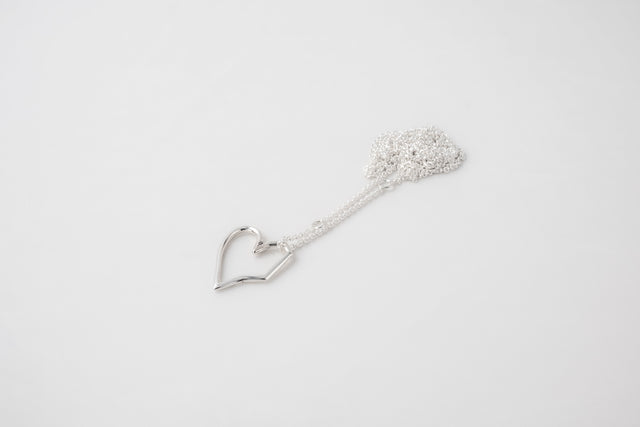
Single Earring (Mono): what it is and how to wear one
A single earring is one earring worn on its own, in one ear, while the other stays bare. It is a deliberate asymmetric statement, not the surviving half of a pair. English chronicles record gold in a man's ear from 1577 onward. At STRUGA asymmetry is the brand's DNA: 54 earrings in the catalogue are sold one at a time.
One earring, one ear, the other bare. The form is documented in England from 1577; the Chandos portrait — painted between 1600 and 1610, catalogued as NPG 1, the first work the National Portrait Gallery in London took into its collection in 1856 — shows a man in a single gold hoop. At STRUGA the form lives in the MONO EARRINGS selection: 54 pieces, from 1.6 to 8 grams, 925 silver with no rhodium plating. Asymmetry here has a family of its own — SIGNATURE ASYMMETRIC; single forms also appear in CARBON and FUSED. A form outside the selection is made to order through Custom Order.
- What a single earring is
- Where the form comes from
- Which ear to wear it in
- The single earring on men
- The single earring at STRUGA
- At a glance
- FAQ
What a single earring is
A single earring is one earring worn in one ear, while the other stays bare or carries something else. Not half of a lost pair, but a whole decision. The weight moves to one side, and the eye follows the weight. A symmetric pair settles the face; a single earring tilts it.
The form itself can be anything — a stud, a hoop, a drop, an ear cuff. A single earring is not a type of fastening but a way of wearing: one ear instead of two. So you can build one from what is already in the box, or take a form designed to live alone. The difference shows in the second week: an object built for solitude holds its weight and proportion on its own, with no mirror half to lean on.
In search the form goes by four names, all pointing at the same thing: single earring, mono earring, one earring, single stud. The variation is habit, not meaning. The catalogue calls it a mono earring.
How it differs from a pair, a stack and mismatched earrings
A pair is two mirrored objects, one per ear. Mismatched earrings are still a pair — the left and the right simply differ. An ear stack is several piercings, cuffs and forms in dialogue across one or both ears. A single earring is the far end of that range: one object, one point, the rest silent. From an ear cuff it differs not in wearing but in mechanics: a cuff grips the upper ear with no piercing, an ordinary earring holds by a pierced lobe.
Where the form comes from
A pair of earrings is a convention, not a law. Jewellery history knows a man's ear with one earring for longer than it knows a woman's ear with two matching ones.
The Renaissance ear
Holinshed's Chronicles set the form down plainly in 1577:
“Some lusty courtiers and gentlemen of courage do wear either rings of gold, stones or pearls in their ears.”
Holinshed's Chronicles, 1577 — quoted after the survey of earring history
The best-known witness from the same circle is the Chandos portrait, painted between 1600 and 1610. It is the only painting with a credible claim to depict Shakespeare, and the man in it wears a single gold hoop. In 1856 the canvas became the first work in the collection of the National Portrait Gallery in London, catalogued as NPG 1. The art historian Tarnya Cooper reads that earring together with the loose shirt-ties as the mark of a poet — the mark of a working imagination, not of rebellion.
Sailors, then the eighties
The next carrier of the form was the sea. A pierced lobe on a sailor meant the man had sailed around the world or crossed the equator. The earring was a record of distance covered, not an ornament: it was worn the way a passport carries a stamp.
In the eighties the form came back through music. British men began piercing their ears in numbers, and George Michael of Wham! became the most recognisable face of that wave. From then on a single earring stopped reporting rank or route. One message remained — a deliberate break in symmetry. The eye catches a break faster than it catches order.
Which ear to wear it in
There is no rule. The ear is chosen by where the piercing sits and where the composition of the face wants the weight.
The question comes up often because of a belief that circulated in Anglo-American culture in the eighties: an earring in the right ear supposedly said something about the wearer's orientation, one in the left did not. The belief lived in narrow urban circles, spread widely through the press of the early nineties, and had faded by the 2000s. No jewellery or etiquette source confirms it as a norm.
Three considerations actually work, and all three are practical rather than semiotic. First, the loaded side: a bag strap on one shoulder will catch an earring on that shoulder. Second, the sleeping side: a heavy form on the ear you sleep on bends its fastening sooner. Third, the asymmetry of the face — a parting, a scar, a neck tattoo already shift the weight, and the earring either strengthens that shift or settles it.
A mirror answers this in a minute. Start with the ear that is already pierced and less loaded, and change sides when the haircut changes.
The single earring on men
The men's single earring is the liveliest query in this whole subject and the least served: what stands behind it in search is catalogues, not explanations. Yet the historical line here runs longer than the women's one. From Holinshed's courtiers through sailors to the eighties, the form was predominantly male.
One earring does not demand a symmetric face, and a man's face is rarely symmetric. One point of metal does not argue with clothing: a black collar, a grey coat, silver on the lobe — the set is closed. And a single form gives weight without volume: 2.5 grams of silver on one ear reads heavier than 5 grams split across two.
The choice comes down to three moves. The stud is the quietest: the Thorn Stud Earring weighs 2.92 grams and lies flat on the lobe as a point. A drop form gives line and movement: the Thorn Earring — 2.5 grams, a thorn that pricks the skin a little and will not let you forget it. A large asymmetric form speaks for itself: the Carabiner #4 Small Earring — 3.5 grams, a carabiner form from the SIGNATURE ASYMMETRIC family.
Size here is not about nerve. It is about how much silence around the face you are willing to give one object.
The single earring at STRUGA
At STRUGA asymmetry is not a device but DNA. That is why the brand has a family of its own, SIGNATURE ASYMMETRIC: the first form of the brand, an aesthetic taken from CNC-cut sheet material — sharp edges, even planes, recessed depth. In this family broken symmetry is built into the geometry rather than played out by wearing. The single earring is the natural gesture of such a form: it declares asymmetry simply by hanging without a pair. The family belongs to CODEX, the world of everyday architectural form.
STRUGA earrings are made of 925 silver with nothing over it — no rhodium. The surface works: the edges the ear and the fingers touch wear down to the light, the recesses go to graphite, and over a year the earring records how it was worn. This is Living Silver — a property of uncoated metal, not a darkening applied in advance at the bench. Two people wearing the same model for a year end up with two different earrings, because the chemistry of skin differs.
In some forms carbon joins the silver — ultralight, unafraid of water, unchanged by time, the counterweight to a living metal. The Blade Fused Mini Line Bloody Earring weighs 5.27 grams and holds both materials in one plane: a BLADE link, melted FUSED silver and carbon from the Bloody palette. Carbon belongs to RITUAL, melted silver to LAB.
Buying one earring instead of a pair
All 54 pieces in the MONO EARRINGS selection are sold one at a time: the price on the page is the price of one earring, not of a pair. There is no mirror half to add, and none is intended. The weight range across the selection runs from 1.6 to 8 grams, median 3.9 — the distance between a point on the lobe and an object visible from the other side of the table. Pieces are made by hand in Bali by master silversmiths; lead times are 2 weeks for silver, 3 for a form with a stone, 4 for carbon made to order. Forms outside the selection are built through Custom Order. A single earring is often stacked beside an ear cuff from the same family — one ear carries the composition, the other holds the pause.
The single earring at a glance
| Aspect | Value |
|---|---|
| What it is | One earring in one ear; the other ear bare or carrying a different form |
| Other names | Mono earring, one earring, single stud, one earring in one ear |
| Not to be confused with | A pair — two mirrored objects; mismatched — a pair of unlike halves; a stack — several forms on one ear |
| Early evidence | Holinshed's Chronicles, 1577; the Chandos portrait, 1600–1610 (NPG 1, acquired 1856) |
| Which ear | No rule; chosen by the piercing, the bag-strap side and the sleeping side |
| Material at STRUGA | 925 silver with no rhodium plating, carbon in some forms |
| Surface | Living Silver: uncoated metal darkens and lightens with wear |
| Pieces in the selection | 54 single earrings, each sold one at a time |
| Weight | From 1.6 to 8 grams, median 3.9 |
| Lead time | Silver — 2 weeks; with a stone — 3; carbon made to order — 4 |
Frequently asked questions
Didn’t find the answer — write to us, we reply personally.
Ask a question →01What is a single earring in simple terms?+–
It is one earring worn on its own — in one ear, without a pair. The other ear stays bare or carries a different form. It is deliberate asymmetry, not a lost half of a pair. The same form is also called a mono earring or a single stud.
02Which ear does a single earring go in — left or right?+–
There is no rule; the side is chosen by practice. The eighties belief that the right ear said something about the wearer's orientation lived in narrow Anglo-American circles and had faded by the 2000s. Look instead at where the piercing sits, which shoulder carries your bag, and which side you sleep on.
03Can you buy one earring instead of a pair?+–
Yes — that is the point of the form. All 54 pieces in the MONO EARRINGS selection are sold one at a time, and the price on the page is the price of one earring, not of a pair. There is no mirror half to add.
04How do you wear a single earring?+–
Two ways: as a single accent, with the other ear bare and all the weight shifted to one side, or in an asymmetric stack — beside an ear cuff and other forms, where one ear carries the composition and the other stays silent.
05Is a single earring on a man normal?+–
Historically it is predominantly a male form. Holinshed's Chronicles describe gold rings and pearls in the ears of English courtiers in 1577, the Chandos portrait of 1600–1610 shows a man in a single gold hoop, and in the eighties the music scene brought the form back. On a man's face one point of metal works better than a pair: it does not demand symmetry.
06How is a single earring different from mismatched earrings?+–
Mismatched earrings are a pair where the left and right differ. A single earring is the extreme case: there is only one earring, the other ear bare. At STRUGA both live in the SIGNATURE ASYMMETRIC family.
07What are STRUGA earrings made of and how much do they weigh?+–
Of 925 silver with no rhodium plating, with carbon in some forms. Weights across the selection run from 1.6 to 8 grams, median 3.9. Uncoated metal darkens and lightens on its own, by the way the earring is worn; this is Living Silver. Lead times are 2 weeks for silver, 3 for a form with a stone, 4 for carbon made to order.