Jewelry Trends 2026 — What's In, in Silver
The runways of 2026 asked for more metal: thick bands, sculptural cuffs, collars, big pendants. The trade weighed out less of it — global silver jewelry fabrication fell 8% in 2025, and Metals Focus expects another 16% drop in 2026 as rising metal prices push makers toward lighter pieces. Weight became the year's headline trend and its most expensive part.
Updated September 29, 2026
Below: where the season's reports agree and where they split, what that means for silver category by category — earrings, rings, bracelets, chains — and a census of the STRUGA catalogue on 29 September 2026: 134 live product records, not forecasts, with one piece for each trend, from the Brutalism V.1 Ring at 9.6–24.0 grams to a 1.6-gram ear cuff. Metal prices are the LBMA London benchmarks; market data comes from Metals Focus for the Silver Institute and from the World Gold Council; sources are linked where the numbers are used.
- The 2026 through-line is scale: thick bands, sculptural cuffs, collars and big pendants.
- Silver led the spring runways; fall brought chunky gold back. Mixing the two is ordinary now.
- By metal value, 1 g of 14k gold equals about 43 g of 925 silver (LBMA, 28 September 2026).
- The STRUGA catalogue: 134 pieces; 17 darkened at the bench, 89 in the Living Silver selection arrive bright.
What changed in jewelry over five years?
Scale and the price of metal — and both can be checked. Scale shows in the season's forecasts, price in the London benchmarks.
| Early 2020s | 2026 | |
|---|---|---|
| Scale | thin chains, barely-there rings | thick bands, sculptural cuffs, big pendants |
| How it is worn | one piece alone | stacks and layers, rings worn in stacks |
| Metals | one lane, silver or gold | mixed freely |
| Gold, per troy ounce | $1,864.30 (28 Sep 2020) | $4,144.55 (28 Sep 2026) |
| Silver, per troy ounce | $22.89 | $61.33 |
| Gold-to-silver ratio | 81 | 68 |
Scale is what the forecasts share. Pinterest Predicts 2026 says jewelry will get "chunkier, bolder and golder" and counts the searches: "gold cuff" up 50% year on year. Who What Wear sees "bolder proportions — thick bands, sculptural silhouettes, and exaggerated shapes." The thin chain has not gone anywhere: it works as a layer beside something denser, not on its own.
Both metals climbed over the same five years — gold 2.2 times, silver 2.7 times on the LBMA benchmarks for 28 September 2020 and 2026. The gap between them narrowed, yet it still decides what a heavy piece is made of; the silver-or-gold section below does the arithmetic.
What jewelry is in style in 2026?
Big and dense. The season's reports agree on five things, and each comes with named runways.
- Sculptural cuffs. Who What Wear opens its 2026 list with them; stylist Kendra Sharpe told Business Insider in September: "The larger the cuff, the better."
- Chunky chains and collars. Chunky gold chains at Saint Laurent and sculptural collars at Chanel for Fall/Winter 2026, in Who What Wear's fall reports.
- Oversized proportions everywhere. Who What Wear on the fall runways: "models wore larger-than-life necklaces, bracelets of extra-big proportions, and earrings that defied gravity."
- Texture over smooth. Jewelers interviewed by Business Insider see a shift "from smooth, polished metals to textured styles" — faceted links, engraved swirls.
- Men's statement jewelry. The same report finds men wearing "thicker rings with stones", with statement rings "especially strong right now."
Pieces with a history are rising too: Pinterest reports searches for "heirloom jewelry" up 45% and "brooch aesthetic" up 110%. What goes out, per Business Insider: rose gold, perfectly matching sets, dainty engagement rings. The reports split on one question — a stack or one big piece — covered in the section on layering.
Is silver or gold in style in 2026?
Both, in different seasons and different roles. The spring 2026 runways leaned silver: ELLE made "sculptural silver" its first spring trend — Ralph Lauren, Jean Paul Gaultier, Torishéju, Bottega Veneta — and tied it to "the skyrocketing price of gold." Fall/Winter 2026 swung back to chunky gold at Saint Laurent.
A runway is not a till. According to the World Silver Survey 2026 (Metals Focus for the Silver Institute), global silver jewelry fabrication fell 8% in 2025 to 189.3 million ounces and is forecast to drop another 16% in 2026. In the US and Europe silver "did not capture any meaningful market share": buyers kept choosing gold, in smaller quantities. US silver jewelry imports rose 8% in value but fell 24% in fine ounces. Gold jewelry is slimming down the same way — 278 tonnes in the second quarter of 2026, down 17%, with "lightweight products" gaining share, reports the World Gold Council.
| Metal value per gram of alloy | In a 6 g band | |
|---|---|---|
| 925 sterling silver | ≈ $1.82 | ≈ $11 |
| 14k gold (585) | ≈ $78 | ≈ $468 |
| 18k gold (750) | ≈ $100 | ≈ $600 |
These are the LBMA prices of 28 September 2026, converted to finished alloy: one gram of 14k gold holds as much metal value as about 43 grams of 925 silver, so 40 grams of silver carry about $73 of metal and the same weight in 14k about $3,120. That is why heavy form stays affordable in silver — and why labor, not the commodity market, carries its price: a size-18 Brutalism V.1 Ring holds 14 grams of silver, about $26 of metal, and sells for $558. The rest is form, hands and finishing, expanded in the piece on whether sterling silver holds value.
Can you wear silver and gold together?
Yes. "Once considered a major fashion faux pas, mixed-metal jewellery has now been fully embraced," writes Who What Wear UK, and Business Insider's stylist names mixed yellow gold and silver as what replaced rose gold. The working proportion: two pieces in two metals look like hesitation, four pieces in two metals look like a decision. A heavy silver signet on the index finger, a gold band on the ring finger, a silver chain at the collarbone and a thin gold chain layered above read as intent. The longer answers sit in the guide to layering silver jewelry and in real gold versus silver in men's jewelry.
How are layers and stacks worn in 2026?
In stacks — but in 2026 the stack has a rival. Who What Wear's fall report bets on "one big piece that packs a major punch," while rings are still worn in stacks — big, with mixed metals. The two ways do not conflict when the stack has a lead piece.
Four stacking rules that hold across every category
- Vary thickness. Pieces of the same section side by side read as a mistake, not as intent.
- Vary chain length. Layers need a clear difference in length, otherwise they tangle and visually merge.
- Keep one metal logic. Either a single lane or an honest mix of three or more pieces; the middle option looks accidental.
- Set one anchor. One dense piece holds the stack while the rest stay quiet.
What is the 2:1:1 rule in jewelry?
There is no single rule — jewelers' blogs read it differently. For Wilson & Son it is two pieces on the hands or wrists, one at the neck and one pair of earrings; for Van Scoy it is two statement pieces, one subtle piece and one area left bare; other readings exist. What the versions share is a limit and one piece that leads. Category detail sits in the guides to bracelet stacks, men's layering and ear composition.
What earrings are in style in 2026?
Bigger, and built as a composition. The fall runways sent out "earrings that defied gravity," and the ear itself is treated as a canvas: several points of different section and position, cuffs on the edge of the ear, asymmetry, mixed metals on one ear. An ear cuff holds on by pressure, so it needs no piercing and can join or leave a composition at any moment.
The STRUGA catalogue holds 54 earrings, 36 of them amulets set with raw stones, each one of one. There are 16 ear cuffs from 0.3 to 7.5 grams — 12 in silver, 4 in carbon. The Brutalism V.3 Dark Treatment cuff weighs 1.6 grams and costs $125; it is the only cuff darkened at the bench: recesses hold the black, worn edges brighten back. All the forms are in the ear cuff collection.
What rings are in style in 2026?
Wide and heavy. Who What Wear calls the 2026 ring stack "bold, chunky": "mixed metals, oversize bands, sculptural shapes." Jewelers interviewed by Business Insider say men are wearing statement rings — thicker ones, often with stones.
The STRUGA catalogue holds nine ring forms weighing 2.1 to 24.0 grams: mass follows the size, and at size 18 the median is 7.0 grams. The heaviest are the BRUTALISM rings — 14.0 grams at size 18, 24.0 at size 22. The size of the Brutalism V.1 and of the bench-darkened Brutalism V.3 is chosen before making: the relief on the top plate does not survive resizing.
How is a signet ring different from other rings?
A signet is a signature cut backwards. The device was engraved in reverse so the impression in hot wax read correctly, and that impression was "a unique, legally recognised signature," explains the Victoria and Albert Museum. Signets carried a coat of arms, a personal device or simply an initial; by the mid-nineteenth century their legal use had faded, while the form stayed on as a worn jewel.
The logic of choosing one has not changed: a mark of a particular person — initials, a personal mark, or a blank shield. At STRUGA the signet lives in the BRUTALISM and THORN families; the signet ring collection holds three rings — Brutalism V.1, Brutalism V.3 and the Thorn Ring at 4.7–12.7 grams. Initials and personal marks are made through Custom Order. The full history of the form is in the signet pillar.
What bracelets are in style in 2026?
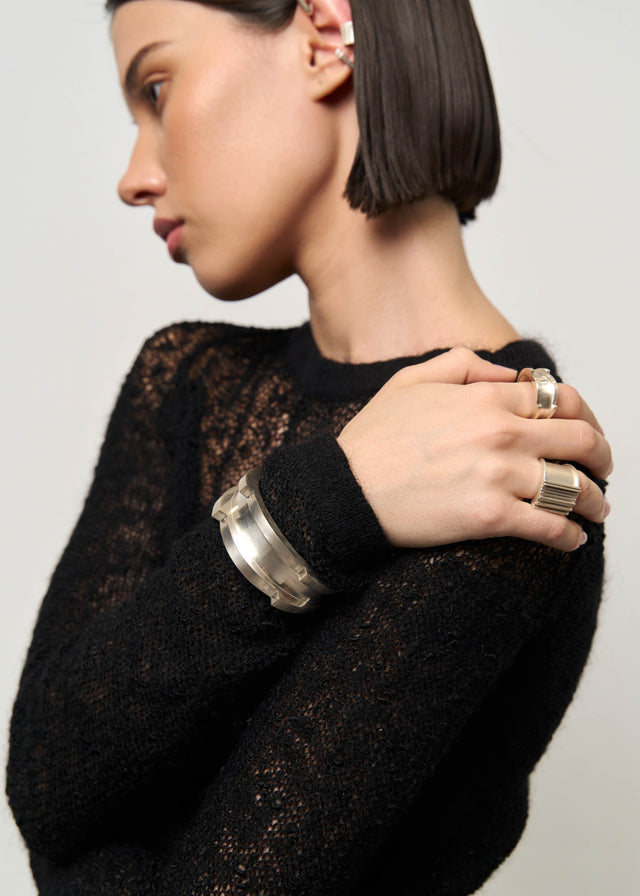
Wide and rigid. Who What Wear leads its 2026 list with sculptural cuffs; Business Insider's stylist says to wear a single large cuff, even over a long sleeve, rather than stacking several small pieces; Pinterest counts searches for "gold cuff" up 50%. On the wrist, the stack gives way to one piece.
The STRUGA catalogue holds 14 bracelets, 13 of them with silver, from the 2-gram carbon One Display Techno to the Carabiner #2 Big Cross at 130 grams. The rigid one is the Big Thorn Bracelet, the brand's first rigid bracelet: silver with carbon edges, 45–95 grams by size, $1,279–$2,701. A heavy chain on the wrist is Blade Big Links at 85–95 grams; a lighter layer is Blade Mini Links V.2, 13–17 grams, with a toggle clasp. All the forms are in the bracelet collection; stacking is covered in the bracelet stack guide.
What necklaces and chains are in style in 2026?
Chunky chains, collars and one big pendant instead of a scatter of fine ones. For Fall/Winter 2026 Who What Wear points to chunky gold chains at Saint Laurent and collars at Chanel, and its UK desk expects chokers to return "bolder, thicker … made of silver and gold." Beads sit alongside — big ones at Chanel for Fall/Winter 2026.
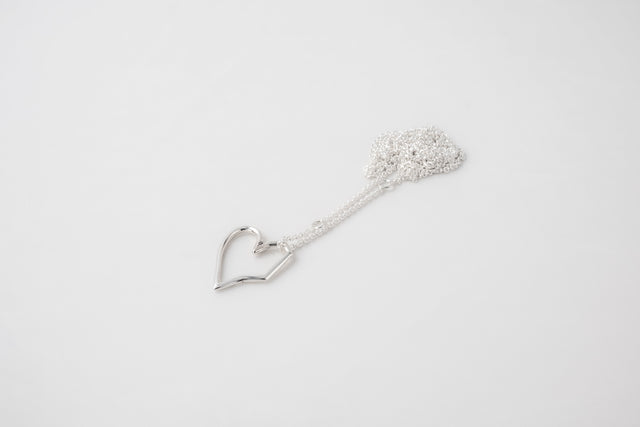
The STRUGA catalogue holds five chains and chokers from 11 to 110 grams. The Thorn Links Chain weighs 11 grams at 40 cm and 18 at 75 cm, $353–$564. The Signature Asymmetric Links Choker weighs 27–33 grams; the heaviest is the Blade Mini Links V.1 Choker at 80–110 grams. Beads in metal: the Small Beads with Heart Choker, silver beads on a Heart Lock clasp. Of 32 pendants and necklaces, 24 contain silver; the largest silver pendant, the Pyramid, weighs 40 grams.
Where does darkened silver fit in 2026?
At the edge of the mainstream. The season's editorial reports say nothing about darkened silver, but Business Insider records the move from smooth, polished metal to texture — and a dark surface is texture you can see from across a room.
Niello and oxidation are different things. Niello is a fused mixture of metal sulfides inlaid into engraving (Susan La Niece's survey, 1983); oxidation is a thin sulfide film on the surface itself. Even the name misleads: nineteenth-century silversmiths "oxidized" silver with a sulfide, "rather than with oxygen," notes the Victoria and Albert Museum.
At STRUGA the dark surface comes two ways. Seventeen of 134 pieces are darkened at the bench: 13 amulet earrings, the Asymmetric Destroyed and Signature Cross V.3 necklaces, and the Brutalism V.3 ring and cuff. The rest of the silver arrives bright and darkens with wear — that is Living Silver, and its selection holds 89 pieces.
How does oxidation differ from Living Silver?
Oxidation is a technique: the surface is darkened deliberately at the work stage, and the piece arrives dark. Living Silver is a property: 925 sterling left without rhodium plating darkens on its own, from air and skin, and records wear as patina. The difference is practical: an oxidized piece can be brought back to bright with care, while Living Silver will darken again, because that is the design. Patina here is not wear damage — it is a map of how the piece is worn.
What makes a piece heirloom-grade, and how do you tell?
A piece built for decades of wear and for passing on. Interest is rising: Pinterest counts searches for "heirloom jewelry" up 45%. Such a piece is set apart by construction rather than price, and it checks out on three points.
- Solid metal instead of plating. Plating is a layer measured in microns: under US Federal Trade Commission rules, "gold plated" may mean 0.175 µm, while heavy gold electroplate and vermeil start at 2.5 µm (16 CFR 23.3 and 23.4). Wear thins the layer and it does not grow back; only re-plating restores the look.
- Solid section instead of hollow. In Leach & Garner's tests, an 18-gauge hollow chain broke at about 2.3 kg of load, while a solid chain of the same size held 13.6–15.9 kg — six to seven times more.
- A form outside the season. The silhouette must not depend on the color of the year, or the piece ages with it.
The heirloom horizon favors signets, heavy bands, solid chains in simple geometry, architectural cuffs. Unplated 925 sterling holds an advantage here: there is no layer to wear through, the patina deepens with its owner, and twenty years of wear work in the surface's favor.
How do these trends look inside the STRUGA catalogue?
STRUGA chased none of the year's trends: large architectural form and a darkened surface were its vocabulary from the start. Below is a census of 134 live product records on 29 September 2026, and one piece for each trend.
| Catalogue fact | |
|---|---|
| Pieces in total | 134 |
| Containing 925 silver | 117; another 13 are carbon pieces and 4 are silk costumes |
| Darkened at the bench | 17 — 13 earrings, 2 necklaces, one ring, one ear cuff |
| Living Silver selection | 89 — arrive bright, darken with wear |
| Rings | 9 forms, 2.1–24.0 g, median 7.0 g at size 18 |
| Bracelets | 14 forms, 2.0–130.3 g |
| Chains and chokers | 5 forms, 11–110 g |
| Ear cuffs | 16 forms, 0.3–7.5 g |
| 2026 trend | Piece | Weight | Price |
|---|---|---|---|
| Heavy ring, signet | Brutalism V.1 | 9.6–24.0 g | $382–$1,013 |
| Dark surface from the start | Brutalism V.3 | 9.6–24.0 g | $368–$920 |
| Ear cuff instead of a piercing | Brutalism V.3 Dark Treatment | 1.6 g | $125 |
| Rigid cuff bracelet | Big Thorn Bracelet | 45–95 g | $1,279–$2,701 |
| Chain with weight | Thorn Links | 11–18 g | $353–$564 |
| Thick choker | Blade Mini Links V.1 | 80–110 g | $2,276–$3,128 |
Where should you start if these trends fit you?
The order is simple: the anchor first, the stack around it second. The anchor is one dense piece that everything else is read against; in 2026 that is usually a wide ring, a cuff or a chain with weight.
- A dense ring as the anchor — rings: nine forms, 2.1–24.0 grams — weight follows the size.
- A chain with weight — chains: five forms, 11–110 grams — weight follows the length.
- A dark surface from the start — the BRUTALISM family, where the V.3 ring and cuff are darkened at the bench.
- An ear composition — ear cuffs, the most reversible way to try the trend.
- The whole everyday vocabulary — the CODEX world, where this year's dense bands, chains and cuffs come from.
- Initials or a mark — Custom Order.
The whole range sits in the full catalogue. The unplated surface is explained on the Living Silver page, and who makes this and how is on the founder's page.
About STRUGA. STRUGA is a dark silver jewelry brand founded by Dmitry Strugovshchikov and Ekaterina Strugovshchikova, handmade in Bali by master silversmiths. Most pieces are 925 sterling silver left uncoated, so they darken with wear; part of the range is darkened in advance, at the bench. The darkening is part of the design.
Frequently asked questions
Didn’t find the answer — write to us, we reply personally.
Ask a question →01What jewelry is in style in 2026?+–
Big, dense pieces: thick bands, sculptural cuffs, chunky chains and collars, oversized earrings, big pendants. They are worn in stacks or as one big piece, and silver and gold are mixed freely. The season's reports — Who What Wear, Business Insider, Pinterest Predicts — agree on the main point: scale instead of thin and barely there.
02Is silver or gold in style in 2026?+–
Both. The spring 2026 runways leaned silver — ELLE tied it to the price of gold — and Fall/Winter 2026 brought chunky gold back. By metal value, one gram of 14k gold equals about 43 grams of 925 silver (LBMA, 28 September 2026), which keeps volume in silver an ordinary purchase.
03What earrings are in style in 2026?+–
Oversized earrings and ear compositions: several points of different section, cuffs that need no piercing, asymmetry, mixed metals on one ear. The STRUGA catalogue holds 16 ear cuffs from 0.3 to 7.5 grams; the Brutalism V.3 Dark Treatment cuff weighs 1.6 grams and is darkened at the bench.
04What rings are in style in 2026?+–
Wide and heavy, worn in stacks with mixed metals; for men, statement rings. The STRUGA catalogue holds nine ring forms from 2.1 to 24.0 grams, with a median of 7.0 grams at size 18. The heaviest are the BRUTALISM rings, 14.0 grams at size 18; their size is chosen before making.
05What bracelets are in style in 2026?+–
Wide and rigid: sculptural cuffs worn one at a time, even over a sleeve. The STRUGA catalogue holds 14 bracelets; the rigid one is the Big Thorn Bracelet, 45–95 grams of silver with carbon edges, and the heavy chain on the wrist is Blade Big Links at 85–95 grams.
06What necklaces are trending in 2026?+–
Chunky chains, collars and thick chokers in silver and gold, and one big pendant instead of a scatter of fine chains. The STRUGA catalogue holds five chains and chokers from 11 to 110 grams: the Thorn Links Chain weighs 11–18 grams by length, the Blade Mini Links V.1 Choker 80–110 grams.
07Can you wear silver and gold together?+–
Yes. Mixing metals went from fashion mistake to norm — Who What Wear and Business Insider both say so. The working proportion: four pieces in two metals look like a decision, two look like hesitation. Keep one dense piece as the anchor and vary thickness rather than multiplying sameness.
08How is oxidized silver different from Living Silver?+–
Oxidation is a technique: the surface is darkened with a sulfide at the work stage, and the piece arrives dark. Living Silver is a property: 925 sterling without rhodium plating darkens on its own with wear. In the STRUGA catalogue, 17 of 134 pieces are darkened at the bench. An oxidized piece can be brought back to bright with care, while Living Silver will darken again.