Real vs Fake Gold and Silver Men's Jewelry — How to Tell the Difference
Metal gives itself away in three measurable ways — density, reaction and price — and a stamp is not one of them. Solid sterling silver is 92.5% silver and weighs about 10.4 grams per cubic centimetre; it darkens in contact with sulfur in the air, and its price cannot fall below the silver inside it. Counterfeit pieces are stamped "925" and "14k" routinely, so the stamp is where checking starts, not where it ends.
Updated September 28, 2026
- Real vs fake men's jewelry comes down to three checks: solid metal is dense, it reacts, and its price tracks the material inside. A "925" or "14k" stamp alone proves none of this — fakes are stamped routinely.
- Sterling silver is 925: 92.5% silver, usually with copper. It darkens through reaction with sulfur in the air, so a piece sold as silver that never darkens is plated or not silver at all.
- Density decides what weight cannot: sterling silver is about 10.4 g/cm³ and brass about 8.4, so the same shape in solid brass is only about a fifth lighter. A chain at half the expected weight is hollow.
- Silver closed at $61.53 per troy ounce on 28 September 2026 — about $1.98 per gram — so 40 grams of sterling holds roughly $73 of silver. A "solid 925" chain priced below its own metal is not solid.
- Gold closed at $4,148.69 per ounce the same day, about $133 per gram; 14k is 58.5% gold, so a 40 gram solid 14k chain carries roughly $3,120 in gold alone.
Our own numbers make the check concrete: the Thorn Links Chain is cast in solid 925 and weighs 13 grams at 50 cm, and that weight is printed on its product page, so every figure below can be checked against a real piece rather than taken on trust.
Counterfeits are common enough that this is worth ten minutes. In a 2023 Michigan State University survey, 7 in 10 consumers said they had been deceived into buying a counterfeit online at least once — across all categories, not jewelry alone. Modern plating mimics solid metal for the first weeks of wear, and a stamp costs nothing to strike. The tests below decide whether metal is what it claims to be, written from the side that pays for the silver.
What separates real gold and silver from plated and fake metal?
Sterling silver (925)
At least 92.5% silver, the rest usually copper; the US Federal Trade Commission allows the words "sterling" and "solid silver" only at that fineness. It darkens with time — black or yellow patina is normal. Common stamps: "925", "STERLING", "STER", "STG".
That reaction is something we work with rather than against: the Thorn Ring is cast in solid 925 and left unplated, so the patina develops on the wearer as part of the design.
Solid gold
Gold alloyed with other metals for hardness — the higher the karat, the more gold, and the softer and more yellow the metal. Stamps: "10k" or "417", "14k" or "585", "18k" or "750"; the number is gold in thousandths, so 585 means 58.5% gold.
Plated, filled and vermeil
"Gold-plated" or "GP" is a thin coating over a base metal. "Gold-filled" or "GF" is a much thicker layer of at least 10k gold bonded to the base and making up at least one twentieth of the article's metal weight (FTC rule). "Vermeil" is sterling silver coated with at least 10k gold no thinner than 2.5 microns (FTC rule) — real silver under a real but thin gold skin.
Metals sold as "silver" that contain none
Brass and zinc alloy with silver-coloured plating, stainless steel listed as "stainless silver", and the trade names "German silver", "nickel silver" and "Alpaca silver" — copper-nickel-zinc alloys with no silver in them at all. "Tibetan silver" usually has little or none.
What should you check by eye before any test?
What should a real stamp look like?
On a chain the stamp sits on the clasp or on a small tag beside it; on a ring, inside the band. A real stamp is struck clearly, with depth. In the United States a quality mark such as "925" or "14k" must be accompanied by the maker's or seller's registered trademark (15 U.S.C. § 297). In the UK, silver articles over 7.78 grams must carry a hallmark struck by one of four assay offices (Edinburgh Assay Office). Italian pieces carry an identification mark: the maker's registration number and the abbreviation of the province (Naples Chamber of Commerce). Be suspicious of:
- a shallow or smudged stamp;
- "925" or "14k" with no maker's mark anywhere on the piece;
- "Italy" on a suspiciously cheap chain without the Italian identification mark.
What colour gives plating away?
Polished silver is a slightly warm off-white; plated brass shows a yellow-green tint at edges and joints. Real 14k gold is warm yellow; cheap "gold tone" alloy reads orange or brassy.
Where does plating wear through first?
Check edges, clasp tabs and the inside of ring bands after a few days of wear. Plating goes first at friction points, and the base underneath shows as coppery, yellowish or grey.
Is the chain solid or hollow?
Hollow links feel light for their size, dent when squeezed and sometimes show a seam along the link. Hollow chains can still be real silver or gold — they are simply a different, cheaper construction, and the weight tables below do not apply to them.
Which home tests work on silver, and which are myths?
Does the magnet test prove silver is real?
No — it only rules out the crudest fakes. Silver, gold, copper and zinc are diamagnetic, so they do not stick to a magnet; neither do brass and zinc alloy.
- Pulls strongly: not silver or gold — probably a steel or iron core.
- No pull: could be silver, gold, brass or zinc — the magnet alone decides nothing.
- Pulls only at the clasp: normal on a real chain. Lobster and spring-ring clasps carry a steel spring, so test the links.
What does household bleach do to real silver?
A drop of household bleach (sodium hypochlorite) turns real silver dark within seconds, while plated brass either stays unchanged or reacts greenish. The test is destructive — the stain has to be polished off — so use a hidden spot on the inside of a clasp or band, never the front.
How do I measure density at home?
Density is the only home test that separates solid brass from solid silver. A measuring cup is too coarse for this — 20 grams of silver displaces under 2 millilitres — so weigh the water instead, with a scale that reads to 0.01 gram:
- Weigh the piece dry.
- Put a cup of water on the scale and zero it.
- Hang the piece on a thread so it is fully under water without touching the cup; the new reading in grams equals its volume in millilitres.
- Divide the dry weight by that reading.
Solid 925 reads about 10.4, brass about 8.4, zinc alloy about 6.6–6.8. Anything under 9 is not sterling silver, whatever the stamp says. Hollow pieces trap air and read low, so the method works on solid chains and rings from about 20 grams.
Does ice melt faster on real silver?
Silver has the highest thermal conductivity of any metal — 429 W/(m·K) for pure silver against 401 for copper — so ice melts visibly faster on a heavy flat silver surface. On thin pieces the difference fades; treat it as a supporting test.
Which popular tests prove nothing?
Smell, biting, a lighter flame and the "does it float" test. Every metal in this guide sinks in water, fakes usually smell of nothing, and a flame damages plating and stones without proving the metal.
How do you test gold at home without ruining the piece?
Non-magnetism tells you little about gold: brass is not magnetic either. Two home methods say more, and a jeweller's instrument settles it.
- Acid kit. Kits sell online for roughly $10–35 with acids for 10k, 14k, 18k and often 22k and a black testing stone. Rub the piece on the stone, drop the acid on the streak and watch: gold of the stated karat holds, a lower karat or a fake fades or dissolves. The rub removes a little metal, so use a hidden spot.
- Streak on unglazed ceramic. Drawn across the unglazed rim under a mug, real gold leaves a gold-coloured line and base metal a dark grey one. It also scratches the piece; do it last and out of sight.
- X-ray fluorescence at a jeweller. An XRF reading takes seconds and damages nothing, but it measures only the outer layer, tens of microns deep (Bruker). Thick plating over a heavy core can read as gold, which is why density still matters on a piece that looks too good.
A green or black mark on skin points to copper in the alloy — common with low-karat gold and brass alike — so it narrows the field without proving a fake.
How much should a real silver chain weigh?
| Style | Length | Gauge | Published weights, solid 925 | Same shape in solid brass |
|---|---|---|---|---|
| Cuban / curb | 50 cm | 3 mm | 10–14 g | 8–11 g |
| Cuban / curb | 50 cm | 4 mm | 18–25 g | 15–20 g |
| Cuban / curb | 50 cm | 5 mm | 15–30 g | 12–24 g |
| Snake | 50 cm | 2 mm | 9–15 g | 7–12 g |
| Snake | 50 cm | 3 mm | 15–30 g | 12–24 g |
| Box | 50 cm | 3 mm | 20–28 g | 16–23 g |
| Rope | 50 cm | 4 mm | 22–31 g | 18–25 g |
| Figaro | 50 cm | 4 mm | 10–20 g | 8–16 g |
The ranges come from weights that named retailers publish for solid 925 chains — among them Luke Zion, Imbued and Italia Chains, read on 28 September 2026. A wide range is real, not noise: a flat Italian curb and a rounded Miami Cuban of the same gauge differ almost twofold. So compare a chain with the grams its own seller states, not with a table. A chain far lighter than the stated weight is hollow or not what it claims; a chain that lands in the brass column is a case for the density test.
The brass column is the silver range multiplied by 8.4/10.4 — about a fifth lighter, never half. For comparison, our Thorn Links Chain, cast links rather than a woven curb, is 13 grams at 50 cm.
Correction, 28 September 2026: earlier versions of this table gave Cuban, rope and Figaro weights roughly two to three times too high. The ranges above replace them.
What does the metal in a real chain cost in 2026?
Silver closed at $61.53 per troy ounce on 28 September 2026, about $1.98 per gram of pure silver. Sterling is 92.5% silver, so every gram of a 925 chain holds about $1.83 of metal.
- 40 grams of sterling holds about $73 of silver before anyone has made anything.
- A chain advertised as solid 925 below its own metal value cannot be solid.
What the making adds is easiest to show with numbers we control. These are STRUGA's own chains at 50 cm, weights from the catalogue and prices from the product pages, read on 10 October 2026:
| STRUGA chain, 50 cm | Weight | Price | Silver in it at spot |
|---|---|---|---|
| Thorn Links Chain | 13 g | Rp 7,426,000 (about $417) | about $24 |
| Signature Asymmetric Links Choker | 33 g | Rp 20,336,000 (about $1,141) | about $60 |
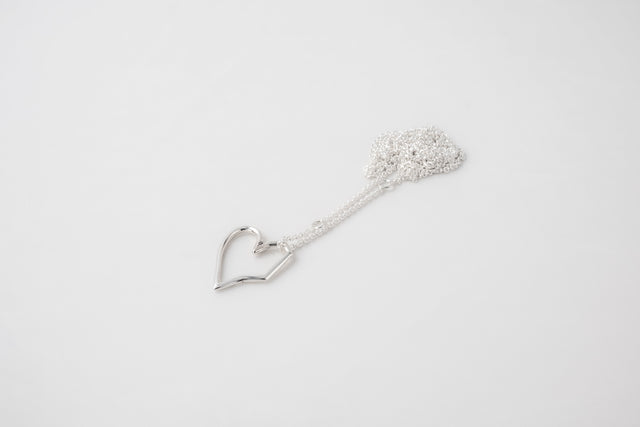
| Small Beads with Heart Choker | 33 g | Rp 18,851,000 (about $1,058) | about $60 |
| Blade Mini Links V.1 Choker | 110 g | Rp 55,754,000 (about $3,128) | about $200 |
On all four chains the silver is under a tenth of the price. The rest is casting, hand finishing, the clasp, a made-to-order run of about two weeks and shipping worldwide. A chain sold as solid silver at a price near its metal value has nothing left in it to pay for the work.
Gold moves the same arithmetic by two orders of magnitude. It closed at $4,148.69 per ounce on 28 September 2026, about 67 times the price of silver, or $133 per gram of pure gold. 14k is 58.5% gold, so each gram carries about $78 of it, and a 40 gram solid 14k chain holds roughly $3,120 in gold alone. Anything sold as a solid 14k chain for less is priced below the metal it claims to contain.
What are the red flags when buying jewelry online?
- "24k gold plated" sold as gold jewelry. Plating stays plating, whatever the karat of the layer.
- Stainless steel sold as "silver". "Stainless silver" is stainless steel.
- "Tibetan", "German" or "nickel" silver. Trade names for alloys that contain no silver.
- Weight not listed. Vague words like "heavy" or "substantial" hide hollow construction; real listings give grams.
- No maker named. A quality stamp without a maker behind it has nobody answerable for it.
- Prices that defy metal cost. A "solid silver chain" at $30 cannot exist: 40 grams of sterling holds about $73 of silver at the 28 September 2026 close.
- "Won't tarnish" silver. Real silver darkens; a listing that promises otherwise is selling a coating or another metal.
What should you do if you have already bought a fake?
- Document the piece — photos of the stamp and clasp, the weight on a scale that reads to 0.01 gram, the order details and the listing.
- Test it — magnet on the links, density, bleach on a hidden spot for silver, acid kit for gold.
- Write to the seller with the results and ask for a refund.
- If you bought on a marketplace, open a dispute through the platform: buyer protection on the major marketplaces covers items not as described.
- For expensive pieces, get an independent reading. A jeweller with an XRF analyser reads the composition in seconds without damage; a written result carries weight in a dispute.
How do you buy real men's jewelry with confidence?
- Buy from people who make jewelry, not only resell it. A maker has a name on the line. STRUGA silver pieces are cast in solid 925 and made to order in Bali by master silversmiths, with the weight in grams on the product page — which is what makes the numbers above checkable.
- Read the specification. A real listing gives the metal, the weight in grams, the dimensions and the finish; a vague listing hides the answer.
- Ask who made it. A legitimate seller names the maker; a reseller of unknown supply changes the subject.
The chains and rings in this guide belong to the CODEX world of the catalogue; the whole men's selection is in men's jewelry. For silver on its own, with the tests explained step by step, read how to tell if silver is real.
Where do I read further on this cluster?
- How to tell if silver is real — every test, step by step
- Real gold and silver earrings — how to tell
- Silver or gold — which to choose
- 925 sterling silver — the complete guide
- Men's silver chain styles compared
- Oxidized silver men's jewelry — care and styling
- STRUGA chains — weights and prices on every product page
About STRUGA. STRUGA is a dark silver jewelry brand founded by Dmitry Strugovshchikov and Ekaterina Strugovshchikova, handcrafted with Balinese and international silversmiths. Most pieces are 925 sterling silver left uncoated, so they darken with wear; part of the range is oxidized at the bench. The darkening is part of the design. It is a brutalist object that reacts and transforms through contact with the environment and the wearer.
Frequently asked questions
Didn’t find the answer — write to us, we reply personally.
Ask a question →01Is tarnished silver fake or low quality?+–
Neither — tarnish is a sign the metal is real. Sterling silver reacts with sulfur in the air and develops a black or yellow patina. What should make you suspicious is "silver" that never darkens: pieces marketed as tarnish-free are usually plated or made of an alloy with no silver in it. Tarnish comes off with silver polish; on a plated piece polishing only wears the coating thinner.
02Does a "925" or "14k" stamp prove a piece is real?+–
No. A stamp states a claim; it does not prove the metal. Counterfeits are stamped "925" and "14k" routinely. In the United States a quality mark must sit next to the maker's or seller's registered trademark, so a lone "925" with no maker's mark is itself a warning. Read the stamp, then confirm with density, a hidden-spot reaction test and the price against the metal inside.
03Is gold-plated jewelry the same as gold?+–
No. Gold plating is a thin coating over a base metal and wears through at friction points, whatever karat the coating is. Gold-filled is a far thicker layer of at least 10k gold that makes up at least a twentieth of the metal weight. Solid gold is gold alloy all the way through, marked 10k, 14k or 18k — only solid gold is gold jewelry.
04Does the magnet test confirm real silver or gold?+–
It rules fakes out; it does not rule authenticity in. Silver and gold do not stick to a magnet, so anything that pulls strongly has a steel or iron core. Brass and zinc do not stick either, so "no pull" only narrows the field. Lobster and spring-ring clasps carry a steel spring, so a genuine chain can react at the closure — test the links.
05How can I tell if a silver chain is real?+–
Weigh it and compare with the grams the seller states: published weights for a solid 925 Cuban of 4 mm at 50 cm run 18–25 grams, and the same shape in brass would be about a fifth lighter. Then measure density — sterling silver reads about 10.4, brass about 8.4. A bleach drop on a hidden spot darkens real silver within seconds.
06How can I tell real gold from fake?+–
Non-magnetism alone proves nothing about the karat. An acid kit at roughly $10–35 distinguishes 10k, 14k and 18k, and a streak on unglazed ceramic shows gold-coloured on real gold, but both mark the piece, so use a hidden spot. X-ray fluorescence at a jeweller reads the composition in seconds without damage, though only in the outer layer.
07Is gold vermeil real gold?+–
Vermeil is real sterling silver under a real gold coating of at least 10k and at least 2.5 microns, as the US Federal Trade Commission defines it. The piece is genuine silver; the gold is a thin layer that wears faster than gold-filled. It is not solid gold and should not be priced or sold as such.
08Why is real silver jewelry more expensive than gold-plated?+–
Solid 925 carries silver through the whole mass of the piece, while gold plating is a thin layer over another metal. Price follows the metal, the weight, the construction and the work, so compare specific pieces by grams rather than by a remembered price per gram — silver spot moves daily.
09Can fake gold be heavy?+–
Yes. Tungsten is almost exactly as dense as gold — about 19.3 grams per cubic centimetre — so gold-plated tungsten passes both a weight and a density check. That is why a surface reading needs a second method on a heavy piece that seems too cheap, and why buying from a maker who states the metal matters more than any single test.
10Is 925 silver worth anything if I sell it?+–
Its metal value is the silver inside: at the 28 September 2026 close, one gram of sterling held about $1.83 of silver. Buyers of scrap pay below that. A finished piece is worth what its design and making are worth to the next owner, which is why the metal is only a small part of a made-to-order chain's price.