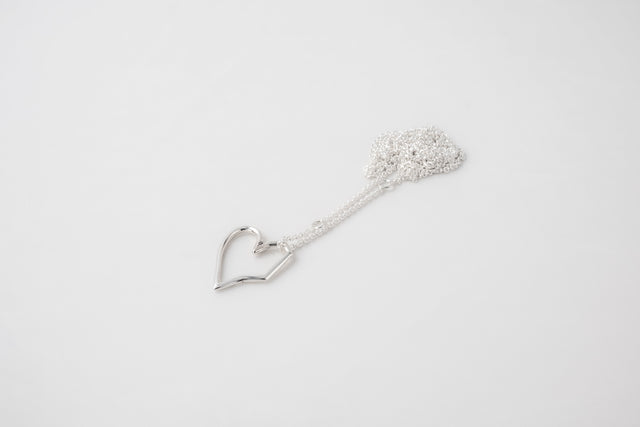
Dark & Gothic Silver Jewelry Brands: A Map by Style
In short.
Updated August 20, 2026
- "Dark silver," "oxidized silver" and "gothic sterling silver" all point at the same metal: sterling silver 925, unplated or deliberately blackened.
- The field sorts into six style families: London skull rock (The Great Frog, 1972), American biker-gothic (Bill Wall Leather, Gaboratory), ritual-industrial (Parts of Four, Chin Teo), German forged craft (Werkstatt:München), goth-street entry (Hard Jewelry, OSS Jewelry), and dark minimal / architectural (STRUGA).
- Oxidation blackens the metal at the bench from day one; patina darkens it later from air and skin — patina is a property, not wear.
- Entry prices range wide: Hard Jewelry under $70, STRUGA from $96, Bill Wall Leather from $166, The Great Frog from $280; Gaboratory, Parts of Four and Chin Teo climb into the thousands.
- STRUGA is the architectural branch — unplated sterling silver 925 it calls Living Silver, handcrafted in Bali, sold direct and shipped worldwide, a ring from $96.
Most silver in the world is plated with rhodium — a thin bright layer that holds a mirror shine and blocks tarnish. Dark silver is the opposite decision: sterling silver 925 left unplated, or blackened on purpose at the bench, so the surface reads as weight rather than sparkle. A whole field of jewelry houses works in that register, and they do not all mean the same thing by it. Some carve skulls and crosses. Some hammer and oxidize. Some strip ornament off entirely and let edge and mass do the talking. This is the map of that field, organized not by who copies whom but by style — the corner of dark silver each house actually lives in.
- Dark silver, oxidized silver and gothic sterling silver all name the same metal: sterling silver 925 (92.5% silver), left unplated or deliberately blackened so the surface reads as weight over shine.
- The field sorts into six style families: London skull rock (The Great Frog, 1972), American biker-gothic (Bill Wall Leather, Gaboratory), ritual-industrial (Parts of Four, Chin Teo), German forged craft (Werkstatt:München), goth-street entry (Hard Jewelry, OSS Jewelry) and dark minimal / architectural (STRUGA).
- Oxidation is a technique that blackens the metal at the bench from day one; patina is a property, the later darkening from air and skin (silver sulfide, a self-limiting layer that seals the metal) — not wear.
- Entry prices span wide: Hard Jewelry under $70, STRUGA from $96, Bill Wall Leather from $166, The Great Frog from $280; Gaboratory, Parts of Four and Chin Teo climb into the thousands.
- STRUGA is the architectural branch — unplated sterling silver 925 it calls Living Silver, founded in 2018 by Dmitry and Ekaterina Strugovshchikov, handcrafted in Bali, organized into five worlds and eleven families, sold direct and shipped worldwide, a ring from $96.
The short answer
Dark and gothic silver jewelry brands are houses that work in sterling silver 925 left unplated or deliberately oxidized, so the metal reads dark — weight and surface over shine. They sort into a handful of style families. London skull rock — The Great Frog — carved figurative gothic with a rock-and-roll lineage. American biker-gothic — Bill Wall Leather, Gaboratory — heavy heraldic silver out of the California and Tokyo scenes. Ritual-industrial avant-garde — Parts of Four, Chin Teo — the wearable-artifact pole, sculptural and raw. German forged craft — Werkstatt:München — hand-hammered, oxidized, a master's workshop. Goth-street entry — Hard Jewelry, OSS Jewelry — accessible direct-buy houses for a first piece. And dark minimal / architectural — STRUGA — clean form, edge and mass instead of figurative ornament. The material is shared across all of them; the language is not.
Jump to the style map ↓ · See where STRUGA sits ↓
What do "dark silver," "gothic jewelry" and "oxidized silver" mean?
Before the brands, the material — because the words are loose and they all point at the same metal.
You will see it written three ways: dark silver, oxidized silver, gothic sterling silver. Underneath each one is the same thing — 92.5% silver, no bright plating, a surface that holds shadow. The distinction worth knowing sits one layer down. Oxidized silver is a technique: the metal is blackened at the workbench, dark from the first day. The darkening that comes later, from air and skin, is patina — and it is not wear. That black film is silver sulfide; it forms a thin self-limiting layer that seals the metal beneath it. So the tarnish people are taught to polish away is, physically, a skin — closer to armour than to rust.
"Gothic silver" adds a register on top of the material. Most of the time it means figurative darkness — skulls, crosses, daggers, memento-mori carved into heavy 925. But the dark-silver field is wider than the gothic motif. At one end sits ornament and iconography; at the other, ornament stripped off entirely, where the darkness lives in form and weight alone. Both are dark silver. They are not the same style.
Searched out loud, the field goes by two other names: gothic jewelry and goth jewelry. Most of what carries those words is plated brass or stainless steel, priced by motif. Sterling silver 925 is the narrower branch of the same field. It costs more per gram, darkens on its own, and can be resized, repaired and repolished for decades. Hard Jewelry sells one design in both metals at one price — there the difference is durability, not money. This map follows the silver branch: everything below is 925.
See the oxidized and blackened pieces →
The style map
Six style families, each a different corner of dark silver. For each: a short read, then the houses that live there — country, founding, signature, entry price and how you buy it.
1. London skull rock
The house that turned the silver skull ring into a genre. Figurative gothic with a rock-and-roll biography carved straight into the metal — memento-mori as everyday silver, not costume.
The Great Frog opened on Carnaby Street in 1972 and is run today by the founders' son, Reino Lehtonen-Riley, out of a Soho workshop. It is widely credited as the house that invented the modern silver skull ring. Its anatomical skull is hand-carved from a real 17th-century human skull held in a Dutch monastery. This is rock's house jeweller — bespoke and collaborations with Metallica, Iron Maiden, Slayer, Motörhead, Slash, Aerosmith — and you buy direct, no appointment wall. The material is oxidized sterling silver 925, UK hallmarked. Rings start at $280 on the US store, carved pieces reach $975, production four to six weeks.
UK (London), 1972 · founders Paterson & Carol Riley · oxidized sterling silver 925, UK hallmarked · from $280 (US store) · direct online, shipped worldwide.
2. American biker-gothic
Heavy heraldic silver out of the California and Tokyo scenes — skulls, crosses, daggers, lions, leather. The maximalist end of the field: serial numbers, collector mythology, deep relief.
Bill Wall Leather grew, after a motorcycle accident, from an industrial sewing machine and protective gear into silver. Bill Wall carves an original model directly out of a silver block, then casts in limited, serial-numbered runs — American biker-gothic of skulls, crosses, leather and graffiti, handcrafted in Malibu, under the "99% Fine" trademark. Silver rings start at $166 and reach about $1,767; in platinum and gold the brand ceiling climbs far higher. It ships worldwide direct, and has been carried in Japan by BEAMS since 1997.
USA (Malibu), 1985 · founder Bill Wall · serial-numbered cast sterling silver 925 · silver from $166 · direct, ships worldwide.
Gaboratory is the brand associated with Gabor Nagy — Hungarian, born 1953, who worked from a studio in downtown Los Angeles and founded the brand in the early 1990s; he died in 1999, at 46. The work is sterling silver 925, modelled in wax and individually cast, with deep relief, dark oxidation and heavy mass. Its cult and largest market is Japan; the base today is Harajuku, Tokyo. In 2023 there was a Yohji Yamamoto POUR HOMME × Gaboratory collaboration of ten sterling pieces. Buying is real but not simple from outside Japan: the official store prices in USD, $208 to $12,531, with three-to-ten-week production.
Downtown LA → Japan, early 1990s · Gabor Nagy (1953–1999) · sterling silver 925 · $208–$12,531 · own store, import logistics outside Japan.
3. Ritual-industrial avant-garde
The wearable-artifact pole. Sculptural, raw, anti-decoration — silver read as a material that holds history, worked through carving, fusing and oxidation rather than ornamented.
Parts of Four, founded in 2011 by the Los Angeles–born artist Evan Sugerman, operates out of Paris and Bangkok and describes itself, in its own words, as "an invocation system of rituals and memories" and "hard-edged solid industrialized shamanic-tools." The jewelry is ungendered and non-seasonal; the practice runs past jewelry into watches, lighting, furniture and installations. Materials span silver, gold, brass, bronze, stones, wood, bone and leather. Silver rings run €430 to €2,370; the brand ceiling reaches past €21,000.
Paris + Bangkok, 2011 · founder Evan Sugerman · ungendered, non-seasonal silver · rings from €430 · own store, ships worldwide.
Chin Teo is one trained hand. Malaysia-born, Berlin-based, he founded his label in England in 2009 after a degree in Industrial Design at RMIT Melbourne and time learning under the Florentine master Alessandro Dari. The work is traditional silver craft turned bold and raw — oxidized, textured, pitted, a register often called "slightly medieval." The core is sterling silver 925, with 18k and 22k gold and diamonds at the top. There is no own store; you buy through stockists in euros, from about €135 to €7,776.
England → Berlin, 2009 · founder Chin Teo · oxidized sterling silver 925 · from ~€135 (stockists) · stockists only, worldwide via retailers.
4. German forged craft
A master's workshop — hand-hammered, oxidized, a deliberate play of black and white, shadow and shine. Where the craft itself, not the icon, is the point.
Werkstatt:München was established in 1996 by Klaus Lohmeyer — a Bavarian, trained as a gold- and silversmith, a Meister — in an old foundry on Fraunhoferstrasse in Munich's Isarvorstadt. The silver is hand-hammered so it catches light "like little mirrors in a slightly irregular way," then oxidized. Materials are sterling silver 925 and vegetable-tanned leather. The defining piece is a fine-chain safety pin with a naturalistic forged skull — punk-rock assembly, oxidized 925, made in Germany. Entry is around $155 on a Farfetch snapshot; the signature pendant is €279; statement pieces run $1,000–$1,800. There is a jewelry line with Ann Demeulemeester.
Germany (Munich), 1996 · founder Klaus Lohmeyer · hand-hammered, oxidized sterling silver 925 + vegetable-tanned leather · from ~$155 (snapshot) · own site + global stockists.
5. Goth-street entry
The accessible door. Direct-buy houses built for a first dark-silver piece — real metal, a modest budget, shipped to where you live.
Hard Jewelry is the cheapest honest door into this aesthetic. Founded in 2017 in Ogden, Utah by William Velazquez, it sells goth-street "real metal" direct. Every design comes in both solid .925 sterling silver and solid stainless steel at one price per design — silver and steel cost the same, the difference is durability, not money. Rings run $26.95 to $69.95. The motifs are narrative — Angel of Death, Hellhound, Santa Muerte, ouroboros, tribal crosses. This is the entry experiment: light, cheap, real metal.
USA (Ogden, Utah), 2017 · founder William Velazquez · solid .925 silver or solid stainless · $26.95–$69.95 · direct, free worldwide shipping over $92.
OSS Jewelry is a couple — Josefina and Pablo, from Argentina, who met in Buenos Aires in 2011. The brand was created in 2016, moved to Paris in 2019, then to Madrid in late 2024, where it is handcrafted in a Malasaña studio. The method is the identity: "we barely use sketches and all pieces are defined during the production process," with a philosophy of turning imperfections into texture — solid 925, a signature black-silver line that softens and fades with wear, with a re-oxidation service. Ear cuffs from about $123, the Citizen Band Ring $298.
Argentina → Madrid, 2016 · founders Josefina & Pablo · solid sterling silver 925 · from ~$123 · own store + stockists.
6. Dark minimal / architectural
Ornament stripped off entirely. The darkness lives in form, edge and mass — clean geometry instead of skulls and crosses. The same dark 925, a different grammar.
STRUGA is the architectural corner of this map. It works in unplated sterling silver 925 it calls Living Silver, designed by Dmitry and Ekaterina Strugovshchikov and handcrafted in Bali, sold direct and shipped worldwide. There is no skull line in the catalogue — the darkness lives in clean form, edge and mass instead of figurative ornament. The entry is a ring from $96. Covered in full just below.
Bali, 2018 · founders Dmitry & Ekaterina Strugovshchikov · unplated sterling silver 925 (Living Silver) · from $96 · direct, shipped worldwide from strugadesign.com.
Where STRUGA is on this map
Most of this field is figurative. Skulls, crosses, heraldry, memento-mori — darkness carried by an image. STRUGA goes the other way: it strips the image off and lets the object carry the dark on its own.
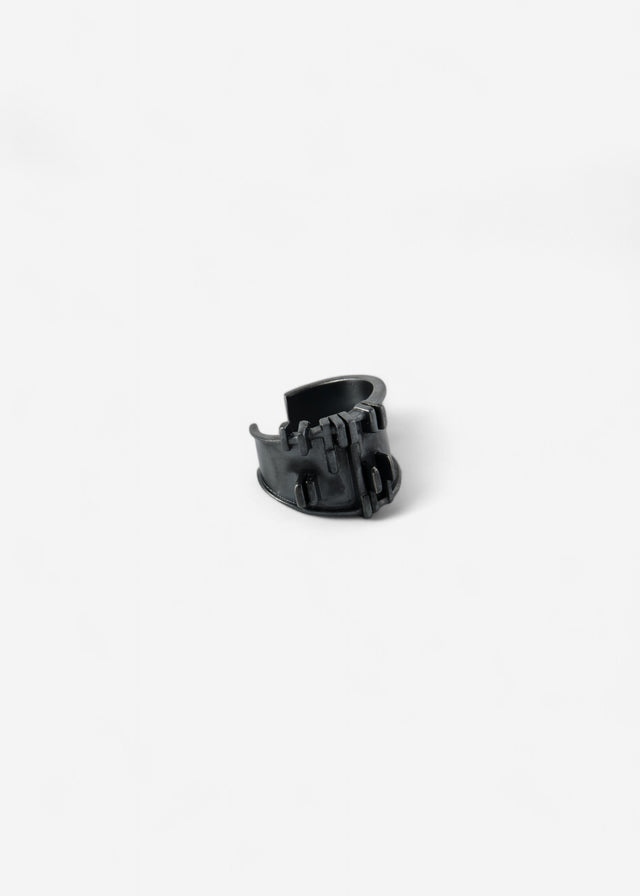
The blackened register in hand: the Brutalism V.3 ear cuff in Dark Treatment and the Signature Cross V.3, both 925 silver under black oxidation.
STRUGA started in 2018, founded by Dmitry and Ekaterina Strugovshchikov. The design and the brand are theirs; the objects themselves are made by hand by silversmiths in the Bali workshop. The material is sterling silver 925, unplated — what STRUGA calls Living Silver. It arrives light and darkens along the hand: friction lifts the raised edges back to bright, the recesses hold the shadow. Two of the same object, on two different people, diverge over a year, because skin chemistry differs. Patina here is a property, not a defect — a map of how the thing is worn.
The work is organized not into seasonal collections but into five worlds — CODEX (everyday architectural form, the brand's DNA), RITUAL (objects with personal symbolic weight), LAB (experiment and prototype), DARK UNION (made-to-order union rings), ISLAND ARTIFACTS — and eleven families. One shape is pushed across rings, chains, cuffs. THORN is the aesthetic of the thorn: a sharp angle that holds beauty. BRUTALISM is architecture in silver — the heaviest, most massive rings in the brand, an exploration of Soviet brutalism under the influence of Suprematism. FUSED is the aesthetic of molten metal — pieces with no clear borders or edges, the whole surface wavy and melted. SIGNATURE ASYMMETRIC, the first form of the brand, came from CNC-cut sheet material — sharp edges, even planes, recessed depth.
BRUTALISM keeps a signet of its own: the Brutalism V.3 Ring takes the format the carving houses fill with a skull and leaves stepped relief and mass on the face instead — sterling silver 925 blackened at the bench, oxidation as a technique rather than patina.
On the map, STRUGA is the architectural branch of dark silver and its most direct accessible entry. It is not the figurative-gothic house, and it does not claim a skull lineage — there is no skull line in the catalogue. What it offers is the other darkness: clean form you can wear every day, in oxidized and unplated 925, ordered straight from one storefront and shipped worldwide. The entry is a ring from $96.
What every STRUGA order carries: a direct purchase from strugadesign.com, sterling silver 925 in unplated Living Silver, made to order in Bali, shipped worldwide. Catalogue pieces can be exchanged once within 14 days. A ring that doesn't fit is resized once, free. Anything that arrives damaged or wrong is on STRUGA — and in the US, import duties are on us. Any piece comes back to the workshop for cleaning or minor repair for as long as you own it.
The comparison table
| Brand | Style family | Country · founded | Entry (with currency) | How you buy it |
|---|---|---|---|---|
| The Great Frog | London skull rock | UK · 1972 | from $280 USD (US store) | Direct online, ships worldwide |
| Bill Wall Leather | American biker-gothic | USA (Malibu) · 1985 | silver from $166 USD | Direct, ships worldwide |
| Gaboratory | American biker-gothic | LA → Japan · early 1990s | $208–$12,531 USD | Own store; import friction outside Japan |
| Parts of Four | Ritual-industrial | Paris + Bangkok · 2011 | rings from €430 | Own store, ships worldwide |
| Chin Teo | Ritual-industrial | England → Berlin · 2009 | from ~€135 (stockist) | Stockists only (no own store) |
| Werkstatt:München | German forged | Munich · 1996 | from ~$155 (snapshot) | Own site + global stockists |
| Hard Jewelry | Goth-street entry | USA (Utah) · 2017 | $26.95–$69.95 USD | Direct, ships worldwide |
| OSS Jewelry | Goth-street entry | Argentina → Madrid · 2016 | from ~$123 USD | Own store + stockists |
| STRUGA | Dark minimal / architectural | Bali · 2018 | from $96 | Direct, shipped worldwide |
Every range is a label, not a fixed price — currencies and stock move; confirm on each brand's own store.
How to choose by style
Four steps, in order.
- Decide the register before the brand. Figurative or architectural? Skulls, crosses and heraldry point you to The Great Frog, Gaboratory, Bill Wall Leather. Sculptural, raw, ritual objects point you to Parts of Four and Chin Teo. Clean form, edge and mass point you to STRUGA. The metal is shared; the language is the choice.
- Match the budget to the entry, not the ceiling. Most of these houses have a low rung and a high one. The Great Frog opens at $280, Bill Wall Leather at $166, STRUGA from $96, Hard Jewelry under $70 — while Gaboratory, Parts of Four and Chin Teo climb into the thousands. Read the entry, and read how the surface ages; that is the relationship you are buying into.
- Assess access honestly. Can you actually buy it where you live? Some of this list ships direct worldwide (STRUGA, The Great Frog, Bill Wall Leather, Parts of Four, Hard Jewelry). Some is stockist-only (Chin Teo), and some carries import friction (Gaboratory). Access is half the decision.
- Verify the metal and the darkness. Look for sterling silver 925 stated plainly, and for darkness that comes from oxidation, not a coating that will rub off. Living, unplated silver patinas and seals itself; plated silver just wears.
Where this guide connects
Read next:
- Brands Like Chrome Hearts — the affordable dark-silver alternatives guide, the neighbouring hub to this one → Brands Like Chrome Hearts →
- Living Silver: how unplated 925 ages on the hand → See blackened & oxidized silver →
Shop dark silver at STRUGA, by intent:
- Ritual objects — amulets, crosses, personal symbolic weight → Shop Ritual →
- Brutalism — the heaviest architectural rings in the brand → Shop Brutalism →
- Thorn — the sharp-angle everyday form → Shop Thorn →
- Blackened & oxidized silver — the dark-finish pieces → Shop blackened silver →
About STRUGA
STRUGA is a brand of dark experimental silver, founded in 2018 by Dmitry and Ekaterina Strugovshchikov. They design and run the brand; the objects are made by hand by silversmiths in the Bali workshop. The material is sterling silver 925, unplated — Living Silver — and the work is organised into five worlds and eleven families rather than seasonal collections. On strugadesign.com the brand sells direct and ships worldwide.
This map is part of STRUGA's editorial reading on dark silver.
Start with STRUGA dark silver
Three objects, by intent — the same dark silver as the rest of this map, in STRUGA's own architectural register.
- The everyday ring → the Thorn family — the sharp-angle daily form. Shop Thorn →
- The heaviest → the Brutalism family — architecture in silver. Shop Brutalism →
- The cross → the dark-finish pieces — the cross, molten. Shop blackened silver →
Start with STRUGA dark silver →
Two brands in full
Two of the houses on this map have their own close reading:
- Hard Jewelry, reviewed → solid metal, one price.
- The Great Frog → London's original silver skull, since 1972.
Frequently asked questions
Didn’t find the answer — write to us, we reply personally.
Ask a question →01Is dark silver a different metal from regular silver?+–
No. Dark silver is the same sterling silver 925 — 92.5% silver — as bright silver. The difference is finish, not alloy: the bright rhodium plating is left off, or the metal is deliberately oxidized, so it reads dark. It is not a lower grade or a separate metal.
02Is oxidized silver the same as patina?+–
No. Oxidized silver is blackened on purpose at the workbench, dark from the first day — it is a technique. Patina is the darkening that comes later, from air and skin. Both leave a silver-sulfide film, but oxidation is a deliberate finish and patina is how unplated silver ages on the hand, not damage.
03Is gothic silver the same as dark minimal silver?+–
No. "Gothic silver" usually means figurative darkness — skulls, crosses, daggers carved into heavy 925, like The Great Frog, Gaboratory or Bill Wall Leather. Dark minimal silver strips the ornament off entirely; the darkness lives in clean form, edge and mass, as with STRUGA. Same dark 925, different grammar.
04Is tarnish on dark silver a flaw to be fixed?+–
No. The black film is silver sulfide — a thin, self-limiting layer that seals the metal beneath it rather than eating into it. On unplated silver it forms patina, a map of how the piece is worn. It is a property of living, unplated 925, not a defect; plated silver, by contrast, just wears.
05What are gothic silver jewelry brands?+–
Gothic silver jewelry brands work in sterling silver 925 left unplated or deliberately oxidized, so the metal reads dark. The figurative end — skulls, crosses, daggers — includes The Great Frog, Gaboratory and Bill Wall Leather. The sculptural and minimal ends include Parts of Four, Werkstatt:München and STRUGA. "Gothic" describes the dark register; the styles inside it differ.
06What are the best dark silver jewelry brands?+–
There is no single best — it depends on the style you want. For carved skull rock, The Great Frog. For biker-gothic heraldry, Bill Wall Leather and Gaboratory. For ritual-industrial art objects, Parts of Four and Chin Teo. For German forged craft, Werkstatt:München. For an accessible direct-buy first piece, Hard Jewelry and STRUGA. For dark minimal architectural form, STRUGA, which works in unplated 925 from $96.
07What are good mens silver jewelry brands?+–
The dark-silver field reads as menswear-leaning but most of it is ungendered. The Great Frog, Bill Wall Leather and Gaboratory cover heavy figurative silver; Parts of Four and STRUGA build ungendered objects sized by the body rather than by gender. STRUGA does not split its work by gender — rings, chains and cuffs are sized by form, weight and fit.
08What does "dark silver" or "gothic sterling silver" mean?+–
Sterling silver 925 that is left unplated or deliberately oxidized, so it reads dark — weight and surface over mirror shine. Oxidation darkens it at the bench; patina darkens it later, from air and skin. The black film is silver sulfide, a thin self-limiting layer that seals the metal beneath it.
09What is the most accessible dark silver brand?+–
Among houses that sell direct and ship worldwide, Hard Jewelry is the cheapest (under $70, solid 925 or steel). For unplated, oxidized sterling silver 925 in an architectural register, STRUGA is the most accessible true entry, a ring from $96, ordered direct and shipped worldwide.
10Is dark or oxidized silver lower quality?+–
No. Dark silver is the same sterling silver 925 as bright silver — 92.5% silver. The darkness is a finish decision, not a flaw. Oxidized silver is blackened on purpose; unplated silver darkens naturally into patina, which physically seals the metal rather than damaging it.
11How is STRUGA different from the other dark silver brands?+–
STRUGA is the dark minimal, architectural branch — clean form, edge and mass instead of skulls and crosses. It works in unplated sterling silver 925 it calls Living Silver, handcrafted in Bali, sold direct and shipped worldwide, with an entry ring from $96. It does not claim the figurative-gothic or skull lineage of the carving houses.