Which brands make handmade men's silver chains
STRUGA, WERKSTATT:MÜNCHEN and The Great Frog offer different approaches to handmade silver chains. Start with a particular model: STRUGA’s Thorn chain uses angular cast links, while Werkstatt’s Squeezed uses links bent by hand. A handmade label alone does not describe every component. Check the silver specification, the work done on the links, the clasp and the measurements of the chain you want.
Updated September 14, 2026
Which brands make handmade men's silver chains?
STRUGA builds chains around its own link and clasp forms. WERKSTATT:MÜNCHEN describes specific hand operations in several necklace listings. The Great Frog explains its workshop process and offers standalone neck chains, although those product pages do not disclose every detail of the links. These are starting points for comparing construction, rather than a ranking of price or quality.
| Brand | Example | What the source states |
|---|---|---|
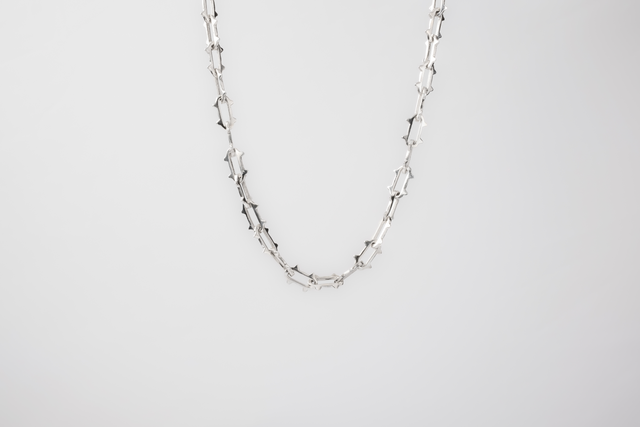
| STRUGA | Thorn Links Chain | 925 silver; cast links finished and assembled by hand; 40 / 45 / 50 / 75 cm |
| WERKSTATT:MÜNCHEN | Necklace Squeezed | 925 silver; links bent by hand; approximately 60 cm |
| The Great Frog | TGF Thin Knife Edge Chain | 45 / 50 / 60 / 75 cm; workshop and silver-care information, without a page-specific fineness, weight or link-making process |
The Great Frog’s production FAQ describes designs developed from sketches and wax models, followed by casting in London. That gives useful context, but a model’s own specification is still needed. Ask the maker to confirm the metal and the operations used for the neck chain you select.
Chrome Hearts is not given a numerical comparison here. Our check of its official website did not find public neck-chain listings with enough specifications to compare materials, dimensions, process and price. That is a gap in the available product information, not evidence that the brand sells no chains. Use its official store directory to confirm a particular model.
What can handmade mean for a silver chain?
A maker can create the original link model, bend links, assemble a chain, solder connections, make a clasp or finish the surface by hand. Those operations produce different constructions. A weave name or an uneven surface cannot identify the complete manufacturing process.
WERKSTATT:MÜNCHEN provides a useful distinction. Its Squeezed necklace uses links bent by hand. The brand’s Embrace necklace has two forged central elements attached to a box chain. The description does not say that every link in that chain is forged. The brand also explains its hand production in Munich, including the development of links and closures.
A detailed process description for a wallet chain does not establish how a neck chain is made. Nor does the word factory tell you that no person worked on an object. Useful evidence names the model, identifies the component and explains the operation. It leaves room for a piece assembled from parts made in different ways.
How do STRUGA's silver chains differ?
STRUGA develops a chain through the shape of a link or a working clasp. The four examples here are made by hand in Bali in 925 silver. Their construction varies considerably: a short BLADE choker holds more metal than a long fine chain carrying separate SIGNATURE ASYMMETRIC elements.
These link and clasp forms belong to CODEX, STRUGA’s world of everyday architectural forms.
Thorn: a continuous line of sharp angles
THORN began with a chain link. The silver links are cast, finished by hand and assembled into a continuous run. The angle belongs to the link itself. Four lengths, from 40 to 75 cm, offer a short line around the neck or a longer chain. Try the angular surface against your skin if you expect to wear the chain without a layer of clothing beneath it.
Blade Mini Links V.1: split links joined on pins
Each mini-link in the Blade Mini Links V.1 Choker is split into two parts and joined on copper pins. A large Carabiner #2 Big, carrying the SIGNATURE ASYMMETRIC form, closes the chain. At 40 cm the choker weighs 80 g. A short length does not make this a light chain: the linked structure carries substantial metal.
Signature Asymmetric: elements along a fine chain
The Long Chain with Signature Links is 120 cm long and weighs 35 g. Runs of fine round-link chain separate the angular elements, which are attached on individual jump rings. It can be worn as a long line or arranged in several loops when the resulting fit is comfortable.
Small Beads with Heart: beads and a working closure
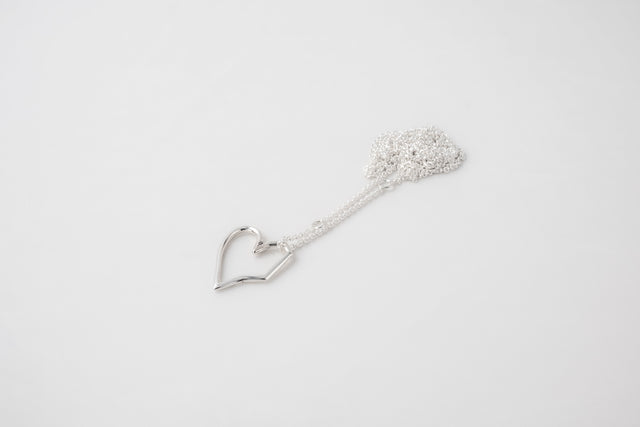
The Small Beads with Heart Choker brings small silver Perlina beads into a line. The Dual Heart functions as the clasp; it is not a pendant added to the finished choker. The catalogue offers lengths of 40, 45 and 50 cm. The clasp can sit at the front or turn towards the nape.
How should you choose chain length and weight?
Measure the intended length with a cord and try it with the clothes you expect to wear. Then compare weight. Equal lengths do not promise an equal feel: the four STRUGA chains below have different structures and carry different amounts of metal.
| STRUGA chain | Length | Weight by size |
|---|---|---|
| Thorn | 40 / 45 / 50 / 75 cm | 11 / 12 / 13 / 18 g |
| Blade Mini Links V.1 | 40 / 45 / 50 cm | 80 / 90 / 110 g |
| Long Chain with Signature Links | 120 cm | 35 g |
| Small Beads with Heart | 40 / 45 / 50 cm | 27 / 30 / 33 g |
These figures were checked against STRUGA’s catalogue variants on September 14, 2026. They describe the selected piece, not its shipping parcel; small variations occur in hand production. A cord helps with length but cannot reproduce a chain’s weight or stiffness. If this is your first heavy choker, a fitting will tell you more than a photograph of it on someone else.
A pendant needs a separate compatibility check. Its opening must accommodate the clasp or end link; it must move as intended; and the connection must suit its weight. A chain with a large sculptural closure may already be a complete piece on the neck. The category “men’s” does not settle the fit: STRUGA pieces are unisex, and the choice depends on body measurements and the chain’s dimensions.
What should you compare before ordering?
Write down the model, silver fineness, length, weight, clasp and surface finish. Compare prices for the selected length and a clearly specified order. A short fine chain and a heavy choker contain different structures and quantities of metal. Their price difference alone cannot establish the quality of the handwork.
Confirm availability, production time and delivery before choosing a piece for a date. The four STRUGA models shown here are listed as made to order, with production taking about two weeks. Delivery time comes separately. If timing matters, confirm the selected model through STRUGA’s contact page before placing the order.
Ask about length adjustments and returns for the particular order. A standard model, a different length and a piece developed from an individual sketch may have different terms. For a substantial chain, it also helps to know who can repair the clasp or replace a link later. Those answers make a comparison useful beyond the first photograph.
How does the silver finish affect your choice?
925 silver contains 92.5% silver. Fineness does not describe the manufacturing process, the presence of plating or how the surface will change. All four STRUGA examples in this article have a Living Silver finish: unplated metal that darkens through contact with the environment and the wearer. Recesses darken, while friction lightens raised surfaces.
A surface darkened at the bench is a different finish. A photograph of a dark chain does not tell you how to care for it: establish whether there is a coating or deliberate darkening before choosing a cleaning method. After wear, the STRUGA chains can be wiped with a soft cloth. Follow the instructions for the particular piece when it needs more thorough cleaning.
Where can you check models and specifications?
The links above lead to the makers’ own information so you can check the exact model before ordering. For STRUGA, start with the chain collection and the four constructions discussed here. Once you know the length and form you want, a comparison with another maker becomes more precise.
For a broader comparison of design, see the guide to Chrome Hearts alternatives. A familiar brand name can help you start looking, but the link, clasp, measurements and finish are what you will wear.
Frequently asked questions
Didn't find your answer — write to us, we reply personally.
Ask a question →01Does 925 silver mean that a chain is handmade?+–
No. The 925 specification describes the alloy: 92.5% silver. Link production, assembly and surface finishing need to be checked separately for the selected model.
02Are all handmade chains cast?+–
No. Workshop descriptions include cast elements, links bent by hand and forged details. One piece can combine several operations. The brand name does not replace the model specification.
03Which STRUGA chain should I consider for lower weight?+–
Of the four models discussed here, Thorn has the lowest weight: 11 g at 40 cm and 18 g at 75 cm. The Long Chain with Signature Links weighs 35 g at 120 cm. Fit and the feel of the angles differ, so weight is only one part of the choice.
04Can I add a pendant to any chain?+–
Compatibility needs a separate check: the pendant opening, the chain clasp and end link, the pendant’s movement and the weight the connection can support. A large clasp may not pass through the opening. A standalone chain may need no pendant.
05Do STRUGA chains all use the same clasp?+–
No. Blade Mini Links V.1 uses Carabiner #2 Big, while Small Beads with Heart uses a working Signature Heart clasp. Check the closure on the specific product page rather than assuming one clasp across the brand.
06How long does STRUGA chain production take?+–
The four models in this article are listed as made to order in about two weeks. Delivery time is separate. Confirm availability and the schedule for the selected size before ordering, especially when the chain is needed for a particular date.