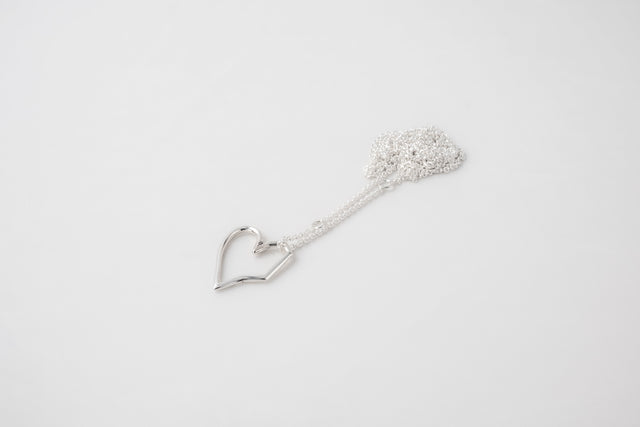
Pendants: what they are and how they differ from a charm
A pendant is the carrier form: a chain with one hanging object. A charm is that object — the thing that hangs.
STRUGA pendants are uncoated 925 silver — no rhodium plating; the surface darkens and lightens by wear (Living Silver).
Thirty-two pendants live in the catalogue: 925 silver in 25, carbon in 14, meteorite in two, quartz in four; 13 hang on a suede cord, the rest on a chain.
Inserts vary — carbon, Seymchan meteorite, an uncut stone; the material of the hanging object changes, the mechanics stay.
The pendant is STRUGA's root form: the brand began with SIGNATURE ASYMMETRIC pendants, an asymmetric cast form on a chain.
The form runs through the CODEX and RITUAL worlds — SIGNATURE ASYMMETRIC, AMULET, CARBON and FUSED families.
An amulet is a pendant with personal or cultural meaning — described as object, geology and symbolic reference, with no promise of protection.
The short version
- A pendant at STRUGA is a form in its own right, not an add-on to a chain. The form is the pendant; what hangs on it is open.
- 925 silver, uncoated. Inserts vary — carbon, Seymchan meteorite, an uncut stone: the material of the hanging object changes, the mechanics stay.
- Worn on a chain or cord — one object at the chest, read as an accent.
- Length and weight follow the object: the chain and the cord are 75 cm, the weight runs from 7 g for a single BLADE link to 40 g for a cast pyramid.
- Forms live in the SIGNATURE ASYMMETRIC, CARBON, FUSED and AMULET families.
- The silver darkens and changes on the wearer. This is Living Silver.
- What a pendant is
- Where the form comes from
- How it differs from neighbouring forms
- Pendants at STRUGA
- The form on pieces
- At a glance
- FAQ
What a pendant is
A pendant is a chain with one hanging object. What matters is that the word names not the object but the method: a single object suspended on a chain at the chest. What hangs is left open. That is why a cross, a stone in a setting, a cast plate and an amulet are all called pendants — the form is one, the content varies.
The hanging object itself — the charm — is the thing that hangs. In everyday speech pendant and charm trade places, and that is not a mistake: most often they are two views of the same thing. But drawn strictly, the line runs here — the pendant is the fastening and the way it sits against the body, the charm is what is actually carried. The carrier and the load.
Where the form comes from
A pendant is the most direct way to wear an object on the body without turning it into a ring or an earring. The chain strips the object of its fastening duty: it no longer has to wrap a finger or catch on an ear — it simply hangs and reads whole, from every side. So a pendant carries what is worth holding as a separate object: a sign, a stone, a fragment with weight.
At STRUGA this form sits at the root. The brand began with SIGNATURE ASYMMETRIC pendants — an asymmetric cast form on a chain; from it came the recognisable silhouette that later spread to rings, ear cuffs and bracelets. For STRUGA the pendant is not one category among many — it is the first.
How it differs from neighbouring forms
A pendant is a frame, and several narrower forms live inside it. An amulet is a pendant with personal or cultural meaning: the same mechanics, but the object carries significance for its wearer. A cross pendant is a geometric cross on a chain — a pendant whose hanging object is a sign. A choker and a collar are different: they sit along the neck as a line, while a pendant drops one object lower, to the chest.
The line with the amulet and the talisman is one of meaning, not of construction. STRUGA describes an amulet and a stone as object, geology and symbolic reference — with no promise of protection or power. The meaning is the wearer's; the brand answers for the metal, the form and the material.
Pendants at STRUGA
At STRUGA the pendant is a root form, not an add-on to a chain. It is uncoated 925 silver, sometimes with carbon, meteorite or an uncut stone — the material of the hanging object changes, the mechanics stay the same. The surface lives — this is Living Silver: the edges the fingers and the fabric touch wear down to the light, the recesses go to graphite, and the relief of the object reads sharper over time.
The form runs through the brand's worlds. In the CODEX world the pendant is carried by SIGNATURE ASYMMETRIC — the asymmetric cast form the brand began with. In the RITUAL world the pendant lives as an amulet with personal weight, as a geometric cross and as an object of meteorite and stone. One set of mechanics — a single object on a chain — drawn through STRUGA's different languages.
The form on pieces
The same mechanics — one object on a chain or a cord — read differently depending on what hangs. Four objects from the catalogue show the range.
| Object | Carrier | Material and surface |
|---|---|---|
| Signature Asymmetric Pyramid Necklace | Chain, 75 cm | Uncoated 925 silver, 40 g — Living Silver: recesses darken, raised planes stay bright |
| Blade Link Small Necklace | Chain, 75 cm | Uncoated 925 silver, 7 g — a single BLADE link as the hanging object |
| Signature Cross V.3 | Suede cord, 75 cm | Classic Graphite carbon body fused with a cast 925 silver element — two materials, one object |
| Big Line Classic Aged on the cord | Suede cord, 75 cm | Multi-layered matte carbon with aged copper inlay, no silver — the copper ages, the carbon does not |
A pendant needs a chain, and the chain is a choice of its own — both together.
Pendants at a glance
| Aspect | What it means |
|---|---|
| What it is | The carrier form: a chain or a cord with one object hanging at the chest |
| Charm | The hanging object itself. The pendant answers how it is fixed, the charm answers what is fixed |
| Metal | Uncoated 925 silver in 25 of 32 live models; carbon in 14, Seymchan meteorite in two, quartz in four |
| Surface | Uncoated silver darkens and lightens by wear — this is Living Silver; blackened objects are darkened in advance, at the bench |
| Carrier | A chain or a cord: 13 of the 32 models hang on a suede cord, the rest on a chain |
| Families | MOSAIC 16, SIGNATURE ASYMMETRIC 14, CARBON 9, AMULET 6, CLASSIC AMULET 4, plus BLADE, SIGNATURE HEART and FUSED |
| Worlds | RITUAL 24 models, CODEX 6, ISLAND ARTIFACTS 4, LAB 3 |
| Models in the catalogue | Thirty-two live |
| Lead time | Made to order: about two weeks for silver, three for an object with a stone, four for a carbon piece |
Frequently asked questions
Didn’t find the answer — write to us, we reply personally.
Ask a question →01What is a pendant in simple terms?+–
A pendant is a chain with one hanging object — a stone, a plate, a sign. The pendant is the form that carries it; the object that hangs is the charm. In everyday use the words are interchangeable.
02What is the difference between a pendant and a charm?+–
A pendant is the carrier form: a chain with one hanging object. A charm is that object itself. The pendant answers how it is fixed, the charm answers what is fixed. In speech they are usually used as synonyms, and that is fine — the strict line is rarely needed.
03Are a pendant and a charm the same thing?+–
Most often, yes: they are two views of one thing. Drawn strictly, the pendant is the way of wearing (an object on a chain) and the charm is the object. In practice the words replace each other and both readings are correct.
04How is a pendant different from an amulet?+–
By construction, not at all: an amulet is a pendant. The difference is in meaning — an amulet carries personal or cultural significance for the wearer. STRUGA describes an amulet as an object and a symbolic reference, with no promise of protection or effect.
05What are STRUGA pendants made of?+–
Of uncoated 925 silver, sometimes with carbon, meteorite or an uncut stone. This is Living Silver: silver with no rhodium plating that darkens and lightens on its own, by the way the object is worn.