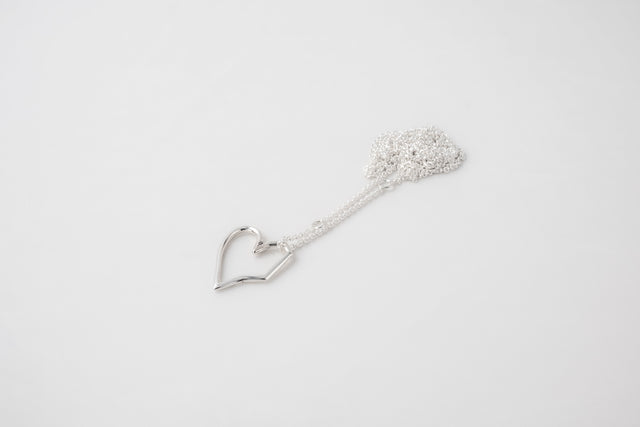
Mens silver necklaces at STRUGA aren't generic chains or commercial pendants. They're sculptural sterling silver necklaces in oxidized 925 — the Big Line Aged with Aged Copper inlay, the Asymmetric series in four pigment moods, hand-finished pendant-on-cord configurations. If you've been searching mens silver necklace online and finding only the same recycled chain styles, this is the alternative: blackened silver necklaces with architectural geometry and Living Silver patina.
A sterling silver necklace is the piece you wear closest to the throat, and that proximity changes everything. The metal sits against skin all day, picks up body heat, catches sweat after a workout, dries under a shirt collar. Where a ring lives on a finger and a bracelet wraps the wrist, a necklace breathes with the chest. Oxidation responds to that breathing — it deepens, softens, builds a graphite shadow in every recessed line.
At STRUGA we make necklaces in 925 sterling silver, blackened by hand, then partially polished back so the high points shimmer and the lows stay dark. No plating, no rhodium, no synthetic finish trying to fake age. The Big Line Aged drop pairs Living Silver with Aged Copper. The Asymmetric series — Bloody, Winter, Toxic, Multy — runs the same skeleton through four pigment moods. Everything is handcrafted in Bali, then shipped to the wearer worldwide.
TL;DR — STRUGA Mens Silver Necklaces
- Oxidized 925 sterling silver necklaces — pendant, cord, and chain formats; mens silver necklace + womens silver necklace cuts
- Big Line Aged: carbon fibre with Aged Copper inlay — $175, 17 grams, no silver in it
- Asymmetric variants: Bloody (red), Winter (blue), Toxic (green), Multy (rainbow) — carbon fibre, $165 each at 5 grams
- Price range $160–$1,250 across the 32 necklaces in the catalogue, by weight, stone, and complexity
- Cord and chain lengths from 45 cm choker to 60 cm sternum drop
- Living Silver finish — patina deepens with wear, no replating ever needed
- Handcrafted one-piece-at-a-time in Bali workshop
What an oxidized silver necklace actually is
Oxidation is a controlled chemical reaction. We expose finished 925 silver to a sulfide solution, which forces the surface to skip ahead twenty years of natural tarnish in about ninety seconds. The metal turns black-grey, sometimes with a hint of blue or aubergine depending on alloy. Then comes the second move — selective polishing. We bring the high points back to bright silver while leaving every recess, every texture, every tool mark sitting in shadow.
That contrast is the entire visual logic of a STRUGA necklace. Without oxidation, the carved geometry reads flat under most light. With it, every angle has a shadow line and every shadow line has a polished edge catching the light. The pendant looks alive against a black t-shirt, deeper against pale skin, almost architectural under a leather collar.
For a fuller breakdown of why we work this way, read the sterling silver jewelry guide 2026. The short version: 925 is the only honest base for this kind of finish.
Necklace, collar and choker are not synonyms: the difference is length and how the piece sits on the collarbone. The terms are separated in the collar necklace reference; this page is the catalogue section — oxidised silver necklaces and collars.
Oxidation is a technique, Living Silver is a property
These two get confused constantly, including in our own older texts. Oxidation happens at the bench: the piece is blackened before it ships. Living Silver happens on the wearer: the piece arrives bright and darkens over months of contact.
The catalogue is mostly the second kind, and the numbers say so plainly. Of the 32 necklaces on the shelf right now, two are blackened at the bench — Signature Cross V.3 at 9 grams and Asymmetric Destroyed at 40 grams. Eighteen are plain 925 that darkens on its own. The rest carry a pigment finish, and eight of those are not silver at all — they are carbon.
| What it is | How many of the 32 | What that means on the neck |
|---|---|---|
Blackened at the bench (finish-blackened) |
2 | Dark from day one, recesses stay dark permanently |
| Plain 925, Living Silver | 18 | Arrives bright, builds its own patina over months |
| Pigment finish — Bloody, Arctic, Toxic, Multy, Aged | 12 | Colour sealed into the surface; eight of these are carbon, not silver |
Why STRUGA refuses rhodium
Most blackened silver on the market is rhodium-coated black rhodium. It looks uniform, it photographs well, and it dies within eighteen months of daily wear. The plating chips at clasp points, fades on the chest where shirts rub, and leaves a patchy grey-and-bright ghost that no jeweller can repair without stripping the whole piece.
Living Silver is the opposite philosophy. The black is in the surface chemistry of the silver itself, not painted on top. When you wear a STRUGA necklace daily, the polished zones gradually warm up — they take on a smoke-grey patina from skin oils, fabric friction, the literal weather of your year. The recessed black stays. The piece doesn't fade. It thickens.
This is why our dark silver jewelry page reads more like a manifesto than a product description. We're not selling a colour. We're selling a metal that ages with the wearer.
Big Line Aged — carbon and Aged Copper together
The Big Line Aged necklace is our flagship two-material piece, and it contains no silver. The structure is our own multi-layered matte carbon fibre. Set into the carbon are inlays of Aged Copper, a dense reddish-brown alloy we treat to a deep umber patina. The colour difference between the two metals is the whole point. Silver reads cool and graphite. Copper reads warm and rust. Where they meet there's a hard line, almost like a tectonic seam. It is 17 grams on a suede cord, $175, made to order in about four weeks.
Worn against bare skin, the copper warms faster than the silver — body heat soaks into it within minutes — so the two halves of the pendant actually carry different temperatures. It's a small detail, but you notice it on the second or third wear. The piece stops being abstract and starts being a thing your body knows.
Big Line Aged sits near the entry of our price range, not the top: $175 against $1,250 for the heaviest piece on the shelf. The inlay work is slow all the same. Each copper section is hand-fitted into a milled carbon bed, locked mechanically rather than soldered, then finished as a single object. The construction is closer to architectural cabinet-making than standard chain-and-pendant assembly.
Asymmetric — Bloody, Winter, Toxic, Multy
The Asymmetric series uses one base form: a fractured, off-axis pendant that refuses to hang straight. The body is carbon fibre, not silver — 5 grams, light enough that people ask twice. The skeleton is identical across all four colourways. What changes is the pigment sealed into the recessed channels.
Bloody runs deep oxblood red through the dark zones. The colour is mineral, almost dried-blood matte, and it shifts toward burgundy in low light. Pairs with black leather, charcoal wool, anything you'd wear to a winter funeral.
Winter is glacial blue, somewhere between iceberg shadow and Prussian dye. It reads colder than silver itself, which is hard to explain until you see it on skin. The patina pulls light differently than the metal, so the necklace seems to be lit from underneath.
Toxic is the loud one — acid green, the green of antifreeze and old laboratory glass. It's the variant we recommend to clients who already wear our Brutalism rings and want a necklace that argues with everything else they own.
Multy is rainbow patina — heat-treated through a controlled flame so the recesses run from purple through blue, green, gold, copper. No two Multy pieces are identical. The colour pattern depends on the exact temperature curve during finishing, which we don't fully control. We've stopped trying to.
All four are $165. The form and the weight do not change with the colour, so neither does the price.
Pendant necklaces across STRUGA design families
Beyond Big Line and Asymmetric, oxidized necklaces appear across three of our core design families.
Blade — the Blade family translates into pendant work as long, narrow, knife-like silhouettes. A Blade pendant is closer to a sharpened keyhole than a traditional medallion. Worn open-collared, it points at the sternum and reads as deliberately weaponized. Pair with a Blade ring for a full Blade silhouette.
Thorn — the Thorn family brings spike geometry. A Thorn pendant has actual points — not sharp enough to cut, but textured enough that you feel them when you reach for the piece. The oxidation pools deep in the carved valleys between thorns, so the pendant reads almost barbed.
Signature Heart — our Signature Heart anatomical pendants are the most figurative work we do. Oxidized heavy, with chambers and ventricles carved deep into the silver, they're a counterweight to the abstract geometry of the rest of the catalogue. The two Heart necklaces on the shelf are light — Wire Heart at 5 grams ($190) and Solid Heart Small at 8 grams ($280) — and we usually mount them on chain rather than cord.
For matching ring families, see our full rings collection or the dedicated signature asymmetric line.
How oxidized necklaces age
A necklace ages faster than a ring. It moves more, sees more skin contact across the chest, gets pulled through shirt collars and jacket zippers a few hundred times a year. After six months of daily wear, expect the polished zones on the front of the pendant to soften — they'll start to show micro-scratches that read as a warm grey rather than mirror-bright.
The black recesses don't change much. The oxidation chemistry is stable; once it's in the surface, it stays there until physically abraded. So the contrast actually increases over time — the highs warm down, the lows stay deep.
The chain ages differently. Where a chain runs over the back of the neck and against the collar, friction will polish links bright. Front links that hang free stay darker. After a year you'll see a clear gradient — bright at the back, dark at the front — and that gradient is the necklace recording exactly how you wear it.
Aged Copper components age fastest. Copper patina deepens in real time and is sensitive to skin pH. Some wearers find their copper inlays go almost black within weeks. Others keep a warm bronze tone for years. We can't predict it. We can promise it'll look correct on you, because it's responding to your specific chemistry.
How to choose length, weight, and fit
Three measurements matter.
Length. STRUGA necklaces ship at 45, 50, 55, or 60 cm.
- 45 cm sits at the throat, close to choker territory — best for pendants under 15 grams
- 50 cm hits the collarbone — the most versatile length, works open-collar and crew-neck
- 55 cm drops to mid-sternum — good for medium pendants, visible over a t-shirt
- 60 cm sits low on the chest — the length for the heaviest pieces, like the 80-gram Asymmetric Fused with meteorite
Weight. A pendant under 20 grams disappears under most fabric. 25–40 grams is our standard weight range — substantial enough to feel present, light enough to wear all day. Anything over 50 grams is a statement piece and needs a thicker chain or leather cord to balance.
Cord vs chain. Leather cord reads more brutal, more raw, and pairs naturally with Brutalism and Thorn pendants. It also costs less to replace if it eventually wears through. Silver chain reads more refined and is the right choice for Big Line Aged, Heart, and any piece where you want metal continuity from neck to pendant. We offer both on most necklaces — pick by what you'll actually wear.
If none of the standard configurations fit, we make custom necklaces. The custom jewelry Bali workflow handles bespoke length, pendant size, two-metal combinations, and stone setting. Lead time is three to six weeks; carbon pieces run about four.
Care basics
Oxidized silver needs less maintenance than people expect, but the maintenance is specific.
Don't use silver-cleaning dips. Those are designed to strip tarnish, which means they strip your oxidation in seconds. A piece dipped once will need full re-oxidation by a jeweller — recoverable, but unnecessary.
Do wipe the polished zones with a soft dry cloth every few weeks. This keeps the highs bright without touching the recessed black.
Don't shower in it. Soap residue dulls the polish and chlorinated water (pools, hot tubs) attacks the patina. Sweat is fine — actually good, since it's part of the aging process — but standing water with cleaning chemicals is not.
Don't store it in plastic bags long-term. Plastic offgasses sulfur compounds that will over-oxidize zones the maker didn't intend to blacken. Store in cotton, leather, or open air.
If a piece eventually loses contrast through years of wear, send it back. We re-oxidize and re-polish under our CODEX lifetime care policy. No charge for original owners.
For full collection browsing, the necklaces collection shows current inventory with photos under multiple lighting conditions.
Related Reading
Frequently asked questions
Didn’t find the answer — write to us, we reply personally.
Ask a question →01Will an oxidized silver necklace turn my skin black?+–
Pure 925 sterling can leave faint grey marks on skin during the first few wears, especially in humid weather or heavy sweat. This is normal — it's micro-particles of silver oxide rubbing off, not a reaction or allergy. It washes off with soap and stops happening within two to three weeks of regular wear, once the surface stabilises. If you have known nickel sensitivity, our 925 alloy is nickel-free, so the necklace itself won't trigger that.
02How heavy is too heavy for daily wear?+–
Most people are comfortable with pendants up to 40 grams on a 50 cm chain, worn eight to twelve hours a day. Above 50 grams the weight becomes noticeable on the back of the neck, especially if you sit at a desk and lean forward. For pieces in the 60–90 gram range we recommend longer chains (55–60 cm) and broader leather cord to spread the load. The heaviest pieces in the catalogue are the Asymmetric Fused necklaces with meteorite, at 80 grams.
03Can I swim or shower wearing the necklace?+–
Showering occasionally won't damage the silver, but soap and shampoo residue will dull the polished zones over time. Pool chlorine and hot tub chemistry are more aggressive — they accelerate patina unevenly and can pit the metal at high concentrations. Salt water is generally fine for sterling silver but rough on Aged Copper inlays. The honest answer: take it off for swimming, shower with it once in a while, sweat in it freely.
04Do the Asymmetric colour variants fade?+–
The pigments sealed into the recessed channels are mineral-based and chemically bonded, not painted. Bloody, Winter, and Toxic colourways hold their hue for years under normal wear. The polished silver around them will age and warm, which can shift the perceived contrast — Toxic green looks more electric against bright silver and more muted against patinated silver — but the colour itself doesn't fade. Multy is the variable one, since it's heat-coloured rather than pigment-sealed.
05What's the difference between a $160 and a $1,250 necklace?+–
Material, weight, and construction time. At $160 you get a light silver link necklace under 8 grams. Around $450 you are paying for mass and a stone: the Asymmetric Fused pieces are 80 grams of silver with meteorite set in. Above $700 the work is either quartz-set or heavily sculptural — the top of the shelf is Asymmetric Destroyed at $1,250, 40 grams, blackened at the bench. Every piece is made by the same hands regardless of price — the difference is hours and material, not care.