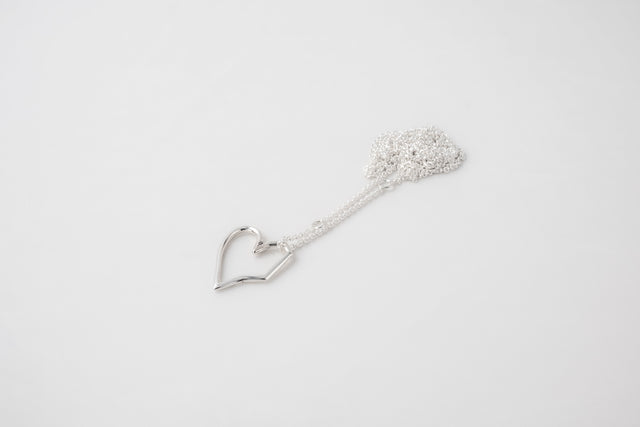
What "handmade" means in STRUGA silver: from wax model to hand finish
A wax model, a silicone mould, cast sterling silver 925, a hand finish — the chain behind the word handmade is that short, and it is a method of making, not a label on the tag. The brand runs two production routes, and whichever one an object starts on, a maker is the last to touch it. So two pieces of one form are alike but not identical: a machine repeats a file, a hand repeats a gesture.
The chain: wax model, silicone mould, casting in 925 silver, hand finish. Two production routes — the wax is either carved by hand or modelled in 3D and printed; on both a maker is the last to touch the object. Sterling 925 is 92.5% silver and 7.5% copper: pure silver sits at about 26 on the Vickers scale, the worked 925 alloy at about 150. An exact copy is taken from a finished object, and the mould it came from is destroyed. Making takes about two weeks, transit about seven days.
- Where it begins
- The chain in plain words
- How it differs from machine-made
- Why the trace of the hand is a property, not a flaw
- What it is — and what it is not
- At a glance
- Frequently asked questions
Where it begins
Pure silver is too soft to live with. At .999 it dents under a thumb — twenty-six on the Vickers scale, softer than a copper coin; a ring made of it would lose its edge in a week. So 7.5% copper goes into the silver. After working, the 925 alloy reaches around a hundred and fifty — almost six times harder. Sterling silver 925 is 92.5% pure silver, the international hallmark standard, and STRUGA makes every object from it.
But the hallmark is about the material; craft is about what the hands do with it. The same alloy can be cast by the thousand on a line, or brought to its final state by hand, one piece at a time. The difference is not in the metal. The difference is how many times a hand takes hold of it.
The chain in plain words
The chain is short and easy to follow: wax model → silicone mould → sterling silver 925 → hand finish. Behind that line stand two routes, and both end the same way: with a hand.
The first route begins with wax. A maker carves the wax model by hand, it is cast in silver, and the silver object is brought to its final state. Then a fork. Either it is a single piece — and it leaves for its owner just as it is. Or a silicone mould is taken from the already-finished piece, molten wax is poured into it, an exact impression of the first model is drawn, and it goes to casting — that is how an exact copy is born.
The second route begins with a screen. The object is modelled in 3D and printed — in plastic or in printable silicone. A silicone print goes straight to casting. A plastic print takes the longer way: a silicone mould is taken from it, wax is poured, silver is cast, the piece is finished by hand — and only then is a fresh mould taken for a series. CNC aesthetics, exact geometry — but at the end, still a graver and a hand.
Wherever the route begins, a maker is the last to touch the object. That is what "handmade" means at STRUGA: not the origin of a legend, but the last step a machine does not take.
How it differs from machine-made
Machine production is built on repetition without loss. The machine reads a file and outputs a thousand identical parts: not one of them remembers a hand, because there is no hand in the chain. This is not worse — it is other. It makes an object whose task is to be an exact copy of itself.
STRUGA craft is built on a different principle. Between the file and the silver stands a person: they cut the wax, smooth the seam, lift a burr, bring the edge to the light. A hand repeats a gesture — and the gesture is a little its own every time. From this comes the thing hidden inside the technique: to take an exact copy, the mould is taken from a piece already finished by hand, not from a drawing. A machine copies the idea of a thing; STRUGA copies a thing already lived through by hand.
The difference is not romance — it is what stays on the surface. On a machine part the surface is sterile. On a STRUGA object you can read where the tool passed: a faint unevenness, the trace of the graver, an irregularity that shows the piece was built, not stamped.
Why the trace of the hand is a property, not a flaw
STRUGA silver arrives with no rhodium plating — this is Living Silver, silver that reacts to air and skin. Its surface is not mirror-even either. The faint unevenness, the marks of the tool, the irregularity — these are not defects caught on a quality line. They are the record that the object passed through hands, not under a press.
The same turn works here as with the darkening. Mass industry trained the eye to read any unevenness as an error. STRUGA reads it the other way: exactly what mass production would apologize for is the character of the thing. Imperfection here is part of the object's beauty, not a reason to doubt the metal.
And out of this grows the "one of a kind" — not as a promise but as a fact of technique. Every object is one of a kind because the mould it was taken from is destroyed. An exact copy is taken not from an abstract drawing but from a specific piece already finished by hand — and the same gesture is never repeated exactly twice. Not because it was meant to be beautiful that way. Because that is how the making is built.
A machine repeats a file. A hand does not.
What it is — and what it is not
STRUGA's "handmade" describes a method of making — the last step belongs to a maker, not a machine. It should not be read as "carved by hand from the first operation to the last": the chain holds a 3D model, a silicone mould, and casting. What is done by hand here is the finish — the contact between hand and silver without which an object never leaves for its owner.
And one more border, a hard one. The trace of the hand, the unevenness, the irregular surface — these are character, not a flaw, and not a promise of anything beyond the thing. A STRUGA object holds no power over the one who wears it; "one of a kind" here is a property of the making, not a property of fate. What the thing means is decided by its owner.
STRUGA craft at a glance
| Property | Value |
|---|---|
| What "handmade" means | A method of making that ends in a hand finish — the last step belongs to a maker, not a machine; not a label on the tag |
| The chain | Wax model → silicone mould → sterling silver 925 → hand finish |
| Two production routes | The first route begins with a wax model carved by hand; the second on a screen, modelled in 3D and printed — whichever it starts on, a maker is the last to touch it |
| Material | Sterling silver 925 — 92.5% pure silver, the international hallmark standard; STRUGA makes every object from it |
| Why the alloy | Pure .999 silver is too soft — twenty-six on the Vickers scale; adding 7.5% copper brings the worked 925 to around one hundred and fifty, almost six times harder |
| The hand finish | A maker brings the silver to its final state with a graver and a burnisher — the contact between hand and silver before an object leaves for its owner |
| Versus machine-made | A machine reads a file and outputs a thousand identical parts with no hand in the chain; a machine repeats a file, a hand repeats a gesture |
| The surface | Living Silver — sterling silver 925 with no rhodium plating; it reacts to air and skin. The faint unevenness and marks of the tool are a property, not a flaw |
| One of a kind | A consequence of the method: an exact copy is taken from a specific piece already finished by hand, and the mould it was taken from is destroyed |
| What it is not | Not "carved by hand from the first operation to the last" — the chain holds a 3D model, a silicone mould and casting; what is done by hand is the finish |
Frequently asked questions
Didn’t find the answer — write to us, we reply personally.
Ask a question →01What does "handmade jewelry" mean at STRUGA?+–
It describes a method of making, not a label on the tag. STRUGA runs two production routes, and both end the same way: a hand finish — the contact between hand and silver without which an object never leaves for its owner. "Handmade" here does not mean "carved by hand from start to end": the chain includes a 3D model, a silicone mould and casting. What is done by hand is the finish.
02How is handmade silver jewelry made?+–
The chain is short and easy to follow: wax model, silicone mould, 925 silver, hand finish. The wax model is either carved by hand or modelled in 3D and printed; then a silicone mould is taken, wax is poured, 925 silver is cast, and the object is brought to its final state by hand. Whichever route it starts on, a maker is the last to touch it.
03What is the difference between handmade and machine-made jewelry?+–
Machine production repeats a file without loss: the machine reads the file and outputs a thousand identical parts, with no hand in the chain. In handmade work the last step belongs to a maker who brings the silver to its final state with a graver and a burnisher. So a machine surface reads as sterile, while on a STRUGA object you can see the trace of the tool and a faint unevenness — proof the piece was built, not stamped.
04Why is every STRUGA object one of a kind?+–
It is a consequence of the method, not a promise. An exact copy is taken not from a drawing but from a specific piece already finished by hand — and the mould it was taken from is destroyed. The same gesture is never repeated exactly twice, so two objects of one form are alike but not identical: a machine repeats a file, a hand does not.
05Does "handmade" at STRUGA mean the whole object is carved by hand?+–
No. "Handmade" describes a method of making, not carving from the first operation to the last. The chain holds a 3D model, a silicone mould and casting. What belongs to the hand is the finish — the last step a machine does not take, the contact between hand and silver before an object leaves for its owner.
06Is Living Silver the same as oxidized silver?+–
No. Living Silver is sterling silver 925 with no rhodium plating — a property: the surface reacts to air and skin and darkens on its own. Oxidized silver is a neighboring method — another way to darken, applied at the working stage. One is how the metal lives; the other is what a maker does to it.
07Are the tool marks and faint unevenness on a STRUGA object a defect?+–
No — they are a property, not a flaw. Mass industry trained the eye to read any unevenness as an error; STRUGA reads it the other way. The trace of the graver and the irregular surface are the record that the piece was built by hand, not stamped, and they are part of the object's character.
08Why does STRUGA use 925 silver instead of pure silver?+–
Pure silver is too soft to live with: at .999 it dents under a thumb — about twenty-six on the Vickers scale, softer than a copper coin. With 7.5% copper added, the worked 925 alloy reaches around a hundred and fifty — almost six times harder. Sterling silver 925 is the international hallmark standard, and STRUGA makes every object from it.
09Is "one of a kind" a marketing promise?+–
No — it is a fact of technique, not a promise of fate. An exact copy is taken from a specific piece already finished by hand, and the mould it came from is destroyed. The same gesture is never repeated exactly twice, so two objects of one form are alike but not identical. What the thing means is decided by its owner.