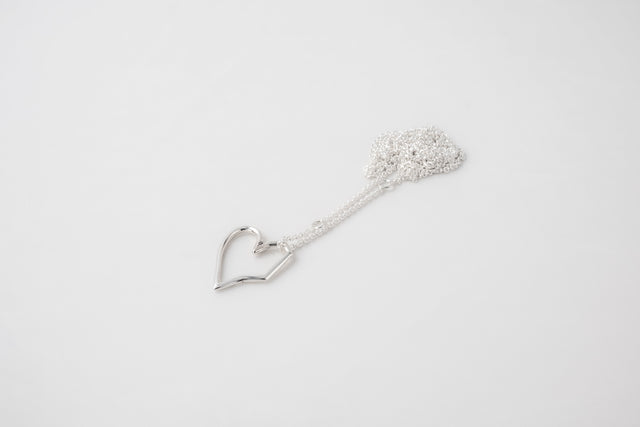
Men's Silver Cross: An Art Object, Not a Religious Symbol
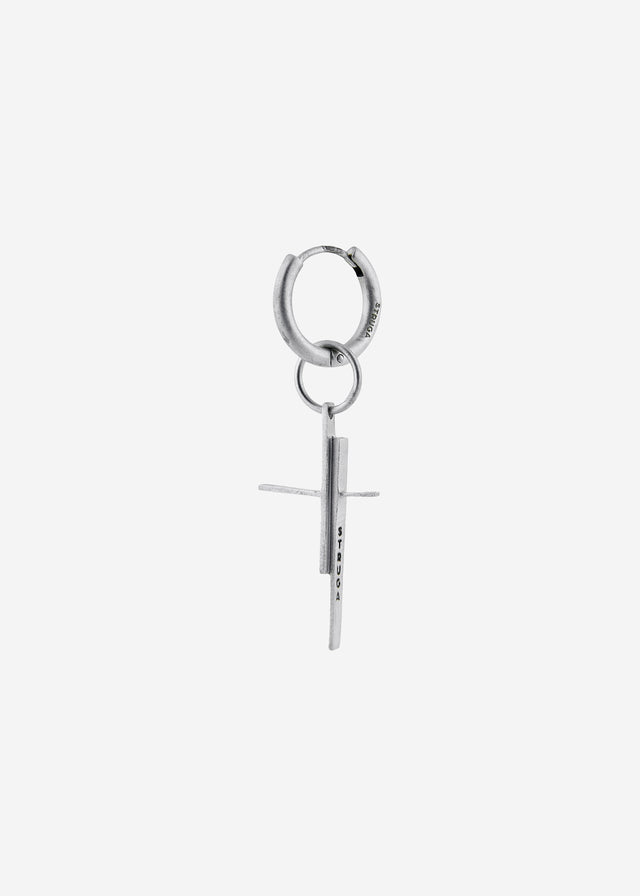
A STRUGA silver cross is not a liturgical object — it is an authored piece in the shape of a cross, with no religious iconography and no sacred purpose. STRUGA works with the cross as a geometric form: two intersecting lines, minimal detail, maximum presence on the body. There are two approaches to one silhouette: Suprematism Cross, a reference to Malevich and his Suprematist compositions of 1915, part of the Thorn family inside Brutalism; and Cross V.4, where a Bloody or Arctic carbon insert sits inside a silver perimeter, part of the Carbon Fiber family. If you need a consecrated cross of canonical proportions, this is not our object. If you want a cross as a piece of jewelry, in 925 silver, it is here.
- A STRUGA silver cross is an authored art object in the shape of a cross, in 925 silver — not a liturgical cross: no religious iconography, no canonical proportions, no consecration.
- Suprematism Cross references Kazimir Malevich and the Suprematist compositions of 1915 (Black Square, Black Circle, Black Cross); it sits in the Thorn family inside Brutalism.
- Cross V.4 joins a silver perimeter with a carbon insert — Bloody (red-black-graphite) or Arctic (white-and-blue ice) — in the Carbon Fiber family; SKUs include necklace-cross-v-4-bloody and necklace-cross-v-4-arctic.
- 925 silver is 92.5% silver and 7.5% copper, contains no nickel, and is hypoallergenic in the vast majority of cases.
- Two laws of ageing in one piece: the silver patinas as Living Silver (silver sulfide, Ag₂S), while the carbon insert does not change and stays stable in ordinary and sea water.
- Chain length sets the register: 40–45 cm at choker level, 50–55 cm at mid-chest, 60–70 cm toward the diaphragm; exact per-SKU weights are on each product page and never rounded. Handcrafted in Bali.
In short.
- STRUGA does not make liturgical crosses — Suprematism Cross and Cross V.4 are authored objects in the shape of a cross, with no consecration and no religious iconography.
- Suprematism Cross references Malevich's Suprematist compositions of 1915 (Black Square, Black Circle, Black Cross); it sits at the intersection of the Thorn and Brutalism families.
- Cross V.4 joins a silver perimeter with a carbon insert — Bloody (red-black-graphite) or Arctic (white-and-blue ice); the silver patinas as Living Silver, the carbon does not change over time.
- Chain length sets the register: 40–45 cm at choker level, 50–55 cm at mid-chest, 60–70 cm toward the diaphragm; exact weights are on each product page, never rounded.
- 925 silver is 92.5% silver and 7.5% copper — hypoallergenic in the vast majority of cases, with no nickel.
A silver cross can be an art object, not only a religious symbol. STRUGA does not make liturgical items — we work with the cross as a geometric form: two lines that intersect, minimal detail, maximum presence on the body. Suprematism Cross is a reference to Malevich and his Suprematist compositions of 1915. Cross V.4 is silver with a Bloody or Arctic carbon insert. These are two different approaches to one silhouette, and neither claims any religious meaning. If you need a liturgical cross, this is not our object. If you want a cross as a piece of jewelry, as an authored object, as a minimal form in 925 silver — it is here.
- The cross as a form is older than Christianity. The geometry of two intersecting lines appears in Bronze Age petroglyphs, on Egyptian ankh amulets (3rd millennium BCE), and in Scandinavian and Slavic pre-Christian iconography. STRUGA works with that primary layer — the intersection, not the iconography.
- A liturgical cross and an art cross are different objects. A consecrated cross of canonical proportions is a religious artifact, made to the rules of a specific denomination. STRUGA Suprematism and Cross V.4 are authored objects in the shape of a cross, not items of worship.
- Suprematism Cross is a reference to Kazimir Malevich and the Suprematist compositions of 1915: geometric clarity, minimal detail, the focus on the form itself with no decorative layer. Part of the Thorn family inside Brutalism.
- Cross V.4 — silver plus carbon. A Bloody carbon insert (red-and-black graphite) or Arctic (white-and-blue ice) sits inside a silver perimeter. A rare material join: one of the few authored projects anywhere where carbon is set into a cross. Part of the Carbon Fiber family.
- Wear it as an object. On a thin chain, on a heavy Blade chain, on a black leather cord, on a carabiner instead of a clasp. Length runs from a 40 cm choker to 70 cm, from collarbone to chest. The silver darkens (Living Silver); the carbon does not change over time — two different laws of ageing in one piece.
The silver cross: symbol, object, jewelry
When someone searches for a men's silver cross in 2026, they are usually looking for one of two things: either a religious object of a specific tradition, or a piece of jewelry in the shape of a cross that can be worn over or under clothing with no sacred meaning. These are two different requests with a different logic of choice. STRUGA answers only the second.
We make pieces. Not objects of worship. A cross in our catalogue is a geometric form treated as contemporary sculpture: with a considered proportion, a deliberate surface, an authored approach to material. Suprematism Cross refers to Suprematism as an art movement of the early 20th century. Cross V.4 sets a carbon-fiber insert into silver — a material that did not exist throughout the whole history of the cross as a form until the second half of the 20th century. Both approaches are about an art object, a piece of design, a thing you can wear as jewelry.
This does not mean we deny the religious meaning of the cross or its place in spiritual traditions. We simply work on a different plane. If you need a consecrated cross of canonical proportions, go to a church or to a workshop that specializes in religious jewelry. If you want an authored cross as an object, keep reading.
A religious cross and an art cross are different things
The line between them is thin but it matters. A liturgical cross is an object made to the rules of a specific denomination: canonical proportions, a defined iconography (the crucifix, inscriptions, symbols), a blessing and consecration. A cross like that plays a role in worship or in personal religious practice. It is worn, kissed, passed down, sometimes buried with its owner. An art cross is an object in the shape of a cross, made as jewelry or sculpture. It has no canonical proportions — the proportions are set by the author. It has no religious iconography — there is the author's intent and the form. It is not consecrated, it implies no particular way of wearing, and no one kisses it.
In the contemporary jewelry industry these two directions run in parallel and do not overlap. Religious jewelers make objects to the canon, often working with specific churches or synodal workshops. Authored jewelers — Chrome Hearts, Werkstatt:München, Ann Demeulemeester, many minimal Scandinavian brands — make the cross as a form, with no claim to sacred status. The people who wear these pieces are different too: some buy an art cross as an accent to a black suit or a minimal look; others choose a specific canonical cross to match their spiritual practice.
STRUGA is in the first group. All of our crosses are authored objects. If you buy a Suprematism Cross or a Cross V.4, you are buying a piece, not a religious object. This is not a stance against religion and not a stance for it — it is simply an acknowledgment that we work on one plane and make no claim to the other.
Liturgical cross and art cross — a comparison
| Aspect | Liturgical cross | Art cross |
|---|---|---|
| Purpose | A religious object for spiritual practice | Jewelry, an authored object, small-format sculpture |
| Proportions | Canonical, set by the tradition of a specific denomination | Authored, decided by the designer |
| Iconography | The crucifix, inscriptions, symbols of the relevant tradition | No religious iconography — pure form or an authored pattern |
| Consecration | Required by the rules of the denomination | Not implied |
| Who makes it | Religious workshops, jewelers with a theological advisor, synodal production | Authored jewelers, design brands, artists |
| Where it is worn | More often under clothing, personal practice | Over or under clothing — the owner's choice, as jewelry |
| STRUGA approach | We don't make it — go to a specialized workshop | Suprematism Cross (Malevich reference), Cross V.4 (silver + carbon) |
This table is not a value judgment, it is a map. A liturgical cross and an art cross are two different objects with a different purpose, a different audience, and a different production logic. There is no hierarchy between them. STRUGA chose to work with the art cross because it is a position where we can be honest: we are not theologians, we do not consult religious workshops, we make no claim to sacred meaning. We make objects that work as contemporary sculpture.
A short history of the cross as a form
The cross as a geometric figure exists long before its Christian reading. Two intersecting lines are one of the most basic forms in human iconography, and they appear in almost every early culture independently. This is worth understanding: the cross as a symbol belongs to a specific religious tradition, but the cross as a form belongs to all of humanity.
The prehistoric and ancient period. Bronze Age petroglyphs in Scandinavia, in the Alps, and across the territory of present-day Russia and Ukraine contain images of crosses as part of solar symbols and calendar signs. The Celtic cross with its ring is a pre-Christian element, later absorbed into Christian iconography. In ancient Egypt the ankh — a cross with a loop on top — stood for life and appears on jewelry from the 3rd millennium BCE. The Tau cross (T-shaped) is known from Mesopotamian iconography and later became part of the Jewish tradition. The swastika, a cross with bent arms, is one of the oldest Indo-European symbols, used in Sanskrit culture, in Norse mythology (as Thor's sun cross), and in Slavic pre-Christian iconography. Two intersecting lines are neutral geometry that different cultures filled with different meaning.
Antiquity and the Roman period. The cross as a means of execution was known in the Persian, Phoenician, and Roman traditions long before Christianity made it a central symbol. In the first centuries CE the early Christian communities did not use the cross as a religious symbol — it became widely accepted only after Constantine the Great (4th century CE) and gradually displaced other symbols (the fish, the anchor, the Chi-Rho monogram) as the main sign of faith.
The Middle Ages. From the 5th–6th centuries onward the cross becomes the most common jewelry motif in Europe. Byzantine encolpia — reliquary crosses worn on a chain at the chest — are the first mass format of a religious object worn on the body. By the 9th–11th centuries in the Slavic lands, pre-Christian amulets (lunnitsa pendants, Perun's axes) and Christian crosses were worn on the same chain — a syncretic practice typical of the era of dual faith. After their baptism the Vikings wore crosses, but alongside Thor's hammers (Mjölnir); both objects have been found in the same burial context.
The 20th century and the emergence of the art cross. From the start of the 20th century the cross becomes a subject of authored work outside the religious context. In 1915 Malevich paints "Black Cross" as part of his Suprematist series — the cross as pure geometry, with no iconography and no sacred meaning. In the jewelry tradition this direction develops later: Maison Margiela, Chrome Hearts, Werkstatt:München, the goth minimalism of the 2000s — all work with the cross as a form rather than a symbol. STRUGA Suprematism Cross continues exactly this line, not the religious one.
STRUGA Suprematism: Malevich's cross in silver
In 1915 Kazimir Malevich exhibits "Black Square," "Black Circle," and "Black Cross" — three compositions that become the manifesto of Suprematism. The idea is to free art from depicting objects: what remains on the canvas are pure geometric forms, with no narrative, no perspective, no decoration. Malevich's black cross is not a religious symbol but a demonstration that a geometric form on its own can be a work of art.
STRUGA Suprematism Cross is an authored reference to that idea, in material. It is the Thorn family inside the Brutalism direction of the STRUGA catalogue: clean lines, minimal decorative elements, maximum geometric precision. An invisible drawing is worked into the form — a depth that reads in raking light but never dominates the silhouette. The piece earring-thorn-small-suprimatism-cross is an amulet earring made as a small cross with a Suprematist surface.
Why Malevich, and not classical Byzantium or Gothic? Because Suprematism is an artistic language in which the cross is already separated from religious meaning and works as a geometric form. When we make the Suprematism Cross, we are not referring to a liturgical canon but to a specific tradition of the early-20th-century Russian avant-garde — the one that first freed the cross as a form from any obligatory sacred content. That lets you wear such an object with no claim to religious belonging, and with nothing to prove.
The Suprematism aesthetic continues in the rings and ear cuffs of the Thorn and Brutalism families. Suprematism is an experiment inside the Brutalism family: the heavy, massive forms of Brutalism meet the geometric clarity of Malevich. At the collection level these pieces sit next to the Brutalism V.1 and V.3 rings, ear cuffs in different sizes, and the Big Thorn Bracelet — all inside one architectural logic, where the form matters more than the decorative layer.
Cross V.4: silver plus Bloody or Arctic carbon
Cross V.4 is a separate line in the STRUGA catalogue, where the silver perimeter of the cross joins a carbon insert. Carbon is a cloth of carbon fiber pressed into a hard composite and CNC-machined to the required shape. It is a material of the 20th–21st centuries, born in aviation and motorsport, and in a jewelry context it remains rare: few brands work with carbon as an equal material rather than a decorative detail.
On Cross V.4 the carbon takes the central part of the piece, and the silver forms the perimeter and holds the composition. The result is a join of two materials with different physical and aesthetic properties. The silver lives by its own laws — it patinas, darkens in the recesses, lightens on the rubbing planes, and over time takes on an individual relief (Living Silver). The carbon does not change. Its surface stays the same after a year, after five, after ten. It can be taken into ordinary and sea water — the carbon does not react. It can be worn daily — the carbon does not scratch the way silver scratches.
The carbon palettes on Cross V.4:
-
Bloody — red-black-graphite. A deep burgundy cast against black fiber, with flecks of dark grey. It looks good with black clothing and with light skin. SKUs:
necklace-cross-v-4-bloody,necklace-cross-bloody. -
Arctic — white-and-blue ice. A cold tone with a translucent effect. It contrasts with warm-toned silver and with a patinated surface. SKU:
necklace-cross-v-4-arctic. -
Classic + silver — matte black-graphite carbon combined with a silver finish. SKU:
necklace-signature-cross-v-3— the third version of the cross, where carbon and silver meet in equal proportion.
The catalogue also has the ring ring-fused-cross — a ring in the shape of a cross made from melted silver, the Fused family. This is not Cross V.4 but a different material experiment: silver heated to its melting point and fixed at the moment of transition. If Cross V.4 is about a clean join of two different materials, ring-fused-cross is about one substance in a borderline state.
Sizes and weights of the crosses: small and massive
The size of the cross decides how it will feel when worn and which chain length suits it best. STRUGA does not make extremely large crosses in the hip-hop pendant style — our aesthetic is closer to minimalism, and our maximum size stays within what can be worn under clothing without discomfort. But we also do not release truly tiny, barely visible pieces — a cross should read at arm's length, otherwise the logic of the object is lost.
The small Suprematism Cross in earring format (earring-thorn-small-suprimatism-cross) is a compact form that works as an accent. It is not the main object in a look but a fine detail at the ear. A stud earring or a Thorn earring with a small cross is the kind of piece you can wear every day without switching register.
The Cross V.4 pendants are larger — they are the central object of a look. They are made for a chain of 50–65 cm, so the cross rests on the chest or a little higher. On a short 40–45 cm chain the cross rises toward the collarbones and works in a choker format — more closed, more minimal. On a long 70+ cm chain the cross drops toward the diaphragm and reads as a heavy object that calls for a particular look.
The exact weight of each SKU is given on the product page. Weights at STRUGA are not the same across different sizes and materials — a silver cross and a silver-plus-carbon cross weigh different amounts, as does a cross on a small versus a medium chain. Before buying, check the product card and the stated mass in grams: this is honest information that we do not round.
How to wear a silver cross: chain, cord, length
Chain length is the first thing that sets the visual register. The basic logic is simple: the shorter the chain, the higher the cross on the body and the more closed the composition. The longer the chain, the lower the cross and the more the accent is on the piece itself.
40–45 cm — choker level, the cross rests at the base of the neck or just below. It works well with a shirt collar, a crew neck, a thin turtleneck. A closed, minimal register.
50–55 cm — the standard length for a men's chain, the cross at mid-chest or a little higher. A versatile option that suits most looks. On a chain of this length the Cross V.4 lands right on the chest and reads well under an open collar.
60–70 cm — a long chain, the cross drops toward the diaphragm or lower. A heavy register, made for a massive pendant. The Suprematism Cross in a large size (when made to order) and large Cross V.4 pieces work well at this length over a sweater or over a shirt.
The type of chain matters. A thin anchor chain is a neutral carrier that does not compete with the cross for attention. A medium-weight anchor chain is a balance between pendant and carrier. The Blade chain (massive links) is already an object in its own right, turning the cross pendant into part of a composition where carrier and pendant are equals. The Thorn chain (with pricking links) is the most tactile option, the kind where the chain itself reminds you of it as you move. A leather or waxed cord is an alternative to metal, especially with the carbon Cross V.4: carbon fiber and leather create a visually consistent material language.
The Carabiner #1 in the Signature Asymmetric form is the standard bail for STRUGA crosses on the Big Line and Mini Line chains. It is not a classic spring clasp but a massive carabiner-lock that is a design object in itself. On the long Big Line the carbon cross is held precisely through the Carabiner #1, and that pairing reads as part of the overall silhouette.
Wear it as an object, not as a symbol. Over clothing — if you want the cross to be seen. Under clothing — if you want its tactile presence without a public statement. STRUGA does not dictate the register — that is part of what "a cross as jewelry, not an object of worship" means: you choose how to wear it.
Care for a silver cross with patina
A 925 silver cross darkens over time — this is normal, and it is part of our Living Silver philosophy. Silver sulfide (Ag₂S) forms on the surface in contact with sulfur from the air and from sweat, and the cross begins to change color within a few weeks of daily wear. For some people this patina comes through faster, for others slower, depending on body chemistry and environment. There is a detailed breakdown of the process in the article on patina: "Silver patina: what Living Silver is and how it works".
On a cross the patina looks especially expressive, because this form has many sharp edges and recesses. The silver darkens in the lines of the drawing, in the seams between surfaces, on the back face that sits against the skin — while the raised planes that rub against clothing stay light. The result is a natural contrast that we deliberately do not try to even out. It is a map of the owner: your cross a year from now will not look like someone else's identical cross, because every body has its own chemistry and its own way of wearing.
What to do over time:
- If you like the current tone — do nothing. A soft cloth without polishing paste, warm water with a neutral soap, careful patting dry. That is enough to remove dust and sweat without disturbing the patina.
- If you want to bring back the original shine — a soft microfiber jewelry cloth or a special silver polishing cloth. Light passes over the raised planes. Leave the recesses alone — let them stay dark for contrast.
- What not to do — do not use baking soda, toothpaste, abrasive pastes, or an ultrasonic bath. These methods strip the patina aggressively and can affect the structure of the surface itself along with it. You get "like new," but without the character built up over the years.
Care for Cross V.4 is a little different. The silver perimeter patinas the same way as an ordinary silver cross, but nothing aggressive should touch the carbon insert. Carbon is stable to water (including sea water), to soap, to moderate temperatures. The only things it does not like are concentrated solvents (acetone, high-concentration alcohol) and abrasives that can scratch the matte surface. So the rule is simple: for Cross V.4, use only a soft cloth and warm water with a neutral soap.
For more on silver care: "Oxidized silver: a care guide" — it covers a wider range of cases and problems.
Where to buy a designer silver cross in Russia
STRUGA crosses are available through several channels:
- strugadesign.com — the main online channel. The full catalogue, delivery to any city in Russia, payment in rubles. Suprematism Cross, Cross V.4 Bloody, Cross V.4 Arctic, Signature Cross V-3, and the ring-fused-cross — all in stock or available to order. The stated weights and sizes come from the real product cards, not marketing figures.
- Hedonist Store in Bali — a multi-brand store where you can try a piece on and take it home right away. A good option if you happen to be on the island and want to see the piece before buying.
- Barefoot Aristocracy in Bali — the second retail channel, the same principle: try on and buy in person. STRUGA is carried in both stores with a similar range, with the selection varying a little by season.
- Custom Order — a made-to-order route for non-standard sizes, non-standard materials, or for crosses that are not in the current catalogue. For example, an enlarged Suprematism Cross or a Cross V.4 with a non-standard carbon palette. Lead time from three weeks.
- Dark Union — a line of paired and wedding pieces made to order. If you want to make matching crosses for a couple or a family set, this is the format to ask about. Dark Union works only through custom order; there are no standard SKUs in the catalogue yet.
Check prices and availability on the specific product page — we update the catalogue regularly, and some positions may be unavailable in different seasons in Bali while in stock in Russia and vice versa.
Production: how a STRUGA cross is made
Every cross in the STRUGA catalogue is a handmade piece in 925 silver. First a three-dimensional model is created: by hand or 3D-printed, depending on the complexity of the relief. A silicone mold is made from the model, wax is poured into it, and the silver is cast from the wax. After casting, the piece goes through hand finishing: removing the sprues, working the surface, leveling the edges, and where needed patinating or keeping the natural "fresh" silver that will darken on the owner. This is the process shared across all STRUGA pieces, and the cross is no different here from a Brutalism ring or a Blade ear cuff.
A special case is Cross V.4. Here the silver perimeter is made separately (the standard casting route) and the carbon insert separately (a slab of carbon fiber CNC-machined to the exact shape, with a finishing grind). Then the two parts are joined: the carbon is set into the silver frame, fixed, and checked for the absence of gaps. Every Cross V.4 is inspected by hand — because carbon and silver behave differently under temperature swings and under load, the join has to stay stable through years of wear.
Every STRUGA cross is handcrafted in Bali. On the site, in the blog, and on the product cards we write "Handcrafted in Bali" — but the specific workshops, the names of the makers, and the addresses we do not disclose. That is a rule of the brand.
Suprematism in the wider context of the STRUGA design language
Suprematism is not a separate story but part of one logic of the brand. STRUGA builds its catalogue around families of form: Signature Asymmetric (the first DNA form), Blade (edges and links), Thorn (sharp textures with an amulet character), Brutalism (mass and architectural volume), Carbon Fiber (the join of silver with carbon), Mosaic (incompatible materials), Fused (melted silver). The Suprematism Cross exists at the intersection of Thorn and Brutalism — it belongs to both lines at once, and that dual belonging defines its character.
In the wider context of dark design this is a direction that sits stylistically next to Chrome Hearts and Werkstatt:München, but differs in its material language: STRUGA does not work with gold, does not use precious stones in high proportions, and focuses on silver, patina, carbon, and meteorite. There is a detailed comparison in Dark Fashion Jewelry Style Guide 2026 and brands-like-chrome-hearts. The basic groundwork on 925 silver is in the sterling silver 925 complete guide.
If you arrived at a designer cross through an interest in minimalism, in authored jewelry, in goth aesthetics, or in material experiments — this is a natural entry point into the STRUGA catalogue. The Suprematism Cross and Cross V.4 are only one of the doors; behind it is the Brutalism family, the Thorn line, the Carbon Fiber ear cuffs, and the rings at the join of all these directions. Many of our clients come in through the cross and gradually discover the rest of the catalogue — a natural path, because the cross is the most recognizable object, while the families behind it take time to read.
Why now: the return of the cross as an object in 2026
In 2024–2026 authored jewelry is seeing a return of the cross as a form — not as a religious symbol but as a geometric composition. It runs alongside several trends: dark minimalism in clothing (the rise of brands in the Rick Owens / Yohji Yamamoto / Maison Margiela category on the mass market), an interest in jewelry as "wearable artifacts" (instead of jewelry-as-investment), a move away from logomania toward objects with their own intent. The cross fits this matrix perfectly — it is a form with a deep iconographic memory, yet basic enough to be reinterpreted without having to "invent" anything.
STRUGA entered this wave with its own language: not the hierarchical canonical cross of Byzantium, not a Gothic religious artifact, not 1990s Chrome-Hearts goth — but Malevich's Suprematism of 1915 plus the material engineering of the 21st century (carbon). It is a position where you can wear a cross without the cultural baggage of a religious statement and without reference to the subcultural eras it has already passed through. A clean form, a clean material, a clean design — with no burden of previous meanings.
Frequently asked questions
Is a STRUGA silver cross a liturgical cross or an art cross?
It is an art cross, not a liturgical one. A liturgical cross is made to the rules of a specific denomination — canonical proportions, religious iconography (the crucifix, inscriptions), and consecration. A STRUGA cross has none of that: the proportions are authored, there is no religious iconography, it is not consecrated. Suprematism Cross and Cross V.4 are objects in the shape of a cross, made as jewelry and contemporary sculpture, with no claim to sacred meaning.
Is the patina on a silver cross a defect?
No. A 925 silver cross darkens over time because silver sulfide (Ag₂S) forms in contact with sulfur from the air and from sweat — this is Living Silver, a property of the metal, not a flaw. On a cross the patina reads especially well: it deepens in the lines, seams, and recesses while the raised planes stay light. It is reversible with care, and STRUGA deliberately does not even it out — it is a map of the owner, not wear or damage.
Does the carbon in Cross V.4 age the same way as the silver?
No — they follow two different laws of ageing in one piece. The silver perimeter patinas: it darkens in the recesses, lightens on the rubbing planes, and takes on an individual relief over time. The carbon insert does not change — its surface stays the same after a year, after five, after ten, and it is stable in ordinary and sea water. That is why care differs: a soft cloth and warm water with neutral soap for both, but never solvents or abrasives on the carbon.
Is the STRUGA silver cross a religious object?
No. STRUGA does not make liturgical crosses. Suprematism Cross and Cross V.4 are authored pieces in the shape of a cross, with no religious iconography and no sacred purpose. If you need a consecrated cross of canonical proportions, go to a specialized workshop or a church shop. We work with the cross as a geometric form and as a contemporary design object.
Does 925 silver cause allergies?
925 silver is a hypoallergenic alloy in the vast majority of cases. 92.5% silver and 7.5% copper contain no nickel or other common allergens. If you have already reacted to other jewelry, ask the seller for information on the composition or start with a short trial period of wear. On the carbon insert of Cross V.4 an allergy is exceptionally rare: carbon fiber is chemically neutral and does not react with skin.
Can it be worn in the shower and during sport?
During sport — yes, both materials withstand sweat and movement. In the shower and the pool — yes for carbon, with care for silver. Shampoos, gels, and soap contain sulfur and chlorine — they speed up the patina, and the silver darkens faster. There is nothing harmful to the metal in this, but if you want to keep the light tone, take the silver cross off before the shower. Cross V.4 is resistant to ordinary and sea water and can stay on.
What length of chain should go with a cross?
40–45 cm — choker level, the cross at the base of the neck. 50–55 cm — standard, the cross at mid-chest. 60–70 cm — a long chain, the cross at the diaphragm. Small crosses work better on a short chain, massive Cross V.4 pieces on a medium and long one. Choose the exact length by height and type of clothing: with a shirt collar a shorter chain is better, with an open neckline a medium or long one.
Can a silver cross be engraved?
Yes, through the Custom Order service. Engraving is possible on the back of the pendant, on a free surface of the piece. Pass on the text and font preference when placing the order — we will discuss the technical options and the timing. On the carbon parts of Cross V.4 engraving is not done: carbon fiber does not allow a clean line to be cut without damaging the structure of the composite.
How do I choose the size of a silver cross as a gift?
If you are buying a cross as a gift and are unsure about the size, choose the medium one — the standard Cross V.4 pendants suit most men on a 50–55 cm chain. The small Suprematism Cross in earring or mini-pendant format is a neutral alternative that needs no precise fitting. For non-standard requests (an enlarged version, a matching set, engraving), turn to Dark Union or Custom Order.
How does delivery within Russia work?
Delivery by courier services to any city in Russia. Lead time is 3–7 days depending on the region. Payment in rubles, through any popular online payment method. Bali delivery is a separate channel; for guests of the island, Hedonist Store and Barefoot Aristocracy are available as retail points.
Can a cross be exchanged if it does not suit?
Returns and exchanges within 14 days of receipt, provided the piece has not been worn and has kept its presentable condition. Custom Order and made-to-order pieces (including engraved ones) cannot be exchanged — this is the rule for all personalized positions. Full terms are in the strugadesign.com store policy.
A designer silver cross at STRUGA is a piece, not a liturgical object. If you want an authored object in the shape of a cross, in the minimal language of Suprematism or with a Cross V.4 carbon insert, choose an option in the family-thorn (Suprematism) and family-carbon-fiber (Cross V.4) collections. For non-standard sizes and matching orders — Custom Order and Dark Union.
About STRUGA. STRUGA is a dark silver jewelry brand founded by Dmitry Strugovshchikov and Ekaterina Strugovshchikova, handcrafted with Balinese and international silversmiths. Every piece is 925 sterling silver, naturally oxidized or hand-patinated. The darkening is part of the design. It is a brutalist object that reacts and changes through contact with the environment and the wearer.
More about the STRUGA brand — the "About" page.