Are Silver Rings Durable? Long-Term Wear, Scratches, and Lifespan
A fine scratch shows on polished silver where it interrupts the reflection. A dark recess on the same ring may still hold its patina. Both are surface changes; a bent band or a crack calls for a closer inspection. Sterling silver can suit everyday wear when the construction and fit work with the way you use your hands. Here is how to distinguish changes you can keep from damage that needs a jeweller.
Updated October 16, 2026
The 925 mark describes composition, not a service life. Hardness helps compare alloys and weight tells you how much metal there is; thickness, shape and joints help explain how a ring handles a load. Remove it before heavy manual work and contact with chlorine or household bleach.
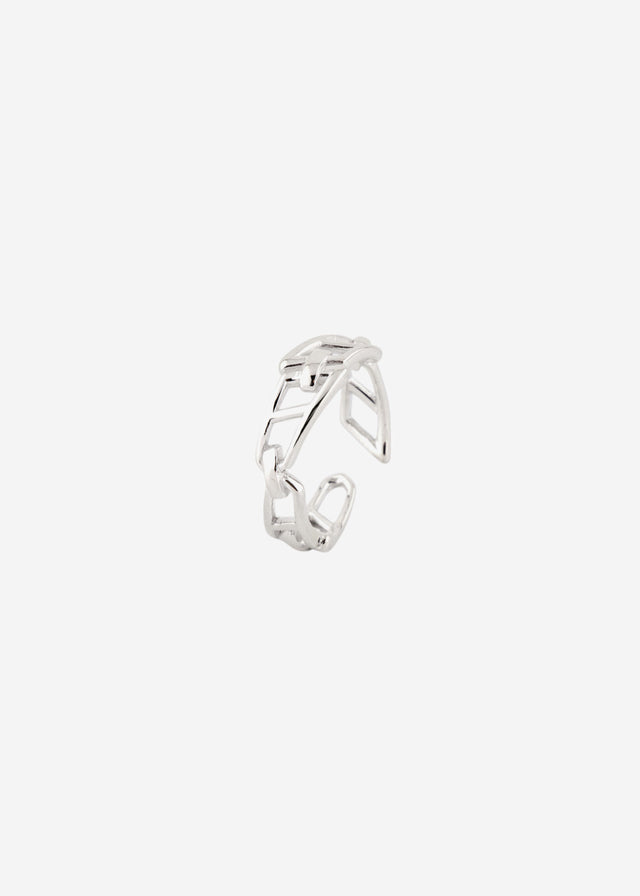
For a comparison of construction, look at Signature Links V.2, with links and a gap in the band, and Brutalism V.1, with a broad band beneath a relief of bars.
Is sterling silver durable enough for everyday wear?
A solid sterling ring of suitable thickness can be worn every day. Sterling contains at least 92.5% silver; in the traditional alloy, copper makes up the remaining 7.5%. Alloying and treatment increase hardness compared with pure silver. Even so, contact with other objects can gradually leave marks.
Start by looking at the shank: the band that circles your finger. Its lower section, on the palm side, meets bag handles, tools and other objects when you grip them. A fine line on its surface and a noticeably thinned section are different changes. The first mainly affects appearance; the second deserves a jeweller's attention.
Hardness describes resistance to indentation or scratching, depending on the test. Silver is commonly listed at around 2.5–3 on the Mohs scale, which compares scratch resistance. Whether a ring keeps its shape also depends on its construction and the force applied to it. One hardness number cannot describe what will happen in an impact.
How hard is sterling silver compared with gold and platinum?
A useful metal comparison needs both the alloy and its condition. Casting, heating and cold working can produce different hardness values. The table uses the Vickers test: a small indenter is pressed into the metal and its impression measured. The result is expressed as HV. This is a different test from the scratch comparison used by Mohs.
| Metal | Vickers hardness, HV | State | Source |
|---|---|---|---|
| Sterling silver 925 | 60–70; up to ~140 after heat treatment | as cast | Fischer-Bühner, FEM |
| Gold 18k yellow | 85–125 | as cast | Chard |
| Gold 14k yellow | 125–165 | as cast | Chard |
| Platinum 950 | 80 (Pt-Ir), 130 (Pt-Ru), 135 (Pt-Co); 210–270 hammered | annealed | Maerz, Ganoksin |
In the stated conditions, as-cast sterling is softer than the listed gold and platinum alloys. Heat-treated sterling can reach about 140 HV; selected platinum alloys are listed at 210–270 HV after cold hammering. Asking which metal is harder therefore also means asking how it was treated. These measurements do not show that one finished ring will acquire three times fewer scratches or last a particular number of years.
Pure 24k gold is softer than sterling, so bending and wear need particular consideration. Our comparisons of gold and silver for men and silver and platinum look further at the materials. On a finished ring, the surface finish adds another difference you can see.
Will a silver ring scratch, and does the finish change how scratches look?
A hairline scratch breaks up the continuous reflection on a mirror-polished ring. It can be easy to see without being deep. Keys in a pocket, sand, a stone worktop or a steel gym bar can leave marks through contact; some fine lines only become visible when you tilt the ring towards the light.
A satin finish already has fine lines, so a shallow scratch may stand out less. Relief changes the appearance too: an uneven surface has no single broad mirror to interrupt. That does not make the metal scratch-proof. A deep mark can remain visible with any finish.
On Brutalism V.1, silver bars rise above a broad band, dividing the surface into edges and spaces. Triple Drills joins three silver drill forms into one band. Dark tones can remain in the grooves while friction brightens the projecting edges. These details make it easier to see how a finish changes in wear.
What actually damages or breaks a silver ring?
After looking at the surface, check the shape. Is the band still round? Are there cracks or changes around a joint? Those details help distinguish routine care from a repair that needs assessment.
Which chemicals harm sterling silver?
Chlorine and household bleach accelerate tarnishing; Tiffany's silver-care guidance recommends avoiding them. Sulfur compounds can darken the surface quickly too. Colour alone cannot establish whether metal or solder has been damaged. If the change comes with rough areas, cracks or moving parts, have a jeweller inspect the ring.
What does a hard knock do to a silver ring?
Silver can bend under load. A ring trapped in a door or struck by a heavy tool may become oval; a stone setting can also be affected. The absence of a complete break does not mean the ring should be worn before inspection.
Why does shank thickness matter?
Look at the metal remaining at the bottom of the band and around its joints. A thin hollow wall and a solid band respond differently to force. Plating has another limit: wear can expose the metal beneath it. A material name on a tag cannot replace a look at those parts of the ring.
Can heat damage a silver ring?
Sterling melts over a range of roughly 800–890 °C; 961.8 °C is the melting point of pure silver. An ordinary shower is far below those temperatures, but melting point is not a guide to safe wear. In a sauna, kitchen or workshop, consider a ring becoming hot, exposure to chemicals, and the requirements of stones or other components. Remove it before using a torch or working at a forge.
| Threat | What it does to the metal | What to do |
|---|---|---|
| Chlorine and bleach | accelerated tarnishing and surface change | take the ring off for pools, hot tubs and cleaning |
| Sulfur hot springs | can darken the surface quickly | take it off before you get in |
| Crushing impact | dents, bends, round band goes oval, stones loosen | take it to a jeweller for assessment before reshaping |
| Thin or hollow shank | may thin or crack, particularly at the palm | consider shank thickness, geometry and joints |
| Plating | wears through and shows the base metal | buy solid silver, not silver-coloured |
Is tarnish on a silver ring damage?
Ordinary tarnish forms at the surface and consists mainly of silver sulfide. Sulfur compounds in the surrounding environment contribute to it. Silver can change from yellowish to grey and black; the conditions determine the pace, rather than a fixed number of months.
A silver polishing cloth can remove light tarnish, taking a little metal with it. For museum silver, the Canadian Conservation Institute recommends limiting repeated tarnish removal. The same mechanism helps explain why returning a ring to a mirror finish again and again has a cost in metal.
You can also keep the dark tone. On STRUGA's oxidized silver rings, it is created during finishing, then removed from the high points. These rings have no rhodium or lacquer coating. Friction can gradually brighten exposed areas while the recesses stay dark. That is how Living Silver changes: different points of contact with the hand and nearby objects become visible on the same piece.
How long does a silver ring last?
A solid silver ring can last for many years, but the 925 mark gives it no fixed service life. Remaining thickness, the condition of joints and the scope for repair all matter. The hardness measurements above are not lifetime tests of finished rings.
| Construction | What wears first | What can be done |
|---|---|---|
| Solid 925 band | surface wear and possible shank wear; timing depends on use | refinishing, re-oxidizing, rebuilding the shank |
| Solid 925, thin light band | the shank at the palm; bends under a crushing blow | a jeweller assesses reshaping; remove any ring before rough work |
| Hollow construction | dents and damage to thin walls | repair depends on wall thickness and access; inspection needed |
| Silver-plated brass or copper | the plating; timing depends on thickness and wear | re-plating; it was never sterling |
Two rings made from the same alloy may have different vulnerable areas: a thin lower band, a hollow wall or a joint between elements. A jeweller can assess them by inspecting the piece. Before buying, ask about construction as well as composition; the Sterling Silver Complete Guide brings those questions together.
How much silver is in a ring, and why does weight matter?
Weight gives that comparison a measurable starting point. It tells you how much metal is present, but not where it sits. A heavy top does not make a thin lower band thicker, and several joined elements cannot be assessed as if they were a continuous band of the same mass.
The table covers nine STRUGA ring models in solid 925 silver without plating. Variant weights were checked against the catalogue on October 15, 2026. The comparison uses size 20; the next column covers each model's full size range. Check the product page for the selected variant.
| Ring | Weight in size 20 | Full size range |
|---|---|---|
| Signature Links V.2 | 3.6 g | 2.1–5.5 g |
| Triple Drills | 3.9 g | 3.1–4.5 g |
| Signature Links V.1 | 4.0 g | 2.7–6.0 g |
| Fused Cross | 7.0 g | 3.7–9.0 g |
| Thorn Ring | 9.6 g | 4.7–12.7 g |
| Heart Lock | 9 g | 5–11 g |
| Double Line | 11 g | 6.0–13.0 g |
| Brutalism V.1 and V.3 | 19 g | 9.6–24.0 g |
In size 20, Signature Links V.2 weighs 3.6 g, Thorn Ring 9.6 g and Brutalism V.1 19 g. The first and last differ by roughly five times in mass, not in lifespan. More metal may leave more room for later refinishing where the design allows it.
Historical price references recorded on October 13, 2026 were from $126 for a light link ring and from $382 for Brutalism V.1. Those prices are not today's offer or a measure of strength; use the selected variant's product page for the current price. Remove any ring before heavy manual work, work with machinery or heavy exercise.
What should you do if a silver ring bends?
If a silver ring bends, stop wearing it and take it to a jeweller. The inspection should cover the lower band, joints, possible cracks and any stone settings before a repair method is chosen.
Some bends can be reshaped on a mandrel, a tapered tool that supports the band as it is brought back into the round, using a soft mallet. Silver hardens as it is deformed, so repeated bending back and forth is best avoided. Pliers leave dents; uneven pressure can damage solder or a setting.
A deep crease or a crack may need another repair, while a severely thinned section can limit reshaping. On an oxidized ring, a tool or polishing wheel can leave a brighter patch. Restoring the piece may therefore involve both its shape and the dark finish in that area.
How do you care for a silver ring so it lasts?
Everyday care has two jobs: removing dirt and keeping the finish you chose. Bright polished silver and a ring with deliberately dark recesses need different treatment.
When should you take a silver ring off?
Before pools, hot tubs, sulfur springs, cleaning with bleach, applying hair dye and heavy work with steel tools. Apply perfume and lotion first, letting them dry before putting the ring on.
What about showers, sea swimming, cooking and sleep?
Brief contact between solid silver and water does not in itself mean a broken ring. Cosmetics, salt and bathing conditions can still change the surface, while stones and other components have their own care requirements. Removing the ring before showering or swimming helps preserve its finish. If it has been in the sea, rinse it in fresh water and dry it. In the kitchen, consider contact with food and chemicals; during sleep, consider pressure or catching the ring. There is no blanket rule for every design.
How do you clean it?
For a solid silver ring without components that must stay dry, use warm water, a little mild dish soap and a soft brush, then rinse and dry with microfibre. A silver polishing cloth can remove light tarnish from bright silver, but may alter deliberately dark areas. Avoid polishing pastes and immersion cleaners on oxidized rings. The silver ring cleaning guide sets out the steps.
How should it be stored?
Put the dry ring in a closed box or pouch, away from rubber bands and strong household chemicals. Friction against skin and fabric can keep raised surfaces brighter during wear. In storage that contact stops, so the pattern of darkening may be different.
Can a scratched silver ring be restored?
Many scratches can be reduced or removed if enough metal remains. A jeweller works on the deeper mark, moves through finer abrasives, then restores the polish or texture and, if needed, the dark tone. Each pass removes metal. The possible result and cost depend on inspection.
First decide what you want to restore. On an oxidized textured ring worn for five years, a bright edge beside a dark recess may be a detail you want to keep. Repolishing changes that balance. A deep scratch or crack still needs separate assessment: keeping patina does not mean ignoring damage.
How do you know a ring is solid sterling and not plated?
Start with the stated composition and the seller's information, then examine the marks. Compare them with documentation and, if in doubt, a professional assessment. No single home test establishes fineness.
In the US, the term sterling requires at least 925 parts of silver per thousand under 16 CFR §23.5. A missing 925 stamp alone does not prove a fake. Where a quality mark is used, 15 U.S.C. §297 sets requirements for an identifying trademark or name; a mark by itself is not an assay. Rules vary by country.
Silver is not attracted to a magnet. Strong attraction indicates a magnetic material is present, but no attraction does not prove the ring is silver: other metals are nonmagnetic too. Sterling has a density of about 10.4 g/cm³, compared with roughly 8.4–8.7 for brass. That comparison needs the same volume of metal, not just the same finger size. The guide to identifying real silver explains the tests and their limits; the 925 mark guide explains the number.
Do ring size and width affect durability?
Size first affects whether a ring sits comfortably and securely. A loose ring is easier to lose; a tight one is difficult to remove over the knuckle. Do not try to correct its fit by force. Fingers can swell towards evening and in heat; the ring sizing guide helps you measure and check a particular model.
A broad band often fits more snugly than a narrow one with the same inner diameter. Going up half a size is a common suggestion, but it cannot replace a fitting: width, inner profile and your hand all matter. Resistance to bending also depends on the band's cross-section, not width alone.
Rings worn against one another can develop bright lines where they touch. On oxidized stacking rings, those lines stand out beside dark recesses. When you look at a familiar ring, check both its surface and the shape of its band. That makes it easier to decide which changes to keep and which to show a jeweller.
About STRUGA. STRUGA is a dark silver jewelry brand founded by Dmitry Strugovshchikov and Ekaterina Strugovshchikova, handmade in Bali by master silversmiths. Most pieces are 925 sterling silver left uncoated, so they darken with wear; part of the range is darkened in advance, at the bench. The darkening is part of the design.
Frequently asked questions
Didn’t find the answer — write to us, we reply personally.
Ask a question →01Are silver rings durable enough to wear every day?+–
Yes, when a solid 925 ring has a thickness and fit suited to your daily use. Scratches and tarnish can develop over time. Bending, cracks and noticeable thinning of the band need separate assessment; the 925 mark does not guarantee a fixed lifespan.
02Does sterling silver scratch easily?+–
A polished sterling ring can acquire fine scratches. The comparison here lists as-cast sterling at 60–70 HV on the Vickers scale, below the listed cast 18k and 14k gold alloys. Shallow marks may stand out less on satin or textured finishes.
03Is platinum harder than silver and gold?+–
It depends on the alloy and treatment. In this comparison, annealed platinum 950 measures 80–135 HV, as-cast sterling 60–70 HV and the listed cast gold alloys 85–165 HV. Annealing is heating followed by cooling. Selected platinum alloys reach 210–270 HV after cold hammering, and heat-treated sterling about 140 HV.
04What ruins a sterling silver ring?+–
Heavy loads, impacts and progressive thinning of the band can damage its structure. Chlorine, bleach and sulfur compounds affect the surface. Darkening alone does not establish a break; have cracks or moving parts inspected by a jeweller.
05Is tarnish on a silver ring damage?+–
Ordinary tarnish is surface corrosion, mainly silver sulfide. It does not by itself establish structural failure. You can keep the dark tone; a silver polishing cloth removes light tarnish along with a little metal.
06Can you shower or swim with a silver ring?+–
Water contact does not in itself mean a broken solid silver ring, but cosmetics and salt can change its finish, and stones need separate care. Remove the ring before showering or swimming to help preserve it. After sea exposure, rinse in fresh water and dry; avoid chlorinated pools and sulfur springs.
07Can a bent silver ring be fixed?+–
Sometimes, after a jeweller inspects it. Some bends can be reshaped on a mandrel, a tapered tool that supports the band. Cracks, thinning and damaged settings can limit repair. Avoid pliers and repeated bending at home.
08Does a heavier silver ring last longer?+–
Weight alone cannot establish this. Thickness, shape and joints matter; more metal may allow more refinishing. At the catalogue check on October 15, 2026, size 20 weighed 3.6 g for Signature Links V.2 and 19 g for Brutalism V.1.
09Does real sterling silver always have a 925 stamp?+–
No. A missing US quality stamp alone does not establish a fake. When a US quality mark is used, an identifying name or trademark is required alongside it. Compare the marks with documentation; neither a magnet nor weight alone establishes silver content.
10Is patina the same as a worn-out ring?+–
No. Dark recesses and brighter contact areas can be changes in finish while the band remains sound. You can keep that contrast on an oxidized ring. Cracks, deformation and thinning need assessment separately from patina.