Necklace Layering — How to Layer Silver Necklaces, Chains and Pendants Without Mess | STRUGA
Necklace Layering — How to Layer Silver Necklaces, Chains and Pendants Without Mess
Necklace layering is what separates one piece of jewelry from a styled hand. Most people fail at it for one of two reasons: they layer pieces that fight each other, or they choose lengths that bunch and tangle. This guide covers what actually works — how to layer silver necklaces, chains, and pendants in oxidized 925 sterling so the result reads as composed, not chaotic. STRUGA's approach starts from the architecture of the chest and works outward.
TL;DR — Necklace Layering
- Length spacing rule — minimum 5cm gap between adjacent pieces. Tighter and they tangle, wider and the eye loses the relationship.
- Three pieces is the sweet spot — choker (40-42cm) + mid (45-50cm) + chest drop (55-60cm). Four-piece stacks work for heavy chest exposure but require careful weight balancing.
- One pendant rule — only the longest piece carries a pendant. Shorter pieces stay clean chain or texture-only. Multiple pendants compete for the same visual real estate.
- Metal consistency — stick to one tone (oxidized silver, OR bright silver, OR mixed metal pair). Three different metals = chaos.
- Weight progression — lighter chain at top, heavier piece at bottom. Visual gravity matches actual gravity.
- STRUGA layering kit — typically a Blade chain (45cm) + Brutalism chain (52cm) + pendant chain (60cm with Asymmetric or Heart pendant). $400-$1,200 depending on family and pendant choice.
The architecture of necklace layering
Layered necklaces work because the chest is a vertical canvas with three distinct visual zones: the base of the throat (38-42cm cord position), the upper sternum (45-50cm), and the chest plate (55-65cm). Each zone reads differently. A piece sitting at the throat acts like a collar — it frames the face. A piece at the upper sternum acts like a focal anchor — the natural eye-rest position. A piece at the chest plate acts like a long pendulum — it announces movement and direction.
Layering is the practice of populating these three zones intentionally. When you put two pieces in the same zone, they bunch and tangle. When you skip a zone, the composition feels incomplete. The classic three-piece layered look uses one piece per zone — and that's why it consistently looks intentional.
Length spacing — the actual numbers
Forget vague "short, medium, long." Use measurements:
- 40-42cm (choker) — sits at base of throat
- 45-50cm (princess) — sits at collarbone or just below
- 55-60cm (matinee) — sits at upper chest, above sternum bone
- 65-75cm (opera) — sits below sternum, can be doubled into shorter look
- 80cm+ (rope) — chest center or below, long pendulum
For a three-piece layered necklace stack, pick one length from groups 1, 2, and 4 (or 1, 3, 4). Skipping a group prevents the bunching problem. The minimum spacing between adjacent layered pieces is 5cm — anything less and they'll tangle on your collarbone within an hour of wear.
Pendant placement — the one-pendant rule
The biggest mistake in necklace layering is multiple pendants. When you wear two pendants, they compete for the same visual focal point. The eye doesn't know where to land. The composition reads as cluttered. The fix is simple: only one piece in the stack carries a pendant. Usually the longest.
Why the longest? Because the longest piece sits in the chest zone — the zone that gets the most visible space when you wear an open-collar shirt or a low neckline. Putting the pendant there means it's seen. Putting it on a choker hides it under your chin.
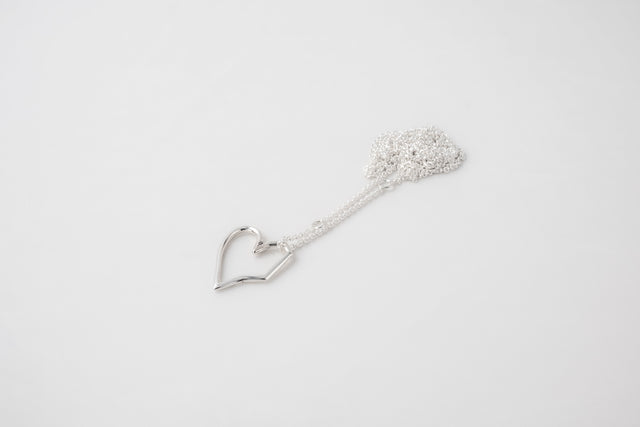
STRUGA pendants designed for layering: the Asymmetric Fused (8-15g, drops to ~58-62cm with chain), the Solid Heart (12-18g, drops to ~55-60cm), the Cross V.4 (10-14g, ~55cm), and Seymchan meteorite slices (varies by piece). All work as the bottom-of-stack focal point. See the full silver pendant range.
Metal consistency — pick one finish family
Layered necklaces fall apart visually when the metals fight. Three rules that work:
- Single-metal layering — all oxidized silver, or all bright silver, or all rose gold. Cleanest read, hardest to mess up. STRUGA's full oxidized 925 range is built for this.
- Two-metal pair — oxidized silver + raw 18k yellow gold (untreated, no rhodium). The temperatures complement instead of clash. Avoid bright commercial yellow gold with oxidized silver — too harsh.
- Mixed-finish single metal — oxidized silver chain + polished silver chain + textured silver chain. Same metal, different finishes. Reads as intentional design choice.
Avoid: silver + brass, silver + steel, silver + gold-plated. Plating wears off and the layered stack looks worse over months. STRUGA never plates — every silver piece is solid 925 oxidized in the workshop, so the metal stays consistent over years.
Weight progression — light at top, heavy at bottom
Visual gravity should match actual gravity. The lightest chain sits at the throat, the medium-weight at the sternum, the heaviest piece (with pendant) at the chest. Reverse this and the stack looks top-heavy and unstable. Same logic applies to chain thickness — thinnest at top, thickest at bottom.
For STRUGA combinations, a clean stack might be: silver chain Blade 2mm at 45cm (light, ~12g) + Brutalism 3mm at 52cm (medium, ~22g) + pendant chain 4mm at 60cm with Asymmetric pendant (heaviest, ~45g total). This puts the visual weight where the chest holds it naturally.
Layering for men vs women
The architecture rules are the same, but proportion calibration differs:
- Mens necklace layering — heavier individual pieces (each 12-50g range), often 2-3 layered total, lengths skewed longer (45-65cm range), pendant on longest. Cleaner stacks (3 pieces max, often 2). See mens silver necklaces and mens jewelry hub.
- Womens necklace layering — lighter individual pieces (each 4-20g range), often 3-4 layered, lengths skewed shorter (40-55cm range), pendant on the longest, sometimes a small charm-style on the choker. More room for delicate texture mixing.
STRUGA's brutalist register works equally for both — the difference is in chain weight and pendant scale, not in the architectural rules.
As of 2026, the practical split holds: men's layering runs heavier pieces (12–50g each), 2–3 layers, lengths 45–65cm; women's runs lighter pieces (4–20g each), 3–4 layers, lengths 40–55cm — in both cases the pendant sits on the longest chain and the architectural rules stay identical.
Layering with STRUGA pieces — three combinations that work
Combination 1: Brutalist mens stack
- Blade 2mm chain at 45cm — choker layer (~12g)
- Brutalism flat chain 3mm at 52cm — middle (~22g)
- Asymmetric Fused pendant on 4mm chain at 60cm — bottom (~45g pendant + chain)
- Total weight on neck: ~80g. Reads heavy, architectural, masculine. Price band $480-$720.
Combination 2: Womens minimalist stack
- Thin oxidized silver chain 1.2mm at 40cm — choker (~6g)
- Twisted silver chain 1.8mm at 50cm — middle (~10g)
- Solid Heart pendant on 2mm chain at 58cm — bottom (~16g)
- Total: ~32g. Reads delicate but architectural. Price band $280-$520.
Combination 3: Statement single-stack
- Big Line Aged necklace at 50cm with Aged Copper inlay — single bold piece (~45g)
- Layered with one thin Blade chain at 45cm choker (~10g)
- Total: ~55g. Reads as one designed object plus framing element. Price band $580-$950.
What ruins necklace layering — common mistakes
- Two pendants in the same stack — competing focal points. Pick one.
- Lengths within 3cm of each other — guaranteed tangle within hours.
- Mixing plated metals with solid metals — plating wears off, stack looks dated fast.
- Stacking 4+ pieces without weight calibration — top-heavy, drags forward, uncomfortable.
- Wearing the stack tangled because you put it on wrong — always layer from longest (first) to shortest (last). Reverse order traps shorter pieces under the longer ones.
- Identical chain types at different lengths — looks like the same necklace doubled. Vary the texture or weight between layers.
How to put on a layered necklace stack
Practical sequence — most people get this wrong:
- Lay all pieces flat on a surface, longest at top, shortest at bottom of the visual.
- Put on the longest first. Settle it in the chest position.
- Add the middle piece. Settle it above the longer one.
- Add the choker last. It sits on top of everything.
- Adjust each piece so the centerlines align (center of pendant = sternum line; centers of chains = same vertical axis).
If you put on the choker first, the longer pieces have to be threaded through, and they'll catch and twist. Always longest-to-shortest.
Care for layered silver necklaces
Layered stacks have one care issue regular single-piece wearers don't: friction between adjacent chains. Silver-on-silver friction polishes both surfaces faster than skin friction. After 6 months of daily layered wear, contact points on each chain will be brighter than the rest. This is normal and looks intentional — it's a kind of accidental highlighting.
To slow it down, rotate pieces in the stack — don't always wear the same three together. STRUGA can re-oxidize any worn piece to restore depth. Read the full silver care guide for full protocols.
Related Reading
Frequently asked questions
Didn’t find the answer — write to us, we reply personally.
Ask a question →01How many necklaces should I layer?+–
Three is the sweet spot. Two reads as deliberate but minimal. Four works for high-chest exposure outfits with careful weight balancing. Five+ usually crosses into chaos unless you're styling a deliberate maximalist look. Most days, two or three pieces gives the layered look without the maintenance overhead.
02What length should each layered necklace be?+–
Pick lengths from different zones with at least 5cm between them. Standard three-piece stack: 40-42cm choker + 50cm princess + 60cm matinee. For mens stacks shift longer: 45cm + 55cm + 65cm. Within those zones, exact length depends on neck size — measure your neck circumference and add 4-7cm for choker fit.
03Can I layer chains and pendants together?+–
Yes, but only one pendant in the stack. The longest piece carries the pendant; shorter pieces stay chain-only. This keeps the focal point clear. Two pendants at different lengths still compete visually because the eye reads them as one cluttered zone.
04Is layered necklaces only for women?+–
No — necklace layering works equally for men. Mens layered stacks tend toward heavier individual pieces (12-50g each), 2-3 layers (not 4+), longer lengths (45-65cm range), and bolder pendant choices. STRUGA's mens silver range and silver chains for men are built for the layered look.
05Can I mix metals when layering necklaces?+–
Carefully. Single metal is safest. If mixing, stick to two complementary metals (oxidized silver + raw 18k yellow gold works; oxidized silver + bright commercial gold clashes). Three+ metals usually fails. Mixing solid silver with plated silver-look pieces is the worst combination — plating wears off and the contrast becomes ugly within months.
06How do I prevent layered necklaces from tangling?+–
Two rules: minimum 5cm spacing between adjacent lengths, and put them on longest-to-shortest. Within those rules, tangling becomes rare. Slight tangling on first wear is normal — the stack settles into your specific neck/chest geometry over a day or two of wear, then stays organized.
07Should layered necklaces match my rings and bracelets?+–
Same metal family — yes. Same design family — not required. STRUGA mixes Brutalism rings with Blade chains and Asymmetric pendants regularly because all are oxidized 925 silver and share the architectural vocabulary. The metal continuity is what holds the look together; identical design language across all pieces would actually feel over-coordinated.
08Can I sleep in layered necklaces?+–
Don't recommend it. Adjacent chains polish each other against the pillow over 7-8 hours of friction. The stack will lose its oxidation faster on the high points. Take them off at night. Hang them on separate pegs (not piled) so they're ready to layer in the morning without tangling.