The STRUGA Design Process: From Concept to Silver
The STRUGA design process is not a single act of inspiration — it is a six-stage sequence that moves a piece from a written brief to finished 925 sterling silver, and it is deliberately slow. A concept that fits none of STRUGA's eleven families is rejected before any silver is poured: the family system itself is the first filter, not the last.
Updated September 24, 2026
- The STRUGA design process is six stages — concept, proportion and form, 3D or wax, sample, production, wear-test — from brief to finished 925 sterling silver.
- A catalog piece takes 3–6 months; a Custom Order piece about 3–6 weeks — a frame, not a date.
- Most concepts take 3–5 iteration rounds; the first sample is cast in silver before review.
- A concept that fits no family is rejected at stage one.
The stages below are visible in finished objects. The Brutalism V.3 Ring took the CAD branch of stage three; the Thorn Ring took hand-shaped wax — and both met the same individual casting and hand finishing at stage five.
What happens at each of the six stages?
The six stages are not equal in weight. Two of them carry most of the calendar: the iteration rounds in stage two and the months of wear-testing in stage six. Everything between them is comparatively quick. The table below is the whole process in one view — what each stage decides, and what it produces before the next one starts.
| Stage | What it decides | What it produces |
|---|---|---|
| 1. Concept | Which of the eleven families the piece belongs to, which of the five worlds it speaks in, and how it will be worn | A written brief or a sketch |
| 2. Proportion and form | Scale, angles, coherence with existing pieces of the same family | 3–5 rounds of iteration |
| 3. 3D or wax | Route by form: geometric goes to CAD, organic goes to wax | A model ready for casting |
| 4. Sample and review | Proportion at scale, how the piece sits on the body, how the surface reads | The first sample, cast in 925 sterling silver |
| 5. Production | Individual casting, hand finishing, quality control | A piece in the catalog |
| 6. Wear-test | Patina behavior, comfort over long wear, durability | Release — or a return to an earlier stage |
A catalog piece runs the full sequence in 3–6 months. A Custom Order piece skips the internal refinement cycles and takes about 3–6 weeks — a frame, not a promised date.
What is the STRUGA design language made of?
Where dark minimalism meets Bali craft
STRUGA exists at an unusual intersection. The design language is rooted in dark minimalism, industrial aesthetics, and subculture — drawn from techno, modern art, and underground communities, but the production is anchored in one of the most traditional craft environments on Earth: the silver workshops of Bali, Indonesia.
This is not a contradiction. It is the core of what makes STRUGA distinct.
Design philosophy
Every STRUGA piece starts from a simple question: what would jewelry look like if it were designed by an architect, an industrial designer, or a sculptor rather than a traditional jeweler? The answers draw from unexpected sources: the geometry of brutalist buildings, the mechanics of carabiners, the organic aggression of thorns, the alien textures of meteorite and carbon fiber.
The aesthetic is intentionally dark. Not dark as in gloomy, but dark as in deep, layered, and textured. Oxidized silver surfaces, raw gemstone inclusions, and big weight create pieces that feel significant.
Material selection
925 sterling silver is the foundation — and the number is a legal threshold, not a style: the US FTC Jewelry Guides (16 CFR §23.5) allow the words «sterling silver» only for an article that is at least 925/1000ths pure silver. Beyond silver, STRUGA works with materials uncommon in Bali jewelry: natural tourmalines in pink, green, purple, and blue; aquamarines; meteorite fragments from the Seymchan pallasite; carbon fiber; and raw crystal formations.
Which families does a concept have to land in?
Eleven, and the brief names one of them before anything else happens. A family is a form; a world is the language the brand speaks about it. Every piece belongs to one family and to one of the five worlds — Codex, Ritual, Lab, Dark Union, Island Artifacts — and a concept that fits no family is rejected at the first stage rather than the last.
- Signature Asymmetric — the first form of the brand — one shape carried through different piece types, in the CNC aesthetic of cut sheet material.
- Blade — the second form — a CNC aesthetic in silver, begun with a single chain link and grown into bracelets, chains and chokers, among them the Blade Pin Necklace.
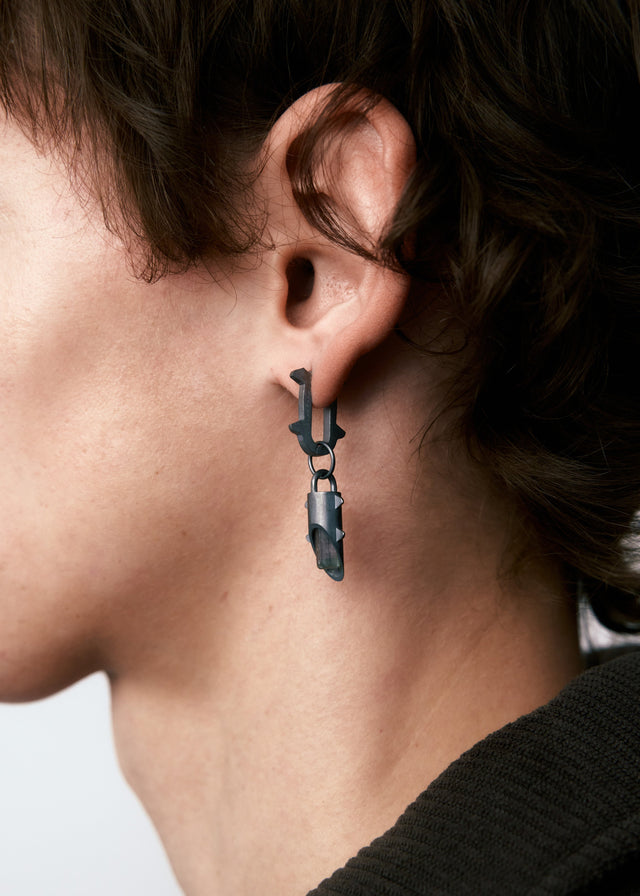
- Thorn — the third form — a thorn with sharp angles, where CNC and 3D modeling meet.
- Brutalism — the fourth form — architecture in silver, and the heaviest rings STRUGA makes.
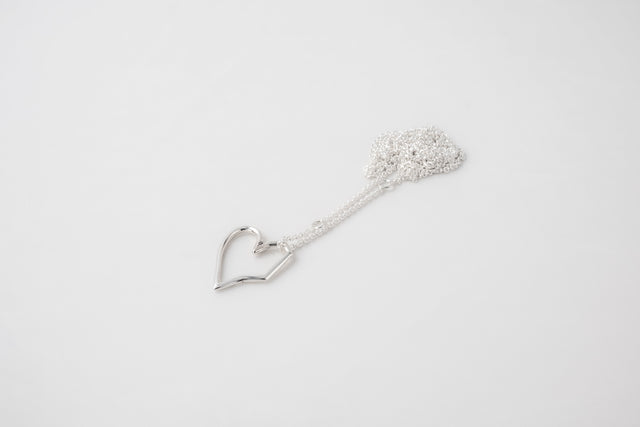
- Signature Heart — the fifth form — STRUGA's own heart, half smooth and half angular.
- Carbon — the material the brand started with: multilayer matte carbon, ultralight and unchanging — the counterweight to living silver.
- Mosaic — the aesthetic of combining materials.
- Fused — the aesthetic of molten metal — no clear borders, angles or edges.
- Amulet — earrings and necklaces built around raw, wild-grown stones.
- Experimental — a zone of pure creativity, where STRUGA steps outside jewelry into clothing and object design.
- Dark Union — an alternative take on the engagement and wedding ring.
What does the work look like inside each stage?
Every STRUGA piece moves through a sequence that has not changed substantially in years. The process is deliberately slow because the brand prioritizes consistency over speed. Each stage has different goals, different tools, and different people involved.
Stage 1 — concept
The design starts as a written brief or a sketch. The brief addresses three things: the family the piece belongs to (STRUGA has eleven — Signature Asymmetric, Blade, Thorn, Brutalism, Signature Heart, Carbon, Mosaic, Fused, Amulet, Experimental, Dark Union), the world it speaks in (Codex, Ritual, Lab, Dark Union, Island Artifacts), and the wear context — daily, statement, or ceremonial. A concept that lands in no family gets rejected at this stage; the family system is the constraint, and it is the first filter rather than the last.
Stage 2 — proportion and form
Hand sketches refine the proportions. The piece is drawn to scale, considered from multiple angles, tested against existing pieces in the same family for visual coherence. Most concepts go through 3–5 iteration rounds before progressing.
Stage 3 — 3D modeling or wax sculpting
Geometric pieces (Blade, Brutalism) are modeled in CAD software for dimensional precision. Organic pieces (Thorn, some Signature) are shaped in wax by hand. The choice is design-led, not technology-led: each piece gets the route that suits the form. Both routes end in the same step — a wax model burned out of its mould and replaced by molten metal, a method archaeologists trace back to the 5th millennium BCE.
Stage 4 — sample and review
The first physical sample is cast in 925 silver. The sample is reviewed for proportion (does it look right at scale), wear (does it sit comfortably on the body), and finish (does the surface treatment work as intended). Most samples get adjustments before approval.
Stage 5 — production
Approved designs enter regular production at the Bali workshops. Each piece is cast individually, hand-finished, and quality-checked before shipping. Production volume is calibrated to maintain hand-finish quality — no mass stamping.
Stage 6 — wear-test and refinement
New designs are wear-tested by the team and selected customers for several months before broad release. The patina behavior, comfort during extended wear, and durability under daily conditions all get observed. Some designs return to earlier stages for refinement based on wear-test data.
What separates STRUGA design from generic Bali silver?
- A family system rather than individual pieces. STRUGA's eleven families work as one system — pieces from different families share underlying logic but resolve into completely different objects. Most generic silver brands lack a coherent system; pieces are produced independently.
- Architectural and brutalist vocabulary. The design language sits in the architectural minimal register, not the traditional ornamental register. This is unusual for Bali silver, which leans ornamental by default.
- Wear-aware design. Pieces are designed for actual daily wear — not just for product photography. Edges that would catch on clothing, weight distributions that would tire the wearer, surfaces that would scratch unevenly — all get caught in design or wear-test phases.
- Living Silver philosophy from concept. Designs assume the piece will develop patina with wear — silver sulfide forming as the metal meets sulfur-containing gases in the air, not dirt on the surface. Surface treatments, edge geometries, and structural choices all account for how the piece will look at year five, not just at purchase.
- Repairability built in. Construction allows resoldering, resizing, and partial recasting. The piece is designed to be maintained across decades, not replaced.
Why does concept-to-silver take weeks rather than days?
Five things hold the calendar, and none of them is a bottleneck that could be removed without changing what the piece is. Three of the five are decisions to reject work — a revision round, a failed review, a design sent back after wear-test — which is why the timeline is measured in cycles rather than in hours of labour.
- Multiple iteration cycles. Sketches → 3D model → sample → revisions → final. Each cycle takes days.
- Hand work at every step. No automated finishing means each piece takes hours of artisan time.
- Quality review. Designs that don't meet standards return to earlier stages rather than being released.
- Wear testing. New designs need months of real-world wear before broad release.
- Production scheduling. The Bali workshops handle multiple ongoing orders; new designs join the queue.
How does a finished piece reach its owner?
STRUGA ships worldwide from Bali. The brand operates direct-to-consumer, cutting out retail markup. A piece that might retail for several thousand through third-party stockists is available directly for a fraction of that price.
The catalog is a list of forms, not a shelf of stock: a piece is made to order, which is why the process described above is not a one-time story about a prototype. The same individual casting and hand finishing happen again for each order, and that is what the production window covers.
About STRUGA. STRUGA is a dark silver jewelry brand founded by Dmitry Strugovshchikov and Ekaterina Strugovshchikova, handcrafted with Balinese and international silversmiths. Every piece is 925 sterling silver. Some pieces are darkened deliberately at the bench — that is oxidation, a technique. Others stay Living Silver: uncoated silver that darkens on its own on the wearer's hand. Either way the darkening is part of the design. It is a brutalist object that reacts and changes through contact with the environment and the wearer.
One form born of this process — the Signature Links V.2 Ring.
STRUGA: dark minimalist jewelry, handcrafted in Bali from sterling silver and natural gemstones. Explore the collection
Frequently asked questions
Didn’t find the answer — write to us, we reply personally.
Ask a question →01Is the STRUGA design process the same as a custom order?+–
No. The catalog design process is a 3–6 month sequence of iteration, sampling, and wear-testing that produces pieces for the collection. A Custom Order is a faster route — about 3–6 weeks as a frame rather than a promised date — where a design conversation with one customer replaces the long internal refinement cycles.
02Is 3D modeling a replacement for hand work at STRUGA?+–
No. 3D modeling and hand-shaped wax are two routes into the same casting flow, chosen by form, not by technology. Geometric pieces like Blade and Brutalism are modeled in CAD for dimensional precision; organic pieces like Thorn are shaped in wax by hand. Both still pass through individual casting and hand-finishing.
03Is the slow process a sign of inefficiency?+–
No. The pace is a deliberate bet on long-term coherence over short-term variety. Multiple iteration cycles, hand work at every step, and months of wear-testing exist so that pieces from different years still work together as one system.
04How long does a new design take from concept to release?+–
Typically 3–6 months including all iteration, sampling, and wear-testing. Custom Order pieces for individual customers run faster — about 3–6 weeks as a frame — because the design conversation replaces the iterative refinement.
05Can I propose a design?+–
Yes through Custom Order. The conversation starts with what you want and works toward how to execute it within the STRUGA design vocabulary. Some custom designs eventually become catalog pieces.
06How does STRUGA decide what becomes a new collection?+–
Coherent design language and real demand. A new collection only launches when there's both a clear aesthetic direction and customer interest in pieces with that language.
07Are wax models always carved by hand?+–
Not always. Geometric pieces use 3D-printed wax for precision; organic pieces use hand-shaped wax for character. Both routes converge in the same casting flow.
08What gets discarded during the design process?+–
Concepts that don't fit any of STRUGA's eleven families. Proportions that look wrong at scale. Surface treatments that wear badly. Structural choices that limit repairability. Most discards happen at the sketch and sample stages.
09Can I see the design process in person?+–
Workshop visits are not part of the public-facing brand. STRUGA pieces are visible at Hedonist Store and Barefoot Aristocracy in Bali — finished pieces in concept-store environments where you can handle and try on pieces.
10Why is the design system so deliberate?+–
Because the brand bets on long-term coherence over short-term variety. A coherent design system means pieces from different years still work together; a trend-led brand means last year's pieces look out of place next year.