How Bali Jewelry Is Made: From Silver to Sculpture
Handmade Bali silver is not cast from a reusable master that stamps out identical copies — it is grown one piece at a time from a wax model that is destroyed in the casting. Each casting burns the wax out in the kiln, so every piece is poured from a fresh wax; the rubber or silicone mold survives to make more wax copies, but the wax itself is single-use. That single detail is why two pieces of the same design carry slightly different file marks, patina patterns, and micro-asymmetries — the variation is the maker's signature, not a flaw.
Updated August 20, 2026
Handmade Bali silver grows from a wax model: the wax burns out during casting, and only the mold is reusable — the finished piece copies that model exactly.
Each piece is cast in 925 sterling and sold uncoated, so patina arrives with wear.
One piece passes through four to six pairs of hands, from the model maker to the quality inspector — as in the Brutalism V.3 Ring.
From Sketch to Silver: The Journey of a Handmade Piece
Every piece of Bali jewelry begins as an idea and ends as an object you can hold in your hand. Between those two points lies a process that has not fundamentally changed in centuries. Here is what actually happens when a piece of jewelry is made by hand in a Bali workshop.
| Step | What happens | Number to know |
|---|---|---|
| 1. Design and wax | The piece is sculpted in jeweler's wax and the silver will copy it exactly | Carved at actual size, 1:1 |
| 2. Mold | A rubber or silicone mold is built around the model | One mold, many wax copies — the wax stays single-use |
| 3. Casting | The wax burns out in the kiln and molten silver fills the hollow | 925 means 92.5% silver; pure silver melts at 961.78 °C |
| 4. Cleaning and assembly | Files, sandpaper and rotary tools take off the casting marks; soldering joins the parts | 4 to 6 pairs of hands across the whole route |
| 5. Surface | Oxidation, matte brushing, high polish or sandblasting | Uncoated silver returns to patina within weeks |
| 6. Stone setting | The bezel is filed back or built up around one specific crystal | One setting per stone, never calibrated |
| 7. Quality check | Weight, dimensions, clasp, stone security and surface are checked | 3–5 days for a simple band, 10–14 for a multi-link bracelet |
Step 1: Design and the Wax Model
The process starts with a concept. At STRUGA, designs originate as sketches exploring form, proportion, and wearability. Once finalized, the design needs to become three-dimensional.
The idea then takes volume in wax. The wax model matches the piece at actual size: every curve, edge, and texture must be precise here, because the finished silver piece will be an exact replica. A complex form takes several days. The wax model is the blueprint: if it is right, everything that follows will be right. It is made slightly oversize — every step that follows, from mold to finishing, takes a little off the piece.
Step 2: Mold Making
Once the wax model is approved, a rubber or silicone mold is created around it. This mold captures every detail of the original model and allows multiple wax copies to be made. The mold-making process requires careful attention to where the mold will split, how wax will be injected, and where air channels need to go.
Step 3: Casting the Silver
This is the step at the heart of Bali silver work. A wax copy is attached to a wax tree, packed into plaster, and set in a kiln. As the kiln heats, the wax burns out and leaves a hollow in the exact shape of the object. Molten sterling silver is poured into that hollow. When the plaster is broken away, a rough silver replica remains.
The temperature, timing, and silver purity at this stage are critical. Experienced casters read the metal's behavior through years of practice.
The alloy in the crucible is sterling silver: 92.5 percent silver and 7.5 percent other metals, usually copper. That is what the figure 925 stands for — a minimum millesimal fineness of 925. Pure silver melts at 961.78 °C; the copper in the alloy brings the working temperature down and makes the metal hard enough to hold an edge. The same copper is why the finished piece darkens later.
The numbers here come from material specifications, not from habit. The data sheet for sterling casting grain gives a melting point of 824 °C and a flow point of 854 °C, a recommended casting temperature of 1060 °C, and a flask temperature of 649 °C at the pour. Before that the investment is brought to 732 °C and held for two hours: wax left behind turns into porosity in the metal.
The wax tree exists for the same reason. Metal contracts as it solidifies — for most silver and gold alloys the difference in volume between the liquid and solid state is 5 to 6 percent — and the sprue keeps feeding molten silver into the casting while it sets. Without that reserve the shrinkage pulls a cavity into the piece itself.
Step 4: Cleaning and Assembly
Fresh from the mold, a cast piece is rough and covered in residue. Artisans use files, sandpaper, and rotary tools to remove casting marks, smooth surfaces, and sharpen edges. For pieces with multiple components, this is where soldering joins everything together.
Step 5: Surface Treatment
Most STRUGA pieces carry an oxidized finish: the silver is darkened at the bench, black driven into the recesses while raised surfaces stay lighter. This builds depth, contrast, and the dark surface the brand is known for. Other finishes include matte brushing, high polish, and sandblasting, and some pieces combine several to push the contrast further.
Oxidation and patina are two different events
Oxidation is a treatment. It happens once, in the workshop, and it is deliberate. Patina is what the metal does afterwards on its own: silver reacts with sulfur compounds in air and on skin, and the black layer that builds up is silver sulfide. Bali silver is sold uncoated, without rhodium plating, so that second process starts within weeks of the first wearing. At STRUGA the ageing has a name — Living Silver — and it is a property of the metal, not a finish applied to it.
Step 6: Stone Setting
For pieces incorporating gemstones, a stone setter creates precise bezel settings. Natural gemstones are each unique in shape and size, so unlike factory jewelry with calibrated stones, each STRUGA setting is a custom job. The setter adjusts the bezel to fit the individual stone, making every finished piece slightly different.
Step 7: Final Quality Check
Weight, dimensions, clasp function, stone security, surface quality, and overall appearance are all checked. Pieces that do not meet standards go back for correction or are melted down and recast.
The Human Element
From start to finish, a single STRUGA piece passes through four to six pairs of hands. The wax carver, the caster, the cleaner, the finisher, the stone setter, and the quality inspector each contribute their skill. Total production time for a complex piece can be several days to over a week.
When you hold a piece of handmade Bali silver, you are holding hours of focused human effort. That is not something you can manufacture at scale.
Three objects from the catalogue show the route at its extremes: the Brutalism V.3 Ring is the plain band described above, 3–5 days end to end; the Thorn Amulet Earring with aquamarine carries a bezel filed to one specific stone; the Signature Mushroom Necklace is cast, cleaned and finished as a single sculptural piece.
See the craft in person: explore STRUGA's handmade collections. Shop now
Continue Reading
What separates Bali handmade from factory production
The differences between handmade Bali silver and factory-produced silver jewelry are visible if you know what to look at. A few markers you can feel with your hands separate the two:
| Where to look | Factory-made | Bali handmade |
|---|---|---|
| Surface | Two pieces of the same model are visually identical | File marks, patina pattern and micro-asymmetries differ piece to piece — that variation is the maker's signature |
| Inside of a band, back of a pendant | Smooth machined interior | File marks, hand-sanded texture, sometimes deliberate finishing texture |
| Solder joints | Automated, geometrically perfect under magnification | Small torch, solder placed by hand; the joint shows a working pattern |
A one-minute check in your hands
The order is simple. Turn the piece over: on factory work the back of a pendant and the inside of a band are smooth, a machine passed there, while handmade work keeps file marks. Find the solder joint: an automated one is geometrically even along its whole length, a joint made with a small torch is neat but not identical. Compare two pieces of the same model: identical down to the micron means casting from a reusable master.
No single marker proves anything on its own: casting does not make a piece factory work, and a smooth interior can also come from a well-finished studio piece. The combination proves it — together with a straight answer from the workshop about who made the model.
The full comparison — price, edition size, repairability, and what the words “handmade” actually cover in a product description — is a separate piece: handmade versus mass-produced jewelry.
This article follows the route of one piece, from sketch to final check. If the workshop itself is the interesting part — the bench, the tools, the order of work — that is covered separately: nine steps inside a Bali silver workshop.
How long does the full process take per piece?
End-to-end timing varies significantly by complexity. Realistic ranges:
- Simple band (Brutalism, plain design): 3–5 days total, with 4–8 hours of hand work spread across that span.
- Complex ring (Blade, Thorn, signature with surface texture): 5–7 days, with 10–15 hours of hand work.
- Amulet with stone setting: 7–10 days, including stone selection time and setting work. 12–20 hours of hand work.
- Multi-link bracelet: 10–14 days. Each link is cast and finished individually, then assembled. 15–25 hours of hand work.
- Custom Order or Dark Union pair: 3–6 weeks total. Includes design conversation, sample fitting, production, finishing.
Those figures are bench time — how long the work itself takes. An order runs on a different clock: production starts once the order is placed, and shipping follows it.
| What is ordered | Production time |
|---|---|
| Catalogue silver | About two weeks |
| Silver with a stone | About three weeks |
| Carbon (CARBON family) | About four weeks, always a custom-order route |
| Custom Order and Dark Union | 3–6 weeks |
| RITUAL amulets | Finished single pieces, no production time |
Shipping adds about a week on top. These are ranges, not a promised date — the exact timing is confirmed by a person at STRUGA.
The numbers explain why mass production exists at $15 price points and why hand-made pieces start at $80 minimum. The labor cost of a hand-built ring exceeds the entire retail price of a stamped one. The two are not the same product wearing different prices — they are different products with different lifetimes, different surfaces, and different relationships with the wearer.
About STRUGA. STRUGA is a dark silver jewelry brand founded by Dmitry Strugovshchikov and Ekaterina Strugovshchikova, made by hand with Balinese and international silversmiths. Every piece is 925 sterling silver. Most carry an oxidised finish applied at the bench; every piece keeps ageing afterwards on the wearer. The darkening is part of the design. It is a brutalist object that reacts and changes through contact with the environment and the wearer.
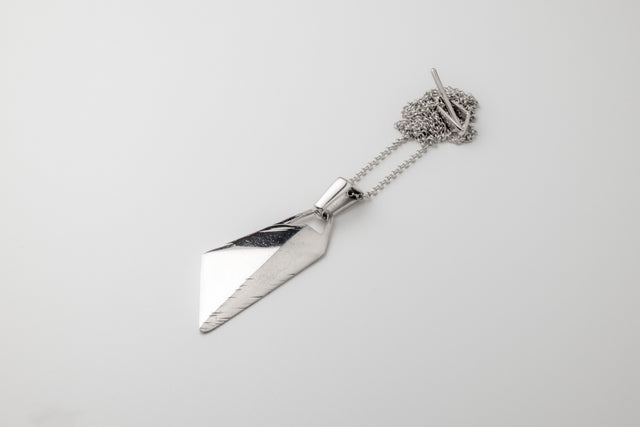
One finished example from the STRUGA catalog — the Signature Mushroom Necklace.
Frequently asked questions
Didn’t find the answer — write to us, we reply personally.
Ask a question →01Is a cast Bali piece the same as factory-stamped silver?+–
No. A stamped piece is mass-produced from a die at price points around $15; a hand-built Bali piece starts at $80 minimum because the labor cost exceeds the entire retail price of a stamped one. They are not one product at two prices — they are different products, with different surfaces, different lifetimes, and different micro-asymmetries from the maker's hand.
02Is the oxidized finish the same as silver that has tarnished with age?+–
No. Oxidation here is a deliberate surface treatment applied during finishing — black is driven into the recesses while raised surfaces stay lighter, to build depth and contrast. Tarnish is what happens later on uncoated silver through everyday contact. The oxidized look is designed in at the workshop; the patina that follows is the metal continuing to age — STRUGA's Living Silver.
03Is the wax model the same as a reusable mold?+–
No. The wax model is single-use — every casting destroys it in the kiln burnout, so each piece is poured from a fresh wax. The mold (rubber or silicone) is the reusable part: it captures the original carving and lets multiple wax copies be made. Wax is consumed; the mold persists.
04Are the wax models reused?+–
No. Each casting destroys the wax model in the burnout. Every piece is cast from a fresh wax. The molds (rubber or silicone) are reusable for producing multiple wax copies, but the wax itself is single-use.
05How much of the work is automated?+–
The kiln (burnout cycle) and the polishing wheel are powered. Everything else — wax preparation, mold-making, casting setup, hand filing, hand polishing, oxidation, stone setting — is hand work. The automation that exists is in support of hand work, not in place of it.
06Why does Bali silver tarnish faster than commercial silver?+–
Most Bali silver is sold uncoated, without rhodium plating. The unplated finish develops patina visibly within weeks. This is by design in the Bali tradition — the metal is meant to age. STRUGA's Living Silver philosophy belongs to this tradition.
07Can I see a piece being made?+–
Workshop visits are not part of the public-facing brand for production reasons (real workshops need to actually produce). STRUGA pieces are visible at Hedonist Store and Barefoot Aristocracy in Bali — concept-store environments where you can see and handle the finished pieces in good light.
08What happens if a piece fails quality check?+–
Pieces that don't meet standards either go back through finishing, or are melted down and recast from fresh wax. The metal is recovered; the work hours are not. This is part of why hand-made silver costs what it costs.