Skull Rings Sterling Silver — A 2026 Memento Mori Guide
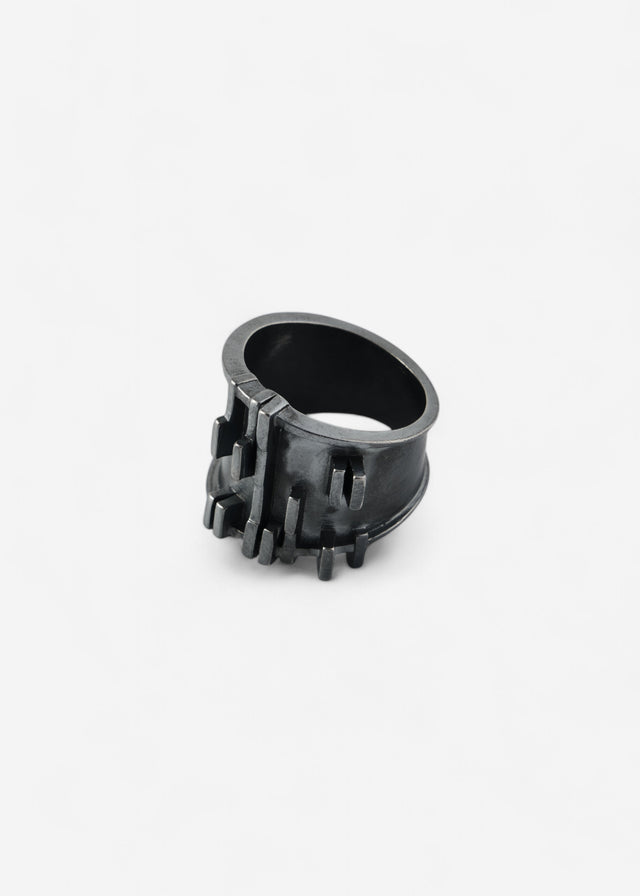
Memento mori — remember you must die — was worn on the finger long before bikers: in 16th-century England skull rings were already in fashion. A skull ring is a reminder of how short life is, not a cult of death. Well made, it is 925 sterling silver, which holds the relief and darkens in the hollows. STRUGA makes no literal skulls; the closest piece is the heavy Brutalism V.3 Ring, from $368.
Updated October 1, 2026
Memento mori is Latin for “remember you must die”. A skull on a ring is the shortest way of writing that thought down: a reminder that is always on your hand.
The Victoria and Albert Museum holds English rings from the second half of the 16th century with a skull and the mottoes BE HOLD THE ENDE and DYE TO LYVE.
Sterling is at least 925 parts of silver in 1,000, traditionally alloyed with copper. Even as cast it is more than twice as hard as annealed fine silver: 60–70 HV against about 25.
The heaviest ring in the STRUGA catalogue weighs 24 g — the Brutalism V.1 Ring and V.3 in size 22. Both are made to order in 2–4 weeks, often sooner.
This guide covers what a skull ring means, where it comes from, how to choose one — and what to wear instead if a literal skull feels too loud. Every STRUGA ring sits in the rings collection, and how grams feel on the hand is worked through in the silver ring weight guide.
What does a skull ring mean?
A skull ring is a reminder of how short life is, worn on the hand. Its Latin formula is memento mori, “remember you must die”. In 16th- and 17th-century Europe merchants and mourners wore such rings, and the point was memory: time is limited, so spend it with intent.
The skull on a finger has had several owners since, and each put something different into it. It helps to know which reading a ring leans towards before you buy:
| Tradition | When | What the skull says | What the ring looks like |
|---|---|---|---|
| Memento mori | Europe, 16th and 17th centuries | Life is short; know yourself | Small gold ring, white-enamel skull, a short motto |
| Mourning ring | England, 16th to early 18th century | Memory of one named person | Name and date of death, enamelled skull, sometimes a lock of hair |
| Biker silver | United States, second half of the 20th century | Defiance, brotherhood, the risk of the road | Large, high relief, dark hollows |
Painting ran alongside the rings. In the 17th-century Netherlands the vanitas still life became a genre: a skull beside an hourglass, a candle and books. An early example is Jacques de Gheyn II’s Vanitas Still Life of 1603 at the Metropolitan Museum of Art. The word itself comes from Ecclesiastes: vanitas vanitatum, “vanity of vanities”.
What is a memento mori ring, and where does it come from?
A memento mori ring is a ring that carries a reminder of death — usually a skull — and it comes from 16th- and 17th-century Europe, where that reminder was part of ordinary life. Skulls, hourglasses, crossed bones and skeletons appeared on many kinds of jewellery at the time, reminding the wearer how brief life is.
The historian Charles Oman considered a late-15th-century ring in the Victoria and Albert Museum the earliest surviving English mourning ring: a heart on the bezel, flanked by crudely modelled shapes that the museum cautiously says may be intended as skulls, and a name on the hoop. Around 1600 an English goldsmith made a ring with a revolving bezel — a white-enamel skull on one side, a merchant’s mark on the other, and NOSSE TE IPSUM, “know yourself”, around the edge (museum record). One object spoke of the owner’s trade on one face and of his mortality on the other.
The mottoes were short: MEMENTO MORI; BE HOLD THE ENDE; DYE TO LYVE. The rings were familiar enough for Shakespeare to joke about them: in Love’s Labour’s Lost, Berowne mocks Holofernes’s face as “a death’s face in a ring”.
How is a mourning ring different from a memento mori ring?
A memento mori ring is a general reminder with no name on it. A mourning ring is for one person: a name and a date of death, often a lock of hair. Skulls stayed on mourning rings from the 16th to the early 18th century: on a gold ring of 1686 in the same museum, the skull is left in gold against black enamel, and the date of death is engraved inside the hoop. In the later 18th century, the museum notes, mourning rings moved to neoclassical motifs — urns, broken pillars, mourning figures. By the mid-19th century, after Queen Victoria’s long mourning for Prince Albert, jet had become the mourning material of the day. The roots of today’s skull ring therefore lie in English rings of the 16th and 17th centuries.
How did the skull ring become a biker ring?
Through American motorcycle culture in the second half of the 20th century, which took an old sign of death and turned it into a sign of defiance. The heavy silver skull ring became part of that look alongside the leather jacket and the bike.
One label shows the path from riding gear to silver. According to the Council of Fashion Designers of America, Chrome Hearts, which Richard Stark was instrumental in founding in 1988, began as a leather motorcycle riding-gear company before silver made its name. Neighbouring design houses are mapped in our guide to brands like Chrome Hearts, and the London workshop has its own guide to The Great Frog.
The biker reading is the loudest of the three: a large skull, high relief, sometimes bones around the band. The European one is quiet: a small sign that the wearer sees first.
Why are skull rings made in 925 sterling silver?
Because fine silver is too soft for relief, while sterling both holds its shape and darkens in a way that draws the relief by itself. Under US rules, “sterling” may only describe metal that is at least 925/1,000ths pure silver; the rest is traditionally copper. Copper supplies the hardness: annealed fine silver measures about 25 HV (ESPI Metals), while sterling is 60–70 HV even as cast and reaches about 140 HV after heat treatment, according to a Santa Fe Symposium paper by Jörg Fischer-Bühner. Eye sockets, cheekbones and teeth keep their shape for years in that metal.
A common myth says lower-grade silver is softer and “melts” its detail. It works the other way: grades such as 800 carry more copper, the metal that hardens silver. Their real cost is simply less silver.
The second property matters more on a skull than on a plain band. Silver darkens from sulphur compounds in the air, such as hydrogen sulphide: a film of black silver sulphide grows on the surface, as the Canadian Conservation Institute describes it. The film forms everywhere, but the high points of a skull rub against skin and fabric every day and stay bright, while eye sockets and the gaps between teeth go to graphite. STRUGA calls this Living Silver — 925 silver with no rhodium plating, left to react to air and skin; more in the patina guide.
Rhodium plating stops that drawing: it holds the shine and keeps the metal from darkening. For anyone who wants the first-day look forever, a plated ring is the right choice.
How heavy should a skull ring be?
Heavy enough to feel and light enough not to tire you: up to 10 g for every day, 10–17 g for a statement ring, 17–24 g for a ring that works as an object. Those three bands are a useful way to think about any heavy ring; below they are laid out against real weights from the STRUGA catalogue.
| Band | Weight | How it feels | STRUGA rings in the band |
|---|---|---|---|
| Light | up to 10 g | Daily wear, sits well beside a second ring | Fused Cross in every size (3.7–9 g), Thorn in sizes 16–20 (4.7–9.6 g), Brutalism in size 15 (9.6 g) |
| Statement | 10–17 g | One anchor on the hand, visible across a room | Thorn in sizes 21–22 (11–12.7 g), Brutalism V.1 and V.3 in sizes 16–19 (10–17 g) |
| Object | 17–24 g | Felt with every gesture, like a wristwatch | Brutalism V.1 and V.3 in sizes 20–22 (19–24 g) |
Weight climbs with size faster than people expect: a Brutalism ring in size 15 weighs 9.6 g, in size 22 it weighs 24 g — two and a half times as much. “The ring weighs 20 g” means nothing without a size, so ask for the weight of yours.
A heavy ring is felt with every gesture for the first few days, then not at all — until you take it off. If this is your first heavy ring, the middle band is the sensible place to start.
How do you tell a well-made skull ring?
By the depth of the relief, by the proportions, and by how much hand work is left on the surface. The difference shows even in a photograph once you know where to look.
- The eye socket is deep and falls into shadow. Brow, cheekbone and jaw read as separate planes.
- The proportions are true to a skull. Oversized eyes and a grin mark a novelty piece.
- Finishing marks stay. A slight asymmetry between left and right, a tool stroke at the temple — those are the places that later catch the patina.
- No mirror polish across the relief. It eats the shadows: the eye has nothing to hold on to, and the ring reads as a prop.
- The weight is given in grams for your size. A 925 stamp tells you only the alloy.
How to wear it: one skull ring, one signet, the third finger empty. Any denser and the hand starts arguing with itself. The signet as a genre of its own is covered in the signet ring meaning and history guide.
What does STRUGA make if you want the meaning without a literal skull?
There are no literal skulls in the STRUGA catalogue; the same job — a reminder you feel on your hand — is done by other forms. BRUTALISM is architecture in silver, the heaviest and most massive rings in the brand: you remember them by their weight. THORN is a thorn with sharp angles: it pricks the skin a little and will not let you forget it. FUSED is the aesthetic of molten metal: a wavy surface with no edges that darkens unevenly, first in its hollows.
| Ring | World and family | Sizes | Weight | Price |
|---|---|---|---|---|
| Brutalism V.3 Ring | CODEX · BRUTALISM, darkened in advance | 15–22 | 9.6–24 g | $368–$920 |
| Brutalism V.1 Ring | CODEX · BRUTALISM, bright silver | 15–22 | 9.6–24 g | $382–$1,013 |
| Thorn Ring | CODEX · THORN, bright silver | 16–22 | 4.7–12.7 g | $181–$488 |
| Fused Cross Ring | LAB · FUSED, bright silver | 16–22 | 3.7–9 g | $150–$359 |
The closest to a skull in mood is Brutalism V.3: the band is darkened in advance, at the bench, and only the projecting ends and edges stay lighter — the same “dark in the depths, bright on the high points” drawing. BRUTALISM explores Soviet brutalist aesthetics under the influence of Suprematism, so the ring reads as a building on the hand.
If you want something lighter with the same hard geometry, there is the Triple Drills Ring: three silver drill bits soldered into one ring, 3.1–4.5 g.
All of these rings are made to order in 2–4 weeks, often sooner. If you want an actual skull, that is the route of an individual commission: a form outside the catalogue, usually 2–4 weeks from sketch approval — details on the custom order page.
Can you wear a skull ring every day?
Yes: a silver skull ring is built for daily wear, and the “bad luck” superstition has no effect behind it. The ring is a sign and an object: it attracts nothing and protects from nothing, and its meaning comes from the person wearing it.
Take it off before water and household chemicals. Chlorine, ultrasonic baths and silver dips strip the darkening completely — and on a skull ring the relief drawing goes with it.
How do you care for a silver skull ring?
Darkening is a property of silver, not wear and tear. For more contrast, rub only the high points with a soft silver cloth and the hollows stay dark. Do not dip the whole ring in silver cleaner — conservators note that dipped objects come out with no tarnish left in the deeper recesses, and the relief goes flat, as on the first day. If you want to start over, the cleaner brings the metal back to bright, and on matte silver an abrasive does the same: a Scotch-Brite pad or fine sandpaper.
A ring darkened in advance, like Brutalism V.3, is washed in warm water with mild soap and a soft brush — no ultrasonic baths, chlorine or silver dips, which would strip the darkening applied at the bench as well.
Related guides and sources
- What 925 silver is — composition, fineness, hardness.
- Silver care — what darkens the metal and how to bring it back.
- Atlas: the signet ring — the form and its history.
- How to choose a men’s silver ring — form, weight, fit.
Sources: Victoria and Albert Museum records for rings 900-1871, 920-1871, 13-1888, M.18-1929 and M.88-1960 and necklace M.944-1983; Love’s Labour’s Lost, Act 5, Scene 2, Folger Shakespeare Library edition; US Code of Federal Regulations, 16 CFR 23.5; ESPI Metals, silver technical data; J. Fischer-Bühner, An Update on Hardening of Sterling Silver Alloys, Santa Fe Symposium 2003; Canadian Conservation Institute Note 9/7, Silver — Care and Tarnish Removal.
About STRUGA. STRUGA is a dark silver jewelry brand founded by Dmitry Strugovshchikov and Ekaterina Strugovshchikova, handmade in Bali by master silversmiths. Most pieces are 925 sterling silver left uncoated, so they darken with wear; part of the range is darkened in advance, at the bench. The darkening is part of the design.
Frequently asked questions
Didn’t find the answer — write to us, we reply personally.
Ask a question →01What does a skull on a ring symbolise?+–
How short life is. Its Latin formula is memento mori, “remember you must die”: in 16th- and 17th-century Europe skull rings reminded the wearer that time is limited. In 20th-century American motorcycle culture the same sign came to stand for defiance and brotherhood. The sign does nothing by itself — its meaning comes from the person wearing it.
02What does memento mori mean?+–
It is Latin for “remember you must die”. In the 16th and 17th centuries the phrase named both the thought and the objects that carried it: rings, pendants, still lifes with a skull. Rings of the period pair the skull with short mottoes — MEMENTO MORI, BE HOLD THE ENDE, DYE TO LYVE.
03What is the difference between a mourning ring and a memento mori ring?+–
A mourning ring is for one person: a name and a date of death, often a lock of hair. A memento mori ring is a general reminder of how short life is, with no name. Both could carry a skull: on mourning rings it lasted from the 16th to the early 18th century, before urns and pillars replaced it.
04Why are skull rings made in 925 sterling rather than fine silver?+–
Fine silver is too soft for relief: annealed, it measures about 25 HV, while sterling is 60–70 HV even as cast and about 140 HV after heat treatment. So eye sockets and cheekbones keep their shape for years, and the darkening settles into the hollows where it makes the relief legible.
05How much does a sterling silver skull ring weigh?+–
It depends on the size: a Brutalism ring weighs 9.6 g in size 15 and 24 g in size 22. Useful bands are up to 10 g for every day, 10–17 g for a statement ring and 17–24 g for a ring that works as an object. The heaviest STRUGA ring weighs 24 g.
06Why does a skull ring darken, and should you clean it?+–
Silver darkens from sulphur compounds in the air: a film of silver sulphide grows on the surface. On a skull it works for the design — the high points rub bright and the hollows stay dark. Do not dip the whole ring in cleaner; rubbing the high points with a soft silver cloth is enough.
07Can you wear a skull ring every day?+–
Yes. It is a sign and an object: it attracts nothing and protects from nothing. Take it off before water and household chemicals — chlorine and silver dips strip the darkening that draws the relief.
08What is a skull signet ring?+–
A signet ring carries a flat or domed face for a seal or a monogram; a skull signet puts a skull on that face. An early relative is an English gold ring of about 1600 in the Victoria and Albert Museum, whose revolving bezel shows a skull on one side and a merchant’s mark on the other.
09Does STRUGA make skull rings?+–
Not literal ones. The closest in mood are the heavy Brutalism V.1 and V.3 rings (up to 24 g, $368–$1,013), the sharp-angled Thorn Ring ($181–$488) and the Fused Cross Ring ($150–$359). A skull as a form outside the catalogue can be discussed as an individual commission.
10How long does a made-to-order ring take?+–
Catalogue rings are made to order in 2–4 weeks, often sooner. An individual commission — a form outside the catalogue — usually takes 2–4 weeks from sketch approval.