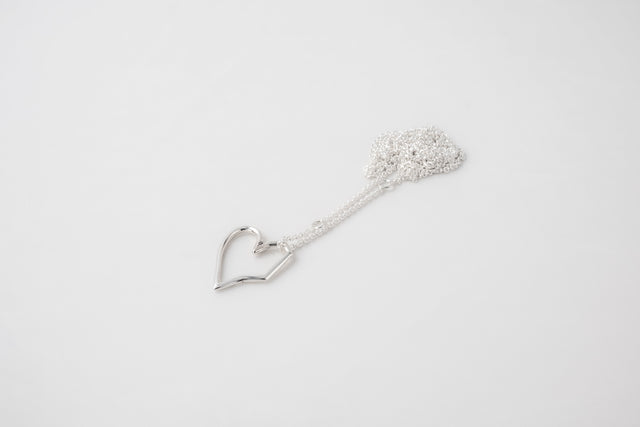
What actually decides whether a ring gets worn?
Mass, relief, patina and the architecture of the form decide whether a ring gets worn or drawered — not the price per gram. That is the difference from the "almost-gold until I can afford platinum" reading this category usually gets. Sterling silver behaves differently on a man's hand: weight tells, the profile tells, and geometry has to stay legible at the scale of a finger.
STRUGA has made men's rings since 2018; they are cast and finished by hand by master silversmiths at the Bali workshop, and we don't rhodium-plate them — the metal is left alive. Nine rings are in the catalogue right now, from 2,1 to 24 grams, in sizes 15 to 22. This guide is about choosing one that works on your hand for decades instead of sitting in a drawer for a year — and it names what we do not make, because that is the half of a buyer's guide most brands leave out.
TL;DR
- A STRUGA men's ring = 925 sterling silver, 2,1 to 24 grams, hand-finished at the Bali workshop; the median across the range is 8 grams, not the 15–20 the category advertises.
- No rhodium, no mirror polish on the final pass — the finish is Living Silver. The metal darkens with wear and records time.
- Rings live in six families: Brutalism (the only ones above 14 g, and the only ones offered dark from day one), Thorn, Signature Asymmetric, Signature Heart, Fused and Experimental. Blade has no ring — it lives in bracelets, chains, earrings and ear cuffs.
- The dark side is its own territory — see the guide to dark silver.
- No ring in the catalogue carries a stone: tourmaline and aquamarine live in the earrings, the Seymchan meteorite in two necklaces, Aged Copper in the Big Line. A ring with any of them is a Custom Order.
- Matched wedding bands — the Dark Union service, 2–4 weeks from sketch approval.
- Non-standard sizes, engraving, bespoke design — Custom Order.
Why men choose silver over gold
The old logic was simple: gold for women, gold for men — same gold, just thicker and without stones. Yellow, smooth, heavy, visible. If a man wore a ring, it was almost always a wedding band or his father's signet. A ring of his own choosing — that wasn't really an option.
Over the last fifteen years, that broke. Silver came back into men's wardrobes not as "the cheap alternative to gold," but as a material with its own character. And that character is fundamentally different.
Gold is the material of stability. It doesn't darken, doesn't react to sweat, doesn't change with wear. A ring bought at 25 looks the same at 45. That's its promise and also its ceiling: gold doesn't record time. It stays a decorative metal that you wear on top of your life, not alongside it.
Silver works differently. It reacts to air, to skin, to water, to friction. Recesses darken, raised surfaces polish themselves against a shirt cuff, and after a year the ring doesn't look "like new" — it looks like yours. That's what we call Living Silver — silver that isn't sealed under rhodium and lives together with its owner. For a deeper read on how dark silver behaves on the hand, see our separate guide.
Then there's the aesthetics. Yellow gold on a man's hand always reads as a status statement: "I can afford gold." Silver makes no such statement. It reads as a choice of material — industrial, cold, graphic. Next to a leather jacket, a black sweater, a tattoo, the worn steel of a watch case — silver rhymes. Gold next to that looks foreign.
And the final reason — mass. The men's ring the category advertises weighs 15–25 grams. In gold, that ring costs as much as a small car and is physically heavy for daily wear. In 925 sterling silver the same volume stays accessible and light enough that you don't take it off at night. That's what makes architectural forms possible — Brutalism, Thorn — shapes that simply wouldn't make sense in gold.
Silver for men today isn't a compromise. It's the first choice for those who care about the material, not the price per gram.
A short history of the men's silver ring
A ring on a man's hand is older than jewelry as fashion. It began not as an accessory but as a tool.
The signet ring. In Mesopotamia, Egypt, later in Greece and Rome, men wore a ring set with a carved stone or metal matrix and used it to seal letters, contracts, amphorae of wine. The signet was signature, password and status marker in one — without it, no document could be closed. That function survived in European aristocracy well into the 19th century: the signet ring was passed down the male line and still pressed wax onto envelopes.
Rings on the thumb. Across warrior cultures — from the Scythians to the Mongols and the Turks — men wore a heavy ring on the thumb of the right hand. For archers it was functional: it protected the thumb when drawing the bowstring. For everyone else it became a sign of rank and belonging.
Tribal and ritual rings. Silver, as a material, worked in a ritual register almost everywhere people learned to melt it — among the Baltic tribes, in the Caucasus, in Southeast Asia, among the Bedouin. Massive rings with rhombuses, crosses, spirals, rough stones — a whole anthropological layer of its own.
The 20th century — the comeback. Silver rings returned to mainstream men's culture through rock and punk. Keith Richards with his skull ring by Courts and Hackett, bikers with heavy cast rings, the gothic scene of the eighties with its weighty crosses. This was no longer a signet, no longer a status object — it was a badge of counterculture.
The brutalist renaissance. In the nineties Chrome Hearts set the template: heavy sterling 925, gothic forms, an oxidized finish, massive architecture. Out of that school, from the 2010s onward, came a whole generation of independent brands — we are one of them. More on this wave in our breakdown of Chrome Hearts alternatives. Today's men's silver ring is heir to all five traditions at once: the signet, the warrior's ring, the tribal sign, the rock attribute, and the brutalist architecture.
Five criteria for choosing a men's ring
Choosing a men's ring comes down to five parameters that work together. Weight, fit, proportion to the hand, alignment with your wardrobe, and intent. If even one of them is ignored, the ring either doesn't get worn, or doesn't get worn the way you wanted.
1. Weight. The category advertises 10–25 grams as the working range, and the upper limit is real: above 25 grams a ring becomes a sculpture that's hard to wear daily — the finger tires, the ring gets in the way when you make a fist, hold the wheel, type on a keyboard. The lower limit is not ours. Across the 66 size variants in this catalogue the median is 8 grams and forty of them sit below 10 g; those rings read as men's through width and proportion, not through mass. Brutalism holds the top of the range at 9.6–24.0 g, Signature Asymmetric covers 2.1–13.0 g, Thorn runs 4.7–12.7 g. Weight follows the size as well as the model: the same Brutalism is 9.6 g in size 15 and 24.0 g in size 22, so the number that matters is the one at your size.
2. Fit and comfort. The inner surface matters more than the outer one. A sharp inner edge will chafe over the course of a day, even on a beautiful ring. On all of our rings the inner edge is rounded during finishing. The size should sit loose: your finger changes by half a size between morning and evening, and another half-size in heat. If the ring fits snugly in the showroom, it won't go on the next morning. Go up by a quarter to half a size, especially for wider profiles — at 4 mm and above you feel the inner surface much more than at 2 mm.
3. Proportion to the hand. A thick finger needs mass — a thin band on it looks like a wedding ring borrowed from someone else. A thin finger calls for restraint — a heavy Brutalism piece looks like it belongs to another person. Simple rule: the width of the ring shouldn't visually exceed the width of the phalanx beneath it. When in doubt, try it on in front of a mirror, not at the counter.
4. Alignment with your style. The ring should rhyme with what you actually wear day to day. A dark palette, leather, wool, monochrome — this is the territory of dark silver. Light linen, suits, classic tailoring — open silver without oxidation works here. Mixed wardrobes call for neutral families like Signature Asymmetric.
5. Intent. Statement or everyday. A statement ring is one per hand, massive, readable from two meters away. An everyday ring is the one you take off once a year: quieter in form, more comfortable in fit, calmer in silhouette. These two jobs are rarely done by the same ring. Knowing which one you're actually buying saves both money and regret.
Sterling silver 925 for men: what to know about the metal
Sterling silver 925 is an alloy: 92.5% pure silver and 7.5% other metals, most often copper. Pure silver (999 fine) is rarely used in jewelry — it's too soft, bends under the weight of your own hand, scratches against any surface. Those 7.5% of copper give the alloy enough strength to hold its shape through daily wear instead of going oval within six months.
This formula is the global standard for jewelry-grade silver. The UK fixed it back in the 12th century — that's where the name "sterling" comes from, after the sterling coin. The US adopted it in the 19th century, and Europe works to the same composition. When you see "925" stamped inside a ring, it means exactly that proportion. Our pieces are 925 silver; for how to check 925 authenticity on someone else's piece, see our how to verify 925 guide. The full technical breakdown of the standard is in the 925 sterling silver guide.
The copper isn't a flaw — it's a feature. It's what determines how silver behaves over time. Copper oxidizes faster than silver, and on contact with air, sweat, and skin oils it produces that characteristic patina: graphite in the recesses, a warm shadow along the edges. The higher the share of pure silver in the alloy, the slower a piece darkens; the higher the copper, the more active the process. 925 is the equilibrium point — strong enough for daily wear, while keeping that "living" surface behavior. For more on why we don't suppress this process with rhodium, see our piece on dark silver.
For men's rings, 925 also works well by weight. Density has to be read on the alloy, not the pure metal: sterling 925 is about 10,4 g/cm³ against 15,6 for 18k gold — a difference of roughly one and a half times, not the double you get by comparing pure silver with pure gold. In practice a ring of 18–22 grams reads as a real object on the finger without dragging the hand down; the same volume in 18k gold would be noticeably heavier, and not every hand takes that as daily wear.
Dark silver in men's rings
If a man wears one ring, and wears it every day, that ring comes in three possible surface states: bright polished silver, rhodium-plated silver, and dark silver. On a man's hand, the third option works better than the other two — and not for fashion reasons, but for physical ones.
Bright polished silver on a large men's form shines like a mirror and pulls in every light in the room. That's fine for a thin minimalist band, but it's bad for a massive 15–20 g signet: the shine visually flattens the form, the relief reads worse, and next to the matte steel dial of a watch or matte cufflinks the ring drops out of the ensemble — it looks like the only "dressed-up" piece on the hand. Rhodium-plated silver behaves the same way, plus it looks identical a year later.
Dark silver removes that problem. The surface isn't a mirror but a matte body with patina in the recesses and lighter raised planes. Light on it works with the form, not against it: edges, chamfers, geometric breaks read directly. On a man's hand — with hair and visible veins — a dark ring settles into a natural contrast. It doesn't glow separately from the hand; it's in the same tonal range as the hand. The watch, cufflinks, belt, bracelet — everything that's usually dark and matte — starts working with the ring in one palette instead of competing with it.
In practice it looks like this. On most STRUGA men's rings — especially in the Brutalism and Thorn families — the patina is built in from day one: the recesses are dark from the moment you receive the ring, while the raised areas are left open to keep living. This is our Living Silver finish: no rhodium, no protective lacquer, sterling 925 left open. After 2–3 months of daily wear, the raised planes polish themselves through friction against the keyboard, the steering wheel, door handles, and the ring settles into its steady-state phase — deep graphite in the relief, a warm restrained glow on the edges, visible mass.
That's the core difference from everything else in the category: the ring records how you live, instead of hiding it under "new".
STRUGA families for men's rings
The brand has five core design families, and each one contains rings that men wear as everyday objects. Family names stay in English across all locales — this is brand naming, not subject to translation.
Brutalism
The heaviest, most architectural rings in the catalogue. Developed in collaboration with an architect, drawing on Soviet brutalism — mass, concrete, right angles, planes meeting head-on. Two versions exist: V.1 — open geometry in light silver that darkens with wear, and V.3 — finished dark from day one, with relief that reads immediately. This is the brand's central men's piece and the only ring we make above 14 g: V.1 and V.3 both run 9,6 g at size 15 up to 24 g at size 22 — the mass grows with the size, visible thickness, tangible weight. Inside Brutalism lives a separate line, Suprematism, where Malevich's suprematist cross appears as an invisible depth in the pattern.
Blade — the family without a ring
Blade started with a chain link: two halves joined by copper pins, sharp edges and planes as if cut from sheet stock. Twenty pieces carry that DNA — bracelets, a choker, necklaces, earrings, ear cuffs — and not one of them is a ring. We say so plainly because guides in this category routinely describe rings a brand does not make. If the Blade language is what you want on the hand, the closest ring we do make is Double Line — flat profile, visible assembly, 6 to 13 g — and a Blade ring itself is a Custom Order.
Thorn
Sharp, spiked, angular forms. The Thorn ring is where the family meets Brutalism: sharp spikes over architectural mass, reading on the finger as a single ritual object. Stacked with Brutalism V.1 or V.3, Thorn locks in tight — the result is one large structure across three vertical levels. The Big Thorn Bracelet — the brand's first rigid cuff — rhymes with this stack on the wrist. Thorn is our most "ritual" family, and dark silver is its natural finish.
Signature Asymmetric
The brand's most recognisable form. The asymmetric silhouette — one side rounded, the other angular — recurs across pendants, clasps, links, rings and ear cuffs. On a man's finger, Signature Asymmetric reads graphically: patina on one side, polished plane on the other, the volume visible even in a flat photograph. A ring that works as a signature — never dominant, always identifiable.
Signature Heart
The STRUGA heart, reinterpreted: rounded on one side, angular on the other. Solid Heart itself is an earring and a necklace — the ring in this family is Heart Lock, 11 g in every size from 16 to 22. At that volume the form stops being decorative and becomes an object: a heart with weight, not a symbol. It arrives bright and darkens where the hand doesn't touch it, so the outline reads more strongly after a year than on the day it came.
One correction to how this is usually sold: of the rings in the catalogue only Brutalism V.3 leaves the bench dark. Every other ring arrives in open silver and darkens on the hand — the dark finish is earned, not applied. A dark finish from day one on any other form is a Custom Order.
The nine rings, by weight and size
Weight moves with size on every ring that has more than one variant, so the table gives the range across sizes 15–22 rather than a single number. These are the figures from the catalogue, not a category average.
| Ring | Family | Sizes | Weight |
|---|---|---|---|
| Brutalism V.1 | Brutalism | 15–22 | 9,6–24 g |
| Brutalism V.3 — dark from day one | Brutalism | 15–22 | 9,6–24 g |
| Thorn Ring | Thorn | 16–22 | 4,7–12,7 g |
| Double Line | Signature Asymmetric | 16–22 | 6–13 g |
| Heart Lock | Signature Heart | 16–22 | 11 g |
| Fused Cross | Fused | 16–22 | 3,7–9 g |
| Signature Links V.1 | Signature Asymmetric | 16–22 | 2,7–6 g |
| Signature Links V.2 | Signature Asymmetric | 16–22 | 2,1–5,5 g |
| Triple Drills | Experimental | 15–22 | 3,1–4,5 g |
Read the table against the category's own advertising and one thing stands out: the median across all sizes is 8 grams, and forty of the sixty-six variants sit below 10 g. The 15–25 gram men's ring the market talks about is, in our catalogue, two rings — both Brutalism, and only in the larger sizes.
Stones in men's silver rings
Start with the fact, because it decides everything after it: not one of the nine rings in the catalogue carries a stone. Every ring is 925 silver and nothing else. The materials below do exist at STRUGA — they live in other pieces — and a ring built around any of them goes through Custom Order, which is a different route with a different lead time.
The principle first. A clear faceted crystal off a display case rarely belongs on a man's hand — it reads as decoration. A stone works when it is a material with character rather than sparkle: one that has weight, texture and history, and rhymes with silver instead of arguing with it.
| Material | Where it lives at STRUGA | On a ring |
|---|---|---|
| Black tourmaline (schorl) | The earrings — raw untreated crystals, natural facets, matte black | Custom Order |
| Raw aquamarine | The earrings — uncut, matte, visible internal fractures | Custom Order |
| Seymchan meteorite | Two necklaces — pallasite, iron-nickel matrix with olivine, Widmanstätten pattern from etching | Custom Order |
| Aged Copper | The Big Line necklaces — copper running alongside silver, with its own green-brown patina | Custom Order |
Black spinel appears in most men's ring guides and it is worth saying that we do not work with it at all — there is no spinel anywhere in the catalogue. Naming a stone a brand does not use is the ordinary failure mode of this genre, and this page carried it until today.
Full detail on the meteorite and how it is cut is in the guide Seymchan / meteorite jewelry. The general rule stands either way: a stone in a men's ring is a structural element, not ornament. If it carries no meaning, leave it out.
Living Silver finish for everyday wear
Most mass-market silver in retail is rhodium-plated — a thin layer of platinum-group metal that shields the surface from tarnish and makes it brighter. The logic behind rhodium is simple: the piece should look "showroom-fresh" a year, two years, five years in. The downside is just as simple: rhodium wears off at friction points — the inner band, the upper edges of the ring, the corners. First yellow patches show through, then gray ones, and eventually the piece goes back to a jeweler for re-plating.
STRUGA uses no rhodium. Every piece we make is sterling 925 left open, with no protective layer on top. We call this approach Living Silver finish — silver that's alive. The idea is that silver as a material knows how to change on its own: recessed areas slowly darken from air and skin oils, raised planes stay bright through friction, and the relief reveals itself more strongly over time than on day one. A year in, the ring looks richer than it did the day you got it. Two years in, it's literally "yours" — it follows the habits of your hand, laying dark shadows exactly where you touch it least.
On men's rings this process is especially pronounced, because men's wear is usually harder than women's. Hands at work, at the gym, on the wheel, on the keyboard, underwater. If a man works with his hands, patina builds faster and more evenly — the ring settles into a stable tone in 4–6 weeks. With quieter, office wear, the process takes 2–3 months, but the patina pattern comes out finer and more contrasted, because the friction is more localized.
The bottom line is simple: with dark silver, a year in, a man has a ring with a history — not a preserved object kept in a box. More on the principle in our piece on dark silver.
Sizing and weight: how a men's ring should sit
Ring size in the metric system is the internal diameter in millimetres. Our rings are sold in sizes 15 to 22 — Brutalism and Triple Drills from 15, the rest from 16 — which covers a finger circumference of roughly 47 to 69 mm. Country scales differ: a metric 19 is a US 9 and an EU 59. Every product page carries a conversion table, and if the ring is a gift, write to us and we will work it out together. Sizes outside 15–22, half sizes and thumb rings go through Custom Order.
One practical rule matters most. If you're between two sizes — go up by half. A finger changes through the day: thinner in the morning, wider by evening, noticeably larger in heat, smaller in cold. A heavy ring that fits "snug" in the showroom becomes a problem on an August evening. Half a size of margin solves this without sacrificing the fit.
The internal profile of the ring is called comfort fit — a slightly rounded inner edge. Not flat like cheap casting, but chamfered so the metal slides over the finger when you put it on and doesn't dig into the skin when you make a fist. All our rings come with comfort fit by default — it's a baseline part of the hand-finishing at the Bali workshop.
By weight, STRUGA men's rings fall into three categories.
Light (2–10 g). Narrow profiles. On the finger it feels like something you are used to — you forget you are wearing it. Two thirds of our ring variants sit here, Signature Links and Triple Drills among them; it works in a stack and works as a wedding band.
Medium (10–14 g). You feel the weight, but it does not get in the way. Heart Lock at 11 g, Double Line and Thorn in their larger sizes live here — the default format for daily wear.
Heavy (14–24 g). Massive architecture, and in our catalogue this band holds exactly two rings: Brutalism V.1 and V.3, and only from the middle sizes up. Nothing we make goes above 24 g — the 30-gram men's ring belongs to other brands.
If you already own a ring that fits perfectly — measure its inner diameter with calipers and send us the number. It's more accurate than any paper sizer.
Stacking Men's Rings
Stacking means wearing several rings on one hand at the same time, deliberately composed into a single look. For women it's been the norm for a while; for men it's still rare — but men's hands, with their mass and finger proportions, actually read stacks very well.
The base logic comes down to two strategies.
Single statement. One large architectural ring, the rest of the fingers empty. This is the play for Brutalism and for the heavier rings from the RITUAL world. When you have 20 grams and more of silver concentrated in one spot, nothing else belongs nearby — a second ring would break the silhouette. This works strongest in the evening, in dark clothing, when the entire visual weight is given to the hand.
Stack of 2–3. Two or three thin rings across different fingers, tied together by a single formal language. The principle is what matters: either all from the same family (two thin Signature Asymmetric links rings on index and middle finger), or a contrast within one palette — a thin Signature Links on the index plus a Thorn on the pinky. In dark silver the stack reads denser: the patina binds the rings into one object.
The thumb + index combination is the strongest men's stack. The ring on the thumb gives mass, the ring on the index gives line, and between them the hand reads as architecture.
From our ready pieces the light rings stack best: Signature Links V.2 at 2.1–5.5 g, Signature Links V.1 at 2.7–6.0 g, Triple Drills at 3.1–4.5 g and Fused Cross at 3.7–9.0 g. A Blade profile cannot join a ready stack — that family has no ring, and on the hand it is a Custom Order. The same door covers a non-standard size or a custom-built combination. Day mode — the stack; evening mode — strip everything off except one. That's the working rhythm.
Wedding Bands — Dark Union
A man's wedding band is the longest-worn piece of jewelry in his life. It doesn't come off at night, doesn't get tucked into a box under the suit, doesn't get picked "to match the look." It lives on the hand for decades — at work, in the gym, in water, in cold, under a shirt cuff and under a glove. Which means it follows a completely different design logic than any other ring in your collection.
Most men who come to us for a wedding band start with one sentence: "I don't want plain yellow gold." From there the conversation moves to material, profile, width, inner surface. And almost always — to wanting something that will outlive the wear, not be worn down by it.
The Dark Union service is bespoke matching bands, 2–4 weeks from sketch approval, shipped worldwide. You can choose:
- profile and width — from a narrow 4 mm band to architectural 8–10 mm Brutalism;
- inner surface — comfort fit (rounded, so the ring disappears on the finger) or flat;
- depth of oxidation — from a barely-there patina to deep, dark geometry;
- engraving — dates, initials, coordinates, symbols; engraving reads deeper in dark silver;
- inlays — raw tourmalines, Seymchan slices, accents in Aged Copper.
The principle behind Dark Union: matching bands should not look identical a year in. Two people live at different rhythms, and silver records that — each ring develops its own patina. That is the point of wearing it: to read time in the metal, not status.
Custom Order for non-standard sizes and shapes
Our catalogue rings are sold in sizes 15 to 22 — inner diameter in millimetres, roughly a US 4 to a US 11. That leaves real hands outside the range in both directions: large hands above 22, narrow fingers below 15, thumb rings, and every half size. For all of these there is Custom Order.
Custom Order isn't just "make it in my size." It's a full re-build of the piece around one specific person. What's included:
- Size outside the catalogue range of 15–22, including half sizes. We measure from an existing ring or through a printed template.
- Inner engraving — dates, initials, coordinates, short phrases. Deep enough to still read after ten years of wear. On dark silver, the contrast is especially sharp.
- Material swap — a ring from the Brutalism family with an integrated Seymchan slice, a Blade ring with an Aged Copper accent, Thorn with rough tourmaline or aquamarine.
- Proportion changes — narrow a massive ring for a slimmer finger, or add weight to a lighter profile.
- Fully custom shape — built from a conversation and sketches.
Lead time is 2–4 weeks from sketch approval. Wedding bands run on a separate track through Dark Union.
I personally consult on every non-standard men's ring. That's not a marketing line — it means that before the workshop begins, you and I go through the sketch, the size, the weight, the finish, the patina tone. Custom Order is the only way to get a ring made for your hand, not for an average one.
Where to buy STRUGA men's silver rings
A few channels, depending on where you are and whether you want to try a ring on before buying.
Online. Our international store is strugadesign.com — prices in USD, worldwide shipping with tracking; the Russian store is strugadesign.ru, prices in roubles. A ready piece from the catalogue is made in 2–4 weeks, often sooner, and the transit takes about seven days. Standard cart, card payments, and the usual checkout systems. Every order ships from the Bali workshop, cast and finished by hand under direct supervision.
On Bali — try on and walk out with it. Hedonist Store and Barefoot Aristocracy are two partner concept stores in Canggu and Ubud carrying part of our men's ring collection. Addresses and hours are on the Contact page. Useful if you're passing through Bali and want to feel the ring physically before buying — 18–22 g of silver sits on the finger very differently than it photographs.
Made to order. Non-standard size, engraving, or reworking an existing shape — through Custom Order, 2–4 weeks from sketch approval. Matching men's wedding bands are a separate service, Dark Union, also 2–4 weeks from sketch approval. A ready piece from the catalogue is made in 2–4 weeks, often sooner, and ships in about seven days. A ring with a meteorite slice in your own size is also Custom Order — more in the piece on Seymchan meteorite jewelry.
Sources and further reading:
- Wikipedia — Sterling silver — on the composition of 925 silver
- Assay Office London — what hallmarking is — who verifies the 925 standard and how the mark is struck
- Bali silver jewelry guide — on handmade work in Bali
- How to verify 925 — practical hallmark checks
Related Reading
Frequently asked questions
Didn’t find the answer — write to us, we reply personally.
Ask a question →01What's the average weight of a men's silver ring?+–
The median across our 66 size variants is 8 g, and the whole run is 2.1 to 24.0 g — forty of those sixty-six sit below 10 g. By family: Signature Asymmetric covers 2.1–13.0 g, Thorn 4.7–12.7 g, Fused 3.7–9.0 g, Signature Heart 11.0 g, Experimental 3.1–4.5 g, and the heavy Brutalism rings 9.6–24.0 g. Nothing we make goes above 24 g. Weight follows the size as much as the model — the same Brutalism is 9.6 g in size 15 and 24.0 g in size 22 — so ask for the number at your size. If it's your first silver ring, 6–10 g is the honest place to start.
02Can I wear a silver ring every day?+–
Yes — and for sterling 925 that is the right regime. Daily wear builds an even patina: friction polishes the raised surfaces, the recesses darken, and after 2–3 months the ring settles into balance. Take it off in three situations: swimming pools (chlorine attacks the surface), beach and sea (salt accelerates tarnish), and the gym with heavy weights (mechanical deformation). Showers, dishes, ordinary water — fine. Sterling 925 is a working metal; it isn't afraid of daily life, only of aggressive chemistry and abrasives.
03How is a men's ring different from a women's?+–
Mostly mass and proportions — but the category's numbers are not ours. It talks about 10–25 g for men against 4–10 g for women; in our catalogue the median men's ring is 8 g and forty of sixty-six variants are lighter than 10 g, so that split does not survive contact with the actual range. Width and diameter carry the signal better: a 6–12 mm band and a 19–22 mm inner diameter read as men's, 2–6 mm and 16–18 mm as women's. The line stays fuzzy anyway — women regularly buy our heavy Brutalism rings for the architectural mass, and the light Signature Asymmetric links go both ways. The men/women split is really about size and proportion, not about form or aesthetic.
04How do I care for a men's silver ring?+–
Don't use polishing paste or abrasives — that strips the patina, which is the whole point of Living Silver. If the ring has gone duller than you'd like, use a soft silver cloth on the raised surfaces only, no pressure, staying out of the recesses. Take it off at the pool, the beach, and the gym with weights. Store it dry. If you want to halt tarnish, a sealed pouch with an anti-tarnish strip works well. Once a year you can hand it to a jeweler for a light refresh if it has picked up deep scratches. More detail in our Bali silver guide.
05Can I order a non-standard size?+–
Yes, through Custom Order. We do non-standard sizes from 14 to 25 (inner diameter), half-sizes included. Lead time is 2–4 weeks from sketch approval. Custom Order also covers engraving (inside or outside), setting a specific stone, adjusting band width or ring weight, and reworking an existing design to fit your hand. If you're between sizes, go up — sterling 925 settles slightly to the shape of the finger over time.
06Is silver appropriate for a wedding band?+–
Yes, and for us it's the natural choice. Sterling 925 behaves differently from gold in a wedding band: it records the life you live together. After a year, a couple sees two different patina patterns on two rings — each partner has their own rhythm of wear, and the metal shows it. The Dark Union service produces paired wedding bands made to order, 2–4 weeks from sketch approval. You choose the level of oxidation, the profile width, engraving, and inserts. Silver is cheaper than gold, but in our logic it's more honest: it shows time rather than freezing the moment.
07Is STRUGA silver or white gold? Why silver?+–
Only sterling 925 — no white gold options. Two reasons. First, material: silver is alive. It reacts to air, to skin, to wear; it changes. Rhodium-plated white gold looks identical at one year and at five — that's its promise, and it's the opposite of Living Silver. Second, economics: at the same mass, sterling 925 costs 6–8 times less than white gold, which lets us build massive architectural forms without losing the point. If you want white gold, go to the classical brands; we're doing something else.