Silver or Gold: Choosing Jewelry for Daily Wear
For daily wear, choose silver or gold by the particular piece: its alloy, surface, fit and care. Uncoated sterling silver darkens over time. Gold jewelry changes with wear too, and its alloy and coating need separate attention. Compare what you will actually wear each day.
Check the fineness and coating. Try the form with familiar clothes. Ask about care for both the metal and the inlays.
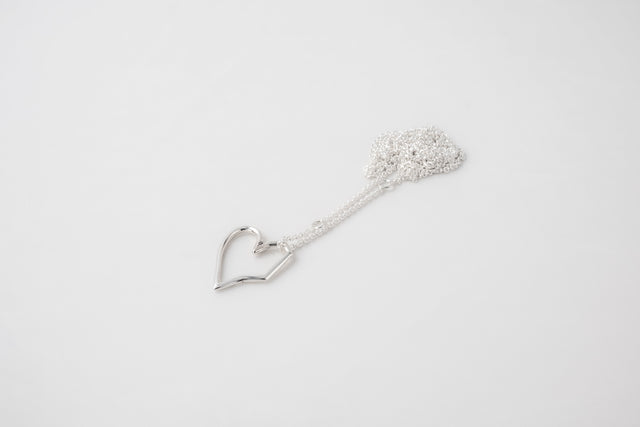
In STRUGA's Big Line Classic Aged on the chain, a silver chain carries a carbon form with aged copper. The word “silver” does not describe the whole object.
Updated September 14, 2026
This object belongs to CARBON in the RITUAL world. The Atlas explains the difference between an alloy and its surface through 925 silver and Living Silver.
Silver or gold: where to start
Put two pieces you would actually wear side by side. Look at colour and scale first, then fineness, coating, fastening and fit. When comparing the prices of two pieces, note their mass, construction, inlays and work.
925 denotes 92.5% silver. A 750 mark denotes 75% gold; 18K describes the same fraction as 18 parts in 24. The US Federal Trade Commission explains these markings. The numbers do not list the alloy's remaining components or tell you whether a coating sits on top.
If you want a yellow or rose colour, compare the relevant gold alloys. If you prefer bright silver with dark recesses, examine the chosen silver object's surface. A white colour alone cannot distinguish silver from white gold: GIA explains that white gold is often rhodium plated, and that layer can wear away over time.
What changes in daily wear
| What to compare | Silver | Gold |
|---|---|---|
| Alloy | 925 means 92.5% silver; ask separately about the remaining components | For example, 750 / 18K means 75% gold; colour depends on the alloy |
| Surface | Uncoated silver darkens; the finish may be bright or darkened beforehand | Check alloy colour and coating; rhodium on white gold may need renewing |
| Daily use | Check the form's thickness, connections, fastening and fit | Check the same parts; the metal name does not make a piece invulnerable |
| Care | Keep patina or lighten selected areas with the finish in mind | Choose care by alloy, coating, stones and construction |
| Budget | Compare the price and configuration of the specific object | Compare the price and configuration of the specific object |
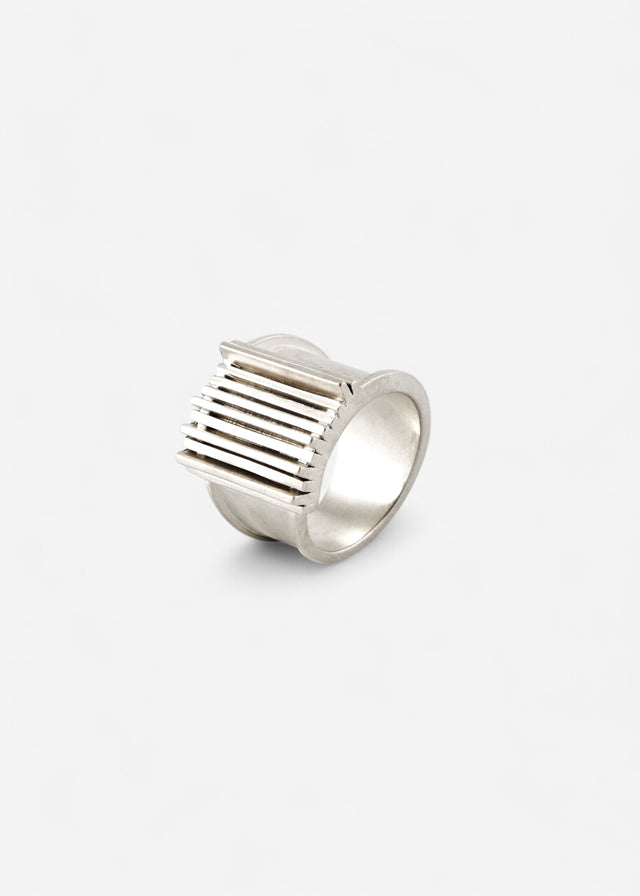
For an everyday ring, check size and projecting parts. For a bracelet, check circumference and fastening. For an earring, check its attachment and how it sits on the ear. These actions are more useful than a blanket promise that one metal is always more comfortable.
Living Silver and oxidized silver
Silver darkens through contact with sulfur-containing compounds. The Canadian Conservation Institute describes the silver sulfide layer and the environment's effect on its formation. An exact timetable for tarnishing cannot be assigned to every object in advance.
For STRUGA, patina is part of how a surface behaves. Living Silver denotes 925 silver without rhodium plating: raised areas brighten through contact while recesses darken. Oxidizing is a separate process that darkens silver beforehand. A material property and a finishing process are different things.
Asymmetric Destroyed Necklace is a flat silver form with deep gouges and a surface darkened in advance. It is a dark version of SIGNATURE ASYMMETRIC in CODEX. In the Signature Asymmetric Pyramid Necklace, the same language of planes becomes a volume. Choose the surface together with the form.
A silver pendant: scale and placement
A small pendant leaves a point near the neckline. A large form occupies more of the chest and needs room around it. Change the chain length and see where the object meets a collar, a seam or a pattern in the fabric.
Women's and men's silver pendants are search categories, not measurements of a person. STRUGA chooses form by the body: a fine chain and a small pendant can work on anyone, as can a larger volume. Try the object on, turn and bend; check whether it catches on clothing.
The pendant Atlas compares constructions. A silver pendant, a carbon object on a silver chain, and Signature Cross V.3, made of carbon with a silver element, need different descriptions. Look at the whole composition.
Choosing a chain length
The same length will not sit at the same height on everyone. Neck circumference, body proportions, pendant length and clothing all matter. Instead of assuming “50 cm always sits on the chest”, measure a chain you already wear and note its lowest point.
Thorn Links Chain has catalog lengths of 40, 45, 50 and 75 cm. Long Chain with Signature Asymmetric Links measures 120 cm. These are dimensions of specific chains; check the product page for the selected variant's availability.
Choose where you want the object to sit, then check the length in the chain and necklace size guide and compare constructions in the necklace collection. A chain can carry a pendant or be a form in its own right.
Both metals need care
A gold object does not stay unchanged simply because it is gold. GIA gives the example of a gold ring whose band thins through ordinary wear, and explains why cleaning products must be chosen with the stones and alloy in mind. One method cannot be applied to every piece.
With silver, decide which areas you want to lighten. A polishing cloth changes the surface; dark recesses and a matte finish should not automatically receive the same treatment as smooth planes. CCI cautions that removing tarnish also removes some metal. That is no reason to polish constantly.
Dry an object before storing it and keep it separate so edges and inlays do not rub against neighboring jewelry. For a complex surface, gemstone, coating or composite object, check the instructions for that model first. Our silver care guide covers the next steps.
Choosing an object at STRUGA
STRUGA works with 925 silver and combines it with carbon, copper and other materials in particular objects. The worlds help you read the forms: CODEX uses recurring geometric elements, RITUAL dark surfaces and material combinations, and LAB experiments with familiar objects. Classic + Pills Earring turns a capsule and tablet into a silver mono earring.
For the international market, STRUGA objects are made in Bali. The catalog at strugadesign.com shows configurations, dimensions and available options. For a form outside the catalog there is Custom Order; paired and wedding objects belong to DARK UNION.
A final check before choosing
Compare two actual pieces with familiar clothes. Does the size work? Do you like the surface? Are the composition and care clear? Does the selected configuration fit your budget? Those answers build a choice between silver and gold without expecting one metal to solve everything.
A 925 mark states the claimed fineness. Surface irregularity, weight or a photograph alone cannot prove composition or how the object was made. Our sterling silver guide explains fineness and the limits of these checks. Questions about the chosen object can go to a person at STRUGA.
Frequently asked questions
Didn’t find the answer — write to us, we reply personally.
Ask a question →01Which is better for daily wear: silver or gold?+–
Compare specific alloys, coatings, form, fit and care. Uncoated silver darkens; gold jewelry changes with wear too. Check the fit of the particular piece and the care its materials need.
02Is Living Silver the same as oxidized silver?+–
No. Living Silver denotes STRUGA 925 silver without rhodium plating, which darkens over time. Oxidizing is a separate process that darkens the surface beforehand.
03Is patina a defect?+–
For STRUGA, patina is a surface property and part of the object’s character. It can be kept or removed from selected areas by a suitable method; fastenings, connections and inlays need a separate assessment.
04Is 925 a lower quality than pure silver?+–
It describes the silver fraction of an alloy: 92.5%. Higher fineness alone does not make every construction more comfortable or stronger. The number 925 does not establish that all of the remaining 7.5% must be copper.
05Has dark silver always darkened with age?+–
No. Some surfaces darken during wear; others are darkened beforehand. A product description should distinguish Living Silver from deliberate oxidizing. The same dark colour can have a different history.
06How can you check handmade silver?+–
Ask the seller about the stated fineness, materials and method of making. Weight and surface irregularities alone cannot establish authenticity or the method of making.