Men’s Silver Cross: Geometry, Material and Meaning
Short answer. A contemporary silver cross can be read as geometry, a cultural sign and a personal symbol at the same time. A Suprematist reference describes a visual language; it does not assign belief to the wearer. Use a three-part check: observable form, verified material and measured fit. Leave personal meaning with the person who wears it.
Updated 29 August 2026. The art context is checked against Tate, silver terminology against current regulation, and care against a government conservation source. Verify dimensions, components and availability for the selected object in the live catalogue.
Use Suprematism as an art reference, not an attribution
Tate defines Suprematism through basic geometric forms and links its foundation to Kazimir Malevich around 1913. Squares, circles, rectangles and lines act as elements of an abstract composition rather than illustrations of visible objects. This source gives a reliable context for discussing proportion, axis and balance.
| Source-bound statement | Unsupported leap to avoid |
|---|---|
| The form uses a geometric visual vocabulary | The pendant is a historical artwork |
| The composition can recall Suprematism | It is a replica of a named painting |
| A catalogue title provides design context | A museum source attributes the jewellery |
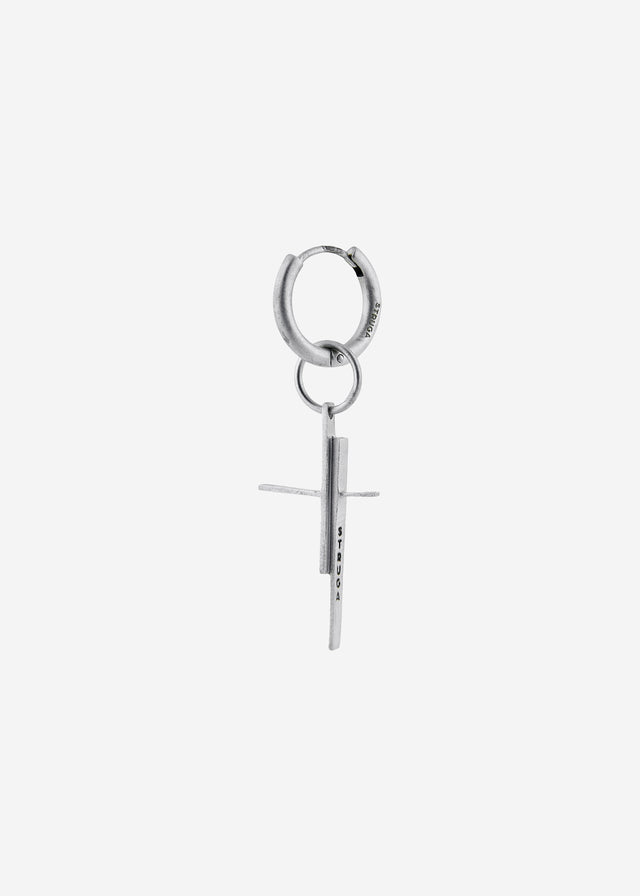
The careful wording is therefore “Suprematist reference” or “geometric art language”. A model name such as the Classic + Suprematism Cross Earring identifies STRUGA’s published route for that object, while Tate’s page defines the movement. Neither fact proves an unrecorded date, authorship or direct copy. Definition and attribution stay two separate source roles.
Separate visible form from the wearer’s personal meaning
A cross can carry religious, cultural, family, artistic or private associations without one description deciding among them. Geometry is observable; personal significance is not a product specification. Treating those layers separately prevents both erasing a religious reading and assigning one to every wearer.
- Describe the outline, proportions, surface and materials as object facts.
- Describe an art reference only to the extent supported by form and source.
- Use the maker’s published collection context for design statements.
- Leave belief, memory and personal symbolism to the owner.
If meaning matters before purchase, read the exact model description and compare it with your own associations. A broad search label such as “men’s cross” cannot establish intent. Ask the seller about documented design context, but recognise that the final interpretation may remain deliberately open. One rule holds throughout: interpretation follows evidence. Keep two records — the listing before purchase and the object after receipt.
Read axis, mass, space and contrast in that order
Begin with the outer silhouette, because it remains visible before small detail and surface texture. A long vertical extends the body line; a broad horizontal makes the object feel more stable. Moving the intersection changes the centre of visual weight even when the same two axes remain.
Mass and empty space
A solid construction reads as a dense sign, while an outlined form allows clothing to become part of the composition. Openings also change apparent scale: a large contour can feel lighter than a smaller solid piece.
Light and dark
- Bright edges clarify geometry in direct light.
- Dark recesses increase depth and preserve the drawing at distance.
- An insert creates another visual plane inside the silver boundary.
- Rotation changes which edge catches light first.
These are visual observations, not claims about technique. Construction must come from the listing for the exact model. Compare the two axes and the surface cues at arm’s length before zooming in, then make one final comparison without zoom.
Read a STRUGA cross from current catalogue facts
Start with the selected listing, because a family name does not guarantee identical dimensions, weight, components or lead time. In the Silver Cross Jewelry collection and the wider necklace catalogue, compare the exact outer contour, silver finish, insert and included support.
| Catalogue field | Question it should answer | Negative check |
|---|---|---|
| Model and variant | Which geometry and material combination is offered? | Do not borrow facts from a related version |
| Dimensions and weight | What is the physical scale and load? | Do not estimate from a cropped image |
| Included items | Are chain, cord or other components included? | Photo styling is not a packing list |
| Ordering route | Is this variant made to order, and what is the lead time? | A collection page can change |
Names such as Suprematism or a carbon variant help navigation, but current commercial facts belong to the product page. Save the dated specification used for a decision. Recheck it if the variant selector changes.
Every STRUGA cross is made to order, not sold from stock. The table lists the cross objects in the catalogue on the date of this update; the product page holds the binding figures.
| Object | Material | Price | Lead time |
|---|---|---|---|
| Signature Cross V.3 | Blackened silver + carbon, 9 g | $218 | 2–4 weeks |
| Cross V.4 Bloody | Silver + carbon | $165 | 2–4 weeks |
| Cross V.4 Arctic Graphite Necklace | Matte carbon, 4 g | $165 | 2–4 weeks |
| Cross Bloody Graphite Necklace | Silver + carbon, 11 g | $260 | 2–4 weeks |
| Fused Cross Ring | Silver 925, sizes 16–22 | $150–359 | 2–4 weeks |
| Classic + Suprematism Cross Earring | Silver 925, 2.6 g | $160 | 2–4 weeks |
| Carabiner #2 Big Cross Bracelet | Silver + carbon | $2,712–3,705 | 2–4 weeks |
The silver in these objects is 925 with no rhodium plating: it darkens with wear, which STRUGA calls Living Silver. Signature Cross V.3 is the one exception — its silver is oxidised in advance and dark from the first day. The carbon does not change. A non-standard size or a matching pair goes through Custom Order and Dark Union, 2–4 weeks from sketch approval.
Treat 925 as a bounded material claim
Current US rule 16 CFR 23.5 ties “sterling” to at least 925 parts pure silver per thousand. The number describes the fineness of the marked alloy, not a universal colour, hardness, weight, workshop or resistance to darkening. The remaining fraction should not be guessed without evidence.
- Apply 925 only to the component identified as sterling silver.
- Check chain, clasp, insert and coating separately.
- Keep a photograph of the complete mark, not just the digits.
- Match seller documentation to the exact variant.
The full rule is available at 16 CFR 23.5. It supports terminology, but does not authenticate a specific pendant. If material certainty matters, combine the mark, listing and appropriate professional testing rather than applying a damaging home test to a finished object. Record which component was tested and which remained outside the result. Keep that boundary clearly with the purchase record. STRUGA’s own sterling silver 925 guide covers the alloy in more depth.
Recreate pendant scale before judging its presence
A close product photograph shows detail but can hide how large the cross will feel on the body. Transfer the published height and width to paper, then hold the outline at the intended resting point. Include the bail when it contributes visible length.
Scale checks
- Compare the outline with the wearer’s chest and usual neckline.
- Notice whether the lower edge meets buttons, a zipper or a desk.
- Consider how a broad lower section may swing while walking.
- Compare the stated weight with a familiar pendant.
A larger outline is not automatically heavier if it contains open space, and a small dense object can still carry substantial mass. Use both dimensions and weight. If either is absent, request the exact measurement for the available piece rather than substituting an average from another cross. Keep the paper outline for the later separate careful chain test.
Check chain length, bail and clasp as one system
Chain length sets the resting point, while bail and clasp decide whether the pendant can be assembled safely. Test a cord of the stated length with the clothing you normally wear. The same nominal length sits differently on different necks and collars. As a guide, 40–45 cm sits at choker level, 50–55 cm at mid-chest and 60–70 cm toward the diaphragm; STRUGA chains such as the Thorn Links Chain run from 40 to 75 cm.
- Compare the bail’s clear opening with the chain end and clasp.
- Confirm whether a chain or cord is included in the order.
- Check that link width is proportionate to pendant scale and load.
- Leave enough level difference when layering several pendants.
A shorter chain limits swing and holds the cross nearer the chest; a longer one creates a stronger vertical and more movement. Neither is universally correct. Check comfort when sitting, walking and using outerwear. Ask before changing a bail or forcing a clasp through it, because deformation can alter both security and geometry. Repeat the check with normal layers.
Distinguish intentional finish from environmental tarnish
Dark recesses may belong to the design, while later uneven darkening can come from the environment. The Canadian Conservation Institute explains silver tarnish as a reaction involving sulfur-containing gases; sterling behaviour also reflects copper in the alloy.
- Compare the object with seller images in neutral, diffuse light.
- Notice whether dark areas consistently follow designed recesses.
- Inspect joints and insert boundaries for local change.
- Record the intended contrast before cleaning or service.
Tarnish does not by itself prove low fineness, and brightness does not prove high fineness. A photograph before care provides a stable reference. If change appears only beside another material, pause: that area may require a different method from an open silver plane. Note smell, looseness and texture as well as colour; each can signal that inspection should precede further cleaning. Compare both front and back under the same light before any intervention. The Living Silver patina guide explains why recesses darken first.
Use the least aggressive care compatible with every material
Begin with dry separate storage and a clean soft cloth, then escalate only after checking the construction. The Canadian Conservation Institute’s silver-care note warns that polishing is abrasive and removes some underlying metal.
- Apply fragrance and cosmetics before putting the pendant on.
- Remove it before swimming, household chemicals and intense exercise.
- Wipe it dry after wear and store it away from scratching objects.
- Do not polish dark recesses when contrast is intentional.
- Pause if an insert moves, a joint opens or colour transfers unexpectedly.
Do not apply one bath or paste indiscriminately to silver, an intentionally darkened finish and inserts. For complex construction or persistent deposits, show the object to the seller or a qualified professional. State which dark areas must remain and let all components dry fully without forced heat. Store the chain free of tension after complete drying in a dry place.
Match each claim to a source and finish with a negative check
Each source answers a different question. Tate defines the art movement; 16 CFR 23.5 sets a sterling threshold; the Canadian Conservation Institute explains tarnish; the selected STRUGA listing supplies current product facts.
- Identify which source supports each sentence that could affect a purchase.
- Separate art interpretation from material and commercial facts.
- List every unknown dimension, component or lead-time detail.
- Ask about the exact variant and keep the dated answer.
Do not fill a missing weight, technique, origin, chain length or lead time from a similar object. The negative check is complete only when uncertainty is visible rather than silently converted into a claim. Personal meaning remains outside this evidence table. Save the source date and selected variant, then repeat the full check if either the listing or intended fit changes materially, keeping every remaining uncertainty visible in writing.
Questions and answers
Didn’t find the answer — write to us, we reply personally.
Ask a question →01Is a Suprematist cross necessarily a religious object?+–
No universal answer applies. Cross forms have religious, cultural and artistic readings. A geometric reference describes the form but does not decide the wearer’s meaning.
02Can the pendant be called a copy of a Malevich work?+–
Not without direct documentary evidence. The careful statement is that the design works with a Suprematist visual language. Tate defines the movement; it does not attribute the jewellery.
03What does a 925 mark guarantee?+–
It communicates the silver proportion in the marked alloy: sterling contains at least 925 parts per thousand. It does not guarantee a colour, weight, immunity to tarnish or the composition of other parts.
04How should I choose a chain length for a large cross?+–
Test a ribbon of the intended length with normal clothing and mark the pendant dimensions. Then check compatibility between the bail, clasp and chain thickness using the selected listing.
05Which STRUGA objects carry the cross form?+–
Pendants Signature Cross V.3, Cross V.4 Bloody, Cross V.4 Arctic and Cross Bloody Graphite, the Fused Cross Ring, the Classic + Suprematism Cross Earring and the Carabiner #2 Big Cross Bracelet. All are made to order; the current list lives in the Silver Cross Jewelry collection.
06How long does a made-to-order cross take?+–
Silver objects such as the Fused Cross Ring or the Classic + Suprematism Cross Earring, carbon pendants and the bracelet all take 2–4 weeks, often sooner, plus roughly a week in transit. Custom Order and Dark Union pieces take 2–4 weeks from sketch approval.