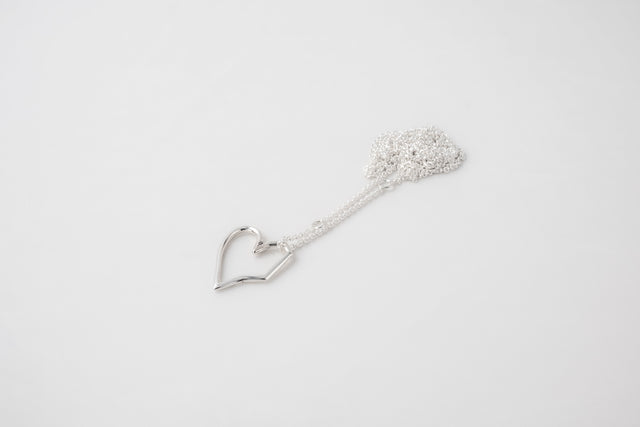
FUSED — the Story of the Form
In short.
- FUSED is the aesthetic of molten metal: no clear borders, angles or edges — the whole surface wavy and melted.
- It is a family of the LAB world — a material and a technique, not a numbered form.
- The family today gathers 3 object types — rings, earrings and necklaces; the main stage is the massive ring — today the Fused Cross Ring, silver 925, from 3.7 g.
- Each piece passes 4 stages used for STRUGA silver: wax model → silicone mold → silver 925 → hand finishing, handcrafted by silversmiths in the Bali workshop.
- Silver 925 is 92.5% pure silver; STRUGA silver is never rhodium-plated, so the wavy surface keeps living — ridges brighten, recesses darken.
Updated August 2026
FUSED — the aesthetic of molten metal.
In this family, pieces have no clear borders, angles or edges — the whole surface is wavy, melted. Sometimes a piece is fully melted and made of silver alone; sometimes melted silver spreads across another material.
That is the canonical description of the family — word for word, as it stands on the collection page. This page is the story of the form: where it came from, what it has gathered, and how it lives on the body.
How the Form Was Born
Some STRUGA families begin with a specific form and carry it through different types of pieces — from a chain link to a pendant, from a carabiner to an earring. FUSED is built differently: this family is a material and a technique, not a numbered form. Its story is not a chain of dates — it is an experiment that worked.
The home of FUSED is the LAB world: experimental forms and objects, prototype, provocation, limited runs and a language drawn from the surrounding world.
FUSED is exactly that case. It joins the language of LAB as a material experiment: molten metal here is not a finish applied over a form — it is the form itself. A wave in which angles and edges disappear.
- Family: FUSED belongs to the LAB world.
- Method: molten silver defines the surface instead of decorating a fixed silhouette.
- Result: clear borders, angles and edges give way to a continuous wave.
How a FUSED object reaches metal
Each piece is born today through the same technical path as all STRUGA silver:
- Wax model: establishes volume and the first distribution of ridges and recesses.
- Silicone mold: preserves that model for the casting stage.
- Silver 925: gives the object its wearable metal and physical weight.
- Hand finishing: resolves edges and surface without turning the molten wave into a uniform plane.
The pieces are handcrafted by master silversmiths in the Bali workshop. The founders are responsible for design and for the brand itself, not for the bench work. This distinction keeps authorship and making accurately assigned.
What the Family Has Gathered
The main stage of FUSED is the ring. In the STRUGA atlas of forms, the massive ring is a ring made to hold visual weight — larger, more sculptural, more pronounced than the everyday. At STRUGA this is where BRUTALISM, THORN, FUSED and Triple Drills live.
A massive ring is about volume and sculpture, without a mandatory plate. STRUGA rings come from different worlds: BRUTALISM, THORN, SIGNATURE ASYMMETRIC are families of the CODEX world; FUSED is a family of the LAB world.
- Visual weight: the ring reads through volume rather than a mandatory flat plate.
- World: FUSED remains in LAB even when compared with heavy rings from CODEX.
- Surface: the molten wave is the identifying feature across object types.
One surface language, several types
The comparison with other massive rings locates visual weight; it does not move FUSED into CODEX. World, object type and surface remain separate classification layers.
Silver alone or silver over another material
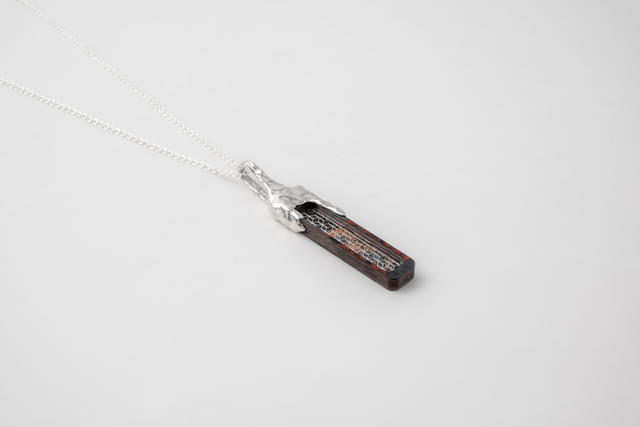
Today the family gathers rings, earrings and necklaces. Sometimes a piece is fully melted and made of silver alone; sometimes melted silver spreads across another material — this is where FUSED meets carbon, and the melted wave settles over a dark surface.
As of 2026, FUSED is a family of the LAB world — a material and a technique, not a numbered form: silver 925 without rhodium plating, made as wax model → silicone mold → silver 925 → hand finishing. The family gathers rings, earrings and necklaces, with the massive ring as its main stage.
The two constructions share a surface language but not the same material stack. Read the object before generalising from the family:
- All-silver object: the molten reading is carried by silver 925 itself.
- Mixed-material object: melted silver spreads across another documented material, including carbon where the catalogue says so.
- Object type: ring, earring and necklace describe placement; they do not change the family into a numbered form.
How the Form Lives on the Body
The ring is the smallest, most defining silver object on the body, and the atlas reads rings by weight, by surface, by intention — not by occasion. For FUSED the defining word is surface: the wave does not end at the display case, it continues in wear.
Before reading the story, compare what the body actually receives:
- Weight: a massive ring concentrates volume on the hand.
- Placement: earrings and necklaces move the same surface language to the ear or chest — the Blade Fused Mini Line Bloody Earring at the ear, the Fused Mini Line Bloody necklace on the chest.
- Contact: raised waves meet skin and clothing while recesses remain more sheltered.
These dimensions explain why one family can gather several object types without becoming one fixed silhouette. The molten surface stays recognisable while scale, movement and contact change with placement.
Start with the place of wear, then judge whether the chosen volume and movement fit that place. The family name alone cannot answer those physical questions.
How Living Silver changes the wave
STRUGA silver is never rhodium-plated — it stays alive. Living Silver is the STRUGA term for silver 925 without rhodium plating: the surface keeps living with the person who wears it — friction brightens the raised edges, the recesses darken. On the wavy, melted surface of FUSED this is clearer than anywhere else: every wave is a ridge and a recess side by side.
Patina is the natural pattern of oxidation — a map of how a piece is worn.
The darkening itself is a chemical reaction: silver reacts with sulphur compounds in air and on skin, which is why the sheltered recesses hold the darker tone longest (Encyclopædia Britannica, Silver).
Silver 925 — 92.5% pure silver, the threshold US law sets for the word «sterling» (16 CFR § 23.5). The beauty of this silver is in the traces of handwork: in slight imperfection, in the unevenness of the surface, in patina and darkening. Imperfection here is part of the object's beauty, not a defect. For a family that has no clear borders, angles or edges, this is not a footnote — it is the definition.
- Ridges brighten where contact repeatedly reaches them.
- Recesses darken and keep contrast inside the molten drawing.
- Hand-finished irregularity remains visible because no uniform rhodium layer freezes the surface.
What FUSED does not mean
Several boundaries keep the family description accurate:
- Not a numbered form: the family is defined by material and technique across rings, earrings and necklaces.
- Not a surface defect: ridges, recesses and later patina are expected parts of unplated silver 925.
- Not one material stack: some objects are all silver, while others place melted silver over another catalogued material.
- Not a promise of protection: Living Silver describes physical surface change through oxidation and wear.
The shared fact is the molten wave: boundaries, angles and edges dissolve into a surface built from adjacent ridges and recesses. Every other claim must be checked against the exact object.
How to choose and continue through FUSED
FUSED — the aesthetic of molten metal: no clear borders, angles or edges, the whole surface wavy and melted. If this language is yours — view the FUSED family.
To see how FUSED runs across the whole catalogue, the FUSED atlas lays out every form the family takes.
Use the route in a fixed order:
- Choose the object type — ring, earring or necklace — by where and how it will be worn.
- Read the exact materials so an all-silver object is not confused with silver over carbon.
- Inspect the wave as a pattern of ridges and recesses, not as a smooth finish.
- Expect surface change because the silver 925 is left without rhodium plating.
FUSED shares the LAB world with EXPERIMENTAL, the core family of that world; where melted silver settles over a dark surface the story continues in CARBON; and the reason the wave keeps changing is set out in Living Silver.
The family page shows current objects; the atlas shows how the same molten language moves across the catalogue. The current-object link below provides one concrete destination rather than an abstract family label.
Frequently asked questions
Didn’t find the answer — write to us, we reply personally.
Ask a question →01Is FUSED a specific form or shape?+–
No. Unlike STRUGA families that carry one numbered form through different pieces, FUSED is a material and a technique. Molten metal is the form itself — a wave with no clear borders, angles or edges — rather than a fixed silhouette.
02Is the uneven, darkening surface of a FUSED piece a defect?+–
No. STRUGA silver is never rhodium-plated, so it stays alive: friction brightens the raised edges and the recesses darken. That patina is the natural pattern of oxidation — a map of how a piece is worn. On the wavy FUSED surface every wave is a ridge and a recess side by side, so this is part of the object, not a flaw.
03Is molten metal jewelry the same thing as FUSED?+–
Molten metal names the look; FUSED names how STRUGA builds it. The melted surface is the form itself, not a texture laid over a finished silhouette, and it reaches metal through the same four stages as all STRUGA silver: wax model, silicone mold, silver 925, hand finishing. Three objects carry the family today — the Fused Cross Ring, the Blade Fused Mini Line Bloody Earring and the Fused Mini Line Bloody necklace.
Continue from the journal to a current STRUGA object: Fused Mini Line Bloody.