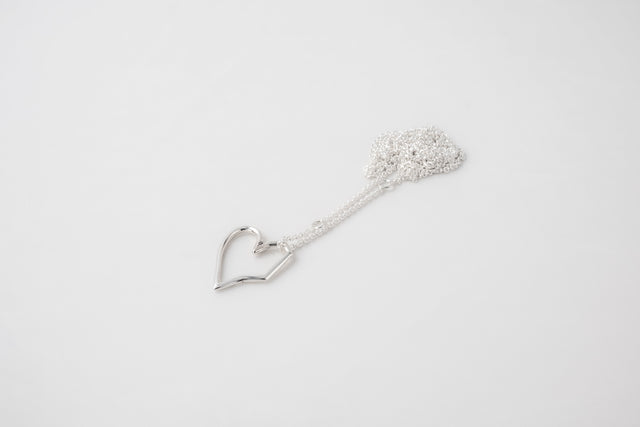
How STRUGA Jewelry Is Made — From Concept to Silver
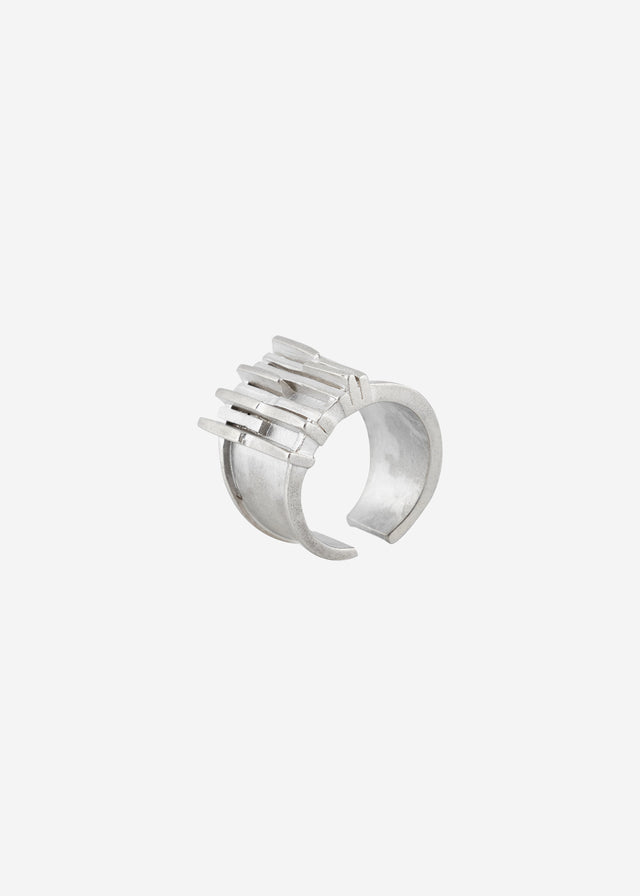
Five steps sit between a sketch and finished silver: concept, wax model, silicone mould, casting in 925 sterling, and hand finishing. A catalogue piece takes 2–4 weeks, often sooner; the hand finishing inside that time runs three to eight hours on every individual piece, and it decides how the object looks and how it will age. All of it happens at a full-cycle production hub in Bali.
Updated August 27, 2026
Five steps: concept → wax model → silicone mould → casting in 925 silver → hand finishing.
The metal is 925 sterling silver: 92.5% fine silver, 7.5% copper, with no rhodium plating. STRUGA calls the exposed surface that takes on patina Living Silver.
Living Silver is a property; oxidation is a finishing step. A piece is Living Silver whether or not it was oxidised.
Hand finishing takes 3–8 hours per piece. That is where the micro-asymmetry, the file marks, and the difference between two pieces from one mould come from — visible on a catalogue piece such as Brutalism V.1.
Production times: plain silver, silver with a set stone and carbon — 2–4 weeks, often sooner; Dark Union and Custom Order — 2–4 weeks from sketch approval. Transit adds roughly one week.
Where it is made: at a full-cycle production hub in Bali, end to end; every silver piece carries the 925 hallmark on a hidden inner surface.
What are the five steps?
Every piece travels the same path. Three steps build the form, two make the metal, and the hours go into the last one.
| Step | What happens | How long |
|---|---|---|
| 1. Concept | Sketch or 3D model: proportion, weight distribution, where the hand touches the piece | Once per model, not per order: from an hour to several months |
| 2. Wax model | The piece rendered in wax — cut by a modeller or printed on a 3D printer | 2–5 days |
| 3. Silicone mould | A flexible negative taken off the master; every working wax copy comes out of it | 1–2 days |
| 4. Casting in 925 silver | Wax burned out of a plaster shell, the cavity filled with molten silver | 1 day per casting batch |
| 5. Hand finishing | Filing, sanding, polishing, oxidation where the design asks for it, inlay setting | 3–8 hours per piece |
Steps 1–3 happen once per model. Steps 4 and 5 repeat for every single unit, and step 5 never comes out the same twice.
What happens at each of the five steps?
Step 1. How does a piece begin?
A piece starts as a structural question rather than an ornament: what if the form wraps the finger instead of hanging from the ear; what if an uncut crystal is held by thorns instead of ordinary prongs. The step answers proportion, weight distribution, contact points, and how mass is balanced. Some designs resolve in an hour; the Thorn family took months of iteration before the geometry worked both visually and physically on a finger. A design that fails on either side does not move forward.
Step 2. Why does the wax model matter?
The concept becomes physical — a wax figure of the piece, accurate to a tenth of a millimetre. There are two routes. A modeller works the wax solid, stroke by stroke, which suits the organic forms of Thorn, Amulet, and Experimental. Or a designer builds the model in 3D software and a wax printer produces it physically, which suits the geometric pieces in Blade, Signature Asymmetric, and Brutalism. Both hold surface texture that will only show after oxidation.
Step 3. What does the silicone mould do?
The wax model becomes the master. Liquid silicone is poured around it in a frame; as it sets it forms a flexible negative holding every detail — solder seams, file marks, the texture of the wax itself. New wax copies are then poured from that mould, one after another. Proportion is identical across copies; everything that separates them arrives at step five.
Step 4. How does wax become silver?
The wax copy is enclosed in a casting shell — a heat-resistant plaster-based material. The shell is heated, the wax burns out and leaves as vapour, and a cavity in the exact shape of the piece remains. Molten 925 silver is poured or vacuum-fed into that cavity; as it cools, the metal takes the form of the original wax. The shell is chipped away and a raw silver blank appears. The alloy itself is covered in our 925 silver guide.
Step 5. What does the artisan do in hand finishing?
The blank is cleaned of casting residue, filed where edges need definition, sanded to the intended surface texture, polished where the design asks for shine, oxidised where the design asks for darkness. If the piece carries an inlay, it is set by hand at this step, along with clasps, jump rings, chains, and earring posts. Every piece passes through this step without exception — and this is exactly where two units from one mould stop being identical.
Why does hand finishing change the finished piece?
Industrial silver jewelry skips this step: pieces come out of the mould, go through abrasive tumbling, and ship. The result is uniform brightness across the whole surface, where each ring repeats the last. STRUGA works the other way: the artisan decides where a piece shines, where it stays matte, where it is deliberately roughened. Two pieces from one mould, finished by one hand, will not be identical.
Variation is part of the design
The contrast between a polished high edge and a darker recess is part of how a piece reads. A fine file reaches an angle no tumbling barrel can; abrasive is drawn across Brutalism texture by hand; polish is laid softly on the high point of a Blade ring. A tumbled ring loses that contrast — everything becomes one even tone of bright silver.
How finishing prepares the patina
When a surface has texture — file marks in places, polish in others, oxidised recesses — the patina that builds over months of wear has somewhere to settle. High points lighten with contact, recesses stay dark, and the piece becomes a map of how it was worn. A surface that machine finishing made uniform patinates flat. How patina behaves over years is covered separately.
How does a carbon, meteorite, or stone inlay change the process?
The five-step path is the same for every piece in plain silver. A material beyond silver adds a setting step after casting and changes how the finishing goes.
| Inlay | What it adds to the process | Where it appears |
|---|---|---|
| 925 silver only | Nothing: file, sand, polish, oxidise if the design calls for it | Most of CODEX, Blade rings, Signature Heart |
| Carbon | The channel is cast in advance; the panel is fitted, bonded with structural adhesive, and trimmed flush by hand | RITUAL and the Carbon family; all-carbon on cord sits in LAB |
| Seymchan meteorite slice | The slice is acid-etched to reveal its crystal structure; the bezel is closed around it cold, without heat | LAB, Blade family |
| Uncut stone | The bezel is shaped around the specific stone rather than the stone around the bezel; slower than a cut stone | RITUAL, Amulet, Thorn |
Carbon comes in six Graphite palettes, and the palette is chosen with the wearer — which is why carbon always runs as a commissioned route.
- Classic — deep graphite black with a readable weave.
- Bloody — wine-red undertone.
- Arctic — smoky white.
- Winter — cold grey-blue.
- Multy Graphite — iridescent, shifting in the light.
- Toxic — acid-green vein.
Material background sits in our carbon and meteorite guide.
Seymchan is a pallasite found in 1967 in the Kolyma region; its iron-nickel lattice formed while the parent asteroid cooled at roughly one degree per million years, so no two slices are alike. Uncut stones — tourmaline, aquamarine, heliodor, natural quartz — are set in their natural geometry, often off-axis.
Where is STRUGA jewelry made?
Every piece is made at a full-cycle production hub in Bali. Wax modelling, mould making, casting in 925 silver, hand finishing, quality control, and hallmarking all happen on the island, end to end. Every product in the catalog passes through the same hub to the same standards.
Why Bali?
The hub sits inside a silver tradition a thousand years deep: artisans are trained within a continuous lineage that has cast, hammered, and finished silver since the 9th century. What matters practically is the unbroken apprenticeship — one artisan per piece. The brand's design language does not survive a division of labour, so STRUGA never splits casting and finishing between countries.
How does hand casting differ from CNC and mass casting?
Three production methods dominate silver jewelry. The method is the first thing you feel in a finished piece.
| What | STRUGA: wax + hand | CNC machining | Mass casting |
|---|---|---|---|
| Model | Wax or 3D print | Digital, milled | Existing mould only |
| Hours | 3–8 hours of hand finishing | 0–30 minutes of correction | Batch polish only |
| Look | Hand marks, live edge | Even, machine-set | Even, no hand trace |
| Age | Patina follows wear | Holds shine, no patina | Plating wears through |
| Custom | Yes, at any step | Via a CAD revision | No, needs a mould |
| Price | Bench hours and weight | Tooling and machine | Batch size |
CNC and mass casting both fight the metal's own behaviour: the first seals the geometry, the second hides it under plating. Hand finishing works with the metal — which is why Living Silver holds together as a logic rather than as a phrase.
How is quality checked, and what does the 925 hallmark mean?
Every piece is inspected before it reaches the catalog. The inspection covers four things.
- Casting integrity. No porosity, no incomplete fills, no shrinkage cracks where the silver cooled unevenly. A piece with a casting fault is recast.
- Finishing quality. Edges sharp where they should be sharp and soft where they should be soft; the surface matches the design intent — matte, polished, oxidised, or mixed.
- Assembly accuracy. Clasps close cleanly, jump rings hold tension, chain links do not catch, earring posts are straight and firmly soldered, inlays sit tight without play.
- Hallmark. The 925 stamp is applied to a hidden inner surface — inside a ring, on the back of a pendant, inside a clasp. It certifies the 92.5% silver content.
A piece that fails any of the four goes back to the bench, not to the catalog. Product photography is shot in-house and surface detail is not retouched: file marks visible on the piece are visible in the catalog too.
How does the same process work for Dark Union wedding rings?
Wedding rings run the same five steps with two additions: paired design and individual sizing. The order of work is:
- the couple describes what they want;
- within a week two paired sketches arrive, built on one of the existing design families — usually Blade, Brutalism, or Signature Asymmetric;
- revisions from feedback, and sizing taken from each finger separately;
- a separate wax model for each ring, both cast in one session;
- finishing done as a pair so the surfaces match in tone.
The timeline is 2–4 weeks from sketch approval. Re-oxidation for a Dark Union pair is free for life.
A wedding ring is the object where Living Silver makes the most sense: worn around the clock, it takes on a patina that becomes a record of the years, while a rhodium-plated ring would freeze on day one. The full case sits in our dark wedding rings guide.
How does Custom Order differ from ordering from the catalog?
STRUGA works to order: a piece is made for a person rather than pulled off a shelf. There are three routes, and the five-step path is identical in all three — what differs is who sets the form.
| Route | What it is | Production time |
|---|---|---|
| Catalog order | An existing form from the catalog, made for the specific order | 2–4 weeks, often sooner |
| Dark Union | Paired wedding rings: design from conversation, individual sizing, free re-oxidation for life | 2–4 weeks from sketch approval |
| Custom Order | A single piece outside the catalog, with no paired ring required | 2–4 weeks from sketch approval |
Those times cover production before handover to the carrier; transit adds roughly a week. Some couples use both services: Dark Union for the wedding pair and Custom Order for an engagement or anniversary piece. The five worlds are CODEX, RITUAL, LAB, DARK UNION, ISLAND ARTIFACTS, and the eleven design families are Blade, Thorn, Signature Asymmetric, Signature Heart, Brutalism, Mosaic, Carbon, Amulet, Fused, Experimental, and Dark Union.
About STRUGA. STRUGA is a dark silver jewelry brand founded by Dmitry Strugovshchikov and Ekaterina Strugovshchikova, handmade in Bali by master silversmiths. Most of the catalogue is 925 sterling silver, oxidised or hand-patinated; alongside it runs CARBON — layered matte carbon with inlays of other materials. The darkening is part of the design. It is a brutalist object that changes through contact with the environment and the wearer.
Continue from the STRUGA catalog:
Frequently asked questions
Didn't find your answer — write to us, we reply personally.
Ask a question →01Is Living Silver the same thing as oxidation?+–
No. Living Silver is a property: STRUGA works in 925 sterling with no rhodium plating, so the surface stays exposed and takes on patina over time. Oxidation is a deliberate finishing step at the bench that darkens the recesses immediately. A piece is Living Silver whether or not it was oxidised.
02Is patina a defect or wear?+–
Patina is a property of exposed 925 silver, not damage. On a hand-finished surface the high points lighten with contact while the recesses stay dark, and the piece reads as a map of how it was worn. Patina can be reset with re-oxidation.
03Is STRUGA jewelry really handmade?+–
Yes. Every silver piece is cast individually in 925 silver and then finished by hand — filed, sanded, polished, oxidised where the design asks for it, and inlaid by hand. This is not batch tumbling, where pieces come out of the mould with uniform brightness; the micro-asymmetry and file marks are the visible signs of hand work.
04How long does a STRUGA piece take to make?+–
Production runs 2–4 weeks, often sooner, for plain silver, silver with a set stone and carbon alike. Dark Union and Custom Order run 2–4 weeks from sketch approval, and transit adds about a week on top of production. A STRUGA person confirms the exact timeline for each order.
05Where is STRUGA jewelry made?+–
At a full-cycle production hub in Bali. The hub covers every step from wax modelling through casting in 925 silver to hand finishing and hallmarking — same standards across every piece, same Living Silver philosophy.
06How does STRUGA check quality?+–
Every piece is inspected against four criteria before it reaches the catalog: casting integrity (no porosity or cracks), finishing quality (the surface matches the design intent), assembly accuracy (clasps close cleanly, inlays sit tight) and hallmarking (the 925 stamp on a hidden surface). A piece that fails any criterion goes back to the bench, not to the catalog.
07Can I see the pieces in person before ordering?+–
STRUGA doesn't run public workshop visits — the production hub is a working space, not a show floor. To see and handle pieces before commissioning custom work, our two retail partners on Bali, Hedonist Store in Seminyak and Barefoot Aristocracy in Canggu, carry curated selections from CODEX and RITUAL.
08Why isn't STRUGA jewelry cheaper, given the materials?+–
The price reflects hours of hand finishing rather than the cost of raw material: a finished 925 silver ring holds under $5 of metal but several hours of skilled bench work. Inlays add the cost of the material plus the setting time. Against mass-produced silver the price is higher; against gold or platinum of comparable complexity it is markedly lower.
09What is the difference between Dark Union and Custom Order?+–
Dark Union is paired ring design built for couples: two rings conceived as a conversation, with individual sizing and free re-oxidation for life. Custom Order is work on a single piece with no paired ring required. The five-step path, the materials, and the Living Silver philosophy are the same for both.