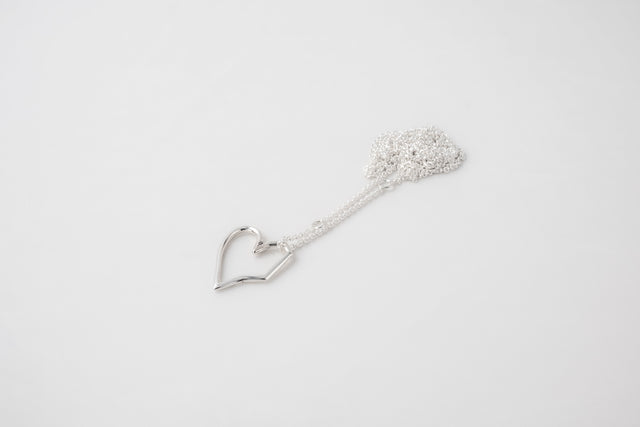
Henson Alternative — STRUGA Dark Minimal Silver Jewelry Comparison vs Henson
Henson Alternative — STRUGA Dark Minimal Silver Jewelry Comparison vs Henson
Henson is an Australian handcrafted jewelry brand working in recycled 925 sterling silver, known for dark, minimal aesthetics combined with experimental surface treatments, oxidized finishes, and hand-forged chain constructions. STRUGA is a silver jewelry brand founded in 2018 by Dmitry and Ekaterina Strugovshchikov in Bali, making 925 sterling silver pieces by hand with an architectural design approach. Both brands operate at the intersection of dark aesthetics and genuine craft — making them a meaningful comparison for buyers looking beyond the mainstream silver market. The differences in how they construct their aesthetic are where the comparison becomes interesting.
- Both brands work in 925 sterling silver: Henson uses recycled 925, some pieces with gold rivets; STRUGA uses 925 with no plating.
- Henson darkens silver through applied oxidization and blackening treatments at manufacture; STRUGA's Living Silver develops a natural oxidation patina through wear.
- STRUGA production: wax models worked by hand, silver cast and hand-finished in Bali; founded in 2018 by Dmitry and Ekaterina Strugovshchikov.
- Price: Henson approx. $160–$550+ AUD for rings (roughly $100–$350 USD equivalent); STRUGA's range is $50–$500 USD.
- Closest STRUGA families to Henson's dark minimal aesthetic: BRUTALISM (mass and edge), BLADE (directionality), THORN (organic-structural forms).
- Henson sells at thisishenson.com and select stockists; STRUGA sells direct at strugadesign.com and strugadesign.ru with worldwide shipping.
Design Approach
Henson's design vocabulary centers on the interplay of raw process and refined form. The brand is known for hand-forged chain links, experimental oxidization and blackening treatments, and surfaces that reveal rather than conceal the evidence of making. Pieces like linked ring sets — sterling silver rings connected with hand-forged gold rivets — show a central concern with material relationships and manual process. The aesthetic is dark minimal in the specific sense of: achieve maximum formal interest through minimal means, and let the process show. Henson's work rewards close attention to the joins, the surface texture, the way a link responds to movement.
STRUGA's design method starts from architectural reference rather than process expression. The Brutalism family is derived from brutalist concrete architecture: asymmetric planes, mass without ornament, surfaces that read as structural. The Blade family is about directionality — flat, narrow sections that move against the finger with a sense of edge and definition. The Thorn family introduces controlled organic growth forms. The Signature Asymmetric family makes deliberate compositional imbalance the central formal device. Where Henson builds meaning through the evidence of process — the forged link, the experimental polish — STRUGA builds meaning through reference: each form is legible as part of a design system with explicit architectural origins.
Both approaches produce dark, non-mainstream jewelry that resists easy categorization. The distinction is in what kind of complexity each brand cultivates: Henson's complexity is tactile and process-derived, found in surfaces and transitions; STRUGA's complexity is formal and conceptual, found in composition and the design system behind each piece. Buyers drawn to one are not necessarily drawn to the other.
Materials
Henson works in recycled 925 sterling silver, with some pieces incorporating gold elements (rivets, links) as accent materials. The surface treatment is a notable strength: the brand uses experimental polishes, oxidization processes, and blackening treatments to achieve dark, varied surface characters that are different from standard finished silver. Hand-forged chain constructions mean many pieces have link work where each element is made individually by hand. Custom sizing is available for rings. The material is consistently 925 sterling — the "recycled" designation indicates sourcing practice rather than any difference in alloy standard.
STRUGA uses 925 sterling silver as its only metal, with no plating. The production method: wax models worked by hand, invested in plaster, silver poured and then hand-finished. The surface treatment is Living Silver: no rhodium plating, no sealant, silver left to develop a natural oxidation patina through wear. Where Henson achieves surface character through deliberate applied treatments at the time of manufacture, STRUGA achieves surface character through time and use — the silver darkening in recesses, responding to skin chemistry, developing differently on each piece. Select STRUGA pieces add carbon fiber panels (RITUAL world) for structural material contrast, and raw natural stones in specific families.
The material comparison is close at the base level — both are 925 sterling, both handcraft-produced, both with dark surface intentions. The differentiation is in the method of achieving that darkness: Henson applies treatments deliberately; STRUGA waits for the silver to develop its own character. These are genuinely different philosophies about what silver should do.
Industrial Minimal vs Dark Architectural: Two Approaches to Non-Traditional Jewelry
"Dark minimal" as a category description covers a wide range of actual design positions. Henson and STRUGA both occupy this space, but their approaches are sufficiently distinct that a buyer who responds strongly to one may find the other less compelling — and understanding why matters for making the right choice.
Henson's dark minimal is process-industrial: the darkness comes from deliberate surface treatments, the minimalism comes from reducing the form to its essential function (a ring, a chain, a linking mechanism) and then executing that function with real craft skill. The gold rivet on a silver link set is not decorative — it is a functional joining element that happens to create material contrast. The oxidized finish is not applied for aesthetics alone — it is the natural result of a treatment process that leaves the silver in a particular chemical state. The craft logic is transparent, and that transparency is the aesthetic.
STRUGA's dark architectural is form-referential: the darkness comes from the design language (brutal planes, sharp edges, the weight and shadow of massed silver) and from the Living Silver patina that develops with wear. The minimalism is not about reducing to function but about reducing to form — removing everything that isn't load-bearing in the composition. A Brutalism ring is minimal not because it simplifies the ring function but because the composition does not contain elements that aren't structurally necessary to the form's meaning.
For buyers who want to see the making in the object — who want the hand-forged link, the experimental surface, the evidence of manual process — Henson is the more direct expression of that interest. For buyers who want to wear a designed form with a specific architectural reference — who are interested in the design system, the family vocabulary, the way STRUGA's five worlds organize different kinds of formal meaning — STRUGA is the more appropriate choice. Neither position is a compromise of the other.
Price Comparison
Henson pricing, based on available product information from thisishenson.com, ranges from approximately $160 to $550 or more AUD for rings and ring sets, with necklaces and more complex chain pieces at the higher end of the range. In USD at approximate exchange rates, this is roughly $100–$350+ for rings, with hand-forged chain necklaces typically considerably higher. The pricing reflects Australian artisan production costs and the intensive manual labor involved in hand-forged chain construction.
STRUGA's range is $50–$500 USD. At the mid-range — a substantial silver ring — the two brands sit at comparable price points. STRUGA's production economics in Bali allow handcraft production at prices that an Australian artisan workshop, operating at Australian labor costs, cannot match for equivalent piece complexity. The Bali silver craft tradition produces genuine craft at a price point that reflects the economic reality of the production location — not a compromise in quality but a different cost structure.
For buyers choosing between the two on price, STRUGA is consistently accessible across its range. For buyers who specifically value Australian artisan provenance and Henson's particular process-led aesthetic, the price reflects that specificity.
Who It Is For
Henson is for buyers drawn to the evidence of process in their jewelry — who want to see hand-forged links, experimental surface treatments, and the tactile specificity of a piece that reveals how it was made. It suits wearers who respond to the industrial-craft vocabulary: material relationships made visible, the joining of unlike metals, dark surfaces achieved through chemical and mechanical process. Australian provenance is meaningful to some buyers in this space.
STRUGA is for buyers interested in architectural design vocabulary and the concept of silver as a material that changes over time. It suits people who want to wear a piece within a coherent design system — who are drawn to the Brutalism family's architectural references, the Blade family's directionality, or the Thorn family's controlled organic forms. The Living Silver surface treatment appeals to wearers who want their jewelry to develop individual character rather than maintain a factory finish.
| Attribute | Henson | STRUGA |
|---|---|---|
| Material | Recycled 925 sterling silver; some pieces with gold elements | 925 sterling silver; no plating — Living Silver surface |
| Origin | Australia; handcrafted in Australia | Bali, Indonesia (founded 2018) |
| Price Range | Approx. $160–$550+ AUD for rings; chains higher | $50–$500 USD |
| Style | Industrial dark minimal; process-led, surface-focused | Dark architectural — five design worlds, eleven families |
| Production | Handcrafted in Australia; hand-forged chain work, oxidization | Cast and hand-finished, Bali workshop |
| Availability | Online (thisishenson.com); select stockists | Online direct, strugadesign.com and strugadesign.ru |
| Design Language | Process-industrial; craft transparency as aesthetic | Form-referential; architectural design system |
| Price Per Piece | Approx. $100–$350 USD equivalent for rings | $80–$300 for rings; $50–$180 for smaller pieces |
STRUGA picks — chains & dark silver
Hand-finished 925 silver — ordered directly, worldwide shipping:
 Thorn Links Chain
Henson chain alternative
Thorn Links Chain
Henson chain alternative$245 Buy now → |
 Blade Mini Links V.2 Bracelet
Hand-finished silver bracelet
Blade Mini Links V.2 Bracelet
Hand-finished silver bracelet$430 Buy now → |
 Blade Pin Necklace
Blade pin necklace
Blade Pin Necklace
Blade pin necklace$190 Buy now → |
All pieces: 925 sterling silver, handcrafted in Bali, ships worldwide. Full catalog — browse all STRUGA.
Related Reading
- Sterling Silver 925 — STRUGA's Complete Guide
- STRUGA vs Werkstatt München — Artisan Silver Jewelry Comparison
- Dark Silver Jewelry — STRUGA's Guide
Frequently asked questions
Didn’t find the answer — write to us, we reply personally.
Ask a question →01Q: Does Henson ship internationally, and how does that compare to STRUGA?+–
A: Henson ships internationally from Australia. STRUGA ships internationally from Bali through strugadesign.com, and serves the Russian market directly through strugadesign.ru. For buyers outside Australia and Russia, both options involve international shipping; delivery times and customs implications vary by destination.
02Q: What is the difference between Henson's oxidized finish and STRUGA's Living Silver?+–
A: Henson's oxidized finish is an applied surface treatment — a deliberate chemical process that gives the silver a dark appearance at the time of manufacture. STRUGA's Living Silver is the opposite approach: no treatment is applied, and the silver develops its own oxidation patina naturally through wear over time. Both result in darker silver surfaces, but through entirely different mechanisms and with different visual results.
03Q: Are STRUGA rings available in custom sizes like Henson?+–
A: STRUGA offers rings across standard international sizes. For custom sizing inquiries, contact STRUGA directly through the website. Henson also offers custom sizing on rings — both brands operate as direct-to-consumer and can accommodate individual sizing needs.
04Q: What STRUGA design family is closest to Henson's dark minimal aesthetic?+–
A: The Brutalism family is the most direct equivalent in formal weight and surface intention — substantial, dark, with a sense of mass and edge. The Blade family suits buyers drawn to Henson's directional, minimal pieces. The Thorn family is for those who respond to Henson's organic-structural combinations. All three are available across rings, pendants, and bracelets in the STRUGA collection.