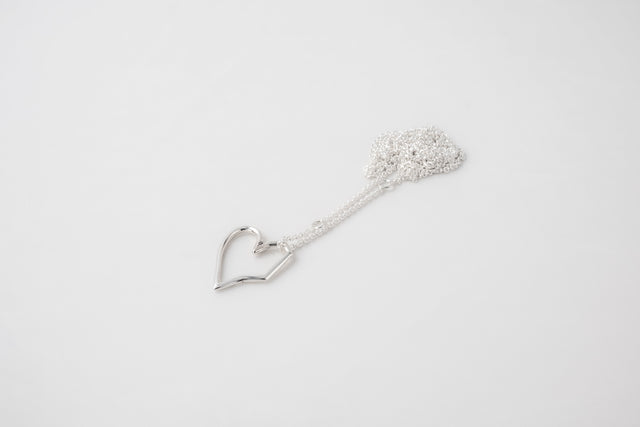
In short. On this page, amulet can describe an object's role, while AMULET is the exact STRUGA family built around raw, wild-growth stones. Crosses and other pendants in the RITUAL world do not automatically belong to that family. Oxidation describes a dark silver surface, not a promised effect. Only part of the family is blackened in advance; the rest is uncoated Living Silver that darkens on the wearer.
Updated August 29, 2026
What does “oxidized silver amulet” mean on this page?
Role, family and exact object
The page gathers dark silver objects worn as personal signs: raw-stone amulets, cross pendants, and other forms from the RITUAL world. That is a useful storefront group, not a new design family. The family, world, material, and surface of each object belong to its exact product page. Storefront examples: Thorn Amulet Necklace #1 (a raw-stone AMULET), Signature Cross V.3 (a blackened cross in RITUAL) and Thorn Earring (stone-free THORN in CODEX).
| Object | Canonical boundary | Route |
|---|---|---|
| Raw-stone AMULET | A family of the RITUAL world; a raw wild-growth stone; every piece is one-of-one. | AMULET collection |
| Cross pendant | A symbolic form; wearing it as an amulet does not place it in the AMULET family. | Silver Cross Jewelry collection |
| Another dark object | It may sit in RITUAL; the exact family and composition remain product facts. | RITUAL world |
The page title is a route into several related objects, not a substitute for their identities. A pendant may function personally as an amulet without joining the named AMULET family. The family boundary comes from a raw wild-growth stone joined to an exact STRUGA form. A cross or another dark RITUAL object keeps the family and composition stated on its own product page. Oxidized 925 silver describes material and finish, not membership by itself. This distinction prevents a broad everyday word from rewriting the workshop map.
Three checks keep the boundary visible. First identify the family or world. Then confirm whether a raw stone is structurally present. Finally read material, set contents and dimensions from the exact object. The storefront grouping helps comparison, while the product page remains the source for a purchase.
What is the STRUGA AMULET family?
Raw stone as the family boundary
AMULET brings together earrings, studs, pendants, and bracelets with raw, wild-growth stones. It is an open family: one object type or one mineral does not define it. The relation between the form and a specific natural stone does. Stones can include tourmaline, aquamarine, quartz, heliodor, and others.
Two anchor models are Classic E-0530 and Thorn E-0528. Live examples: Classic Amulet Necklace — Clear Quartz and Thorn Amulet Earring #19 — Green Tourmaline (M). A model sets the construction, but it does not promise a repeatable pattern or colour: the stone in each piece is its own. Exact mineral, size, weight, set contents, and availability must be read from the live product page.
AMULET stays open because neither one mineral nor one object type closes the family. Earrings, studs, pendants and bracelets can all enter it when a raw stone and the designed silver form make one object. Tourmaline, aquamarine, quartz and heliodor are examples, not a complete catalogue or a promise of availability. Classic E-0530 and Thorn E-0528 are anchor models: they identify constructions, while the individual crystal keeps its own outline, direction and colour.
A family name cannot provide the missing product fields. The live card must still settle the exact mineral, size, weight, set contents and availability. Those facts may differ even when two pieces share a model.
How is THORN different from a Thorn Amulet?
Two uses of the thorn form
THORN is a metal form in the CODEX world: a thorn with sharp angles. Thorn Amulet is a model inside the AMULET family and the RITUAL world. It repeats the language of THORN in volume but builds around a raw stone.
The working boundary is simple: THORN without a stone remains the THORN family; a form built around a raw, wild-growth stone belongs to AMULET. They are not two versions of one product and the names are not interchangeable.
The repeated word THORN describes a formal relation, not a shared catalogue identity. In CODEX, stone-free THORN is the metal thorn itself, read through sharp angles and concentrated volume. Thorn Amulet belongs to AMULET and RITUAL because its construction is organised around a raw stone. The model can recall the metal language without becoming the same family or a variant of the same product.
Use the material boundary before visual resemblance. If the exact object is built around a raw wild-growth stone, read it through AMULET. If the thorn remains a stone-free metal form, read it through THORN. Names can point to a relation, but they do not transfer stone, world, availability or set contents from one card to another. The object page confirms the final answer.
Why can a raw-stone amulet not be repeated exactly?
Archive instead of duplication
Every AMULET piece exists as a single specimen. The photographs on its product page show the exact stone and exact object being sold. After the sale, the page remains as an archive; a second piece does not appear under the same photographs.
Other stones can exist in the workshop before photography, but that does not make them available products. If an object has gone, the only route is to request something similar. STRUGA can look for related geometry, mineral, or tone, but cannot promise a copy of a natural stone.
One-of-one means the photographs and stone belong to one saleable specimen. Natural outline, crystal direction and colour are not a repeatable setting that can be ordered from the same images. When the object is sold, its page remains an archive of that exact piece rather than a promise that another will appear. Stones that have not been photographed are workshop material, not available products.
Request Similar begins a new search instead of reopening the old product. The archived link gives the workshop a reference. The request should then name one leading observable priority, such as geometry, scale, colour or mineral position. A related object may be possible; an exact copy of the natural stone is not.
How do you choose a form and stone without effect claims?
Observable choices before symbolism
Choose through observable properties: silhouette, colour, transparency, crystal direction, visible silver mass, and the way a pendant works with your chain. A mineral name describes material, not a result for the person wearing it.
Before ordering, verify the product page: one object or a set, material, suspension or length, exact stone, and availability. For a piece outside the storefront, a similar-object request works best with a link and one clear priority—form, scale, colour, or stone position.
Selection can stay precise without assigning an effect to a mineral. Compare silhouette, colour, transparency, crystal direction, visible silver mass and the relation to a chain. These are observable properties of the actual object. Protection, luck, energy or a health benefit are not product facts and are therefore not used to explain the choice. A personal association can remain personal without becoming a workshop promise.
Before ordering, turn preference into verifiable fields. Check whether the listing is one object or a set, how it is suspended, which stone is pictured and whether the exact specimen is available. For Request Similar, one clear priority helps more than a list of guaranteed outcomes.
How does oxidized silver change through wear?
Changing silver and careful handling
Oxidation gives silver a dark starting tone. It is a separate technique, not another name for Living Silver. At STRUGA only part of the amulets are blackened in advance; they are gathered in Blackened Silver. The rest ship as uncoated Living Silver, light at first and darkening on the wearer. The product page states the finish. Both surfaces respond to wear: raised areas and contact points gradually brighten through friction, while recesses keep or gather darkness.
A changing surface does not mean the metal is damaged. A dry soft cloth is enough after ordinary wear. Deep cleaning and tone restoration should be checked for the exact object because stone, setting, and matte surface require different handling.
Oxidation and Living Silver describe different starting conditions. Oxidation deliberately gives silver a dark tone; uncoated Living Silver remains responsive to contact. In wear, raised areas and points of touch can brighten while recesses retain more darkness. That contrast can reveal the form and does not by itself prove damage or promise a permanently even black surface.
Care begins with the exact stone, setting and finish. A soft dry cloth is suitable after ordinary wear. On uncoated Living Silver the owner can reset the patina: silver-cleaning liquid on polished silver, a fine abrasive on matte silver. On a blackened piece the same tools remove the dark tone, so the finish on the product page decides. Around a raw stone, deep cleaning and abrasive polishing are not neutral choices. When more is needed, photographs and the exact product link let the workshop judge the object rather than prescribe one method for every amulet.
| Identity | Separate the broad role of an amulet from the raw-stone AMULET family. |
|---|---|
| Object | Verify the exact stone, model, set contents and availability on the product page. |
| Choice | Use observable form, colour, transparency, direction and silver mass, without effect claims. |
| Care | Expect contact zones to brighten and ask the workshop before deep cleaning or tone restoration. |
Frequently asked questions
Does every dark STRUGA cross belong to the AMULET family?
No. A cross can live in the RITUAL world, but the AMULET family is defined by a raw, wild-growth stone and its own model map.
Can I order an exact copy of a sold amulet?
No. The natural stone is singular. You can request a related object by form, scale, colour, or mineral without a promise of a copy.
Are Thorn Amulet and the THORN family the same?
No. Stone-free THORN is a CODEX family; a Thorn Amulet with a raw stone is a model in AMULET and RITUAL.
Does oxidation promise a permanently even black colour?
No. Contact zones brighten through friction while recesses usually stay darker. The surface continues to change.
How do I request an amulet that is no longer available?
Use Request Similar: include the archived object link and name the observable properties that matter to you.