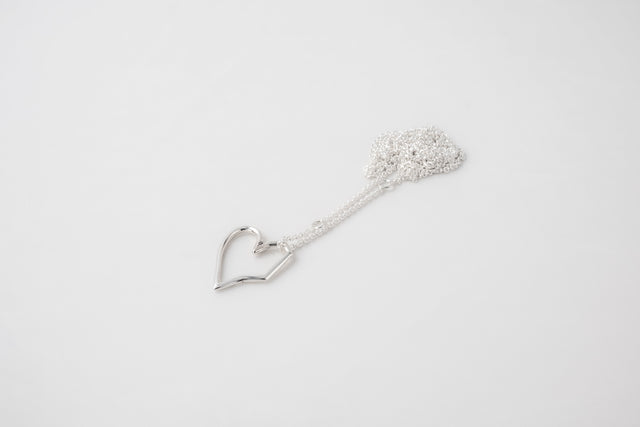
Bound
Matching rings for couples do not need identical silhouettes: silver wedding bands can be bound by one material, one patina, one repeated edge. The two-ring ceremony itself is younger than it looks — it went from 15 % of weddings at the end of the Depression to around 80 % by the late 1940s. The DARK UNION world exists for people the standard script does not fit.
In short. A pair is bound by one principle out of four — material, depth of patina, cut line, a repeated detail — and the silhouettes need not match. There is no rule requiring an identical pair: it is a habit about 70 years old.
The two-ring ceremony became standard within a single generation: from 15 % of weddings at the end of the Depression to around 80 % by the late 1940s, driven by the war and by jewellery-industry advertising rather than by centuries of custom. The historical model of a pair works the opposite way to a matched set: a gimmel ring of 1575–1650 is two hoops carrying different names, worn separately and joined at the wedding.
The ready route today is one: Thorn Ring, the only item in the DARK UNION collection. Seven sizes, 16 to 22, weighing 4.7 to 12.7 g — the largest is 2.7 times heavier than the smallest. 925 silver, uncoated and not pre-oxidised.
Material sets the lead time, not the occasion. Silver takes around 2 weeks to make plus roughly 7 days in transit. Your own pair logic, or a form outside the catalogue, goes through an individual order with a reference window of 3–6 weeks once the direction is agreed.
- A shared object does not have to repeat someone else's script
- The principle can match where the form does not
- The surface stays personal
- Size, weight and lead time are confirmed before payment
- Where to start
- Bound — at a glance
- Frequently asked questions
A shared object does not have to repeat someone else's script
A wedding ring does not have to be smooth, bright and matched to the millimetre. That tradition is younger than it looks, and it is not the only one.
The two-ring ceremony became standard within living memory. Between the end of the Depression and the late 1940s the share of weddings using two rings rose from 15 % to around 80 % (Journal of Social History, 2003). Before that the groom most often wore no ring at all: the pairing was made by the war and by jewellery-industry advertising campaigns, not by centuries of custom.
One plain thing follows. "Rings should match" is not a rule but a habit two-thirds of a century old, invented by the people for whom a set is easier to sell. No rule ever required a pair to share a silhouette.
The habit rests on the seller's convenience, not on the meaning of a union. A set solves the shop's problem: one item, one price, one conversation. It does not solve the problem of two people, whose hands, work and character are different.
Two people are not choosing a pair of objects. They are choosing the principle that binds them.
DARK UNION is STRUGA's world for alternative wedding and proposal rings. It is the language of a different union: not softer than the usual one but stronger — objects of a union rather than wedding merchandise. Size, material and the logic of a pair are resolved here or through Custom Order.
The principle can match where the form does not
A pair can be bound by one of four things: material, the depth of a patina, a cut line, a repeated detail. One is enough — the rest can diverge.
The rings will then not be identical, and that is an old device rather than a modern liberty. A gimmel ring of 1575–1650 in the Victoria and Albert Museum (inv. M.281-1962, Holland) is two interlaced hoops of enamelled gold set with turquoises. One is inscribed "SYMON CORNELIS Z.", the other "CORNELISIE ENGELS. D." — the names of the groom and the bride. The betrothed wore one half each and joined them at the wedding.
So the historical model of a pair works exactly the opposite way to a matched set. These are not two copies but two different halves that make sense together and read as unfinished apart.
The device is visible in our own THORN family. One form is carried through seven pieces: a ring, two bracelets, two earrings, an ear cuff and a chain. Seven different objects and one shared thorn — precisely the case where a repeated detail binds, and the silhouette does not.
In the catalogue the ready route today is one: Thorn Ring, the only item in the DARK UNION collection. Seven sizes, 16 to 22; the weight runs from 4.7 to 12.7 grams. 925 silver, uncoated and not pre-oxidised.
A different scale, a different combination, your own pair logic — that is the individual-order route. There a pair is built from the shared principle first: you decide what the two objects will hold in common, and only then where they part.
The surface stays personal
Living Silver shifts contrast through oxidation, friction and care. This is not a ceremonial promise but the physics of a thin film.
Thickness sets the colour. While the film grows from 10 to 100 nanometres the surface runs from yellow through red-brown to blue; above one hundred nanometres the interference dies out and black remains — the true colour of silver sulphide (Sheffield Assay Office). A dark ring a year on does not look like it did the day it went on because the film has grown.
For two people it grows differently. One hand works more, the other wears more carefully, one of you takes the ring off in the shower and the other does not. After a year the pair diverges in colour — not by design but by biography.
There are two ways to handle that, and it is a choice too. Strip the patina and the ring returns to bright and starts its history again. Leave it and the contrast deepens in the relief and wears away on the raised parts, where the ring rubs against things and against the other hand.
That is not a defect. It is the one thing that cannot be faked: an identical new pair can be bought, an identical lived-in one cannot.
Size, weight and lead time are confirmed before payment
A conversation about a pair starts with numbers, not with pictures. Thorn Ring has seven sizes, 16 to 22, and across that run the weight moves from 4.7 to 12.7 grams — the largest is 2.7 times heavier than the smallest.
For a pair this matters more than it seems. Two hands rarely take the same size, which means two rings of one form will be of different mass and will sit differently. An identical silhouette does not even that out; it only makes the difference more visible.
Uncoated 925 silver darkens on its own; there is no rhodium layer here to hide it. The surfaces of a pair will start to diverge from the first month, and that is what to plan for rather than museum sameness.
Material sets the lead time, not the occasion. Silver takes around two weeks to make, plus roughly seven days in transit. Everything is made to order: stock decides nothing here, the ring is started after the order.
A form outside the catalogue is a different route. An individual order runs from a brief, and the public reference window is three to six weeks once the direction is agreed. Size, construction, material and lead time are confirmed before payment, not after.
Where to start
For a proposal or a wedding, the first route is DARK UNION. This world stays narrow on purpose: it is about a wedding, an engagement, paired rings and a vow — and about nothing else. It does not work as a general answer to "buy some jewellery", and offering it that way would be dishonest.
For an anniversary or a private shared marker, the field is wider — look at Island Artifacts, the selection of pieces that hold attention longest in Bali. It is assembled by demand rather than by form, so an object of any type can enter it.
If no ready route fits, the individual order remains. It starts not with a picture but with three answers: what the two objects will hold in common, where they will part, and how each of you wears a ring every day. The third question usually decides it: a ring taken off for work and a ring never taken off arrive at different surfaces within a year, and that is better planned for in advance.
Navigation across ring forms and sizes is gathered in the Rings section of the Atlas — it is easier to come back to the pair from there, already knowing which form you mean.
Everything is made to order. Size, construction and production time are confirmed before payment.
Bound — at a glance
| Property | Value |
|---|---|
| What binds a pair | One principle out of four: material, depth of patina, cut line, a repeated detail |
| Do they have to match | No. There is no rule requiring an identical silhouette — only a habit about 70 years old |
| Where the habit came from | The two-ring ceremony: 15 % of weddings at the end of the Depression, around 80 % by the late 1940s (Journal of Social History, 2003) |
| The historical model of a pair | A gimmel ring of 1575–1650, Holland: two hoops with different names, worn separately and joined at the wedding (Victoria and Albert Museum, M.281-1962) |
| The ready route today | Thorn Ring — the only item in the DARK UNION collection |
| Sizes | Seven, from 16 to 22 |
| Weight across the size run | From 4.7 to 12.7 g: the largest size is 2.7 times heavier than the smallest, so two rings of one form are almost always of different mass |
| Material | 925 silver, uncoated and not pre-oxidised — it darkens on its own |
| Why a pair diverges in colour | Film thickness: from 10 to 100 nanometres the colour runs yellow, red-brown, blue; above one hundred it is black |
| Production time | Around 2 weeks for silver, plus roughly 7 days in transit |
| A form outside the catalogue | Individual order: a reference window of 3–6 weeks once the direction is agreed |
| Confirmed before payment | Size, construction, material and lead time |
Frequently asked questions
Didn’t find the answer — write to us, we reply personally.
Ask a question →01Do paired rings have to match?+–
No. One principle can bind them — material, patina, edge, a repeated detail — across different silhouettes. No rule ever required a pair to share a form.
02Where did the matching habit come from?+–
From mid-twentieth-century advertising. The two-ring ceremony became standard within a single generation: from 15 % of weddings at the end of the Depression to around 80 % by the late 1940s.
03How many ready rings are in DARK UNION today?+–
One: Thorn Ring, seven sizes from 16 to 22, weighing 4.7 to 12.7 grams. A different scale or your own pair logic goes through an individual order.
04Why do two identical rings look different after a year?+–
Because of the thickness of the film on the silver: it grows with friction, care and environment, and the colour follows it. From 10 to 100 nanometres it runs yellow, red-brown and blue; above one hundred it is black.
05How long is the wait?+–
Silver takes around two weeks to make, plus roughly seven days in transit. An individual order has a reference window of 3–6 weeks once the direction is agreed.
06Where are size and construction confirmed?+–
In DARK UNION or through Custom Order: size, construction, material, lead time and the logic of the pair are settled there.