Sterling Silver vs Stainless Steel Bracelet: Which Lasts
In short.
- Which lasts longer? Decide whether you mean keeping its finish, resisting deformation or remaining repairable. These are different tests.
- For less tarnish removal: compare a documented stainless grade with sterling silver, then check the bracelet’s finish and the maker’s care instructions.
- For silver you can maintain: tarnish is a surface change, not proof that a bracelet has failed. Check which repairs and refinishing the maker offers for this exact construction.
- Bracelet design governs the outcome: link thickness, clasp, joints, finish and fit can matter more than the material label alone.
Updated October 9, 2026
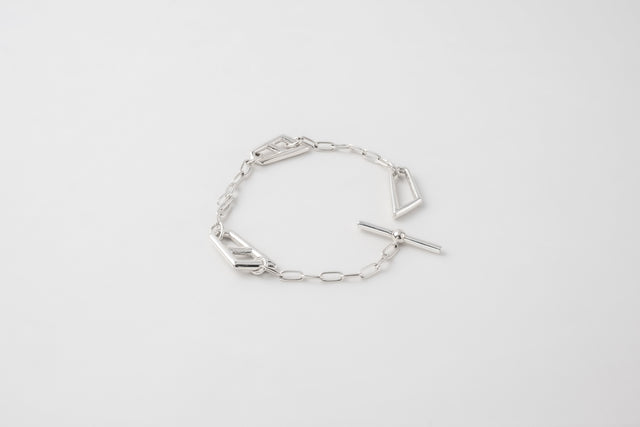
A darkened silver link may still work perfectly; a bright steel bracelet with a clasp that opens by itself needs repair. Compare surface wear and mechanical failure separately. Neither 925 nor 316L specifies a lifespan in years. Start with the clasp, link thickness and fit, then compare care and repair options. The Blade Mini Links V.2 Bracelet gives a concrete starting point: silver 925, with weight and length stated for each size.
Start with exact material identity
925 and 316L describe different systems
Sterling silver contains 92.5% silver; the 925 mark expresses that proportion in parts per thousand. The Federal Trade Commission defines the marking and distinguishes sterling from silver plate, where silver covers another metal. The mark tells you the silver content. It does not tell you when the clasp will wear out.
- Family: stainless steel is a group of alloys rather than one jewelry recipe.
- Grade: a seller should state it when material properties form part of the claim. World Stainless technical tables list 316L under several EN designations and give reference density of 8.0 kg/dm³ at 20°C.
- Evidence: the table does not prove that an unmarked bracelet is 316L. Compare documentation, hallmarks and maker records before drawing conclusions from colour or a title.
The same rule applies to every clasp and connector whose material differs from the main links. STRUGA states the material on every card in its Bracelets collection: 925 silver, or silver combined with carbon where a piece uses both.
Define what “lasting” means for this bracelet
Separate surface, structure and service
- Surface: how quickly the finish shows scratches, polish change, tarnish or coating wear.
- Structure: whether links, pins, soldered joints and clasp keep their geometry under actual use.
- Service: whether the maker or a qualified workshop can inspect, refinish, repair or replace the affected part.
- Continuity: whether the owner accepts visible ageing or expects the original appearance to remain nearly unchanged.
- Evidence: whether the exact alloy, construction and care limits are documented rather than inferred.
Check three things on the bracelet itself: does the clasp close and stay closed, do the links move without an opening joint, and does the fit let the wrist bend? A change of colour and a failing joint call for different actions. Keep a patina if you like it; have a loose joint inspected before wearing the bracelet again. These checks describe its present condition, not a forecast of how many years it has left.
Scratches, dents and deformation depend on construction
Inspect the construction before comparing strength
Hardness, strength and stiffness are different properties. A harder surface may resist some marks yet still scratch; a stiff link can keep its shape while a thin hinge or pin takes the load. World Stainless notes that grade selection depends on multiple considerations and publishes separate chemical, physical and mechanical tables. That separation matters: a single number cannot describe a finished bracelet.
Inspect the places where motion concentrates. Link contact points polish each other; a rigid cuff loads its opening; a chain transfers force through pins, solder and clasp. Take the STRUGA BLADE link as an example: each link is assembled from two halves on copper pins and soldered into one whole, so on a Blade Medium Links V.2 Bracelet the pins and the clasp are the places to inspect, not the flat planes. Sterling designs can dent or bend when section thickness and geometry allow it. Stainless constructions can also scratch, deform or fail at a joint. Ask for the exact grade, link build, clasp type and repair route. Judge a used bracelet by movement, gaps and alignment, not only by the brightness of its broad surfaces.
Tarnish and corrosion are not the same test
Appearance changes need an exact diagnosis
Silver darkens as its surface reacts with sulphur-containing compounds. The Canadian Conservation Institute explains that polishing removes some silver along with tarnish. That matters when judging wear: removing every mark is itself an intervention in the metal. Choose the intended finish before cleaning; deliberate blackening should not be polished away by default.
STRUGA silver is Living Silver: 925 without rhodium plating, left to darken on the wearer. That patina is a property, not a defect, and it can be reset with a silver-cleaning liquid or, on a matte surface, with a fine abrasive. For a bracelet with stones, carbon or hollow components, confirm the cleaning method with the maker first. Blackening in advance is a separate technique the brand applies only to pieces marked as blackened.
- Steel boundary: corrosion resistance does not mean immunity in every environment; grade, finish, crevices, contamination and local exposure affect the result during wear.
- Diagnosis: a dull patch may be abrasion, residue or local corrosion, so a universal chemical bath is not evidence.
- Care: rinse only when the maker permits it, dry joints and closures, and keep unknown cleaners away. A stable surface is a maintenance advantage, not proof that the entire bracelet will outlast every sterling construction.
For a bracelet worn near the sea in Bali, 316L is not a promise of unrestricted water exposure. The British Stainless Steel Association explains that 316 types can suffer pitting and crevice corrosion in seawater, with design, finish and exposure conditions affecting the result. That technical guidance concerns the material, not a test of your bracelet. Ask the maker about the clasp, joints and any coating; remove the bracelet before swimming when those parts or their care limits are unknown.
Weight on the wrist comes from the whole design
Density alone does not predict comfort
The World Stainless table gives 316L a reference density of 8.0 kg/dm³ at 20°C. That fact is useful for engineering, but it does not tell you the weight of a bracelet whose dimensions are unknown. A hollow steel chain may weigh less than a solid silver cuff; a thick steel link may weigh more than a fine sterling chain. Finished mass follows volume, geometry and every component.
Catalogue numbers show the spread inside one alloy: the Thorn Bracelet weighs approximately 5 g in S (17 cm) and 5.4 g in M (21 cm), the Signature Links Bracelet 15 g and 18 g in the same sizes, and the Blade Big Links Bracelet 85 g in M (23 cm) and 95 g in L (26 cm). All three are 925 silver; the difference is geometry.
Comfort also depends on distribution. A compact heavy clasp can rotate under the wrist, broad links spread load, and a rigid cuff concentrates contact at its edges. Compare actual grams, inner length, width, thickness and clasp mass for the exact size. Then try the intended movement: typing, bending the wrist and passing the hand through clothing. “Steel is lighter” and “silver feels heavier” are unreliable shortcuts unless the two objects share the same geometry and recorded measurements.
Skin contact needs evidence, not allergy promises
Check every component that touches the skin
Do not describe either material as universally hypoallergenic. Sterling is 92.5% silver, but the remaining alloy and any solder, plating or clasp component still need identification. “Stainless steel” also covers different grades and manufacturing routes. A 316L claim should be supported by a maker record rather than inferred from a marketing category.
Jewelry can cause contact dermatitis, and the American Academy of Dermatology recommends identifying and avoiding the trigger. If a bracelet causes a rash, stop wearing it and seek advice from a dermatologist, especially if the rash persists or returns. For a known metal allergy, check the alloy and the clasp components against that advice. A material name alone cannot settle an individual reaction.
Repair and resizing are object-specific
Ask who can service the exact construction
Sterling is often presented as automatically repairable, but the real answer is object-specific. It depends on link access, solder, stones, oxidation, coatings and the workshop. Heating can alter a finish or affect nearby components. Removing material during refinishing cannot be repeated without limit. A repairable alloy does not make every clasp, hollow form or mixed-material bracelet economical to rebuild.
A documented service path looks like this: STRUGA cleans and does minor repairs on its own pieces free of charge for as long as the owner keeps them; shipping to the workshop is on the owner, and patina is removed only on request. Commissioned forms and sizes go through Custom Order and, for rings made in pairs, Dark Union.
Stainless work has its own routes and constraints. Welding, finishing and replacement may require equipment and matching stock that a jewelry bench does not keep. Some modular steel bracelets accept a replacement link; others are effectively closed assemblies. Before purchase, ask whether the maker services the model, which parts are replaceable, how size changes are made and what evidence must accompany the piece. A documented service path is stronger longevity evidence than a general claim that one metal “can always be fixed”.
Cost and value are different questions
Compare the ownership path, not a fixed price
Ask for two separate figures: the purchase price and the cost of servicing the exact bracelet. A replacement clasp, a size change and refinishing are different jobs. Find out which the maker offers, whether parts are available and who pays for shipping. Without those answers, comparing the initial prices leaves part of the decision out.
For STRUGA, cleaning and minor repairs are free while the piece remains with its owner; shipping to the workshop is paid by the owner. That policy gives the comparison a concrete service term. It does not promise that any damage can be repaired. Ask about the damaged part before sending it, and compare the same repair terms when considering a steel bracelet.
Choose by a documented decision matrix
Where STRUGA stands in this comparison
- Choose documented 316L steel when a stable low-care surface and a known grade are central, and the model has an acceptable clasp and service path.
- Choose documented sterling 925 when 925 silver content, a surface that records wear and the maker’s silver-work route are central.
- Pause when the grade, plating, clasp construction, actual weight or repair policy is missing.
- For a STRUGA bracelet: check the current product page; every piece for this storefront is made by hand in Bali, Indonesia, in Living Silver or silver combined with carbon, and the whole range sits in the Bracelets collection.
- For every object: use the current product page for weight, size, finish and availability rather than importing facts from a similar bracelet.
| Test | Sterling silver 925 | Stainless steel 316L |
|---|---|---|
| Composition | 92.5% silver, marked 925 (FTC) | One grade of a whole alloy family; the grade must be stated |
| Reference density | Depends on the remainder of the alloy; 925 states silver content | 8.0 kg/dm³ at 20°C (World Stainless) |
| Surface over time | Darkens; reversible by cleaning; Living Silver at STRUGA | Stable chromium-oxide surface; local corrosion still possible |
| Marks and refinishing | Shows marks sooner; refinishing removes material | Resists many marks; refinishing needs steel-specific equipment |
| Weight | Follows geometry: 5 g to 95 g across STRUGA bracelets | Follows geometry; hollow chains can be lighter |
| Service path | STRUGA: cleaning and minor repair free while the owner keeps the piece | Depends on the maker; some modular links are replaceable |
Choose the bracelet whose clasp, fit and care you can live with. Steel can suit someone who wants less visible surface change; silver 925 can suit someone who accepts patina and wants to keep working with the same piece. Neither choice supplies a number of years. The decisive question is what happens when this particular link or clasp needs attention.
Material is one of four things that tell bracelets apart — the other three.
Frequently asked questions
Didn’t find the answer — write to us, we reply personally.
Ask a question →01Does a stainless steel bracelet always last longer than sterling silver?+–
No. Steel often keeps a lower-maintenance surface, but finished life also depends on grade, link geometry, joints, clasp, fit and available service.
02What does 925 sterling silver mean?+–
The FTC explains that sterling contains 92.5% pure silver and that 925 means 925 parts per thousand are silver.
03Is 316L steel lighter than sterling silver jewelry?+–
Not necessarily. Finished weight depends on volume, geometry and components. Compare actual grams for the exact bracelet size rather than material names alone.
04Which material is safer for sensitive skin?+–
Neither label predicts an individual response. Confirm the exact alloy and every skin-contact component, consider fit and condition, and follow professional medical advice for a known sensitivity.
05Can a STRUGA silver bracelet be cleaned or repaired later?+–
Yes. STRUGA cleans and does minor repairs on its own pieces free of charge for as long as the owner keeps them; shipping to the workshop is on the owner. Patina is not a defect and is removed only on request.
06Is a dark surface on a STRUGA bracelet tarnish or a finish?+–
Both exist, and they differ. STRUGA silver is Living Silver: 925 without rhodium plating that darkens on the wearer, and that patina can be reset with a silver-cleaning liquid. Blackening is a separate technique applied in advance only to pieces marked as blackened.
Continue from the journal to a current STRUGA object: Blade Mini Links V.2 Bracelet.