How Much Does an Engagement Ring Cost in 2026?
The US average was $4,600 in 2025, down from $5,200 a year earlier, on a centre stone of 1.9 ct. Under any price sit three lines — metal, stone, hours. At the London fix of 28 September 2026 a 6-gram band holds about $11 of sterling silver or $600 of 18k gold, so the stone usually decides the total, and the choice between a grown and a mined diamond decides the stone.
- The Knot 2026 Real Weddings Study (10,474 US couples married in 2025): average spend $4,600, average centre stone 1.9 ct, lab-grown centres in 61% of purchases — a 239% rise since 2020.
- A whole ring with a grown centre averaged $4,300; with a mined centre, $7,000.
- At the fix of 28 September 2026 a gram of alloy holds: 925 silver $1.82, 14k gold $77.95, 18k gold $99.94, platinum 950 $52.90.
- A finished catalogue ring costs $36–42 per gram of silver with the design already paid for: the Thorn Ring runs from $181 at 5 g to $488 at 13 g.
- A commission is quoted from published parts: design $350, silver at $50 per gram, a $250 consultation deposit credited toward the quote; 2–4 weeks from sketch approval, as a frame, not a date.
- Duty-free de minimis entry to the US has been suspended for all countries of origin since 29 August 2025; STRUGA covers the duties on US orders.
Updated September 29, 2026 — STRUGA editorial team
What is the metal in an engagement ring actually worth?
Less than almost anyone expects. The figures below take the LBMA afternoon fix of 28 September 2026 — gold $4,144.55, silver $61.33 and platinum $1,731.85 per troy ounce — and scale each price to the share of pure metal in the alloy.
| Alloy | Metal value per gram | In a 6-gram band |
|---|---|---|
| 925 sterling silver | $1.82 | about $11 |
| 14k gold, 58.5% pure | $77.95 | about $470 |
| 18k gold, 75% pure | $99.94 | about $600 |
| Platinum 950 | $52.90 | about $320, and the same ring weighs more |
Two things follow. Weight moves this line as hard as the choice of metal does: a 12-gram sculptural band doubles it against a 6-gram one. And gram for gram, 18k gold carries about 55 times the metal value of sterling silver — the gap people most often misjudge. Platinum is priced below gold per gram yet ends up close to it in the ring, because it is roughly twice as dense as silver and a band of the same size simply weighs more.
Read the table as an order of magnitude on one date. Metal prices move every trading day, and a maker buys casting grain above the fix, not at it.
What does the centre stone cost — lab-grown or mined?
The stone is usually the largest line of the three, and origin moves it more than anything else. Brilliant Earth's diamond price guide, updated in August 2026, puts a one-carat diamond at $1,000–16,000 mined and $500–4,500 lab-grown, depending on cut, colour and clarity. The spread inside each column is as wide as the gap between them, which is why a price quoted without a specific stone in front of you tells you very little.
The couples in The Knot's study show the same split in whole rings. According to Rapaport's report on the study, a ring with a grown centre averaged $4,300 with a 2.0 ct stone, and a ring with a mined centre $7,000 with a 1.6 ct stone. The grown stones were larger and cheaper at once.
Is a lab-grown diamond a different material?
No. A grown diamond is the same crystal as a mined one, with the same hardness and the same optical behaviour. What differs is origin, supply chain and price, and the grading report of the individual stone states its specification.
How do coloured stones and raw crystals price?
Coloured stones do not sit on a carat ladder at all. A sapphire is priced by origin first: the GIA notes that Kashmir stones command the highest prices, and Lotus Gemology wrote in 2020 that a Kashmir report can fetch up to ten times the price of an identical Madagascan stone, while Madagascan prices move towards Ceylon's. Rough, uncut crystals and meteorite — the materials a DARK UNION commission can carry instead of a faceted diamond — are quoted against the actual piece.
How much do people spend on an engagement ring in 2026?
In the United States, $4,600 on average, and the figure keeps falling. The Knot's 2026 Real Weddings Study surveyed 10,474 couples married between January and December 2025; its previous edition put the average at $5,200.
The number beside it explains the fall. The average centre stone grew to 1.9 ct while 61% of engagement-ring purchases carried a lab-grown centre, a 239% rise since 2020. Rings are getting visibly larger and cheaper at the same time, and the entire difference sits in the stone line.
An average is not a budget. It mixes grown and mined stones, gold and platinum, city and small-town prices. The honest way to set a number is from the other direction: choose the metal and the weight of the band, choose the stone, and add the hours — the three lines this article prices one by one.
Where did the "three months' salary" rule come from?
From advertising, not from tradition. De Beers engaged the agency N. W. Ayer & Son in 1938 to rebuild American demand for diamonds, as Edward Jay Epstein reconstructed in The Atlantic in 1982. The line "A Diamond Is Forever" was first coined for De Beers in 1947 by the copywriter Frances Gerety.
The salary yardstick grew out of the same campaigns. Al Jazeera's 2025 history of the diamond ring describes the expectation of two or three months' pay as a product of that marketing rather than an accident.
No law and no religious practice ties the price of a ring to income. The multiple was built to lift the average ticket, and it did. A budget built from metal, stone and hours answers the question the rule only pretended to.
Where does the retail price of a ring actually go?
Into the shop around the ring as much as into the ring. The two largest listed jewellers publish the split.
- Signet Jewelers, the group behind Kay, Zales and Jared, kept a 39.5% gross margin on $6.81 billion of sales in its 2026 fiscal year and spent 8.1% of sales on advertising (results release, 19 March 2026).
- Pandora reported a 79.1% gross margin for 2025 and spent 13.9% of revenue on marketing (annual report announcement, 4 February 2026). That margin means roughly $4.80 of price for each dollar of cost of sales, although part of Pandora's revenue is wholesale.
What the margin pays for is visible from the shop floor:
- rent for a mall location, spread across every piece in the case;
- sales staff on every shift;
- advertising that keeps the name in front of buyers;
- stock — a counter has to own hundreds of rings so that a customer can try one on today, and the cost of that money sits inside every tag.
A ring made to order carries none of the stock: the metal is bought after the design is agreed.
How much does a custom engagement ring cost at STRUGA?
The estimate is built from three published parts, and the total is fixed before the work starts.
- Design $350 — form, two sketch rounds and one revision of the 3D model, sign-off.
- Silver at $50 per gram of the finished object.
- A $250 consultation deposit, credited toward the quote rather than added to it.
The quote is fixed after the consultation and the sketch direction; before the sketch is approved, only the deposit is paid. Worked through for a 6-gram silver solitaire: $350 design plus $300 silver is $650 before the stone, deposit included. The stone is quoted against the actual stone. On the custom order page the bands are $350–1,500 for a basic object and $1,500 and up for a complex one, and the timeline is 2–4 weeks from sketch approval — a frame, not a promised date.
What does a catalogue ring cost by comparison?
| Ring | Size | Weight | Price | Per gram |
|---|---|---|---|---|
| Thorn Ring | 16 | 5 g | $181 | $36 |
| Thorn Ring | 22 | 13 g | $488 | $38 |
| Double Line Ring | 16 | 6 g | $250 | $42 |
| Brutalism V.3 Ring | 15 | 10 g | $368 | $37 |
A finished catalogue ring costs $36–42 per gram of silver with the design already paid for; the weight is the catalogue weight for that size, and every hand-finished piece differs slightly. A commission adds the design line and prices silver at $50 a gram. The difference is the price of a form that did not exist before. A catalogue ring modified to your brief — another width, a stone — has no design line: it costs its catalogue price plus 30%, at least $100 more.
For engagement, wedding and paired pieces the door is DARK UNION: not a wedding product off a shelf but an alternative union — harder, more durable, stronger than the standard one. An artifact you arrive at, not one you pick out. Its ready-to-wear line currently holds one ring, the Thorn Ring.
How much does the setting change the price?
Less than the internet claims, and in a way you can calculate yourself. A setting changes two things: how much metal the band carries and how many extra stones sit in it. The rest is setting time.
| Setting | Extra stones | Metal in the band |
|---|---|---|
| Solitaire, 4 or 6 prongs | none | the baseline |
| Bezel | none | more — a wall of metal around the stone |
| Halo | a ring of small accents around the centre | close to the baseline |
| Pavé band | small stones along the band | close to the baseline |
| Channel | stones sunk into the band | more — the band is thicker |
| Three-stone | two matched side stones | close to the baseline |
| Tension | none | the most — the band is the mechanism |
Price it with the metal table above. In 18k gold every extra gram of band is about $100 of metal at the fix; in silver it is under $2. Accent stones are priced like any stone, per carat and by origin. The forms themselves are in our guide to ring types; darkened and brutalist variants in DARK WEDDING.
What moves the price most, and what matters less than you think?
Three variables move the total by multiples.
- Grown or mined. The widest single gap in the purchase: at one carat, $500–4,500 against $1,000–16,000.
- Carat weight. Diamonds are priced per carat, and the per-carat price steps up at round weights, so one 1 ct stone costs more than two 0.5 ct stones of the same grade.
- Metal. Gram for gram, 18k gold holds about 55 times the metal value of silver.
Grades just below the top matter less than the charts suggest: most eyes cannot tell adjacent colour or clarity grades apart without magnification, and the price of a step is paid for a difference that stays on paper. The labour of a setting, stripped of the stones it carries, is the smallest line of all.
How do you spend less without compromising the ring?
Five moves, in order of what they save:
- Choose a lab-grown stone — the same crystal for a fraction of the price.
- Stay just under a round carat. A 0.90 ct stone reads as a carat at arm's length and skips the step in the price list.
- Take a grade below the top in colour and clarity — the difference is invisible without a loupe.
- Choose silver or 14k over 18k and platinum. On a silver band the metal line almost disappears.
- Buy made to order rather than from stock, so you pay for your ring, not for the case of rings around it.
Two things cost more than people expect. Origin decides a sapphire's price before its size does, and a three-stone ring needs side stones that read as a pair against one particular centre — finding them is a sourcing job in itself.
Engagement ring or wedding band — how do the two compare?
Different objects with different jobs, and the cost gap between them is structural.
| Engagement ring | Wedding band | |
|---|---|---|
| Worn from | the proposal | the ceremony |
| Centre stone | usually — often the whole point | normally none |
| Bought as | one piece | a matched pair |
| What sets the price | the stone | metal weight and hours |
A band costs less because it carries no centre stone, simpler geometry and fewer hours — not because it matters less. How the two are worn together is in our comparison of the two; the pieces are in the DARK UNION collection.
What do shipping and customs add to the price?
For the United States, nothing on a STRUGA order: the duties are covered. The rule behind that changed recently. An executive order suspended duty-free de minimis treatment for all countries of origin from 29 August 2025; a US Customs interim final rule made the suspension indefinite for non-postal shipments from 24 June 2026, and the One Big Beautiful Bill Act ends the exemption by law from 1 July 2027. Any page still promising that a piece under $800 clears US customs free is describing a rule that no longer exists.
Elsewhere, local rules apply and the recipient pays on arrival:
- European Union — VAT from the first euro since 2021, and since 1 July 2026 a temporary €3 customs duty per item on low-value online purchases, in force until 1 July 2028 (European Commission).
- United Kingdom — VAT charged at the point of sale up to £135, normal import VAT and duty above it (HMRC); duty relief below £135 is due to end by October 2028.
- Australia — GST collected at sale on goods up to AU$1,000; above that, duty and GST at import (Australian Border Force).
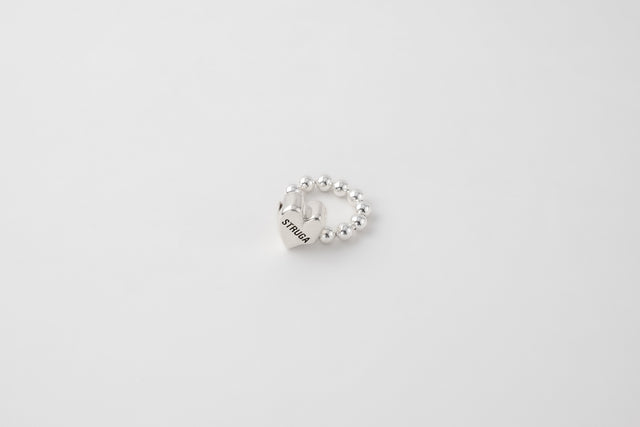
STRUGA makes rings to order in 925 sterling silver; the Brutalism V.3 Ring and the Heart Lock Ring show two directions of the same language. How a commission runs step by step is in our article on the custom ring process.
About STRUGA. STRUGA is a dark silver jewelry brand founded by Dmitry Strugovshchikov and Ekaterina Strugovshchikova, handmade in Bali by master silversmiths. Most pieces are 925 sterling silver left uncoated, so they darken with wear; part of the range is darkened in advance, at the bench. The darkening is part of the design.
Frequently asked questions
Didn’t find the answer — write to us, we reply personally.
Ask a question →01How much does a custom engagement ring cost?+–
At STRUGA the estimate for a ring designed from scratch is built from published parts: design $350, silver at $50 per gram of the finished object, and a $250 consultation deposit credited toward the quote. A 6-gram silver solitaire comes to $650 before the stone. Basic objects run $350–1,500, complex ones $1,500 and up. Modifying a catalogue ring costs its catalogue price plus 30%, at least $100 more, with no design fee.
02What is the average engagement ring cost in 2026?+–
In the US, $4,600, according to The Knot's 2026 Real Weddings Study of 10,474 couples married in 2025; the previous edition put it at $5,200. The average centre stone is 1.9 ct, and 61% of engagement-ring purchases carry a lab-grown centre.
03How much cheaper is a ring with a lab-grown diamond?+–
Couples in The Knot's study paid $4,300 on average for a ring with a grown centre and $7,000 for one with a mined centre, and the grown stones were larger. For a one-carat diamond Brilliant Earth lists $500–4,500 grown against $1,000–16,000 mined, depending on grade.
04Is a lab-grown diamond a fake diamond?+–
No. It is the same crystal as a mined diamond, with the same hardness and optical behaviour. Origin, supply chain and price differ, and the grading report of the individual stone confirms its specification.
05Is the three-months-salary rule real?+–
No. It is an advertising yardstick, not a tradition: De Beers engaged the agency N. W. Ayer & Son in 1938, and "A Diamond Is Forever" was coined in 1947. No law or religious practice ties the price of a ring to income.
06How much is the gold or silver in a ring actually worth?+–
At the LBMA fix of 28 September 2026 a gram of 925 silver held $1.82 of metal, 14k gold $77.95, 18k gold $99.94 and platinum 950 $52.90. A 6-gram band therefore holds about $11 of silver or $600 of 18k gold.
07Is the quoted price final, or a "from $" starting point?+–
The quote is fixed after the consultation and the sketch direction. Before the sketch is approved only the $250 consultation deposit is paid, and it is credited toward the quote rather than added to it.
08Will I pay customs duty on a ring shipped to the United States?+–
Not on a STRUGA order — STRUGA covers the duties on US orders. Duty-free de minimis entry has been suspended for all countries of origin since 29 August 2025. Outside the US, local VAT, GST or duty is paid by the recipient on arrival.
09How can I save money without sacrificing quality?+–
Choose a lab-grown stone, stay just under a round carat, take a colour and clarity grade below the top, choose silver or 14k over 18k and platinum, and buy made to order rather than from stock.
10How long does a custom ring take to make?+–
Two to four weeks once the sketch is approved, often sooner. That is a frame rather than a promised date: the term depends on the form, the material and the workload.