Alternative Engagement Rings: Why More Couples Are Choosing Dark Silver Over Diamonds
The diamond engagement ring is not an ancient tradition — it is a 20th-century marketing invention. Copywriter Frances Gerety wrote "A Diamond is Forever" for De Beers in 1947; the line first ran in 1948, and within one generation a clear stone in a gold band became the only "acceptable" symbol of commitment. An alternative engagement ring returns to what came before: a ring chosen for who the couple actually is, in oxidized 925 sterling silver, with a dark stone like raw tourmaline, aquamarine, quartz or Seymchan meteorite instead of a diamond. Wedding and engagement pieces live in DARK UNION.
Updated September 24, 2026
- An alternative engagement ring is a ring chosen for who the couple actually is — oxidized 925 sterling silver with a dark stone instead of a diamond.
- The diamond engagement ring is a 20th-century marketing invention: the "A Diamond is Forever" line was written in 1947 and first ran in 1948.
- The rarity argument has already collapsed: 61% of US engagement rings now carry a lab-grown centre stone, a 239% rise since 2020, and 40% of couples specifically want a grown stone.
- A STRUGA ring runs $121–1,013 against a US engagement-ring average of $4,600 — for example the Thorn Ring at $181–488.
- Stones in the STRUGA catalogue: tourmaline in 25 pieces, aquamarine in 8, quartz in 4, Seymchan meteorite in 2 — chosen for structure and meaning, not resale value.
- STRUGA makes engagement rings to order in its Bali workshop: cast in 925 sterling silver, about two weeks.
The line that built the diamond engagement ring was written by one person at one agency. Frances Gerety worked at N.W. Ayer in Philadelphia and wrote "A Diamond is Forever" for De Beers in 1947; the line first ran in advertising in 1948, and in 1999 Advertising Age named it the slogan of the 20th century. Before that campaign, people proposed with rubies, sapphires, pearls, plain gold bands — or with nothing at all.
In 2026 the spell is breaking, and the evidence sits in the industry's own numbers rather than in taste.
Why are more couples choosing an alternative engagement ring?
Because the argument that held the diamond in place has been abandoned by diamond buyers themselves. The figures below come from The Knot Worldwide's 2026 Real Weddings Study, a survey of 10,474 US couples married in 2025, as reported by Rapaport:
- 61% of engagement rings now carry a lab-grown centre stone — a 239% rise since 2020.
- 40% of couples say it matters to them that the stone is grown, not mined.
- The average spend fell to $4,600 in 2025, down from $5,200 in 2024.
- The average centre stone grew to 1.9 carats, up from 1.7 in 2024.
- Nearly 9 in 10 proposals happen with a ring already in hand.
Read those lines together and the tradition reads differently. A grown stone is the same carbon as a mined one, so a market that moves to grown stones is a market that stopped paying for rarity and started paying for appearance. Once rarity is off the table, the only honest question left is which object the two of you actually want on the hand. That is the question an alternative ring answers directly.
This is not contrarianism for its own sake. Couples who dress in black, who spend weekends in galleries or at techno nights, who value craft over carats — they do not see themselves in a Tiffany advertisement. They want a ring that reads as their relationship, not as a generic sign of any relationship.
Why does dark silver work as an engagement ring metal?
Oxidized sterling silver does four things a diamond solitaire cannot:
- It evolves with you. A diamond ring looks the same on day one and day ten thousand. An oxidized silver ring changes — the dark surface wears uniquely with your body chemistry and habits. After a year it carries a visible history of your daily life.
- It is honest. Silver does not pretend to be something it is not. No artificial scarcity props up its price, and no ethical minefield surrounds its sourcing. It is a working metal with a craft tradition in every culture on earth.
- It is distinctive. In a room of diamond solitaires, a dark sculptural silver ring says you chose deliberately, and that the relationship needs no external validation.
- It is accessible. The money goes into the work — the form, the casting, the finish — instead of into the financial stress the diamond industry normalized.
The fourth point is the one couples feel first, and it is worth a number. A Fused Cross Ring is $150–359; the US average engagement ring is $4,600. That gap is material cost and market expectation, not skill or care.
Which stones go into an alternative engagement ring?
Alternative engagement rings use stones chosen for structure and meaning rather than resale value. STRUGA works with four, and the catalogue counts are public.
| Stone | Pieces in catalogue | What it looks like | Why it is used |
|---|---|---|---|
| Tourmaline | 25 | Uncut crystal, natural facets, in pink, green, grey, purple and colourless achroite | No two stones are alike; the piece is built around the one you pick |
| Aquamarine | 8 | Pale blue-green, translucent | Unexpected inside a dark setting, and the contrast carries |
| Quartz | 4 | Clear, green or brown, cut large | Depth that shifts with the light instead of flat sparkle |
| Seymchan meteorite | 2 | Iron-nickel with a visible crystal pattern | Material with a verifiable origin outside the earth |
Two honest notes before you plan around a stone:
- Black onyx and obsidian are not in stock. They appear in almost every article on dark engagement rings; the STRUGA catalogue runs on tourmaline, aquamarine, quartz and meteorite instead.
- None of the nine rings on the shelf carries a stone at all. A stone set into a ring goes through a custom order, not through the shelf — the shelf rings are pure form in silver.
How much does an alternative engagement ring actually cost?
The US average was $4,600 in 2025, down from $5,200 in 2024. A silver ring made to order sits an order of magnitude below that, and the whole catalogue is priced openly.
| Diamond ring, US average | STRUGA silver ring | |
|---|---|---|
| Price | $4,600 | $121–1,013 |
| Metal | Gold or platinum | 925 sterling silver |
| Made | Stocked, sized on order | To order, about two weeks |
| Over ten years | Looks the same | Surface wears to the hand that carries it |
Five rings from the shelf, by price, so the range is not abstract:
- Brutalism V.1 Ring — $382–1,013, the heaviest form in the BRUTALISM family.
- Brutalism V.3 Ring — $368–920, the same language in a narrower band.
- Thorn Ring — $181–488, a single spike worn as a statement.
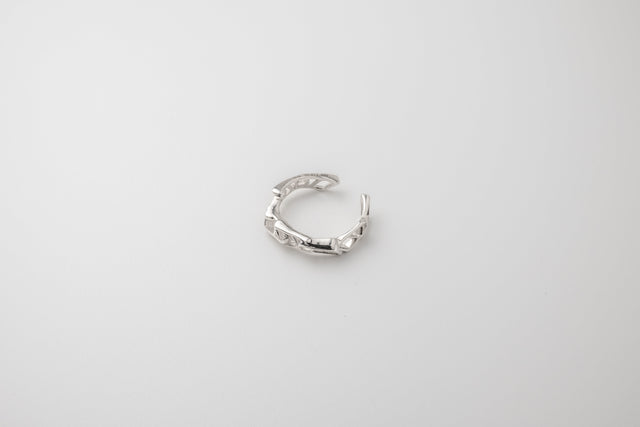
- Fused Cross Ring — $150–359, fused rather than cast smooth.
- Signature Links V.1 Ring — $122–270, the quietest entry into the catalogue.
For many couples the difference is not about being cheap — it is about being intentional. Money not spent on a stone goes toward a home, toward travel, or simply toward not starting a marriage in debt.
Does sterling silver hold up as an everyday engagement ring?
Honestly: silver is softer than gold and platinum, and an engagement ring is worn every day. Sterling silver is 92.5% silver and 7.5% alloy, and that alloy is softer than 14k gold or platinum. A silver ring will pick up fine scratches faster than a gold one. Anyone telling you otherwise is selling something.
What changes the calculation is the finish. A polished gold band shows every scratch as a bright line against a mirror. A dark surface does the opposite — small marks read as texture rather than as damage, and the ring looks better at year three than at week one. A silver ring also survives being dropped better than a harder alloy: the metal bends where a harder one dents.
And a silver ring is repairable at a price that does not require a decision. Re-darkening and re-finishing are bench work, not a rebuild. Over a decade the ring will not look the way it did in the photograph — that is the point of choosing it.
What do you say to people who expect a diamond?
This is the part nobody puts in the buying guides, and it is the question that actually stalls the decision. A ring without a clear stone gets read, at least once, by someone who thinks a step was skipped. The answer that works is not a defence of the budget.
What works is naming the choice as a choice: this is the ring we wanted, made for us, in two weeks, by a person we can name. The number is not the interesting part of that sentence, and the conversation moves on. Couples who lead with the price tend to get an argument about the price; couples who lead with the object tend to get asked to see it.
There is also a factual answer available now. Six engagement rings in ten already carry a grown stone, so the person across the table is comparing your silver ring to a stone that was also made in a workshop.
How do you order a custom engagement ring from STRUGA?
What the process looks like
- You bring the starting point. An idea, reference images, a photograph of a piece you loved, or a description of what it should feel like on the hand.
- The form gets built and shown. Nothing is cast until you have seen and approved the shape.
- It is cast in 925 sterling silver and finished by hand — including the darkening, which is put there deliberately rather than waited for.
- About two weeks from approval to a finished ring.
- Pairs are made as pairs. Wedding and engagement pieces belong to DARK UNION, so two rings can be built in one language.
The most meaningful engagement rings tell a specific story. STRUGA makes engagement rings to order in its Bali workshop — starting from your idea, reference images, or even just a feeling, master silversmiths build the form for your approval and cast it in 925 sterling silver. Production runs about two weeks; the shelf is not the point, because every piece is made for the person who ordered it.
Explore our wedding & engagement collection →
Continue Reading
Alternative Engagement Rings — Key Points
Alternative engagement rings are growing in popularity as couples seek jewelry that reflects their personal aesthetic rather than industry convention. The rarity argument has already gone: 61% of US engagement rings carry a lab-grown centre stone and the average spend fell to $4,600 in 2025. Dark oxidized sterling silver offers a distinctive option — it evolves with wear, carries no ethical sourcing concerns, and runs $121–1,013 across the catalogue. The stones STRUGA works with are tourmaline, aquamarine, quartz and Seymchan meteorite. STRUGA makes alternative engagement rings to order, cast in 925 sterling silver in its Bali workshop, in about two weeks.
About STRUGA. STRUGA is a dark silver jewelry brand founded by Dmitry Strugovshchikov and Ekaterina Strugovshchikova, handmade by master silversmiths. Silver pieces are 925 sterling silver; the CARBON family is pure carbon, without silver. Where the surface is left bare, the metal darkens on its own from the hand that wears it; where a piece is blackened at the bench, the darkness is put there by hand as part of the design. It is a brutalist object that reacts and changes through contact with the environment and the wearer.
Frequently asked questions
Didn’t find the answer — write to us, we reply personally.
Ask a question →01Is an alternative engagement ring the same as a cheap engagement ring?+–
No. "Alternative" describes the aesthetic and the material, not a compromise on quality. A handcrafted oxidized silver ring costs a fraction of a diamond ring because silver carries no artificial scarcity, not because the craft is lesser — the savings go into hand-carving, individual casting and custom design rather than a stone's resale value.
02Is oxidized silver the same as silver that has tarnished with age?+–
No. Oxidized sterling silver is darkened deliberately as part of the design, not metal that has degraded over time. After that, the dark surface keeps evolving — it wears uniquely based on your body chemistry and habits, so a year of wear leaves a visible history rather than damage.
03Is a black stone the same as a black diamond?+–
No. STRUGA works with tourmaline, aquamarine, quartz and Seymchan meteorite, and they are chosen for structure and meaning rather than resale value. Raw tourmaline, for example, arrives uncut with its natural facets intact, so no two stones are alike and the piece is built around the one you pick — it is not a graded diamond substitute.