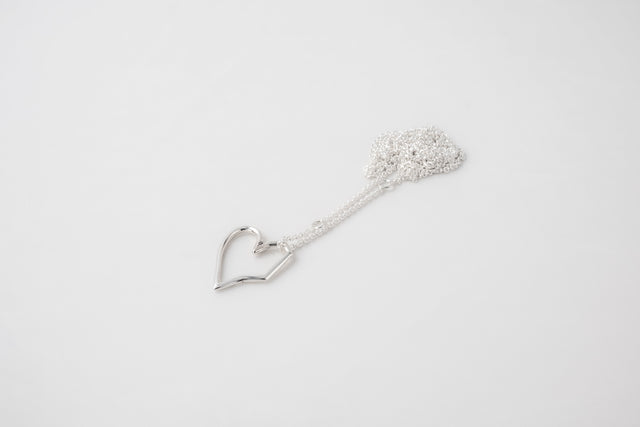
What an Asymmetric Silver Ring Is, the STRUGA Way
SIGNATURE ASYMMETRIC is the brand's first form: sharp edges and recesses, carried over from CNC-cut sheet metal. The asymmetric silver ring is one embodiment.
An asymmetric silver ring has no two matching sides: the STRUGA version is cut and recessed rather than turned around an axis, so the silhouette shifts as the hand moves. SIGNATURE ASYMMETRIC is the brand's first numbered form and its most widely represented — 31 pieces across six categories, of which three are rings: Signature Links V.1, Signature Links V.2 and Double Line. Sterling silver 925, unplated, 2.1 to 13 grams depending on model and size, sizes 16 to 22, made to order in about 14 days.
- Where the form came from
- Anatomy
- The asymmetric ring
- Its place in CODEX
- At a glance
- Frequently asked
Where the form came from
SIGNATURE ASYMMETRIC did not come from jewelry. It came from the machine. This is how sheet metal is cut on a CNC: sharp edges, even planes, recesses. The cutter takes material away in layers and leaves a relief you can read, instead of a rounded silhouette. STRUGA was the first to translate that language into a design of its own.
The brand began with this form — and so did its central experiment: take one form and carry it across different types of pieces. The canon puts it this way, word for word, as the description of a living collection.
The first form of the brand. STRUGA began with it — and so did the project's central experiment: take one form and carry it across different types of pieces.
The aesthetic came from CNC-cut sheet material — sharp edges, even planes, recessed depth. STRUGA was the first to translate that language into a design of its own.
Anatomy
Three named parts make the form. The sharp edge — a margin that is never smoothed to a curve. The even plane — a broad field where light is caught. The recess — a cut that sinks into the volume. No ornament is needed: the angle itself and the shift between planes hold the drawing. The surface is Living Silver, sterling silver 925 without plating. The edges the hand touches lighten; the recesses sink toward graphite; and the relief of the form reads sharper.
One form ran through the whole range — the path the canon fixes word for word.
It started with a pendant, and there were many. The first ones were carbon with inserts — copper, brass, steel, meteorite, patterns. The MOSAIC family grew out of that early work, and it was here that the carbon palette the brand still uses was chosen. Then came the smooth silver SIGNATURE Pyramid, then Asymmetric Destroyed — a broken version of the form in a dark register.
From there the form moved into construction: a chain link, a toggle clasp with its counterpart, a carabiner bail. Carabiners #1, #2 Small, #2 Big and #4 all carry the SIGNATURE Asymmetric form.
A chain link, a toggle, a carabiner, a pendant — and a ring. In this form the ring is built from SIGNATURE ASYMMETRIC links: an open volume held not by a closed band but by an edge clenched around the finger.
The asymmetric ring
The STRUGA asymmetric silver ring is that same edge with its recess, closed into the circle of the finger. The word "asymmetric" here is not a trick for effect: the form is asymmetric from the start — it has no two matching sides, because it was cut and recessed rather than turned around an axis. Look at the ring from different angles and the silhouette shifts.
People search for this ring by an exact phrase — "asymmetric silver ring." STRUGA answers it not as a trend but as the form the brand began with: the one you recognize in any piece. Sterling silver 925, no rhodium, unplated; over time the ring darkens along its own geometry — the raised edge lightens, the recess goes black.
Three rings carry the form today, and they differ by mass rather than by drawing. Signature Links V.1 is the original: a single link closed on the finger, 2.7 grams at size 16. Signature Links V.2 redraws that link lighter — 2.1 grams at the same size. Double Line runs two lines side by side and weighs 6 grams at size 16, 13 at size 22. All three are sterling silver 925 without rhodium, in sizes 16 to 22, made to order in about 14 days.
Its place in CODEX
SIGNATURE ASYMMETRIC lives in the CODEX world — STRUGA's everyday architectural language, its DNA. It is the brand's first numbered form, and today the most widely represented: it lives in more categories than any other. The canon closes the thought in a single line.
Today it is the most widely represented form in the brand — it lives in more categories than any other. For STRUGA it is, above all, about beauty: one form you recognize everywhere.
Beside it, in the same world, stand BLADE, THORN, BRUTALISM and SIGNATURE HEART — each its own line, its own recognizable silhouette. Among them, SIGNATURE ASYMMETRIC is the one about the cut and the recess: an edge you recognize before you work out what kind of piece you are looking at.
The asymmetric ring at a glance
| Aspect | Value |
|---|---|
| What makes it asymmetric | Cut and recessed, not turned around an axis: no two matching sides, and the silhouette shifts as the hand moves |
| Form | SIGNATURE ASYMMETRIC — the brand's first numbered form, from CNC-cut sheet metal: sharp edge, even plane, recess |
| World | CODEX — everyday architectural language, beside BLADE, THORN, BRUTALISM and SIGNATURE HEART |
| Metal | Sterling silver 925, no rhodium and no plating — Living Silver, darkening along the geometry of the form |
| Rings in the family | Three: Signature Links V.1, Signature Links V.2, Double Line |
| Weight and size | 2.1 to 13 grams depending on model and size; sizes 16 to 22 |
| Spread of the form | 31 pieces across six categories — rings, necklaces, chains, bracelets, earrings, ear cuffs |
| Made to order | About 14 days; a size or a form not in stock goes through Custom Order |
Frequently asked questions
Didn’t find the answer — write to us, we reply personally.
Ask a question →01How is an asymmetric ring different from an ordinary one?+–
An ordinary ring is symmetrical, with an axis and matching sides. The STRUGA ring is asymmetric by construction: it was cut and recessed rather than turned around an axis, so the silhouette shifts as you turn it. The asymmetry is not decoration laid over a band; it is the SIGNATURE ASYMMETRIC form itself, closed into the circle of the finger.
02What is an asymmetric silver ring made of?+–
Sterling silver 925 without rhodium plating, our Living Silver. The ring arrives bright and darkens over time: the raised edge lightens where the hand touches it, the recess sinks toward graphite. Over time the relief of the form reads sharper.
03What other pieces carry the SIGNATURE ASYMMETRIC form?+–
The same form ran through the whole range. It started with pendants, then moved into construction, a chain link, a toggle clasp, a carabiner bail. This is the brand's central experiment: one form carried across different types of pieces, the form you recognize everywhere.