Which Hand Do Wedding and Engagement Rings Go On? 29 Countries
In roughly two-thirds of countries the ring goes on the left hand; in the remaining third, on the right. The left-hand habit rests on a single page written around 150 AD, where a Roman collector of curiosities repeats an Egyptian claim about a fine nerve running from the fourth finger to the heart. The right-hand habit is older in places: Northern European, Slavic and Indian custom treats the right hand as the active or the sacred one.
Updated September 14, 2026
Neither is "correct." Both are correct. Which one applies to you depends on where you live, where your family is from, and what religion or tradition is being followed.
This guide covers the question by country, by religion, by hand position during the ceremony, and by the practical question of how to wear the engagement ring on a different hand than the wedding ring.
One practical note before the country tables: for most people the right hand is the working hand, so a band worn there meets more edges and more wear than the same band on the left. A rounded inner profile and a finish that ages evenly matter more on that side. STRUGA makes its rings to order, so the size is taken for the hand the ring will actually be worn on; the Thorn Ring is the wedding band of the DARK UNION world.
Left hand in about two-thirds of countries, right hand in the rest; neither is more correct.
The right hand is standard for the wedding ring in Germany, Poland, Greece, India and across Orthodox and Slavic countries, Russia included.
The left-hand habit rests on one Roman page — Attic Nights X.10, about 150 AD — a fine nerve, not a vein.
The wedding ring goes on first, closest to the palm; the engagement ring stacks above.
So which hand is it — left or right?
Three rules cover almost every case.
- Left hand, both rings. The United States, United Kingdom, France, Italy, Spain, Canada, Australia, New Zealand, Mexico and most of South America — 14 of the 29 countries in the tables below.
- Right hand for the wedding ring. Russia, Germany, Austria, Norway, Denmark, Poland, Greece, India, Colombia and Venezuela among others. The engagement ring may sit on the left until the ceremony and move across on the day, or both rings stay on the right from the start.
- Religion overrides the country. In Eastern Orthodox, Jewish and Hindu weddings the rite decides the hand, wherever the wedding takes place.
Why the left hand?
The left-hand tradition traces to a single Roman page. In Attic Nights X.10, written around 150 AD, Aulus Gellius passes on a claim by the Egyptian writer Apion: dissection had found a very fine nerve — not a vein — running from that one finger to the heart. The Latin phrase vena amoris, "vein of love," never appears in Gellius. It is a later label pinned onto his sentence, and it changed the anatomy in the retelling.
The anatomy was wrong twice over: there is no such nerve, and no vein of that kind either. But the symbol stuck. The Roman tradition spread through the Roman Empire, through Christianity, and through 1,500 years of Western European cultural inheritance. By the time the question arose in modern English-speaking countries, the left hand was already the default.
The fourth finger specifically — counting from the thumb — is the "ring finger." In English, we still call it that. In most Romance languages it has a similar name (French annulaire, Spanish anular, Italian anulare — all from Latin anulus, ring).
Why the right hand?
Four separate traditions arrive at the right hand, and none of them borrowed it from the others.
Northern and Eastern European tradition
Pre-Christian Northern and Slavic European cultures treated the right hand as the sacred or active hand. Religious gestures, oaths, and signing happened with the right hand. The wedding ring, as a sacred object, naturally went on the right. Germany, Austria, Norway, Denmark, Poland, and several others retained this even after Christianization.
The pattern persists strongly across many Slavic and Orthodox-tradition countries: wedding rings are worn on the right hand in Russia, Bulgaria, Georgia, Serbia, Belarus, and Ukraine. In some, the engagement ring follows the same pattern; in others, it stays on the left until the wedding day.
Eastern Orthodox tradition
The Eastern Orthodox Church places wedding rings on the right hand in the wedding ceremony itself. The priest blesses the rings and places them on the right ring finger. Greek, Bulgarian, Serbian, and Romanian Orthodox weddings follow this rule regardless of the country's general tradition.
Indian tradition
Hindu tradition treats the left hand as ritually impure (used for cleaning), so most jewelry is worn on the right. The wedding ring or wedding band, where used, is worn on the right hand. However, modern Indian weddings — especially in cities — increasingly follow the Western left-hand convention as a secondary tradition alongside the religious ceremony.
Jewish tradition
In traditional Jewish weddings, the groom places the ring on the bride's right index finger during the ceremony itself (so the witnesses can clearly see the act). After the ceremony, the bride moves the ring to her left hand. This means a single ring physically passes through three positions: groom's hand → bride's right index → bride's left ring finger.
| Tradition | Hand at the rite | What decides it |
|---|---|---|
| Roman Catholic, Protestant | Left | Country custom, left-hand in most of them |
| Eastern Orthodox | Right | The rite, in any country |
| Hindu | Right | The left hand is treated as ritually impure |
| Jewish, traditional | Right index finger | Witnesses must see it; moves left afterwards |
Which hand is the engagement ring worn on in Russia?
In Russia the engagement ring goes on the ring finger of the right hand — the same hand that will later carry the wedding band. The reason is the Orthodox rite: the priest places the wedding ring on the right hand, so the engagement ring holds that place in advance.
This creates a problem Western couples never meet. After the wedding, two rings compete for one finger. The usual Russian answer is to leave the wedding ring on the right and move the engagement ring across to the left hand. The Western stack — band underneath, engagement ring on top — is rare here, because the band is not taken off again.
Neither law nor church rule fixes any of this: the hand is custom, and custom bends. Couples in Moscow and St Petersburg increasingly wear both rings on the left in the Western way, and nobody treats it as an error. Belarus, Ukraine, Georgia and Serbia follow the same right-hand pattern.
By country — quick reference
Left hand traditions:
| Country | Engagement ring | Wedding ring |
|---|---|---|
| United States | Left | Left |
| United Kingdom | Left | Left |
| France | Left | Left |
| Italy | Left | Left |
| Spain | Left | Left |
| Canada | Left | Left |
| Australia | Left | Left |
| New Zealand | Left | Left |
| Ireland | Left | Left |
| Mexico | Left | Left |
| Argentina | Right (engagement) → Left (wedding) | Left |
| Brazil | Right (engagement) → Left (wedding) | Left |
| Japan | Left | Left |
| South Korea | Left | Left |
Right hand traditions:
| Country | Engagement ring | Wedding ring |
|---|---|---|
| Russia | Right | Right (engagement ring usually moves to the left) |
| Belarus | Right | Right |
| Ukraine | Right | Right |
| Germany | Left | Right |
| Austria | Left | Right |
| Norway | Left | Right |
| Denmark | Left | Right |
| Poland | Left → Right | Right |
| Greece | Right | Right |
| India (Hindu) | Right | Right |
| Bulgaria | Right | Right |
| Serbia | Right | Right |
| Colombia | Right | Right |
| Venezuela | Right | Right |
| Netherlands | Left → Right (Catholic) or Left (Protestant) | Same as engagement |
The Brazil and Argentina pattern is unique: the engagement ring (called aliança de noivado) is worn on the right hand during engagement, then moved to the left hand at the wedding ceremony. Both rings end on the left.
The Polish pattern is similar but in reverse: engagement ring on the left, then both engagement and wedding rings move to the right after the ceremony.
Which goes first — engagement or wedding ring?
The wedding ring goes on first, closest to the heart; the engagement ring stacks above it.
The reasoning is partly symbolic (the wedding ring closer to the body, the engagement ring "guarding" it) and partly practical (the wedding ring stays on through the wedding ceremony itself; the engagement ring is often removed for the ceremony so the wedding ring can be placed on the empty finger and then re-stacked afterward).
For Western (left-hand) traditions, the typical sequence is:
- Day before wedding: bride wears engagement ring on left ring finger
- Wedding morning: bride moves engagement ring to right hand temporarily
- Wedding ceremony: groom places wedding ring on left ring finger
- After ceremony: bride moves engagement ring back to left ring finger, stacked on top of the wedding ring
By the end of the wedding day, both rings are on the left hand, with the wedding ring closer to the palm and the engagement ring further out.
Mixed-tradition couples
What if one partner is from a left-hand country and the other from a right-hand country? Three patterns we see in STRUGA custom orders:
- Each partner follows their own tradition. The wife wears her rings on the left; the husband wears his on the right. Visually mixed but personally meaningful.
- Both follow the country of residence. Whichever country the couple lives in becomes the default. Common when one partner has emigrated.
- Both follow the religious tradition. The ceremony's religion decides — Catholic or Protestant left-hand, Eastern Orthodox right-hand.
None of these is wrong. The choice is the couple's. Custom workshops do not require any particular hand orientation — a ring is symmetric and works on either hand of the same size.
In practice the venue settles the argument. A Greek Orthodox wedding in Greece or a Hindu ceremony in India carries its own hand by default, and the family closest to that tradition usually holds the firmest opinion about it. After the ceremony the couple is free again.
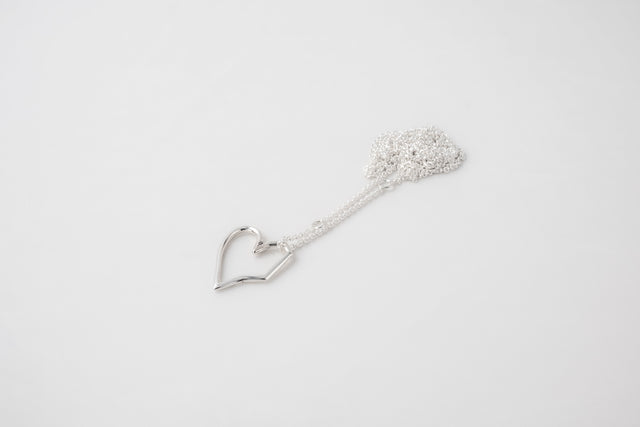
Two traditions holding in one marriage have a parallel in the brand's own form: SIGNATURE HEART is half smooth, half angular, two different hearts joined into one. The Wire Heart Necklace is its lightest reading — 5 grams of 925 silver drawn as a single continuous line, on a 75 cm chain that also fastens at 65 and 55 cm.
Wearing the engagement ring on a different finger
Some people prefer not to wear the engagement ring on the ring finger. Reasons include:
- Profession requires no jewelry on the dominant hand (surgeons, machinists, kitchen staff)
- The ring is too valuable for daily wear
- Personal preference for the middle finger or pinky
- Knuckle joint changes with age — the ring no longer fits the original finger
The engagement ring can be worn on any finger. Popular alternatives:
- Right ring finger. Mirrors the conventional position on the opposite hand.
- Middle finger of either hand. Common in fashion-forward markets; acceptable in most cultures.
- Pinky finger. Older European tradition for unmarried family heirs; modern fashion choice.
- On a chain around the neck. Common when the ring cannot be worn during work or sports.
For a wedding ring, traditional ceremonies place the ring on the fourth finger specifically. After the ceremony, what the wearer does with the ring is personal.
What if my finger size has changed?
Finger size changes with weight, age, climate, and pregnancy. Most people experience a 0.5–1.5 size change over a 20-year period.
Three options when a ring no longer fits:
- Resize. Most rings can be resized up or down by one or two sizes. Some settings — channel, eternity — cannot be resized at all: there the answer is a new ring, not a repair.
- Wear on a different finger. If the original finger no longer fits, the ring may fit a different finger naturally.
- Wear on a chain. Permanent solution if the wearer no longer wants daily ring wear.
STRUGA includes one free resizing of a ring; shipping in both directions is on the owner. Cleaning and small repairs stay free for as long as the piece is with its owner.
What about same-sex couples?
Same-sex couples follow the hand and finger convention of the country of marriage, exactly as everyone else does. What differs is the giving: sometimes one partner gives, sometimes both give at once, sometimes the engagement is marked by paired rings rather than a single one. Couples who plan both rings as one coordinated set from the start — common in custom work — never meet the stacking problem at all, and the same approach suits mixed-tradition marriages.
Common questions about ring placement during the wedding day
Three small details that surprise couples on wedding day:
- Removing nail polish from the ring finger. Some traditions and superstitions say the ring finger should be unpainted at the moment of placement. This is a personal choice with no practical effect.
- Engagement ring transferred during the ceremony. Many brides hand the engagement ring to a maid of honor at the start of the ceremony, then receive it back after the wedding ring is placed. This avoids a fumble.
- Photographs of the ring placement. The "ring shot" works best when both rings are visible. Many photographers ask for a brief moment after the ceremony to capture the stack — engagement on top of wedding band — on the left or right hand depending on tradition.
Where does the left-hand tradition actually come from?
Gellius never claims the idea as Roman. He credits Apion's Egyptian History, and the evidence offered is Egyptian dissection. The chain runs Egyptian claim, Greek-language report, Roman notebook, then eighteen centuries of jewellery habit — with the anatomy never checked once along the way.
The ring enters the Christian record in 866, when Pope Nicholas I answered the Bulgarians: at betrothal the man marks the bride's finger with a ring of faith. Read the passage and two popular claims fall away — it describes betrothal rather than the wedding rite, and it names neither the hand nor the finger. The fourth finger of the left hand became the Catholic European norm afterwards, by custom rather than by decree.
The Eastern Orthodox Church, which split from Roman Catholicism in 1054, kept earlier Greek and Slavic right-hand traditions instead. This is why Greek, Bulgarian, Serbian, and most Eastern European Orthodox weddings still use the right hand for the wedding ring.
Protestant Reformation countries (England, Scotland, Scandinavia) mostly retained the left-hand Catholic tradition, except Norway and Denmark which kept the older pre-Christian right-hand custom. Germany is mixed: traditionally right-hand wedding ring, traditionally left-hand engagement ring, with regional and religious variation.
The British colonial period spread the left-hand tradition to North America, Australia, New Zealand, and parts of Africa and Asia. The Spanish and Portuguese colonial period spread it through South America. By the 21st century, the left-hand tradition is dominant globally because it travels with the languages of former colonial empires.
What happens to the ring during the ceremony itself?
The placement is a public act, and each rite stages it differently.
- Western Christian. One ring, placed by the partner on the fourth finger of the left hand. One moment, one position.
- Eastern Orthodox. The priest blesses two rings, exchanges them three times over the couple's heads, then places them on the right ring finger.
- Jewish (traditional). The ring goes on the bride's right index finger, where witnesses can see it clearly, and moves to the left ring finger afterwards.
The witnessed moment matters more than the long-term position: the ring may change hands later, but placing it on a named finger in front of witnesses is the legal and religious act of the marriage.
Does a ring have to be made differently for the right hand?
No, but it may need a different size. Most hands are not perfectly symmetric: the dominant hand is usually slightly larger, so a ring sized for the left can run half a size small on the right. For couples who plan to move the ring between hands we make adjustable sizing, or two slightly different sizes of the same ring — one line in the brief that prevents an awkward fit later.
- Paired bands that work on either hand — the DARK WEDDING concept and the DARK UNION wedding rings.
- How a ring is actually made to order — the process guide.
- Engagement ring or wedding ring — the difference explained.
- What it costs, metal by metal — the cost guide.
- Send a brief — the custom order form.
- Who designs these pieces — Dmitry Strugovshchikov.
About STRUGA. STRUGA is a dark silver jewelry brand founded by Dmitry Strugovshchikov and Ekaterina Strugovshchikova, handcrafted with Balinese and international silversmiths. Every piece is 925 sterling silver, naturally oxidized or hand-patinated. The darkening is part of the design. It is a brutalist object that reacts and changes through contact with the environment and the wearer.
Frequently asked questions
Didn’t find the answer — write to us, we reply personally.
Ask a question →01Is the left hand the "correct" hand for an engagement ring?+–
No. There is no single correct hand — both are correct. The left hand is the default in roughly two-thirds of the world (the United States, United Kingdom, France, Italy, Spain, Canada, Australia, and most of South America), while the right hand is standard in Germany, Austria, Norway, Denmark, Poland, Greece, India, and across many Slavic and Orthodox-tradition countries. Which applies to you depends on country, family, and religion, not on a universal rule.
02Is the engagement ring the same as the wedding ring in how it is worn?+–
No. They are worn differently in sequence. The wedding ring goes on first, closest to the palm and "closer to the heart"; the engagement ring is stacked above it. In many ceremonies the engagement ring is removed during the rite so the wedding ring can be placed on the empty finger, then re-stacked on top afterward.
03Does the right-hand tradition mean the marriage is different from a left-hand one?+–
No. The hand is a regional and religious convention, not a difference in the marriage itself. The witnessed act of placing the ring on a specific finger at a specific moment is the legal and religious act of the marriage — the long-term hand position can even change afterward without affecting it.
04Does a ring sized for the left hand fit the right hand?+–
Not always exactly. A ring is symmetric and works on either hand of the same size, but most hands are not perfectly symmetric — the dominant hand is usually slightly larger, so a ring sized for the left may be a half-size too small for the right. For clients who plan to switch hands, STRUGA offers adjustable sizing or two slightly different sizes for the same ring, and one free resizing is included; shipping both ways is on the owner.