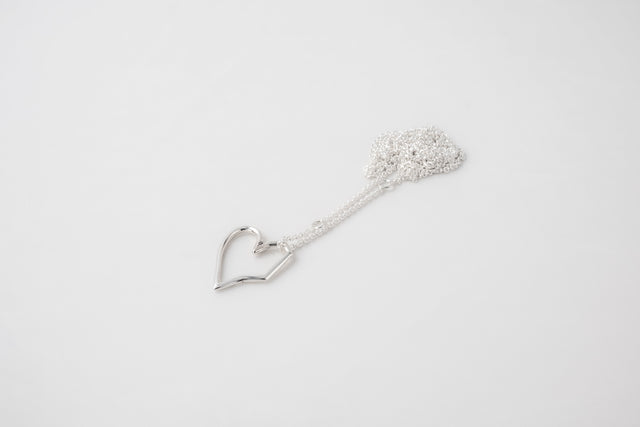
How to Clean Silver Earrings at Home — Finish, Stones, Posts and Backs
In short. Bright silver without a stone is washed in warm water with a drop of mild soap, the post and back brushed, then rinsed and dried. A silver dip on a cotton swab, rinsed off at once, brings polished silver back to light; a fine abrasive refreshes matte. Blackened pairs get only cloth, water and soap: dips, paste and baking soda strip the blackening. Tourmaline stays out of ultrasonic and steam.
Updated September 29, 2026
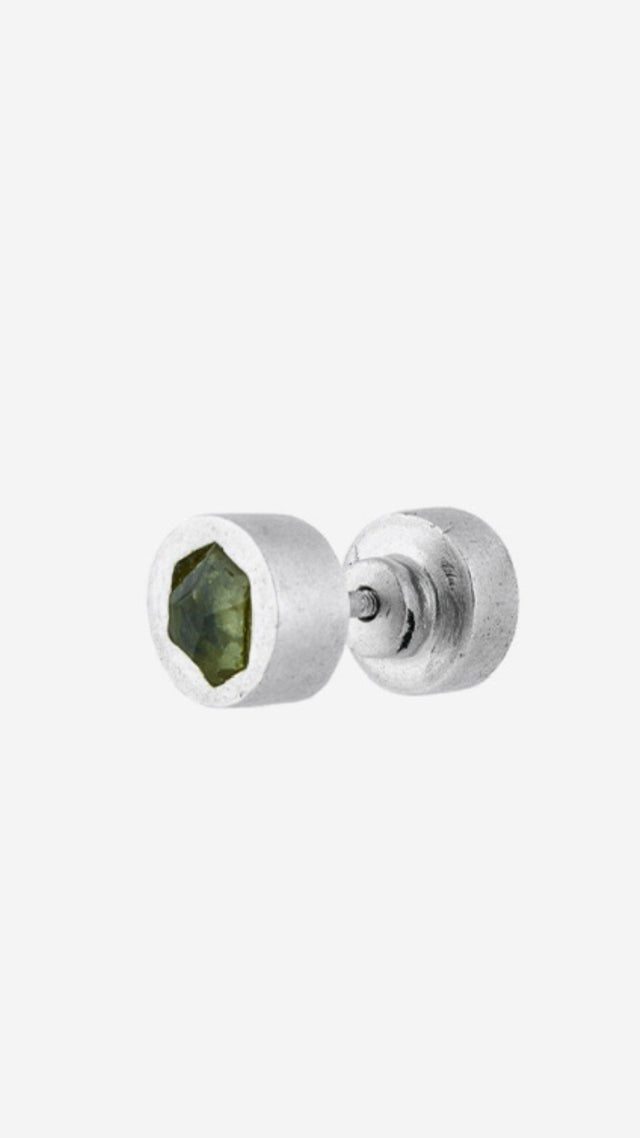
An earring does not darken all at once. Fingers, hair and collars rub the raised parts bright, while the dark layer stays in the recesses, in the thread of the post and under the back — friction never gets there. The Thorn stud weighs 2.92 g: a polished plate, a threaded post and a screw-on back. The Thorn Amulet #23 is a cone darkened from day one, with a clear tourmaline in its cut. The same metal — 925 silver with no rhodium plating. Opposite ways to clean them.
Why do silver earrings tarnish, and where does it start?
The dark layer on silver is silver sulfide. It grows from sulfur compounds in ordinary indoor air, hydrogen sulfide above all (Canadian Conservation Institute). The film stays on the surface and protects the metal beneath it; as it thickens its growth slows, but in humid air it keeps going (G. T. Burstein for Assay Office London). Sterling silver — 92.5% silver and 7.5% copper — tarnishes faster than the pure silver on a plated object. Humidity speeds it up: CCI advises keeping silver dry, below 50% relative humidity.
An earring has its own map. The front gets touched and brushed; the back sits against the lobe, and the thread and seams stay hidden. Nothing wipes the dark layer off there, so the back and the recesses darken first while the front holds its light longer. The chemistry is covered in full in why 925 silver tarnishes.
STRUGA silver carries no rhodium, so the earrings arrive bright and darken on their owner. This is Living Silver: patina is a property, not a defect — a map of how the pair is worn. The Thorn stud belongs to the CODEX world: pure uncoated silver without stones or inserts. Blackened earrings are another case: they were darkened at the bench, and the dark tone is there from the first day. Everything darkened in advance lives in the RITUAL world, together with the amulets built around raw stones, like the Thorn Amulet #23.
What should you check before cleaning an earring?
Three questions decide the method. The answer to each is on the product page or visible to the eye.
- Which finish. Polished silver shines, matte silver scatters light evenly or with fine abrasive lines, blackened silver is dark all over and lightens only on raised points and edges.
- Is there a stone, and how is it held. Tourmaline and aquamarine in a metal setting take warm soapy water. Pearls react to acids, cosmetics and perfume; a glued stone is better kept out of a soak.
- What else is it made of. Carbon, another brand's plating, a hollow part — each one changes the rule for the whole pair.
One rule holds: the most sensitive part sets the method for the whole earring.
Which method suits which pair?
Every day the method is the same for all of them — a soft dry cloth after wear. After that the paths split.
| Pair | When it gets dirty | To bring back the light | Never |
|---|---|---|---|
| Polished silver, no stone — Thorn stud, 2.92 g | warm water, a drop of soap, a soft brush | silver dip on a cotton swab or a polishing cloth | toothpaste, multi-purpose metal polish |
| Matte silver | warm water and soap | a scouring pad or fine sandpaper sets a new matte | polishing to a shine if the matte is intended |
| Blackened silver with tourmaline — Thorn Amulet #23, 3.5 g | warm water and a drop of mild soap | not needed: the dark tone is the finish | silver dip, polishing paste, baking soda, ultrasonic |
| Bright silver with aquamarine — Thorn Amulet #1, 5.0 g | warm water and soap | a cloth or silver dip, briefly | ultrasonic, harsh chemicals |
| Stud with an uncut crystal — Classic Amulet (M), 3.0 g | warm water and soap | a cloth or silver cleaner | ultrasonic, harsh chemicals |
| Silver and carbon — Blade Fused Mini Line Bloody, 5.27 g | water and soap: carbon is unafraid of water | the silver parts only, separately | polishing the carbon |
| Pearls | a soft cloth after wear; warm soapy water now and then | — | ultrasonic, steam, acids |
How do you clean plain silver earrings at home, step by step?
Bright silver without a stone needs five minutes and what is already in the kitchen.
- Take the back off and work over a towel: a small part vanishes down a sink in a second.
- Soak the earrings for a few minutes in warm water with a drop of mild soap or dish soap.
- Run a soft toothbrush over the post, the thread, the inside of the back and the recesses of the form.
- Rinse in clean water so no soap stays in the thread.
- Pat dry with a soft cloth and leave the parts apart until the thread and the back are fully dry.
Soap takes off dirt, not the film. If the earring is still dark once dry, the finish decides what comes next — and so does the owner: darkness on bright silver is not damage but the start of a patina.
How do you bring tarnished silver back to light — dip, cloth or abrasive?
Living Silver is reversible: the patina comes off and the earring starts its life again. Whether to do it is the owner's choice, not a required routine.
- Silver dip — for polished silver with no stone, or with a stone the product page allows. A dip dissolves tarnish faster than the silver beneath it, and total immersion easily over-cleans; the safer practice is to apply it locally with a cotton swab and rinse at once (CCI). A dipped piece looks new because no tarnish is left in the recesses.
- Polishing cloth — spot work on raised points and the front. The cloth is impregnated with a mild abrasive and suits lightly tarnished silver; it too takes a little silver along with the film.
- Scouring pad or fine sandpaper — for matte silver. The abrasive takes off a thin top layer and sets a new matte together with the patina.
The less often dip and cloth come out, the longer the edges stay sharp: each pass carries a little metal away with the film.
How do you clean blackened earrings without stripping the finish?
Blackening is neither dirt nor patina. The earring is darkened at the bench by controlled oxidation, and the dark tone belongs to the form as much as the cut or the barb. On the Thorn Amulet #23 only the barbs and the edge of the cut catch light — by design.
- after wear — a soft dry cloth;
- when it gets dirty — warm water and a drop of mild soap, then dry;
- no silver dip, no polishing paste or cloth, no baking soda and foil, no ultrasonic bath: they strip the dark layer or harm the stone.
If the dark tone has worn off the raised points, the earring is not ruined: that is how the map of wear shows through. The wider routine for darkened metal is in the oxidized silver care guide, and the blackened earrings and cuffs are gathered on the oxidized silver earrings page.
How do you clean earrings with stones — tourmaline, aquamarine, pearls, cubic zirconia?
The stone sets the limit for the whole earring. The silver may take a dip while the stone beside it cannot.
Can earrings with tourmaline, aquamarine or crystal be washed?
Yes, in warm soapy water. For tourmaline GIA calls warm soapy water the best method and does not recommend ultrasonic or steam cleaners: high heat can alter its color, and a sudden temperature change can crack it (GIA). For aquamarine warm soapy water is always safe; ultrasonic and steam are usually safe only when the stone has no liquid inclusions or fractures (GIA). A raw stone cannot be checked for those at home, so STRUGA product pages keep one rule for earrings with a stone: no ultrasonic baths and no harsh chemicals.
How do you clean pearl earrings?
Pearl is sensitive to chemistry: GIA notes that many chemicals and all acids damage it, hair spray, perfume, cosmetics and even perspiration among them. Put pearls on after perfume and makeup, wipe them with a soft cloth after wear, use warm soapy water for an occasional thorough clean — and never an ultrasonic or steam cleaner (GIA).
What about cubic zirconia and glued stones?
The same logic applies: if a stone is set in glue, keep the earring out of a soak. Wipe it with a damp soft cloth and dry it straight away.
How do you clean earring posts and backs — and should you use alcohol or peroxide?
The post goes through the lobe and the back presses against it from behind; both touch skin all day. Clean them with the earring: soapy water and a soft brush over the thread and the inside of the back, then rinse and dry.
For a healed piercing, alcohol is the one to use. The American Academy of Pediatrics symptom guide advises cleaning earrings, posts, backs and earlobes with rubbing alcohol before putting earrings in (AAP); 60–90% alcohol has long been used to disinfect small surfaces and evaporates quickly (CDC). Wipe the metal only — past pearls and glued stones.
Peroxide is a poor match for silver: the CDC’s ATSDR toxicology guide lists silver and copper — the two metals of sterling — among the materials hydrogen peroxide reacts with (ATSDR). A fresh piercing follows other rules: the Association of Professional Piercers advises against both alcohol and peroxide on it, because they damage cells, and suggests sterile 0.9% saline (APP).
Do baking soda and foil, ammonia, citric acid and toothpaste work?
Household tricks part ways with chemistry more often than it seems. Briefly, one by one.
Do baking soda and aluminum foil damage silver?
They do not remove metal, but they change the surface. With aluminum in contact, a warm soda solution — CCI specifies warm, not boiling — turns the tarnish back into silver; that silver stays on the surface as rough particles that leave a dull, matte finish, and the piece must be rinsed well afterwards (CCI). CCI adds two limits: objects cleaned this way may tarnish again faster than polished silver, and anything with sealed hollow parts should not go into a solution at all. On blackened silver the bath removes the very darkness the earring was made with.
Does ammonia clean silver?
No. Ammonia works on grease, not on tarnish: conservators added it to polishing fluid only to help lift greasy deposits, and then dropped even that (Wharton et al., 1990). Silver sulfide itself dissolves only in nitric and sulfuric acids (Palomar et al., 2018). What ammonia does dissolve is the copper in 925 silver, and residue left in crevices later turns green (CCI).
Do citric acid, lemon juice and vinegar work?
No. Organic acids do not remove silver sulfide: in a conservators' comparison of cleaning methods, organic acids alone proved ineffective (Palomar et al., 2018). They harm other things instead: acids damage niello (CCI), and GIA notes that all acids damage pearls.
Can you clean silver with toothpaste?
No. Toothpaste is an abrasive, and GIA advises against cleaning jewelry with abrasives like those in toothpaste and some metal polishes: they erode the metal and can scratch gems (GIA). CCI rules out multi-purpose metal polishes too: they are more abrasive than silver polishes and remove more silver.
Can earrings go in an ultrasonic cleaner?
Not STRUGA earrings: their product pages rule out ultrasonic baths, for bare silver and for stones alike. For stones it is GIA's rule as well: ultrasonic is not recommended for tourmaline and never for pearls, and aquamarine takes it only when the stone has no fractures or liquid inclusions. Ultrasonic does not remove tarnish anyway — it washes, and silver sulfide does not dissolve in water (Palomar et al., 2018).
How should you store earrings so they darken more slowly?
- Put earrings away dry — after washing and after a hot day.
- Give each pair its own bag or compartment so a post never scratches its neighbors.
- A sealed polyethylene bag with small packs of silica gel and activated charcoal slows tarnish (CCI).
- Keep rubber, wool and felt away from silver — they give off sulfur compounds (CCI).
- Keep chlorine away — in the pool and in household cleaners: GIA advises avoiding chlorine and bleaching agents, and household bleach oxidizes silver on its own, leaving a dark brown-gray film (Berman and Awayda, 2013).
Storage is covered in full in how to prevent silver from tarnishing, and the general rules for any silver in the Atlas section on silver care.
Can you wear tarnished earrings, and why does the lobe turn black?
Tarnish does not stop you wearing the earring and does not spoil the metal: the film lies on the surface, and the alloy beneath it is not eaten away. It can come off at any time, or stay — on Living Silver it is the patina.
A black line on the lobe is what dermatologists call black dermographism: hard particles of powder and other products on the skin abrade the metal, and the tiniest metal particles absorb light and look black (Zawar et al., 2018). The mark is benign and washes off with soap and water; keeping powder off the metal helps, so earrings go on after makeup. A blue-gray spot right at the piercing that does not wash off is something else — localized argyria — and is one to show a dermatologist. Marks on the skin are covered in why silver leaves a mark on skin.
A year on, two identical Thorn studs on two people look different: skin, hair and habits differ, and the silver records them. Cleaning takes an earring back to the beginning. When to do it is up to the one who wears it.
Frequently asked questions
Didn’t find the answer — write to us, we reply personally.
Ask a question →01How often should silver earrings be cleaned?+–
A dry cloth after every wear. For a healed piercing, wipe the post and back with rubbing alcohol before putting the earrings in. Warm soapy water when the earring gets dirty. A silver dip or polishing cloth only when you want the light back: every pass takes a little metal.
02Does a darkened earring mean it is damaged or fake?+–
Neither. Tarnish is a film of silver sulfide on the surface; the metal beneath is intact, and the film comes off with the right method. On STRUGA it is expected: Living Silver is 925 with no rhodium plating, so the surface keeps reacting to air and skin.
03Is tarnish the same as blackened silver?+–
No. Tarnish is a property of the material: uncoated silver changes with wear. Blackening is a technique: the surface was darkened at the bench. Both react to cleaning the same way, and that is the trap — a silver dip, a polishing cloth or baking soda and foil take off either one.
04Can you clean silver earrings with rubbing alcohol?+–
The posts and backs of a healed piercing, yes: the American Academy of Pediatrics symptom guide advises wiping them with rubbing alcohol before putting earrings in. Alcohol is hygiene, not cleaning: tarnish comes off with a silver dip or a polishing cloth. Keep it off pearls and glued stones.
05Why did an earring turn dull or yellow after cleaning?+–
A dull matte look follows baking soda and foil: the restored silver settles on the surface as rough particles. A yellow tint sometimes stays after a silver dip. In both cases gentle polishing with a silver polishing cloth takes it off (CCI).
06What should you do if a stone in an earring is loose?+–
Take the earring off and put the cleaning aside: cleaning is not a repair, and neither water nor a bath will tighten a setting. Write to us with a photo from the front and the side — we will say how to proceed with that exact pair.
07How do you clean earrings made of silver and carbon?+–
Carbon needs no polishing and is unafraid of water, so the whole earring can be washed in warm soapy water. Refresh the silver parts separately — with a cloth or a silver cleaner, keeping it off the carbon.
08What about tarnish on a rhodium-plated earring?+–
STRUGA does not plate. Rhodium holds the shine and blocks tarnish, so when a rhodium-plated piece from another brand darkens, the plating has most likely worn through and the silver beneath is reacting. That is re-plating work for a jeweler, not a home clean.
09Why do two identical earrings look different after a year?+–
Silver records how it is worn: friction brightens the raised parts, recesses darken, and skin chemistry differs from person to person. Two identical pairs on two people drift apart over time — a property of Living Silver, not a difference in the metal.
10Is a faint patina on well-worn earrings a cleaning failure?+–
No. Patina is a property, not a defect — a map of how the pair is worn. Over-cleaning is the greater risk: every pass of a polishing cloth takes a little metal along with the film, and edges soften over years of frequent cleaning.