Silver vs Gold Wedding Rings: Cost, Wear and Care
A silver wedding band and a gold one feel different before either has its first scratch. Colour, weight and price are apparent at the counter. Years later, other details matter: where the band has worn smooth, whether its size can be changed, whether the dark finish remains in its recesses. Those differences come from the construction as well as the metal.
Updated October 23, 2026
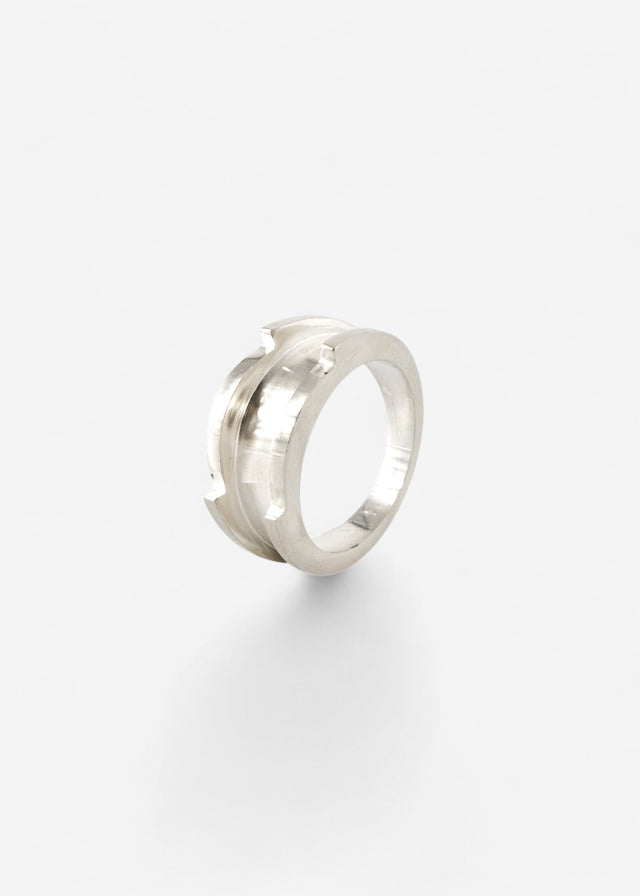
This comparison looks at sterling silver and 14k gold through the experience of wearing a ring every day. The THORN ring offers one starting point for looking at a silver form. Choosing the material begins with your habits and preferences; there is no single metal that suits every hand.
A sterling silver wedding band usually costs less than a comparable gold one and changes its surface more visibly with wear. Gold resists tarnishing better, but still scratches; rhodium-plated white gold may need its coating renewed. Long service depends on the alloy, band construction and repair options. Choose silver if you welcome patina and understand the demands of the design; choose gold for its colour and greater resistance to tarnishing.
What does the metal in a wedding ring cost?
The metal explains part of the price difference between a silver wedding ring and a gold one. It does not explain the whole retail price. Sterling silver contains 92.5% silver. A 14k gold alloy contains 14 parts gold out of 24, or approximately 58.3%; you may also encounter 585 gold, with 58.5% gold content. GIA explains gold fineness and how alloying affects colour.
To estimate the precious-metal content, you need the ring's weight, its fineness and a metal price for a stated date. A hypothetical 12-gram sterling band contains 11.1 grams of silver. A 12-gram band in 585 gold contains 7.02 grams of gold. These quantities describe the precious metal within the alloy. Making, other materials, finishing and the seller's terms all contribute to the finished price. Compare finished-ring quotations to see the difference in the price of a pair.
Ask for two quotations for a similar design and the same size. That makes the comparison useful: does the material change the weight, finishing, labour cost or construction? Assuming that all work costs exactly the same in both metals can conceal those differences.
For a finished silver example, the Thorn ring is $181–488 across sizes 16–22, with weights of 4.7–12.7 g. This is the catalogue price of one ring. For an individual pair in gold or another metal, bring the material, form, sizes, finish and your budget to DARK UNION; the team develops a personal proposal from that brief. STRUGA specialises in sterling silver; for a custom order, the team confirms the metal’s fineness, timing and quotation after the sketch.
Why choose silver rather than gold for a wedding band?
Silver makes sense when you like the way the finished ring looks and feels. A cool pale surface, dark recesses or a broad band without a stone can be a deliberate choice. It need not be a temporary step towards gold. Equally, there is no reason to give up yellow gold if that is the colour you both want.
Silver's lower material cost can leave room to explore a larger form before the raw metal dominates the budget. That volume still needs to work on a hand. A ring can look compelling from above yet press against neighbouring fingers. The inner profile and the edge touching the skin deserve as much attention as the relief on top.
The related Silver or Gold: Choosing Jewelry for Daily Wear considers the broader material choice. Here the question is specifically about wedding bands: daily wear, contact with an engagement ring and the possibility of maintaining the piece years later.
Silver vs gold wedding rings: a practical comparison
The figures below separate metal content from the properties of a particular alloy. The density and hardness examples are conventional sterling silver and Cookson’s yellow 14ct AY alloy (58.6% gold). Hardness in HV measures resistance to indentation; a finished ring’s section and joints also affect how it handles daily wear.
| What to compare | Sterling silver 925 | 14k / 585 gold |
|---|---|---|
| Precious-metal content | 92.5% silver | 58.5% gold for 585; 14/24 ≈ 58.3% for 14k |
| Fine metal in a hypothetical 12 g ring | 11.1 g silver | 7.02 g gold at 585 |
| Density: technical examples | 10.3 g/cm³ | 13.0 g/cm³, yellow 14ct AY |
| Mass at the same 1 cm³ volume | 10.3 g | 13.0 g |
| Hardness: annealed examples | About 63 HV | 100 ±10 HV, yellow 14ct AY |
| Price | Thorn catalogue example: $181–488 per ring, depending on size | Ask the gold-ring maker for a quote for the same form and sizes |
| Colour | Cool pale tone; dark finishes are possible | Yellow, rose or white, depending on the alloy |
| Tarnishing | The surface changes over time | Generally more resistant to tarnishing |
| Scratches and deformation | About 63 HV when annealed; remove for tools and sport | 14ct AY example: 100 ±10 HV when annealed; also remove for tools and sport |
| Weight | Technical example: 10.3 g at 1 cm³ | 14ct AY example: 13.0 g at 1 cm³ |
| Maintenance | Soft cloth for routine care; patina may be retained or removed | White gold may need its rhodium renewed |
| Resizing | STRUGA: one free adjustment; owner pays shipping both ways; BRUTALISM V.1/V.3 excluded | A plain band and a band with continuous stones or relief have different resizing options |
| Repair | STRUGA service: cleaning and minor repairs are free while owned; owner pays shipping to us | Ask the maker about repairs, coatings and service charges before buying |
| Resale | Metal content is only part of an assessment | A higher metal value does not guarantee that you will recover the original retail price |
Sources: Cookson technical tables, p. 53; 14ct AY data sheet; Corti’s review, p. 6. These are alloy examples, not a test of STRUGA rings. At the same volume, 13.0 ÷ 10.3 gives about 1.26 times the mass.
How does a silver wedding band change with wear?
Uncoated silver can darken while areas exposed to friction remain brighter, producing different tones on the same band. STRUGA calls its sterling silver without rhodium plating Living Silver. Patina is treated as a property of the material and removed at the owner's request. Oxidizing is a different starting point: the surface is deliberately darkened before the piece is worn.
Silver tarnishing involves a reaction with sulfur-containing gases, producing a dark surface layer of silver compounds. The change of colour alone tells you little about the condition of the whole ring. A crack, a bent band and patina call for different attention. The Canadian Conservation Institute explains the chemistry of silver tarnish.
If you like the dark recesses, there is no need to polish them back to a mirror finish on a schedule. Abrasive polishing also removes a little metal; fine relief and engraving deserve particular care. The institute's guidance on caring for silver objects explains why. That is a reason for gentle maintenance, rather than an instruction to apply museum treatments to your ring at home.
What advantages does a gold wedding ring offer?
Gold deserves consideration for its colour and greater resistance to tarnishing. If you want a pale band without silver's characteristic patina, compare silver with white gold. A gold alloy still acquires scratches: resistance to tarnishing does not make the surface unchanging.
With white gold, ask about rhodium. The coating often provides the bright white surface; as it wears, the underlying alloy's tone can become visible. GIA's comparison of white gold and silver describes this finish and its maintenance. A white ring in a photograph does not, by itself, tell you whether you will like the way it ages.
Strength varies with the alloy and how it has been worked, as well as its fineness. Christopher Corti's technical review of jewellery alloys describes changes with composition and processing. For a buyer, the useful next step is to discuss the particular design, rather than choose a metal from a single Mohs-scale entry.
How do you choose STRUGA DARK UNION silver rings?
DARK UNION is STRUGA’s vision of an alternative union: stronger, more reliable, more powerful. Its ring is an artifact chosen with intent. The imagery is a neon city at night and the pulse of techno. A shared form can unite the pair while each person chooses a width and fit for their own hand. The DARK UNION Atlas chapter develops this relationship between form and union.
In the current catalogue, the THORN ring weighs approximately 4.7–12.7 grams across its sizes. Check the weight of your chosen size, but assess fit and construction separately: try the ring to feel how its width and inner profile suit your hand. To compare other approaches to silver form, look at Triple Drills and Signature Links V.2. These are references for design; their use as a wedding pair and their resizing options need separate discussion.
For a deliberately dark finish, compare the Brutalism V.3 ring: oxidized recesses contrast with its lighter edges. Its listed weight is 9.6–24 g across sizes. Try the width and inner profile as well as the surface; this model’s resizing exception is set out below.
For the international market, STRUGA rings are made in Bali. A wax model, a silicone mould, silver 925 and hand finishing give the object its form and surface. The finish you choose becomes the starting point for how the ring changes with wear.
A custom pair is quoted from the brief: form, sizes, finish and budget. DARK UNION production generally takes 2–4 weeks from design approval, often sooner; allow around another week for delivery. This is a guide rather than a promised date. STRUGA confirms whether the schedule works for your wedding. Current catalogue options are in the DARK UNION collection.
What should you check before ordering?
Start by trying the width and inner profile. A 6 mm width and 2–3 mm thickness describe the proportions of an individual design. Finger size, the band's cross-section, relief and loading all matter. For an everyday silver ring, choose a construction suited to your activities and follow its care instructions.
Remove any ring before sport or work involving tools and machinery: choosing gold does not remove the risk of catching a band. Take it off before swimming or handling household chemicals as well. For a complex finish, check the care instructions for your design, particularly if it includes inserts.
If you will wear an engagement ring beside it, try the two together. Different metals can be combined, but check their contact points, whether the band catches a setting and whether you can bend your finger comfortably. Choose the colour combination you like, then check that both bands sit comfortably without pressing a setting.
Finally, ask about resizing before ordering. STRUGA offers one free ring-size adjustment, with shipping both ways paid by the owner. BRUTALISM V.1 and V.3 keep their original size after production, so a fitting before ordering is especially important. Cleaning and minor repairs are free while the piece remains with its owner; shipping to us is paid by the owner. Send STRUGA photos of any damage so the team can assess the repair. The comparison comes back to a question you can answer at a fitting: which ring feels right on your hand, and which changes to its surface will you welcome?
Related
Frequently asked questions
Didn’t find the answer — write to us, we reply personally.
Ask a question →01Is a silver wedding band just a cheaper version of a gold one?+–
Silver is a material in its own right, with its own colour, weight and surface character. A lower raw-material cost does not determine finishing quality or fit. Compare the actual rings and their maintenance options.
02Is Living Silver patina the same as a defect or tarnish damage?+–
STRUGA treats Living Silver patina as a property of the material and removes it on request. Surface darkening alone does not mean the ring is broken. A crack or a bent band needs a separate assessment; polishing does not repair those faults.
03Is oxidized silver the same as silver that has blackened from age?+–
Oxidized silver is deliberately darkened before wear. Natural patina develops over time. Both surfaces can continue to change, particularly at points exposed to friction.
04Is silver too soft for a wedding band?+–
Silver can suit an everyday wedding band with appropriate construction and careful wear. A 6 mm width and 2–3 mm thickness do not establish durability on their own: alloy, cross-section, relief and loading matter. Remove any ring for sport or work with machinery.
05Will a silver wedding band hold up for 20+ years?+–
A well-chosen silver band can be worn for many years. Its service life depends on construction, daily loads and maintenance. Look for thinning, cracks or deformation as well as changes in colour. STRUGA offers free lifetime cleaning and minor repairs; send the team photos to discuss the condition of your ring and the work it needs.
06Can we mix metals — silver band with a gold engagement ring?+–
Yes, if you like the combination and the rings fit comfortably together. At a fitting, check contact points, settings and freedom of movement. Check where the bands and settings touch, and try bending your finger with both rings on.
07Does silver cost less because it's lower quality?+–
No. The market price of a metal and the quality of the finished ring are separate questions. Construction, finishing and fit matter in silver as they do in gold. Cheaper raw material promises neither worse nor identical workmanship.
08Will future generations think silver was a budget choice?+–
Choose a ring for what matters to you as a couple: colour, form, budget and the way its surface changes. The years you wear it together give the object its personal meaning. If you hope to pass it on, keep a record of its material, maker and care.
09Can I wear my silver band swimming?+–
Remove the ring before swimming. Surface changes can be especially visible on silver; an oxidized finish or inserts need the care appropriate to that design. Gold should not be treated as protection against household chemicals either.
10What if my hand size changes?+–
Resizing depends on the construction. STRUGA offers one free ring-size adjustment, with shipping both ways paid by the owner. BRUTALISM V.1 and V.3 keep the size in which they were made. Confirm the available size adjustment for any other design before ordering.