Raw Tourmaline Crystal Amulet Necklace: What It Is and Where to Buy One
In short.
- The crystal in such a necklace keeps its natural faces and outline instead of being cut to a calibrated shape.
- GIA describes tourmaline as a mineral group with a broad colour range and rates it at 7–7.5 on the Mohs scale; an exact stone still needs its own visual and care record.
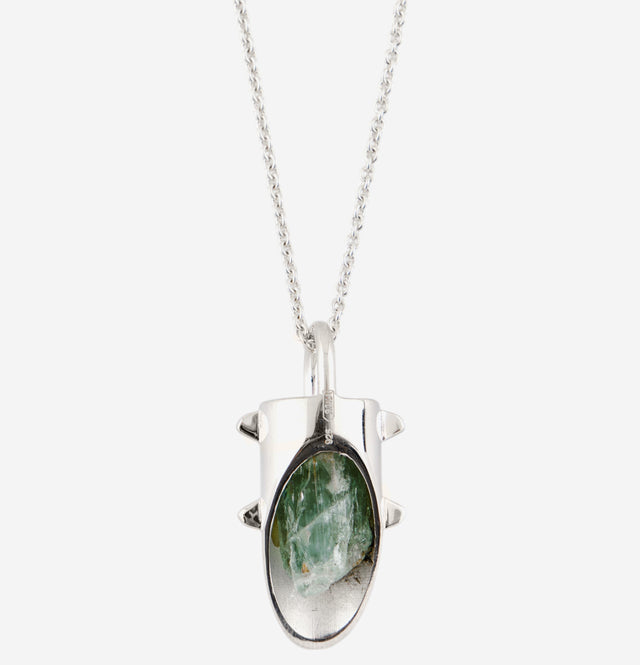
- At STRUGA, AMULET objects use raw, wild-growth stones. Every amulet is one physical piece; a sold object is not reproduced.
- Where to buy: on strugadesign.com the necklace form is held by Thorn Amulet Necklace #1 and Thorn Amulet Necklace #2, made in Bali; in person the work is shown at Hedonist Store and Barefoot Aristocracy in Bali, Soul Mate in Phuket and Poison Drop in Dubai.
- Current availability, price, weight and chain length belong to the live product page, not to this article.
Updated August 29, 2026
A raw tourmaline amulet necklace begins with one crystal rather than a standard setting. The silver has to follow that crystal’s contour, hold it securely and leave the intended faces visible. The result is not a cut gemstone necklace with the polish removed. It is a different construction: stone first, setting second, and no promise that the next crystal will repeat the same geometry. The construction pairs one raw crystal with silver 925, but that alloy mark does not describe the stone or prove the setting.
Earrings of the same family follow the same stone logic: Classic Amulet Earring #7 — Pink Tourmaline (S) and Thorn Amulet Earring #8 — Green Tourmaline (S). Each product page shows one exact crystal; a sold page stays as an archive.
What “raw tourmaline” means
Separate mineral fact from interpretation
GIA describes tourmaline as a group of closely related mineral species with one of the widest colour ranges among gems. Iron and possibly titanium contribute to green and blue; manganese to red and pink. Crystals may also contain several colour zones.
“Raw” is a construction description, not a promise of origin, treatment or quality. The crystal has not been translated into a standard faceted shape. Growth lines, natural faces, terminations and breaks remain part of the object. Those features need to be inspected on the actual stone: a generic name cannot prove which surfaces are natural, which are broken, or whether the colour has been treated.
Tourmaline also becomes electrically charged when heated. Eighteenth-century Dutch traders used warmed crystals to draw ash out of their pipes and called the stone aschentrekker, the ash-puller. GIA treats that pyroelectric behaviour as a mineral property, not as a health or protective effect. STRUGA makes no promise that a stone changes the wearer. The amulet carries the meaning the owner gives it.
Where to buy a raw tourmaline amulet necklace
Three kinds of seller, one construction rule
Handmade marketplaces such as Etsy gather independent makers: silver with minerals is there, and the level of work is judged by photographs and reviews. Mineral shops start from the crystal — the stone leads, the setting serves. Chain jewellers work in runs and cut stones; a raw crystal does not fit a serial seat, because every stone has its own geometry.
STRUGA stands at a third point: a wild-growth crystal, silver 925, one piece, with the setting built around the specific stone. On strugadesign.com the necklace form is held by Thorn Amulet Necklace #1 and Thorn Amulet Necklace #2; every piece is made in Bali. In person the work is shown at Hedonist Store and Barefoot Aristocracy in Bali, Soul Mate in Phuket and Poison Drop in Dubai. A sold necklace stays on the site as an archive page; how a new one is ordered is described in the section on Request Similar.
How to inspect a raw-crystal necklace
Read the object from several angles
- Ask for the exact object from several angles; a front image can hide depth, an exposed point and the load-bearing part of the setting.
- Read the junction: the stone should not move, metal should not press on a fragile point, and intended faces should remain visible.
- Match chain and connection to the object’s weight and intended movement rather than to a representative sample.
- Separate evidence: material, maker’s construction, known treatment and live commercial facts need their own records. A crystal story cannot replace them.
- Use neutral light to compare colour zones and visible breaks without treating one photograph as a laboratory report.
- Keep unknowns explicit: if treatment, origin or a hidden contact point is not documented, mark it unknown and ask for a closer read-back.
- Read-back: repeat the same four views after delivery so transit or later movement is visible against the approved record.
How a STRUGA amulet is built
Stone first, setting second
AMULET is a family of one-of-one ritual objects — earrings and necklaces built around a raw, wild-growth natural stone. Two models anchor it. Classic is a restrained cylinder; the stone in it speaks quietly. Thorn is a torpedo split lengthwise — as if the object had lain in the ground for millennia and a crystal had grown inside; an homage to Daniel Arsham.
The silver is Living Silver — 925 with no rhodium plating. The metal darkens from air and skin: recesses sink into shadow, raised edges stay lighter where they rub. Patina is a property, not a defect.
Live and sold tourmaline pieces are gathered in the tourmaline jewelry collection; sold pieces stay in the archive of tourmaline amulets.
The setting is a structural answer to one irregular crystal. Read where silver takes the load, which natural faces remain open and how the chain joins the body. Surface appearance and authorship do not prove stability; movement and contact points must be checked on the exact piece.
One piece, archive and Request Similar
Archive is direction, not inventory
Every STRUGA AMULET is one physical object built around one raw stone. When it sells, the product page stays as an archive, but its photographs do not become a promise that an identical second crystal exists.
The route for an unavailable amulet is Request Similar. The archived object sets a direction — model, stone type, colour and scale — while the next stone keeps its own geometry and number. It is a related object, not a copy.
Price, availability, exact weight, chain length and shipping are live facts. Read them on the current product page or confirm them in the order brief. As orientation from the catalogue: the Thorn Amulet Necklace is listed at $250, and tourmaline earrings of the family at $160–$220 depending on size; the exact figure sits on each product page.
A saved product page is evidence of a prior object, not a reservation. Keep its immutable identity, photographs and stated model in the request, then record which details may vary. A new stone can change outline, colour distribution, open faces and balance within the same model and scale.
How to choose between Classic and Thorn
Compare the metal-to-stone relation
AMULET is an open family held together by raw, wild-growth stones rather than by a single object type. Classic and Thorn are its two anchor models. Classic uses a restrained cylinder. Thorn uses a split torpedo-like form with the crystal visible inside; the form is STRUGA’s homage to Daniel Arsham.
Compare Classic Amulet Earring #16 — Green Tourmaline (S) with Thorn Amulet Earring #6 — Green Tourmaline (M): the same stone type, a different relation between metal and stone.
Choose by the relation between metal and stone, not by a size letter alone. Look at how much of the crystal remains open, where the object sits on the body and whether the chain or ear construction matches the intended use. Do not infer exact weight from another object in the same model.
Use a body-scale image as well as a close view. Confirm total drop, chain length, side profile and how the object turns while moving. A close-up explains texture but not balance. The selected model should still be read back against the exact crystal, connection and intended side of wear.
Exact-object evidence
Build a record before deciding
- Identity: keep the current product or archive URL, model and immutable item reference.
- Stone: record colour distribution, visible faces, terminations, breaks and any disclosed treatment.
- Setting: photograph front, side and back so load points and exposed edges can be compared.
- Scale: record the exact weight and chain length only from the current object or order brief.
- Wear: state where the object sits, how it moves and which contact or impact conditions matter.
- Care: attach the gentler stone-and-silver cleaning rule and the signs that require inspection.
This record turns a visual preference into a checkable object brief. Missing facts stay marked as unknown instead of being inferred from another AMULET.
- Comparison rule: later photographs and service notes must refer to this same immutable object, not a visually similar archive piece.
- Acceptance: state who confirmed the stone, setting views, scale and remaining unknowns before the object proceeds.
What Request Similar can carry forward
Preserve direction without promising a copy
- Carry forward: anchor model, object type, broad colour direction, approximate scale and the desired relation between open stone and silver.
- Confirm again: the selected crystal, its geometry, visible surfaces, setting contact, exact weight, chain and live commercial terms.
- Do not transfer: a sold object’s unique stone number, exact outline, current availability or historical price.
That boundary protects both sides of the request. The archive remains useful as visual evidence, while the next piece is judged on its own immutable identity. Approval of a direction is not approval of a stone that has not yet been shown.
The request should therefore name its evidence version: which archive page was used, when live facts were checked and which details remain open. If a candidate stone appears later, compare it against the brief and record the accepted differences before construction begins.
Care for tourmaline and silver together
Use the gentler material rule
GIA lists tourmaline at 7–7.5 on the Mohs scale, rates its toughness as Fair, and cautions that high heat or sudden temperature change can damage it. Warm soapy water is the recommended cleaning method; steam and ultrasonic cleaners are not recommended.
Use the gentler rule when stone and silver meet. Avoid aggressive chemical or abrasive cleaning around the setting. If the crystal moves, the metal catches, or a visible crack changes, stop wearing the object and ask for inspection. Living Silver darkens and changes with wear; that expected surface change is separate from movement or damage at the setting.
Inspect before cleaning if the crystal moves, a connection catches or a visible break changes. Record what was observed and which method was used. Expected darkening of uncoated silver is a surface process; it does not establish that a setting remains mechanically sound.
Source record
What the sources establish
- Gemological Institute of America: Tourmaline — mineral group, colour causes, colour zoning and pyroelectric behaviour.
- Gemological Institute of America: Tourmaline care and cleaning — hardness, toughness, heat, thermal shock and cleaning guidance.
- Federal Trade Commission: Jewelry Guides — truthful material description and disclosure of material gemstone treatments.
- Evidence chain: a claim is used only where the cited page supports it; catalogue language does not enlarge a mineral or care source.
- Negative boundary: no cited source establishes protection, health outcomes, energy transfer or a guaranteed personal response.
- Object boundary: source-backed material facts still require photographs and specifications for the exact necklace or earring.
- Freshness boundary: archived evidence remains useful for form and history, while commercial facts are read again at decision time.
Frequently asked questions
Didn’t find the answer — write to us, we reply personally.
Ask a question →01How is a raw tourmaline different from a cut stone?+–
A raw crystal keeps natural faces, growth lines and an irregular outline instead of being cut into a calibrated shape. The setting is built around the actual stone.
02Does a STRUGA amulet promise a protective effect?+–
No. STRUGA describes mineral, construction and form without health, energy or protective claims. The owner gives the object its personal meaning.
03Can a sold AMULET be reproduced exactly?+–
No. Every AMULET is one physical object built around one raw stone. Request Similar uses an archive object as direction but the next crystal keeps its own geometry.
04How should a tourmaline amulet be cleaned?+–
GIA recommends warm soapy water for tourmaline and does not recommend steam or ultrasonic cleaning. Use the gentler rule for the stone and silver together.
05Where can you buy a raw tourmaline amulet necklace?+–
On strugadesign.com: the necklace form lives on the Thorn Amulet Necklace pages, and every piece is made in Bali. Each amulet sells once, a sold page stays as an archive, and a new one is ordered through Request Similar. In person the work is shown at Hedonist Store and Barefoot Aristocracy in Bali, Soul Mate in Phuket and Poison Drop in Dubai.