Meteorite Rings — What to Know Before You Buy
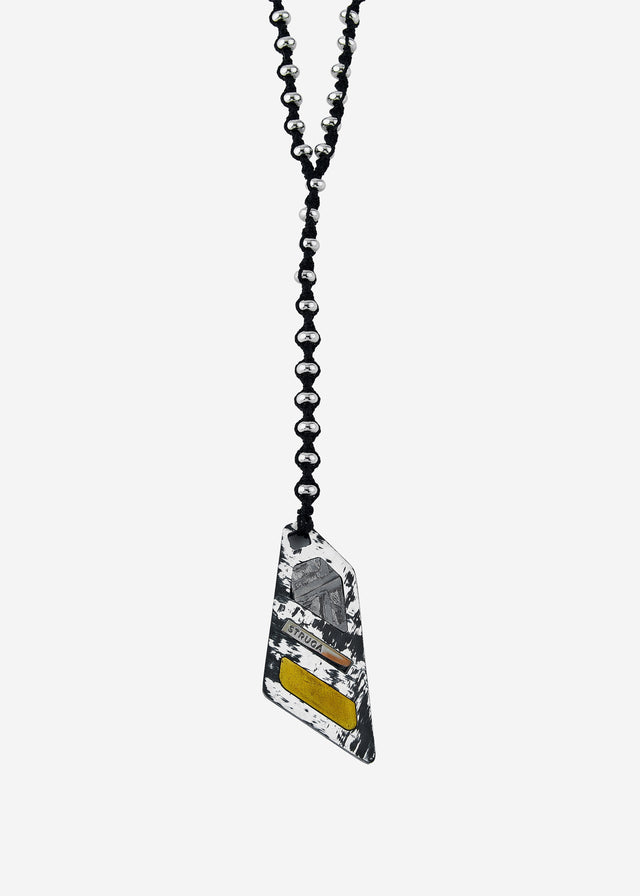
Not a stone set in metal: what sits in a meteorite ring is a slice of an asteroid's iron-nickel core, about 4.5 billion years old, that cooled roughly one degree per million years in the vacuum of space. That slow cooling grew the Widmanstätten pattern of interlocking kamacite and taenite plates, and it cannot be reproduced in any furnace on Earth: no two slices repeat. Before you buy one, it helps to know what the material is, how to check it's real, and how it behaves on a hand.
Updated August 2026
In short.
- STRUGA works with one meteorite: Seymchan, a Main Group pallasite found in 1967 on the Kolyma — an iron-nickel matrix with about 8% nickel and olivine grains.
- Pallasites are the rarest class: less than 1% of all meteorite finds.
- Three checks before paying: a named origin (the meteorite, its class, the year of find — 1967 for Seymchan), an irregular Widmanstätten pattern, and the magnet test — a pallasite clings to a neodymium magnet.
- The slice stays bright while the surrounding Living Silver (sterling silver 925, no rhodium) darkens into patina — that contrast is the point.
- Keep it dry: the iron in a pallasite oxidizes under prolonged contact with water.
- Not radioactive; the only caveat is the ~8% nickel for a confirmed nickel allergy.
- In the STRUGA catalogue the ring route to a slice is the Thorn Ring of the Dark Union line — a wild-growth stone or a meteorite is chosen at order; finished pendants with a Seymchan slice are in meteorite pieces.
A meteorite ring is not a metaphor. The dark slice set into the metal is a fragment of an asteroid's iron-nickel core that spent about 4.5 billion years in space before falling to Earth.
Source-bound buying check
Meteorite in a ring must be described by documented identity, structure and care—not by promises of force or protection. The Meteoritical Bulletin is the scientific catalogue for approved meteorite names and classifications. GIA documents meteorite use and the need to distinguish material claims from appearance. For buying, request the named meteorite, seller evidence, exact ring materials, sizing route and care instructions.
| Source | Use |
|---|---|
| scientific primary catalog | approved meteorite names and classifications |
| gemology primary | gemological research and material identification |
| STRUGA catalog | current STRUGA meteorite pieces and live-only facts |
Read the exact product page on the day of purchase. Record the material, measurements, weight where supplied, seller identity, delivery route and written policy. A hallmark supports a fineness claim; it does not prove authorship, comfort, origin or current availability. Photographs support form and surface, but not hidden construction.
Six checks before a silver-jewellery purchase
The first pair binds the meteorite and ring identity before comparison. Record the seller’s exact wording and leave absent fields unknown for this exact ring.
-
Bind every claim to the exact object
A catalogue can contain several materials, sizes and finishes under one design name. Save the exact variant, not only the collection page. Record its title, meteorite name, metal line, size, weight when supplied, finish and seller. If the page changes later, the note still identifies the object described.
-
Separate fineness from meteorite identity
The mark 925 addresses silver content, not the inserted slice. It does not prove the meteorite name, classification, every component or construction. Read the complete material statement and ask for the evidence tied to the named meteorite. Keep that answer beside the exact product record and receipt. Do not transfer evidence between two slices or variants sharing one design name.
Measure fit and treat care as material-specific
The next pair concerns ownership. Measurements belong to the exact ring and body; care instructions belong to the disclosed slice, metal and finish for this exact object.
-
Measure the body and the object
Fit is geometry. Compare internal diameter, circumference and band width with a ring that already fits. Measure the intended finger and account for a broad shank instead of relying on a gender label. Record the seller’s sizing system so a familiar number is not silently converted into another scale. STRUGA lists rings by inner diameter in millimetres: the Brutalism V.1 Ring runs from size 15 to 22, and its weight grows with the size — from 9.6 g to 24 g — so the same shank reads differently on different hands.
-
Read surface as a maintenance choice
Meteorite and sterling require separate, documented care. A method suited to raised silver may not suit an etched slice or another finish. Decide whether gradual silver contrast is welcome, then follow the seller’s instructions for the exact materials. Do not transfer an abrasive or chemical method between surfaces without explicit guidance. Record that guidance with the order.
Verify the seller and date volatile facts
The final pair separates stable identification from today’s transaction. Written terms and a dated product page keep commercial claims auditable in the chosen market.
Verify the seller and the route after purchase
Read delivery, exchange, return, resizing and repair terms before payment. Check who pays shipping and whether custom sizing changes eligibility. A social post or marketplace image does not replace an accountable seller record. For current price and stock, use the final product page in the relevant market.
Date volatile evidence
Price, stock, variants and store access can change. Treat them as a dated snapshot and never turn one listing into a permanent range. Scientific names and classifications can support stable background; commercial details still need a fresh read on purchase day. Save the market, currency and selected size together. A later date never supplies an identity field that the original page omitted.
What a meteorite ring actually is
A meteorite ring carries a fragment of a real meteorite — most often a thin slice set in metal. The material splits into three classes. Iron meteorites — Muonionalusta, Gibeon, Campo del Cielo — are solid iron-nickel; after etching with a weak acid, a slice reveals the Widmanstätten pattern: interlocking plates of kamacite and taenite crossing at roughly 60°. Pallasites — Seymchan, Imilac, Esquel — are the rarest class, less than 1% of all finds: an iron-nickel matrix interlaced with grains of olivine, a semi-translucent yellow-green silicate. Stony meteorites rarely make it into rings: brittle, no metallic luster.
The pattern is the point. It grew over millions of years of extremely slow cooling in the vacuum of space — about one degree per million years — and cannot be reproduced in any furnace on Earth. No two slices repeat.
The scientific name and classification still need documentary support.
Seymchan — the pallasite STRUGA chose
STRUGA works with one specific meteorite: Seymchan, found in June 1967 by geologist F. A. Mednikov in the upper reaches of the Hekandya river in Kolyma. The first fragment weighed around 272 kg. Isotopic dating puts it at about 4.5 billion years — older than Earth in its current form. By composition it is a Main Group pallasite: an iron-nickel matrix with about 8% nickel and large olivine inclusions.
STRUGA chose Seymchan over the more common iron meteorites for two reasons. First, the olivine: in transmitted light the grains give a warm green glow, so a slice reads as three layers at once — metal, pattern, translucent stone. Second, the olivine sits in the matrix at random: even two adjacent slices from one fragment look different. Pure iron is repeatable; Seymchan is not. The full story of the material is in the full Seymchan meteorite guide.
How to tell a real meteorite from a fake
There is a lot of counterfeit in this category. Most often what's sold as "meteorite" is etched terrestrial steel: a pattern drawn with acid, but dead — even and repetitive. Less often, ceramic or composite with glass standing in for olivine. Three checks before you pay:
- A named origin. A real piece has a named source: the meteorite, its class, where and when it was found. For every STRUGA piece with a Seymchan slice the answer is the same: Pallasite, Main Group, found in 1967 near Seymchan, Magadan Oblast. A seller who can't say which meteorite the slice came from is a reason to pause.
- An irregular pattern. Real Widmanstätten bands run at varying spacing and thickness, with natural glitches. A fake gives itself away through regularity: identical spacing, symmetrical cells, repetition.
- The magnet test. A standard neodymium magnet clings to a pallasite through its iron-nickel matrix. No reaction at all means an imitation.
One indirect check is price: a ring in sterling silver 925 with a genuine, readable slice priced like a souvenir is almost always a fake or a fragment too small to read.
Meteorite next to sterling silver 925 — Living Silver
Mass-market silver is rhodium-plated by default — a thin layer that freezes the surface. STRUGA doesn't use rhodium. Our finish is Living Silver: sterling silver 925 left open, doing what silver is supposed to do. Raised areas that rub against skin stay bright; recesses and edges darken. Patina here is a property, not a defect — a map of how the ring is worn.
The meteorite does the opposite. The iron-nickel matrix of a pallasite is chemically more stable than sterling: while the silver around it drifts toward graphite, the slice stays as bright as on day one. On the hand it becomes a seam between two ages of matter — the silver records your time, the meteorite doesn't notice it.
The silver is handcrafted in Bali. The slice is set at the final stage and its bezel is fitted individually: olivine is brittle, so the setting must match the exact slice. Current pieces with a Seymchan slice are in meteorite pieces.
How to care for a meteorite ring
One rule above the rest: keep it dry. Pallasite contains iron, and prolonged contact with water can start surface oxidation along the edges of the slice. A wet hand or rain is short contact and fine; a pool, the sea, the gym, a ring left by the sink for days is not. After water, blot it dry. Store it in a dry box with a silica gel sachet — silver also tarnishes more slowly there.
Cleaning: a soft silver cloth on the raised silver surfaces only, never abrasive pastes. The Widmanstätten pattern lives in the top few microns of the etched surface, and one stroke of paste can take it off. The slice itself doesn't need cleaning. If a rust spot appears or the pattern looks faded, send us a photo — restoring it is re-etching work for a craftsman, not a home job.
If the ring you want isn't in the catalog
If the size, profile or specific slice you have in mind isn't among the current meteorite pieces, a meteorite-ring enquiry can begin through Custom Order: name the selected slice, form, metal and measurements. The usual frame is 2–4 weeks from sketch approval; that is a guideline, not a promise. Feasibility and price are confirmed for that exact request. Write to us about the slice you're picturing.
A custom request should begin with the same evidence record as a catalogue purchase. Name the meteorite, selected slice, ring metal, dimensions, finish and seller route. Keep volatile timing and price separate from the stable material description. Agreement on a photograph is not agreement on hidden identity or final fit. Ask which measurements will be confirmed before work begins, what care applies to the exact surfaces, and which written terms govern changes.
Continue from the journal to a current STRUGA object: Fused Cross Ring.
Frequently asked questions
Didn’t find the answer — write to us, we reply personally.
Ask a question →01Is a meteorite slice the same as a gemstone?+–
No. A gemstone is a mineral chosen for hardness and cut; a Seymchan slice is a dated fragment of an asteroid's iron-nickel core: a Main Group pallasite, found in 1967. It isn't graded or faceted — its value is in the Widmanstätten pattern and olivine, which no two slices repeat.
02Is the Widmanstätten pattern the same as acid-etched steel?+–
No. The pattern in a real meteorite grew over millions of years of cooling at about one degree per million years and runs at varying spacing with natural glitches. Etched terrestrial steel only imitates it: the lines come out even and repetitive — a dead, regular pattern is the tell of a fake.
03Is Living Silver the same as oxidized or rhodium-plated silver?+–
No. Living Silver is sterling silver 925 left open, with no rhodium layer to freeze the surface; it darkens with wear, and that patina is a property, not a defect. It is not a one-time oxidized blackening and not rhodium plating — it's silver doing what silver does, while the meteorite slice beside it stays bright.
04Does surface oxidation on the slice mean the ring is damaged?+–
No. A rust spot is the iron in the pallasite reacting to prolonged water, not a flaw in the piece. Kept dry, the slice behaves predictably for decades; if oxidation appears, a craftsman restores the surface by re-etching — it isn't a permanent defect.
05Is a meteorite ring safe to wear?+–
Yes. Seymchan pallasite is not radioactive — billions of years of cosmic radiation leave no residual radioactivity, and any geological lab can confirm it. The one caveat is nickel — the matrix contains roughly 8% of it. With a confirmed nickel allergy, consider a pendant instead of a ring, or ask via Custom Order about a version with an inner silver lining isolating the slice from the finger.
06Will the meteorite rust?+–
It can, if treated like ordinary metal. The iron in pallasite oxidizes under prolonged contact with water. Keep the ring dry and the slice behaves predictably for decades; if oxidation does appear, a craftsman restores the surface by re-etching.
07Is a meteorite ring a men's ring?+–
It's searched that way — "meteorite ring mens" is a frequent query — but the material doesn't care. STRUGA doesn't divide pieces by gender: a ring is chosen by form, weight and fit. Seymchan reads dark and architectural — that's why it gets filed under men's rings; on the hand it's a ring with a slice of an asteroid core.
08Does the ring come with a certificate?+–
No. STRUGA puts no certificate in the parcel. The origin is named openly: Seymchan, a Main Group pallasite found in 1967, and the pattern and magnet checks work on the slice itself. The slice in your ring isn't a decorative stone — it's a dated fragment.
All types of rings in one place: Rings — form, purpose, material, fit.