Gothic: art, architecture, fashion and jewelry

Gothic is the name of a medieval art movement, a literary genre, a music subculture and a visual language, each with its own history.
At Saint-Denis, Gothic began with light rather than black clothing. Vault ribs carried the load, walls grew thinner and windows took their place. Colored glass changed the air inside. Centuries later, black fabric, crosses and skulls made another kind of Gothic recognizable on the body. The underlying question remains: how does form alter what we see and feel?
If you are reading Gothic to choose a piece of jewelry, start with the Thorn earring: its sharp angle works like an architectural line at a smaller scale, not a compulsory costume sign. The route through the catalog is the CODEX world → the THORN family → the form in the Atlas.
Updated November 11, 2026
Four histories share one name: medieval architecture and art, the Gothic novel and cinema, mourning and memento jewelry, and the post-punk subculture that reshaped fashion. We will keep those histories distinct, separate Gothic from Dark fashion, then show how to choose crosses, skulls, pointed lines, dark silver and black stones without turning the result into a costume.
What Gothic means and why the word was an insult
Gothic is neither a single period nor a single way of dressing. The word covers several cultural forms that reuse related motifs for different purposes. An architect answers with a vault, a novelist with a returning past, a musician with a nocturnal sound and a designer with a shoulder line or a cross at the throat. Treating them as one continuous movement would erase the differences that make each of them worth studying.
| Layer | When it formed | Signs and misconceptions |
|---|---|---|
| Medieval Gothic | From the mid-12th century | Pointed arches, ribs, stained glass, sculpture, manuscript illumination That its makers called themselves Goths or aimed at a gloomy appearance |
| Gothic fiction and film | From the 18th century | The castle, the secret, the vampire, the past returning That every horror story belongs to the Gothic tradition |
| Mourning and memento mori | Many centuries; a peak in the 19th | Skulls, jet, black enamel, hair and remembrance That every skull signals menace or membership of a subculture |
| Goth subculture | From the late 1970s | Post-punk, clubs, DIY clothing, pallor, mesh and sharp silhouettes That one black garment makes someone a goth |
| Gothic fashion | Different periods; museum analysis from the 20th century | Mourning, romance, the macabre, vampirism and historical quotation That every designer who uses black claims the word Gothic |
This map matters when choosing jewelry. A cross in a religious setting, a cross on a runway dress and a geometric cross in contemporary silver have different jobs. Decide which one you need: an article of faith, a memorial sign, a reference to music or a clear form. In the STRUGA catalog, the choice also lies in the construction of the object: the sharp angle of THORN, the volume of BRUTALISM, the combination of materials in MOSAIC or the raw stone in AMULET.
Why the word was an insult
Goths did not build Gothic cathedrals. The name came much later, when Italian Renaissance writers contrasted the clarity of classical antiquity with medieval architecture and dismissed the latter as barbarous. Britannica is explicit that Gothic art has no genuine connection with the Goths: the term was a durable slur applied to a non-classical style. Read the term's history in Gothic art.
The insult endured, but the word acquired new meanings. It came to signify what was foreign, dark or unsettling. The Museum at FIT's Gothic: Dark Glamour uses the word in this later, cultural sense: death, destruction and decay make it useful to people who want to stand outside accepted taste. Read the museum's introduction.
Three distinctions follow. In art history, Gothic is an established academic label with an unfair origin. In the subculture, it is a sign chosen by some participants and rejected by some of the musicians associated with it. In fashion, it is a quotation: a way of talking about death, romance, transgression or desire. A skull does not carry the same meaning in each of these contexts.
How Gothic architecture opened walls to light
Saint-Denis is one of the earliest buildings in which the characteristic devices of Gothic formed a coherent system. The eastern arm, including the choir, was built in 1140–1144, and the choir was consecrated on 11 June 1144. The basilica's official chronology. The pointed arch, rib vault and flying buttress redistributed the pressure of the masonry ceiling. Load-bearing walls could become thinner and window openings larger. Britannica explains the structural system.
The pointed arch meets at a peak rather than a semicircle. Its height can be adjusted independently of its span, and it channels thrust downward and outward. When the shape appears on a ring or pendant, we recognize the silhouette rather than its original structural function. The piece of jewelry cites a line; it does not hold up a roof.
The rib vault distributes weight through intersecting stone ribs, with thinner panels laid between them. The load travels along a framework to individual supports instead of pressing continuously along the whole wall. The resulting mesh is therefore more than ornament. It is a method of construction that became a spectacle.
The flying buttress carries part of that thrust outside to a separate support. The upper wall is relieved and can accommodate large windows. Gothic verticality comes from this precise relationship between structure and appearance, not simply from a desire to build higher.
Gloucester Cathedral shows another development of the same logic. Its south transept is an early surviving example of English Perpendicular architecture. Net-like vaults, carved bosses and the vast east window offer different answers within one ensemble. The article's current cover was photographed there: the stone ribs converge, but the eye continues towards the light. Read the cathedral's architectural history.
Why Gothic art was not gloomy
A Gothic cathedral is designed to fill space with colored light, not to serve as a dark backdrop for candles. The Metropolitan Museum describes how reflections on carved surfaces and radiance through stained glass were associated with divine light. Sculpture moved from stiff elongation towards freer, more naturalistic modeling, while windows turned biblical narratives into immense colored images. Explore the Met's discussion of medieval light.
Manuscript illumination carried the same richness into books. The Limbourg brothers began the Très Riches Heures around 1411 for John, Duke of Berry. The patron and the artists died in 1416, leaving the manuscript unfinished for other hands to continue. Its calendar pages preserve clothing, architecture, labor and daily life: the Gothic world contains fabric, gold and color. Read the manuscript's history at Musée Condé.
This changes how we read Gothic motifs in jewelry. A pointed architectural contour can suggest ascent. A rose window or a piece of tracery can repeat the geometry of light. A colored stone can do the work of stained glass: it gives the composition a center instead of darkening it. Black belongs to Gothic, but it does not exclude garnet, amethyst, green, milky white or transparency.
How the Gothic novel emerged
The Gothic novel began with a manuscript presented as a discovered medieval text. Horace Walpole's The Castle of Otranto appeared anonymously in 1764 and claimed to be an authentic rediscovered story. He revealed his authorship in the second edition. The device matters as much as the plot: from the start, Gothic made the past return in a form that still had power over the present. Explore the first edition with the British Library.
The genre developed a recognizable setting. A castle or old house conceals a forbidden room, family history weighs on the living, a document or portrait knows more than the protagonist, and the supernatural enters everyday life. Fear here is tied to scale, distance and secrecy. Gothic is therefore not interchangeable with horror in general: a slasher or domestic thriller need not share its memory, ruins or returning past.
Frankenstein: the laboratory replaces the castle
Mary Shelley shifted the genre towards modern knowledge. Frankenstein appeared in 1818 and replaced the ancestral castle with the laboratory. The creator now produces the thing he cannot accept. This is Gothic at another angle: responsibility, the unfamiliar body and the impossibility of putting the experiment back into its box.
Dracula: the vampire becomes a cultural costume
Bram Stoker fixed another figure in the public imagination. Dracula was published in 1897 and joined the vampire legend to travel, investigation and the collision of old and new. It left not only the count but a complete costume language: patrician bearing, the cape, pallor and the attraction of the unfamiliar. A contemporary goth can wear a version of that costume without reading Stoker, because cinema and photography have already made it independent.
What cinema did to the vampire and the shadow
F. W. Murnau's Nosferatu appeared in 1922 as an unauthorized adaptation of Dracula. Count Orlok was no suave aristocrat but a bald, emaciated creature with elongated fingers. The BFI notes how shadow, negative images, accelerated film and superimposition turn real landscapes into nightmares. Read the BFI's analysis of the film.
The shadow on the wall became as important as the actor's costume. It lengthens the hand, distorts the shoulder and turns an ordinary staircase into a trap. Gothic fashion borrowed the same device: an extended sleeve, a sharp collar or an exaggerated shoulder changes the wearer's outline just as light changes Orlok's.
Cinema later offered many other vampires: elegant, sensual, frightened, aging or almost human. What they share is not a compulsory cape but the capacity of a dark form to be attractive and unsettling at once. The cross changes meaning in that environment too. From an article of faith, it becomes a barrier, an intimate object and finally a sign that can be worn without explanation.
How mourning entered dress and jewelry
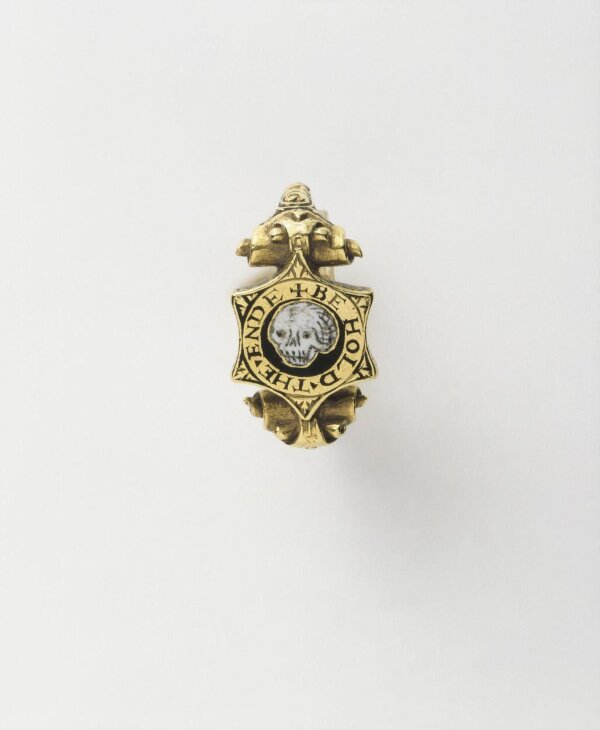
Long before the goth subculture, the skull served as a reminder to live morally in the knowledge of death. An English gold and enamel ring dated around 1550–1600 carries a skull and the inscriptions “BE HOLD THE ENDE” and “RATHER DEATH THAN FALS FAYTH”. The V&A notes that memento mori could sit beside marriage imagery: awareness of mortality did not cancel attachment but tested its seriousness. Read the museum's object record.
A contemporary cross does not have to copy a museum object. The Signature Cross V.3 combines carbon and silver: the sign remains recognizable, but it also becomes a composition of materials. The MOSAIC Atlas examines that transition from symbol to construction.
Mourning and black fabric
Victorian mourning made black a matter of detailed etiquette. After Prince Albert died in 1861, Queen Victoria remained in mourning for many years and mourning conventions became increasingly formalized. Mourning dress did not have to reject beauty: matte silk, veils, braid and jewelry varied according to the stage of mourning and the wearer's means. Read the V&A's historical context.
Jet, glass and substitutes
Jet suited this clothing for physical reasons. The fossilized remains of driftwood are light enough for substantial pieces and can be carved and polished. The first industrial jet workshops with lathes opened in Whitby in 1808; by 1872 the industry employed up to 1,500 people. Here, black comes from the material rather than from dye.
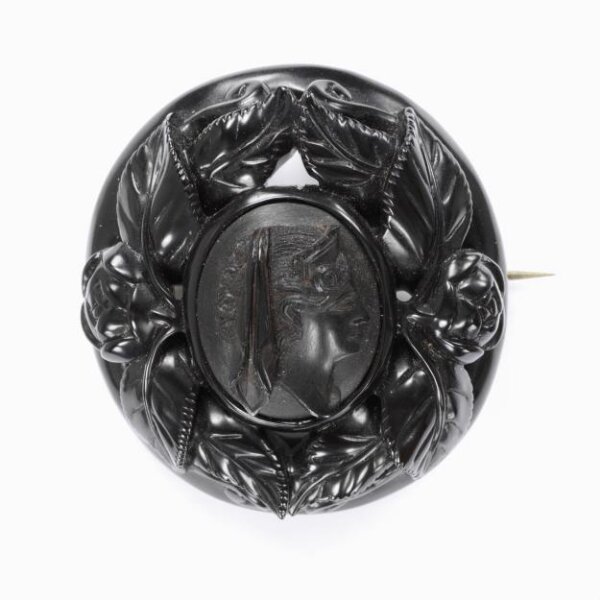
Substitutes soon appeared. “French jet” is cast black glass used to imitate jet and make pieces accessible to more buyers. The distinction matters to anyone handling antique jewelry: jet, glass, vulcanite and plastic may look similar in photographs, but they have different weights, aging patterns and care requirements. The V&A explains the imitation.
Mourning and goth are not the same thing. Mourning supplied fabric, veiling, crêpe, black stones and a particular tone, but goths used them outside funerals. The meaning shifts: mourning dress is no longer tied to the deceased or a prescribed convention; it becomes the wearer's personal gesture.
How post-punk became a subculture
The goth subculture grew from the music of the late 1970s, not from a wardrobe. The Museum of Youth Culture connects it with post-punk and records Martin Hannett's description of Joy Division as “Gothic” in 1979. Bauhaus released “Bela Lugosi’s Dead” in August that year. The word was already circulating in the music press before a recognizable club style emerged. Explore the Museum of Youth Culture's history.
Olli Wisdom and the members of Specimen opened the Batcave in 1982. Post-punk, glam and new wave shared space with films, theater and DIY clothing. It became a center of southern English goth, though not its only source: parallel communities emerged in Leeds, Berlin, New York and elsewhere. Read The Quietus on the club's history.
Early outfits were assembled from what was available: torn tights became sleeves, found fabric was dyed, and chains or borrowed jewelry acquired new roles. There was no single store-bought uniform. Punk supplied the DIY habit, club culture added theatricality, and literature and cinema supplied figures to inhabit.
Pallor, dark eyeliner, exaggerated hair, mesh and sharp silhouettes became a form of shorthand. Yet some musicians labeled as goths rejected the term. Wearing these clothes can therefore signal musical taste, a theatrical role, an appreciation of fabric and line, or a personal route through a scene. None of those choices requires a complete recreation of an archive photograph.
What Gothic does on the runway
The Museum at FIT staged Gothic: Dark Glamour from 5 September 2008 to 21 February 2009, with more than 75 ensembles. Victorian mourning stood beside work by Alexander McQueen, Ann Demeulemeester, Yohji Yamamoto and Rick Owens, along with street variations of goth. The exhibition demonstrated that high fashion does not simply borrow a complete subcultural costume; it rearranges its details. Explore the exhibition record.
John Galliano placed a cross at the throat of a red silk dress for Christian Dior. Alexander McQueen used fabric and embroidery to hold tension against the body. Rick Owens's autumn 2008 jacket acquired the name “bat jacket” because of its shape: felted wool, denim, silk chiffon and knit expand the shoulder beyond expectation. No skull or cross is needed; the construction carries the reading.
This is why a wide black jacket can look Gothic in one photograph and minimalist in another. The reading depends on its neighbors: collar, fabric, hair, footwear, pose, light and the photographer's narrative. Clothing does not always carry meaning alone. The person and the setting complete it.
A designer's intention and a viewer's reading do not always receive the same name. Dark romanticism, Gothic and minimalism can coexist in descriptions of one collection. The useful response is to name the particular device: drapery, collar, cross, corset, raw edge, pale makeup or black veiling, rather than declaring one school from color alone.
Directions within Gothic style
There is no official register of compulsory Gothic sub-styles. The names help us navigate, but their boundaries move: one person might combine a Victorian blouse, heavy boots and a contemporary geometric ring. The Museum of Youth Culture distinguishes trad goth, cybergoth and deathrock, while FIT adds Victorian, industrial, steampunk and Elegant Gothic Lolita. Compare the Museum of Youth Culture's overview.
| Direction | Core elements | What to use in everyday dress |
|---|---|---|
| Trad goth | Torn mesh, leather, DIY details, exaggerated hair and dark eyeliner | One texture or accent rather than the entire club scene |
| Romantic / Victorian goth | Velvet, lace, long lines, collars and historical jewelry | A blouse, skirt, coat or collar outside a theatrical ensemble |
| Vampire goth | Cape, pallor, burgundy and black, an aristocratic silhouette | Deep color and precise cutting without copying a specific character |
| Deathrock | Androgyny, sharp makeup, torn lines and punk energy | Asymmetry, an unfinished edge or one deliberately harsh detail |
| Cybergoth | Neon, synthetic hairpieces, goggles, technical fabrics and industrial music | One technical fabric or one point of light |
| Elegant Gothic Lolita | Full skirts, lace, playful historical quotation and Japanese street culture | Lace or a sleeve shape without reproducing the whole ensemble |
| Minimal / contemporary goth | Precise cutting, geometry, less ornament and contemporary jewelry | Shoulder line, length, proportion and one noticeable object |
| High fashion Gothic | The macabre, historical quotation, vampirism and sculptural cutting | A principle of silhouette or material rather than someone else's runway look |
Musical lineage is a more reliable guide than price. Deathrock belongs to a particular scene and sound; minimal goth is primarily an exercise in editing a wardrobe. Victorian lace can be expensive or found at a flea market without changing its historical reference. Price alone does not determine an aesthetic.
Gothic, Dark fashion, punk and emo
Gothic rests on recognizable motifs and cultural memory: the cross, skull, vampire, mourning, cathedral and romantic horror. Dark fashion is broader: a dark palette, silhouette, texture, construction and technical fabrics can work without a single Gothic sign. All Gothic clothing can be part of a dark wardrobe, but not all dark clothing is Gothic.
For a wider map of dark clothing, read Dark fashion; for a practical examination of silhouettes, fabrics and jewelry, see our Dark fashion guide. These texts approach style differently from the museum history of Gothic.
| Term | Main foundation | Elements and mistake |
|---|---|---|
| Gothic | Cultural motifs and atmosphere | Crosses, skulls, vampires, mourning, stained glass and romance Calling every black garment Gothic |
| Dark fashion | Form and material | Volume, asymmetry, layers, graphite and technical fabrics Demanding subcultural symbols from every outfit |
| Punk | Protest and DIY practice | Safety pins, studs, rips, slogans and aggressive construction Assuming it must be gloomy or romantic |
| Metal | A music scene | Leather, heavy chains, skulls and band logos Calling it a Gothic offshoot because of shared symbols |
| Emo | Emotional expression and a different musical lineage | Slim silhouettes, dark fringes, stripes and a restrained palette Confusing it with 1980s club goth because of black hair |
| Dark academia | The library and academic dress | Blazers, wool, checks, shirts and dark browns Calling it Gothic because books and old buildings are involved |
| Witch / occult aesthetics | Symbols of practice, nature and ritual | Moons, stars, plants, candles and raw stones Assuming a religious or mystical practice from the clothing alone |
Shared objects do not erase different foundations. The skull appears among bikers, metal fans and goths as well as in old memento mori. A leather jacket can be a punk garment, a minimalist staple or part of a vampire silhouette. To describe an outfit accurately, look at the whole: music, proportion, fabric, makeup and the wearer's intention.
What makes jewelry Gothic
Gothic jewelry joins a motif to a way of displaying it. Dark metal alone is not enough: a polished geometric signet can remain neutral until a cross, skull, thorn, architectural contour or mourning association changes the reading. Material assists, but does not decide by itself.
If you are interested in the cross as a form rather than a statement of denomination, the Atlas of the cross pendant separates the history of the sign from the way it is worn.
| Motif | Origin and change |
|---|---|
| Cross | Christian symbolism, historic jewelry and the vampire costume Faith, cultural quotation, geometry or a personal sign From a religious object to an element of runway or club dress |
| Skull | Memento mori and memorial objects Mortality, rebellion, rock aesthetics and anatomical form From a moral reminder to a theatrical or musical sign |
| Bat | Nocturnal imagery, vampire literature and cinema Night, a changing silhouette and club quotation From a supernatural sign to a wing or shoulder line |
| Rose and thorn | Botanical ornament, romance and the contrast of tenderness and defense Flower, sharp edge and the body's contact with the object From naturalistic carving to clear contemporary geometry |
| Pointed arch | Gothic architecture Verticality, aspiration, contour and an opening for light From load-bearing construction to decorative form |
| Tracery | Stone patterns in windows and vaults Mesh, rhythm, open space and repeated modules From stonework to an open jewelry lattice |
| Moon and stars | The night sky, astrology and popular symbolism Personal signs, nocturnal settings and compositional rhythm From a general image to a sign defined by its wearer |
| Serpent | Ancient and later jewelry iconography Bodily movement, a coiled line and temptation From a mythological creature to a purely sculptural form |
A symbol need not become a declaration of identity. A cross can be an article of faith, an appealing geometric form, or a reminder of a particular book. A skull can be a museum memento mori, a musical quotation or an anatomical study. You do not owe anyone an explanation of which meaning is yours.
Choosing metal, stone and scale
Silver suits Gothic not because gold is forbidden, but because its cool reflected tone sits well beside black fabric and pale makeup. Polishing gives a sharp highlight, a matte finish diffuses light and oxidation brings out recesses from the start. Gold and gilding are entirely permissible: historic crosses and memento mori rings were often made of gold.
For practical care of darkened metal, see the guide to oxidized silver and the explanation of why 925 silver tarnishes. The first distinguishes a deliberate finish; the second explains natural patina.
Oxidation darkens the surface of silver before a piece is worn. Patina develops on exposed silver later, through wear and contact with the environment. Those are different states: one establishes an initial contrast, the other records how the object is being lived with. At STRUGA, the second route is called Living Silver: 925 silver without rhodium plating, where friction brightens raised areas and recesses darken.
The Canadian Conservation Institute explains silver tarnish as the formation of silver sulfide on contact with sulfur-containing gases. It also warns that polishing removes both the dark layer and some of the underlying metal. If the relief matters to you, do not polish it back to uniform newness: choose care according to the desired surface and the other materials in the object. Read the CCI's care guidance.
Stones and color
Black stones differ too. Jet is light and warm to the touch, cast glass is heavier and cooler, onyx offers a smooth dark plane, and garnet can seem almost black until light reveals its wine-red depth. Amethyst, tourmaline and smoky quartz do not cancel a Gothic form: they give it a colored center, just as stained glass gave one to a stone framework.
Scale on the body
Scale depends on placement and clothing. A large cross at the throat reads from a distance, a small earring works as the head turns, a wide ring appears in a gesture, and a fine chain can disappear beneath a collar. Start with one object beside a familiar fabric: notice where its outline ends, how it moves and whether it catches on lace or a cuff.
| Placement | What to check | When to add another piece |
|---|---|---|
| Ring | Finger movement, neighboring rings, band width and contact with a cuff | When the first form leaves your grip free and remains visible to you |
| Chain or cross | Length, neckline, pendant position and weight on fabric | When the first line is not lost in the collar or hardware |
| Earring or ear cuff | Head movement, hair, collar and the security of the fitting | When the face is not already crowded by makeup and a large collar |
| Bracelet | Watch, cuff, desk work and wrist movement | When it does not compete with a watch or become trapped under a sleeve |
Building a Gothic outfit without a costume
A Gothic outfit relies on editing, not on the number of symbols. Choose one leading line: Victorian, club, vampire, architectural or minimal. Then decide which detail should dominate: collar, length, texture, makeup, footwear or jewelry. When every detail speaks at once, the wearer becomes an illustration of a checklist.
| Layer | What to choose | How to check the whole |
|---|---|---|
| Base | Dress, shirt, turtleneck, top, trousers or skirt | A clear line and a comfortable fit on your body |
| Texture | Velvet, lace, leather, mesh, satin, wool or a technical fabric | One smooth and one intricate surface rather than five competing textures |
| Silhouette | Length, collar, shoulder, corsetry, sleeve and trouser width | The figure reads before the symbols become visible |
| Color | Black, graphite, bone, wine, dark green or violet | The shades remain distinct in daylight and in a photograph |
| Footwear | Pointed toes, heavy soles, boots or shoes | The visual weight of the footwear matches the fabric and silhouette |
| Jewelry | Cross, skull, ring, chain, earring, ear cuff or bracelet | One lead object; the others answer it rather than compete |
| Makeup and hair | Pallor, eyeliner, dark lipstick, volume or colored strands | You can leave your face as it is: clothing and form already work |
Everyday, evening and club
For an ordinary day, remove some of the theatricality. A black shirt, straight trousers and one angular ring already establish an architectural line. For the evening, add a collar, velvet or veiling and a more noticeable cross. For a club, mesh, leather, exaggerated hair and sharper makeup can return: the setting permits a greater density of devices.
There is no compulsory gendered route. Lace, skirts, jackets, corsets, ear cuffs and heavy rings are chosen for the body and the desired effect, not for a category label. Fit and comfort matter more than whether a shop calls an item men's or women's.
The most frequent mistake is copying an entire archive photograph. Take one element from it: the line of a collar, lace beside heavy metal, pallor or a pointed shoe. Leave the next element to your own life. Gothic then becomes a way of wearing things rather than an attempt to impersonate someone else.
Where to start reading and watching
Objects and primary material are more useful than a long list of sub-styles. Begin with architecture and a museum catalog, then choose one novel and one film. Motifs in clothing and jewelry will stop looking like decorative spots and acquire a source.
| Step | What to open | What to notice |
|---|---|---|
| Architecture | Gothic architecture, Britannica | How ribs and supports free a wall for light |
| Art | Gothic Art, the Met | Changes in sculpture, illumination and stained glass across Europe |
| Literature | The British Library's Gothic collection | From Walpole's fabricated manuscript to Shelley's scientific nightmare |
| Cinema | Nosferatu, BFI | How a shadow alters a body and a space |
| Jewelry history | A history of jewellery, V&A | Material, power, belief and memory on the body |
| Fashion | Gothic: Dark Glamour, FIT | How mourning and subculture meet the runway |
| Subculture | Goth, Museum of Youth Culture | Music, clubs and variations without a single template |
This is not a complete library. It offers seven entrances, after which you can move towards French cathedrals, English Perpendicular, Southern and Eastern European Gothic fiction, Japanese street fashion or medieval jewelry techniques.
Where Gothic meets STRUGA
STRUGA does not reproduce cathedrals or present its objects as historic jewelry. The meeting point lies in the construction of form: a sharp angle, weight, a dark surface, personal symbolic weight and time on metal. A Gothic motif can be as explicit as a cross or as quiet as a tense vertical shoulder.
Continue into the RITUAL world for personal symbolic weight, or the CODEX world for everyday geometry. They offer two different ways to move from the history of Gothic to an object.
THORN works with sharp angles and the thorn. It can sit beside leather and mesh, but it does not have to: next to a smooth shirt, the same angle reads as a clean line. BRUTALISM brings Soviet brutalism and Suprematism into silver, placing it closer to architectural scale and weight than to historical costume.
MOSAIC joins carbon with silver, meteorite, brass, copper and steel. Its compositions recall not one particular Gothic symbol but the principle of contrasting materials: smooth and dark, bright and matte, metal and non-metal. AMULET uses raw, wild-growth stones. Its meaning remains personal: the amulet promises no protection, energy or change to the wearer.
For the international market, STRUGA objects are made in Bali. The island's tradition of handwork meets a dark architectural language there: uncoated silver, crisp edges, asymmetry and sculptural form. Orders ship worldwide from the island, with availability and timing confirmed at checkout.
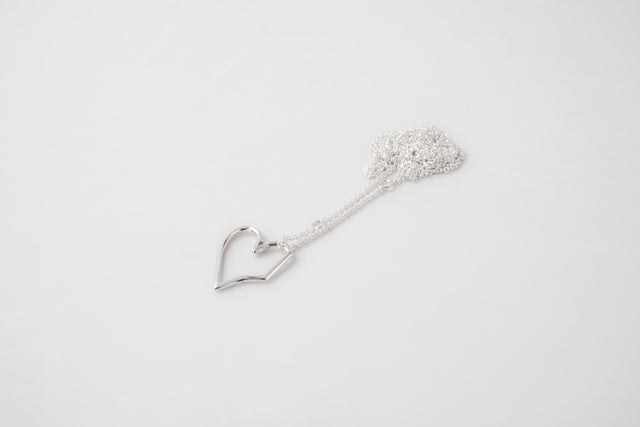
For a different fit, consider the Signature Asymmetric ear cuff for a geometric edge, the Blade ear cuff for a flatter link, and the Wire Heart necklace for a fine line without a sharp angle. Compare their scale with the Thorn earring and Signature Cross V.3 rather than assembling the whole set at once.
For a different finish, size or personal form, begin with a specific object and discuss the change through Custom Order. Polishing, a matte finish and black oxidation are available without a surcharge; a new geometry requires a separate brief. General production timing is confirmed when you order.
01What does Gothic mean in simple terms?+–
It is the name of several cultural forms: medieval art, Gothic fiction and cinema, a music subculture and fashion. They share motifs of light and shadow, the past, verticality, mourning and strange attraction, but not one compulsory costume.
02Are Goths and Gothic the same thing?+–
No. Medieval Goths did not create Gothic architecture. The name arose during the Renaissance as a derogatory description of non-classical art. Modern goths belong to a musical and visual subculture that developed from the late 1970s.
03Why are Gothic cathedrals called light if Gothic is considered gloomy?+–
Ribs, pointed arches and flying buttresses relieved the walls and allowed larger windows. Stained glass filled interiors with colored light. Dark clothing belongs to the much later history of mourning, literature, clubs and fashion.
04Are Gothic and Dark fashion the same?+–
No. Gothic often uses recognizable motifs and a distinctive atmosphere: a cross, skull, mourning, vampire or romantic horror. Dark fashion can rely on palette, silhouette, texture and construction without those symbols.
05Are goth and punk the same?+–
No. They share origins and DIY methods, but punk is driven primarily by protest, while goth adds romance, the macabre and historical or cinematic motifs. In practice, people and garments can sit between the two.
06Is all black clothing Gothic?+–
No. A black jacket can be minimalist, classic, technical or Gothic depending on silhouette, fabric, jewelry, hair, makeup and setting. Color alone does not explain a style.
07Are pale skin and black lipstick compulsory?+–
No. They are recognizable devices of early club goth, not an entry requirement. Clothing, proportion and one motif can work with your usual face and hair.
08Does a skull always signal a threat?+–
No. In the memento mori tradition, a skull is a reminder of mortality and moral choice. In music and fashion it also became a sign of rebellion, anatomy or club quotation. Meaning depends on the wearer and the setting.
09Can gold be worn with Gothic clothing?+–
Yes. Historic crosses and memento mori rings were made of gold. Silver gives a cool contrast; gold gives a warmer, older-looking glint. Choose what supports your fabric and form.
10How do jet, onyx and black glass differ?+–
Jet is fossilized driftwood, light and suitable for carving. Onyx is a mineral with a smooth hard surface. Black glass is a manufactured material that was often used to imitate jet under the name French jet. They differ in weight, temperature, shine and care.
11How is oxidized silver different from Living Silver?+–
Oxidation is a deliberate darkening applied before wear. Living Silver is STRUGA's term for 925 silver without rhodium plating, which changes in use: raised areas brighten through friction and recesses darken. The first sets the starting point; the second records time.
12Can I buy STRUGA in Bali?+–
In Bali, STRUGA is sold at Hedonist Store and Barefoot Aristocracy in Canggu; there is no STRUGA-owned store on the island. Online, order through strugadesign.com, with worldwide shipping from Bali.
13How should I start a Gothic wardrobe?+–
Start with one line and one detail: a collar, length, lace, leather or an angular ring. Keep part of your usual wardrobe so the result does not become a complete costume. Add the next pieces one at a time and check them in motion.