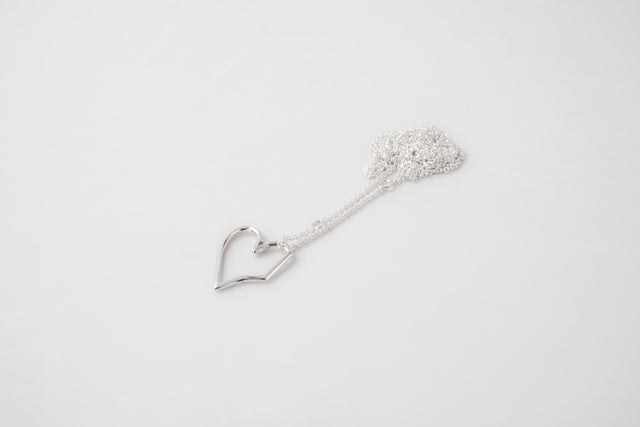
Dark fashion
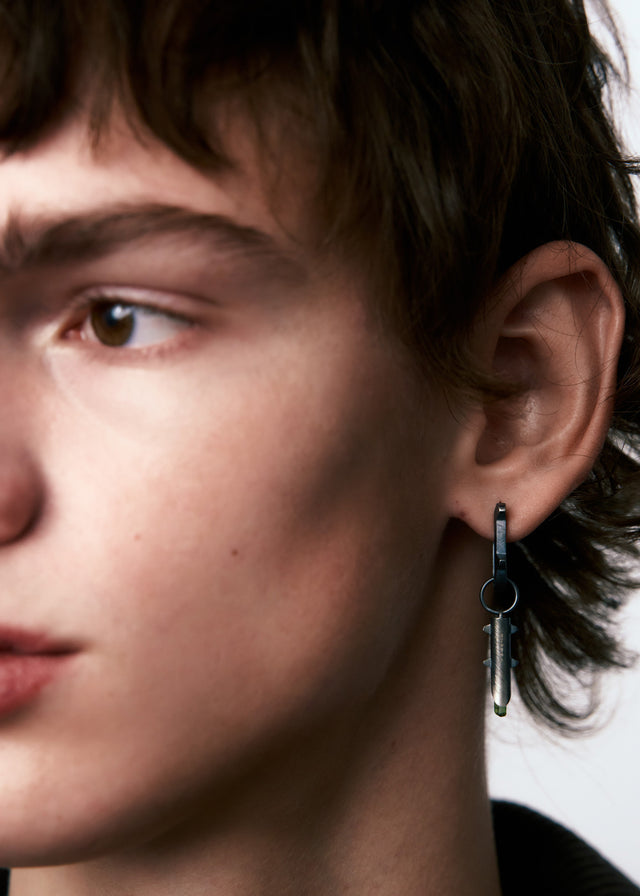
Dark fashion is the name of the style. It is not translated, and it is not a jewelry category. Three histories sit under it: a heavy black wardrobe, gothic dress, and silver that shows against black cloth. The photograph is a Thorn Amulet earring: a spiked frame and a green tourmaline at the tip.
Updated November 9, 2026
They are set apart below by year and city. A year in the text is the date of an event. How to wear the silver with clothes you already own is in the fitting guide.
How the style looks
The clearest living example is Rick Owens, because he writes his own show notes, and those notes are public.
On 26 June 2025, in Paris, at the Palais de Tokyo, he showed a men’s collection and named it Temple. The same evening, across the street at the Palais Galliera, the retrospective Temple of Love opened. In the note he writes that the retrospective smells of a peak and a sunset, and that he likes that. He describes the clothes through body and skin: skin showing between black leather, studded belts he ties to Hollywood Boulevard, slashed and spiked leather from Tuscany, bulky jackets in nylon and silk. The sound of the show is Dido’s lament, a song about death.
On 2 October 2025 the women’s collection carries the same name. He sums it up in one line: hard clothes for hard times. Among the pieces he himself names a small leather jacket with a Dracula collar and fringe on the sleeves, cropped capes, metal shoulders, layers of sheer fabric that suggest the body and then close it again. The site does not bring back the old nickname “lord of darkness.” The Dracula collar stays in the clothes. Dropping a nickname and dropping a motif are different decisions.
Vogue watches the same day from the other side of the room. Models descend into water in the courtyard. The whites of the eyes are covered by black lenses. Shoulders are wide. The soles lift the figure until the silhouette becomes almost impossible. That is the magazine’s description, not the brand’s note. Together the two texts give a sharper picture than either one: the brand has leather, a collar and hard times; the magazine has water, black eyes and the height of a sole.
The year of his birth does not settle on one figure, and that disagreement should stay. In a text on his site in October 2023 he writes that he was born in 1962 in Porterville, California. A 2025 note about printing the astrological chart his father drew on the day of the birth gives 1961. He opened the brand in 1994, in a small studio by Hollywood Boulevard. Those are his own words.
From there the path splits across other people’s records. The CFDA writes that he moved to Paris in 2003, after working as artistic director of the fur brand Revillon, founded in 1723. Business of Fashion places the middle differently: from 1994 the clothes were sold through Charles Gallay in Los Angeles, in 2001 production moved to Italy, in 2002 the Revillon role began, and the Paris shows came after that. Three accounts, three texts. A column in the same publication says he pushed a harsh gothic reading into fashion. His site does not confirm that sentence. Highsnobiety separately warns that the nickname “lord of darkness” and the Goth Ninja style of 2008–2009 do not describe the current seasons. The collar and the black leather shown in 2025 sit beside that warning.
Beside Owens in the same year stands Rei Kawakubo. The autumn collection of Comme des Garçons is called Smaller Is Stronger. Her own words, as 10 Magazine gives them on 2 September 2025: there is strength in the small, the small can be mighty. Her husband Adrian Joffe adds, in the same statement, that they are tired of big business, big culture and world systems, and that small acts on every continent are also worldwide, and that this is not “big.” The magazine describes the clothes: men’s fabrics, stripe, check, grey flannel, inflated to inhuman volumes, then, over a black ground, red and purple dresses, a velvet crinoline, layers of pink satin. Sarah Mower, in Vogue on 9 March 2025, writes that teenagers crowd the entrance and that inside the room Bulgarian women’s voices play, a recording of workers in a field. Black remains the ground on which another colour sits. This is how the black wardrobe looks with the designer with whom it began in Paris.
Paris, the early 1980s
The black wardrobe people still argue about gathered in Paris while the runway was still wide shoulders, beads and bright silk. Time names that moment through Claude Montana, Thierry Mugler, Valentino and Yves Saint Laurent. Into the same fashion come Rei Kawakubo, with Comme des Garçons, and Yohji Yamamoto: black clothes, a loose cut, cloth that does not follow the body.
The sources do not agree on one year. Vogue France, AnOther, Time and a Business of Fashion teaching text put 1981. i-D puts 1982. The teaching text narrows the picture to February 1981: Kawakubo and Yamamoto come out together, the cloth is torn, the hem is asymmetric, and the press applies the label hiroshima chic. An essay from the Kyoto Costume Institute, citing a book on Japanese fashion, gives another month and another place: April 1981, the Hotel Intercontinental, a half-empty room, because they did not yet have their own people in Paris. Both accounts are secondary. The show itself is not in this article.
Vogue France adds a city detail. Yamamoto’s models come out in the Louvre courtyard. He opens a shop in the Marais. Issey Miyake is already working in Paris by then. AnOther passes on Yamamoto’s words about the first show: seventy percent booing and thirty percent acceptance. Highsnobiety quotes him on black: the colour is modest and arrogant at once and says “I do not touch you.”
In 2017, in a conversation with Grazia, he remembers those days more simply. He wanted to open a shop. At the same time Rei was showing in a hotel. The coincidence looked like a shared movement: as if a Japanese army had landed on European fashion. Alone, he says, he would not have produced that effect. Journalists were rude. Many said “go home.” He did not understand what was happening. One journalist wrote “Hiroshima without love.” He did not name the paper.
French papers spread that formula across different issues, and the English Hiroshima Chic does not appear in their quotations. Time, Vogue France and AnOther supply it. Le Figaro of 21 October 1982 writes of holes and rags, “as for survivors of a nuclear catastrophe,” and asks whether this is a show or a psychiatric asylum. Le Figaro of 18 March 1983 ends its description of the models with “this is Hiroshima without love”: a shoulder in a sling, a scarecrow hat, ghost women, as if from a hospital or a camp. These words are given by the researcher Kyoko Koma, who read the bound volumes. The paper reaches this article only through her quotation. Libération of 20 March 1983 writes of a “Prussian manner” and recalls the old phrase that the Japanese are the Prussians of Asia. WWD of 16 March 1983 runs the headline Intellectual Bag Ladies and calls the look Terminal Fashion.
The New Yorker in 2005 separates two seasons. The 1981 debut is one thing. The next year, and a collection named Destroy, is another. The label the magazine passes on for that collection sounds different: “Hiroshima’s revenge.” Three formulas, three sources, one fear of a foreign black cut. They cannot be collapsed into a single caption.
The Le Monde link of 26 October 1981, long taken for an account of this show, turned out to be a different article. Pierre Dommergues writes about why Japan is overtaking America, and about two books on managing people. The open portion names neither Yamamoto nor Kawakubo. A Le Monde article of 24 April 2015 is directly about fashion: in 1981 Comme des Garçons arrives in Paris with black cloth, aside from what Paris was showing then, and Yamamoto chooses Paris, a large cut, and clothes whose gender is unclear.
The Libération pages of 17 and 18 October 1981 are this paper’s first text on ready-to-wear from the runway, and they are about the Japanese designers. That is what Koma writes, having read the archive. Those pages are not in the digital libraries, so their words are not here. What she quotes verbatim belongs to the issues of 1982 and 1983. There is a later look from the same paper at that season. Libération of 20 October 1991, in Koma’s quotation, writes that in the autumn of 1981 ready-to-wear shows become a rite, and the state begins to support them. That is the paper’s memory ten years later, not the review of that October.
Ann Demeulemeester
In a Highsnobiety account, Ann Demeulemeester leaves the Royal Academy of Antwerp, opens the brand in 1985 with Patrick Robyn, and joins the Antwerp Six. A show at London Fashion Week in 1986, in the same account, changes the view of Belgian fashion. Her own site does not give a founding year. There she is a member of the Antwerp Six, and the site says that for more than three decades she set the look of Belgian fashion. The site then records a change of hands: in 2020 the Antonioli Group took the brand, from the autumn-winter 2021–2022 collection; in 2023 Stefano Gallici became creative director. He was born in 1996 in Teor and has been at the brand since 2020. The year 1985 remains the magazine’s word.
Roundups often place Martin Margiela, Yamamoto and Owens beside her. The National in 2017 describes the Metropolitan Museum’s exhibition on Comme des Garçons that way. The overlap in that description is narrow: almost only black, sometimes white, and texture, finish and silhouette matter more than the season. That is a magazine looking at an exhibition, not a charter of the brands.
Gothic is older than the black wardrobe
Gothic is older than the black clothes of the early 1980s. A cross, a skull and mourning are its motif. A wide black jacket is not explained by that motif. The separate text is Gothic.
Silver that shows against black
Silver in this wardrobe is older than the Paris show of 1981 and lives in other cities. A near-black colour of metal does not make the brands equal. The eye stops on different things.
A skull reads as a face and as the height of a relief. That is how a piece by The Great Frog is built. On its own site the brand writes a founding in 1972 in London: Paterson Riley and Carol Lehtonen-Riley, the first shop on Carnaby Street. Esquire UK, from the family, adds the path: first imported rings from Morocco, then their own pieces in Soho, and in 2002 a son was called in because the bank had nearly closed the business. The phrase “the Cartier of the goths” stands in 10 Magazine; Reino Lehtonen-Riley says it. The about page does not carry that phrase.
Mass reads as volume. That is how Parts of Four reads. Evan Sugerman writes on the brand’s page: born in the United States, in Los Angeles, the brand from 2011, objects, pieces, furniture, with no division by gender and no season. A showroom in Paris, 36 rue Charlot. On that page Bali is named as the shop Laboutik. The partner FOB Paris, on 20 February 2024, writes of Balinese workshops as the place where material becomes objects. The brand’s own text on Anima Sound writes that the body of the piece is made in Bali and finished in Berlin. Vogue Hommes of 30 June 2020 passes on his words: the name came from a note in a sketchbook, he came to jewelry by accident, before his own brand he was taken with Chrome Hearts, and he wears Rick Owens and Boris Bidjan Saberi. Those words do not say that he designed jewelry for Rick Owens. Other sources write that about the years 2011–2015. The name Damian appears in notes of a 2021 podcast. That conversation is not in this article, so the name stays someone else’s note, not a fact of the brand.
A surface reads through the way the metal was worked. Werkstatt:München writes on its page: Klaus Lohmeyer, a master, opened the workshop in 1996. The pieces are made in Munich, at Fraunhoferstrasse 31. The metal is recycled, and there are no coatings. The old foundry, the philosophy and the music before the craft remain the words of Homo Faber, not the words of the workshop.
A straight joint reads as a stepped edge. That is how the STRUGA Brutalism V.3 cuff, size M, reads. Silver 925, black oxidation, worn without a piercing. The card opened on 7 November 2026 gives the weight as 1.6 g. The same form in size L, in light silver, is given as about 7.5 g. Brutalism is a family of the CODEX world; as a piece darkened in advance, this cuff is also listed in RITUAL. Another object in the same dark metal is Thorn Amulet Earring #19: size M, 5.4 g, a spiked frame and a green tourmaline, also darkened before wear. That exact earring has been sold. The cuff is made to order. The two objects show two ways of holding dark metal on a person: one sits on the rim of the ear without a piercing and reads as a step, the other hangs from the lobe and reads as a frame and a stone.
Chrome Hearts enters this row as a name that roundups of dark silver use. It is not an island brand. In a jobs text the company writes: conceived in 1988 by Richard Stark in Los Angeles, “thirty-plus” stores. Business of Fashion names the co-owner Laurie Lynn Stark, leather for motorcyclists in that same 1988, a CFDA accessories award in 1992, and 36 stores. Wikipedia writes three founders: Stark, Leonard Kamhout and John Bowman, and the departure of two of them in 1994. The brand’s homepage does not carry the history; it carries the cities of the stores. The numbers do not agree, and there is no reason to pick one of them.
Gaboratory’s English site does not give a history: a menu and a rights line. The Japanese general agent and the English page of the Hiroshima shop agree on the core. Gabor Nagy was born in Budapest in 1953, on 10 May according to the shop page. In 1988 he opened an atelier in Venice Beach. In 1999 he died of heart failure, at 45, on 16 January, according to the same pages. The brand was then continued in the workshop. A shop blog divides the dates differently: a personal workshop from 1988, a company with Pascal Zaza from 1994, and disputes after that. The lawsuit is not part of this account, so the disputes remain someone else’s retelling.
Russia, in its own press
In the Russian press, “dark fashion” is used for clothes, not for silver. Sobaka uses the name for Pirosmani and for its founder Evgenia Malygina. The brand’s site runs collections from 1999 and stresses that there is no season and no race for a show. Sorockolita writes a founding in 2017, Moscow, neo-gothic, Japanese motifs and handmade batches. The Blueprint writes that the brand was noticed in 2018 at fashion week in Vancouver. A Designers from Russia roundup dates the Moscow label Agony Project to 2020 and the Belarusian Viceseason to 2014. That is clothing.
The silver was checked on the brands’ own sites, and it does not fold into one dark style. Darkrain is Victoria Sycheva and Dmitry Sidorov, from 2016 in Saint Petersburg, sculptural silver, and the brand describes the making itself. Out of the Blue is Anya Pavlova, jewelry from 2011; until September 2025 she was a co-founder of Mineral Weather, and now silver sits beside brass, glass and ceramic. OMUT writes outright that this is not precious metal in the ordinary sense: chains and objects for the body, its own workshop in Russia since 2010. ELEMENT47 describes a large Moscow silver shop, objects from around the world, and its own limited production. Avgvst writes Berlin, 2019, and the founder Natalia Bryantseva. That site does not call itself Russian production.
Celuk is a village where silver has been made for a long time. The heavy black wardrobe discussed above did not arrive through that village. Paris, Antwerp, London and Los Angeles hold the wardrobe in this history. Celuk holds a long craft. Island silver brands, on their own pages, talk about jewelry, workshops and stones. Among them, darkened silver as a language of its own is what STRUGA shows. For three of them the word black sits in a menu: a chain’s name, black stones and pearls, a colour filter. A colour menu and a black wardrobe are different things.
Parts of Four stands beside that circle and does not merge into it. Its own page shows the Paris showroom and the Laboutik shop in Bali. A partner and one of its own texts write that the pieces are made in Balinese workshops and finished elsewhere. Both facts stay, because the brand’s page and the partner’s page say different things.
For the international market, STRUGA objects are made in Bali. Dmitry and Ekaterina design. Masters make the object. The Brutalism V.3 cuff, size M, is one object. Thorn earring #19 is another. Where to try a piece, and how an order begins, is in the fitting guide.
The Brutalism V.3 cuff, size M, and Thorn earring #19 are two different objects in that silver. Earring #19 has been sold.
Frequently asked questions
Didn’t find the answer — write to us, we reply personally.
Ask a question →01What is Dark fashion?+–
It is the name of the style. It is not translated. The black wardrobe, gothic dress and dark silver belong to it as separate histories.
02Is Dark fashion the same as gothic?+–
No. Gothic is older and rests on a motif: a cross, a skull, mourning. A wide black jacket is not explained by that motif.