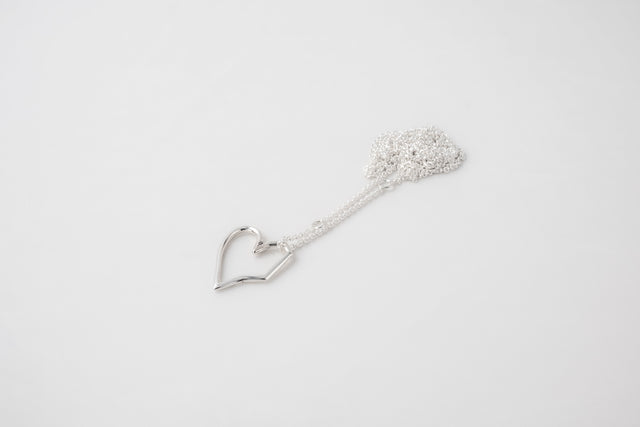
Mixed Metal Jewelry: Carbon Joined with Silver, Meteorite, Brass and Copper — MOSAIC
MOSAIC is the STRUGA family built on one principle: carbon with insets of other materials. Not a shape — a way of joining. Twenty objects, five inset materials, from 2 to 95 grams, everything brought down to a single plane.
MOSAIC is a material principle, not a numbered form: carbon is the ground, a second material is set into it, and the two are brought flush.
Five materials go into the carbon — sterling silver 925, Seymchan meteorite, brass, copper, stainless steel.
Twenty objects in the family: 16 objects worn at the neck, 3 bracelets, 1 earring. No rings — the family began with a pendant and has stayed with the pendant.
Weight runs from 2 grams (One Display Techno) to 95 grams (Carabiner #2 Big Cross) — one rule across a forty-fold range of mass.
The carbon holds still; the inset lives. Silver, copper and brass darken and take on patina while the carbon keeps its color.
MOSAIC lives in the RITUAL world, side by side with CARBON — both were born in the brand's first collections.
- Where the family came from
- The anatomy of the join
- What is joined with carbon
- The forms the family lives in
- Its place in RITUAL
- MOSAIC at a glance
Where the family came from
MOSAIC appeared in the brand's first work — carbon pendants with a second material set into them. The carbon palette STRUGA still uses was chosen in the same breath. The brand began with CARBON, and the carbon was almost never left bare: from the start it carried copper, brass, steel, meteorite. So a single root put out two families at once — CARBON, where the carbon stands alone, and MOSAIC, where it meets another material.
The brand canon states this family in one line that does not reduce to anything shorter. The aesthetic of combining materials. Not ornament laid over a surface, not a stone in a setting — the seam between two different materials is itself the drawing.
That origin still shows in the shape of the family. The first MOSAIC objects were pendants, and pendants are what the family is made of today: 16 of the 20 objects hang from a cord or a chain. The principle was worked out on a flat plate of carbon worn at the chest, and the flat plate remains its natural ground.
The anatomy of the join
The canon describes the mechanic word for word, as the published description of the living collection.
MOSAIC — the aesthetic of combining materials.
In MOSAIC, carbon is joined with silver, with meteorite, with brass, with copper, with steel. One is set into another, joined with a third in a single plane — and a composition of materials is the result.
The key word here is plane. The materials do not stack in layers and do not fight for volume: they are brought to one level, flush, so the boundary between carbon and metal reads as a line, not a step. A finger runs across the object and never catches on the seam — it sees the seam, but does not feel it.
In this pairing carbon holds the role of the dark, unchanging ground. STRUGA cuts it on a CNC machine from sheet material: ultralight, unafraid of water, unchanged by time. The inset behaves the other way. Sterling silver 925 darkens on the skin; copper and brass STRUGA oxidizes and patinates by its own techniques; meteorite carries a geological drawing. The carbon stays put — the metal around it lives. That contrast is what holds the composition.
The join works at very different scales. Big Line Classic Aged weighs 17 grams and carries copper inlaid into the carbon with no silver at all. Carabiner #2 Big Cross weighs 95 grams and runs the same principle around the wrist. The lightest object in the family, the One Display Techno bracelet, weighs 2 grams. One rule, forty times the mass from end to end.
What is joined with carbon
The list of materials in MOSAIC is closed by the canon and checkable against the catalogue: sterling silver 925, meteorite, brass, copper, stainless steel. The meteorite is Seymchan — the only one STRUGA currently fuses into its objects, and it appears in two necklaces of the twenty. Copper and brass do not arrive as bare metal: the brand sets their color and character by its own hand through patination, the same way it lays down the dark surface of silver.
The densest composition in the family is Asymmetric Fused Bloody with Meteorite — four materials of four origins in one object: meteorite from space, copper and steel from inside the earth, carbon made by human hands. It weighs 80 grams. At the other end of the range sits Signature Cross V.3, 9 grams of carbon and blackened silver 925, where the join comes down to two materials and a single edge.
That is where the family's search address comes from. People do not look for these objects by the word "mosaic" — they look for them through the metals: mixed metal jewelry, a mixed metal necklace, carbon joined with silver, brass, copper, meteorite. MOSAIC answers that query literally: it is the carbon object with a second material set into it. The family name is the brand's internal code; on the storefront the object carries it.
The forms the family lives in
A material principle does not reach every form on its own, and MOSAIC is the clearest case of that in the brand. Twenty objects: 16 objects worn at the neck, 3 bracelets, 1 earring. There is no MOSAIC ring, and no carbon ring anywhere in the catalogue — all nine STRUGA rings are sterling silver 925 with no carbon in them.
This is a property of the form, not a gap in the range. The family grew out of a flat carbon plate worn at the chest, and the plate is where the join works: enough surface for two materials to meet, and no curvature to fight. A ring is a closed band under constant contact — a different problem, which the brand solves in silver instead.
So the route splits in two. For the join of materials the address is the MOSAIC collection — pendants first, then bracelets and an earring. For a ring the address is the rings, all in silver, some of them blackened in advance. An object outside both — another pairing of materials, a size beyond the stock — is discussed through Custom Order.
Its place in RITUAL
MOSAIC lives in the RITUAL world — the dark, spiritual side of STRUGA, where shamanism sits beside contemporary materials. The family moved here together with CARBON: both were born in the brand's first collections and stand side by side. RITUAL gathers objects with a personal weight — amulets, stones, meteorites, carbon; MOSAIC adds its own principle to that row — material met with material.
Beside it in the world stand AMULET — the core of RITUAL — and CARBON, the clean branch of that same original carbon. MOSAIC is its other half: what is left once a foreign material is set into the carbon and everything is brought down to a single plane.
MOSAIC at a glance
| Property | Value |
|---|---|
| What it is | A material principle, not a numbered form — the aesthetic of combining materials |
| The ground | Multi-layered matte carbon, CNC-cut from sheet: ultralight, unafraid of water, unchanged by time |
| Inset materials | Sterling silver 925, Seymchan meteorite, brass, copper, stainless steel |
| How they meet | Flush, in a single plane — the seam reads as a line, not a step |
| Objects in the family | 20 — 16 objects worn at the neck, 3 bracelets, 1 earring; no rings |
| Weight range | From 2 grams (One Display Techno) to 95 grams (Carabiner #2 Big Cross) |
| Over time | The carbon keeps its color; silver, copper and brass darken and take on patina |
| World | RITUAL, side by side with CARBON and AMULET |
Frequently asked questions
Didn’t find the answer — write to us, we reply personally.
Ask a question →01What is mixed metal jewelry?+–
It is an object where one material is joined with another instead of being decorated. At STRUGA that principle is the MOSAIC family: a carbon ground with sterling silver 925, Seymchan meteorite, brass, copper or stainless steel set into it. The two are brought flush in a single plane, and the seam itself is the drawing.
02What metals does STRUGA join with carbon?+–
Five materials, and the list is closed: sterling silver 925, Seymchan meteorite, brass, copper and stainless steel. The brass and copper are oxidized and patinated by the brand's own hand rather than used as bare metal. The meteorite appears in two necklaces of the twenty objects in the family.
03Does mixed metal jewelry tarnish?+–
The inset lives, the carbon does not. Sterling silver 925, copper and brass darken and take on patina over time, while the carbon keeps its color and shrugs off water. The metal around the carbon settles into shadow — that is intended, not a fault.
04Does STRUGA make a carbon ring?+–
Not in the catalogue. All 20 MOSAIC objects are worn at the neck, on the wrist or in the ear, and all nine STRUGA rings are sterling silver 925 with no carbon in them. The family grew out of a flat carbon plate worn at the chest, and that is where the join works.
As of 2026, a ring in carbon is an individual object: it is discussed through Custom Order, not picked off the storefront. For a ring available now the address is the silver rings — some of them blackened in advance.