Blackened Silver — the dark side of STRUGA
Blackened silver is 925 sterling silver with a deliberately darkened surface. The finish comes from a chemical change at the surface, rather than paint or a different silver grade. At STRUGA, dark recesses and bright edges show the form; contact with the hand changes that contrast over time. For the international market, STRUGA objects are made in Bali.
Updated October 5, 2026
Blackened silver is a surface finish on sterling silver, not a separate alloy. Living Silver is STRUGA’s name for uncovered 925 that changes with wear. Intentional blackening starts dark; friction brightens raised areas. Both finishes remain silver 925 underneath. Care should preserve the chosen contrast rather than polish every recess back to bright.
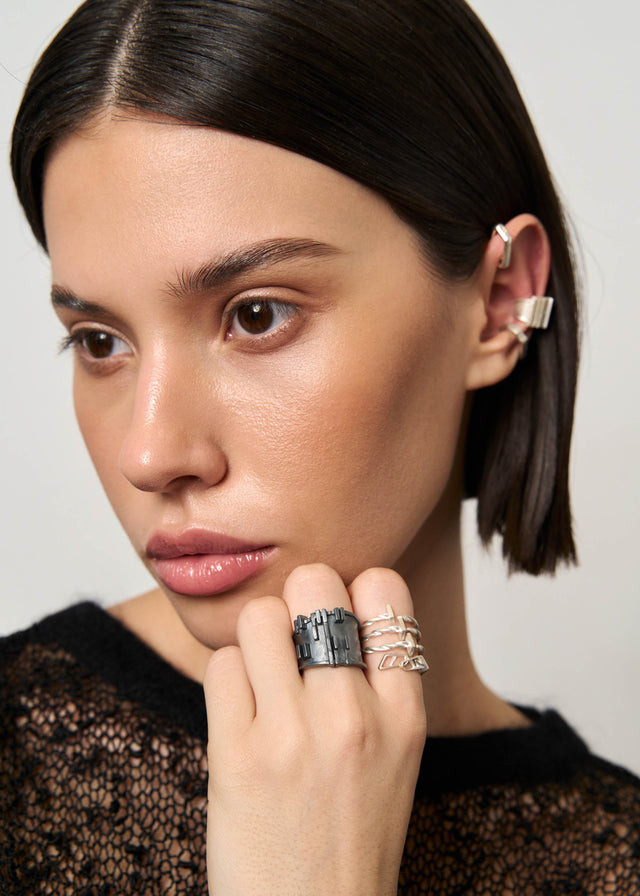
One object in the collection is the Brutalism V.3 Ring: 9.6 g of blackened 925 in size 15, with the ring size chosen before manufacture.
| Blackened silver | What the description establishes |
|---|---|
| Metal | 925 sterling silver: 92.5% silver |
| Finish | A deliberately darkened surface |
| Natural patina | Can develop on uncovered silver |
| Thickness | Not measured for STRUGA objects |
| Collection, October 5, 2026 | 17 active objects; individual weights depend on the object and size |
| Lead time | In stock: ships sooner; made-to-order silver without stones: about two weeks |
The first thing you notice in a STRUGA piece is the colour. Not the bright shine of classic silver, but a deep, dark tone — as if the metal had passed through time and earned its history. This is the blackened finish — oxidised silver, the visual signature of the brand.
What blackened silver is
Intentional blackening forms a dark finish through a chemical change at the surface of silver. It is not black paint or a different alloy. For STRUGA objects described here, the underlying metal is silver 925.
A blackened surface can change during wear. Friction can brighten raised areas; how much the contrast changes depends on use. There is no fixed month-by-month progression for every object.
Blackening is not the same thing as Living Silver
Blackening and Living Silver describe different starting surfaces. Intentional blackening begins dark; uncovered silver can develop patina during wear. The alloy can be the same while the initial contrast differs.
Does 925 silver tarnish on its own, without a workshop
Yes. The Sheffield Assay Office explains that sulfur-containing gases produce sulfides on silver and copper in sterling silver. Pure silver can tarnish too. A dark surface does not by itself establish a lower silver grade: the fineness describes the alloy, while tarnish describes a change at its surface.
Natural patina arrives through exposure and use; intentional blackening establishes the starting contrast before wear. Neither puts the surface outside time. A ring’s raised edge rubs against skin and fabric, while a recessed line receives less friction. The same object can therefore carry light and dark areas together.
STRUGA works with that movement. Living Silver starts uncovered and bright; intentional blackening starts with a darker surface. The choice concerns how the form first reads on the hand, not whether the silver is genuine. Composition and the individual object’s specifications remain separate questions.
| What changes | Living Silver | Intentional blackening |
|---|---|---|
| Starting surface | Uncovered and bright | Deliberately darkened |
| How the contrast develops | Patina develops during wear | Wear changes the starting contrast |
| Raised areas | Friction can keep them brighter | Friction can brighten them |
| Care choice | Keep the patina or ask for cleaning | Preserve dark recesses when cleaning |
| Silver fineness at STRUGA | 925 | 925 |
Blackened versus plain silver
A polished surface reflects light; a darkened surface sets a different contrast. STRUGA uses the relation between recesses and raised edges to make the form visible.
Dark recesses beside lighter raised edges can make the relief easier to see. The finish changes how the form reads; it does not change its geometry.
What a dark surface gives back in exchange for shine:
- Dark recesses and lighter raised edges show the relief of the form.
- Friction can brighten contact points; the amount depends on wear.
- A change of finish is a separate request for the individual object, agreed before sending it.
The patina philosophy
Patina records contact with the surroundings. Its appearance can change with wear, storage and cleaning; the choice of care begins with the finish you want to preserve.
More on the philosophy on the Living Silver page.
The Blackened collection
The Blackened Silver collection brings together the current blackened objects. Check the individual object for its material, size and availability: a collection name does not replace those specifications.
A different finish belongs to a specific object and request. Discuss the surface through the existing order form before choosing an alteration; the geometry, stones and current condition matter.
How blackened silver gets its color
Intentional blackening uses a chemical treatment to establish a dark surface. The Sheffield Assay Office describes the use of sulfur-containing compounds for deliberately darkened silver jewelry. The finish changes the outside of the object; it does not change its stated silver fineness.
What the reagent actually is
A dark appearance alone does not identify the reagent or the silver grade. The alloy and the finish are separate specifications; this article does not provide a home treatment recipe.
On an object, contrast appears where dark recesses meet lighter raised areas. A general explanation of silver chemistry does not establish the process used for a particular STRUGA object.
How deep the darkening goes
The Canadian Conservation Institute explains the progression of tarnish colors through thin-film interference. Its general reference range is 10–100 nm for colored films and above about 100 nm for black. These are observations about silver tarnish, not a measured thickness for STRUGA pieces.
| General CCI reference | Color of silver tarnish |
|---|---|
| 10–100 nm | Yellow through red-brown to blue |
| Above about 100 nm | Black |
| Scope | General tarnish reference, not a STRUGA product measurement |
Color describes the finish you can see. A numerical thickness claim needs a measurement of that particular surface; the name “blackened” alone cannot provide it.
The technical depth of blackened silver
- The silver fineness and the finish answer different questions: alloy composition versus surface appearance.
- Dark recesses and bright raised areas make a relief easier to read.
- Refinishing is a separate request for the individual object; ask before sending it.
How blackened silver ages with wear
Over time, the blackened surface interacts with skin contact and ambient conditions:
- Contact points brighten through friction. The amount depends on how the piece is worn.
- Recesses receive less friction and can retain more of the dark finish.
- The pattern develops through use; there is no fixed month when every piece changes in the same way.
- If you want the contrast restored, discuss the object with STRUGA before sending it.
STRUGA's specific approach
Intentional blackening and the patina of Living Silver both change the reading of a form. The current Blackened Silver collection is the route to objects with a deliberately dark starting surface; the object page gives its exact specifications.
What is blackened in the catalog, in numbers
The Blackened Silver collection contains 17 active objects at the October 5, 2026 catalog check. They range from the 1.6 g Brutalism Ear Cuff V.3 to the 40 g Asymmetric Destroyed Necklace. The Brutalism V.3 Ring weighs 9.6 g in size 15; its other sizes have different weights. Signature Cross V.3 weighs 9.0 g. See each object’s current size, weight and availability before ordering. Made-to-order silver without stones usually takes about two weeks; stone-set objects have a different schedule, and an in-stock object can ship sooner.
The silver fineness stays the same across these surface choices. An alteration is a separate request: ask STRUGA about the individual object before sending it for work. A finish description does not promise that every form can be changed in every direction.
Care for blackened silver
- Use a soft cloth for routine wiping, without trying to brighten the dark recesses.
- Keep abrasive silver polish and silver dips away from the intentional dark finish.
- Clean an object with stones or other materials according to its own care instructions; a bare-silver method does not apply to every assembled piece.
- Remove the object before swimming or using household chemicals, and dry it before storage.
For cleaning steps and storage, use the oxidised silver care guide. The Canadian Conservation Institute’s care note explains why abrasive polishing and chemical dips remove tarnish. On an intentionally dark object, that also removes part of the selected contrast.
About STRUGA. STRUGA is a dark experimental silver brand founded in 2018 by Dmitry and Ekaterina Strugovshchikov. The brand works with silver 925 and distinguishes intentional blackening from Living Silver. For the international market, STRUGA objects are made in Bali. The island is the brand’s craft context; the alloy is sterling silver, not a separate “Bali silver” grade.
Frequently asked questions
Didn’t find the answer — write to us, we reply personally.
Ask a question →01Is blackened silver a coating?+–
It is a chemical change at the silver surface, rather than black paint or a different silver grade. The object remains silver 925 underneath.
02Is blackened silver a lower silver grade?+–
No. Silver fineness describes the alloy, while blackening describes its surface. A change of finish or repair must be discussed for the individual object; its silver grade alone does not guarantee a particular service.
03Is a wear pattern on blackened silver a defect?+–
Friction brightens contact points, while less exposed recesses retain more darkness. STRUGA treats this movement as part of the surface’s life; a new mark does not by itself establish a defect.
04Is blackened silver the same as Living Silver?+–
Blackening is an intentional surface treatment. Living Silver is STRUGA’s name for uncovered 925 that changes with wear. The finish and the material’s behavior describe different things.
05What does the name of a dark finish establish?+–
A dark finish describes the appearance of the surface. Intentional chemical darkening is separate from the silver fineness. The name alone does not establish a particular reagent, layer thickness or care method; check the individual object’s specifications.
06Will the blackening rub off?+–
Friction can brighten contact points, while recesses receive less friction and can retain more darkness. The degree of change depends on wear. If the appearance raises a question, discuss the particular object with STRUGA.
07Is STRUGA blackened silver made in Bali?+–
For the international market, STRUGA objects are made in Bali. The finish is a surface choice on silver 925, not a separate Balinese alloy. Check each object’s current size, weight and availability before ordering.
08Can blackened silver be polished back to bright?+–
Polishing removes the dark surface along with some underlying silver. A chemical dip can also strip the contrast from recesses. Choose this only as a deliberate change of finish, after discussing the particular object; it is not routine care for intentional blackening.
09Why does my blackened ring look different from the photo?+–
Lighting and the stage of wear affect how a dark surface appears in a photograph. If the received object raises a question about its finish, ask STRUGA about that specific object; the photograph alone cannot explain every difference.
10Can I have a Living Silver object blackened?+–
Discuss the individual object with STRUGA first. Its form, stones and condition matter; an alteration should be agreed before it is sent for work.
11Does the Brutalism V.3 Ring always weigh 9.6 g?+–
No. The catalog lists 9.6 g for size 15. Other sizes have their own weights. Choose the ring size before manufacture: Brutalism V.3 is not resized afterward.