Bali Silver vs Turkish Silver vs Thai Silver — Honest Comparison
Three countries supply most of the world's affordable handmade silver: Indonesia (Bali), Turkey and Thailand. The metal is often identical — 925 sterling, 92.5% silver — but the school around it is not, and the difference shows up in the alloy habits, the casting method, the ornament and, above all, in what the piece looks like after a year on skin. STRUGA works inside the Bali school, so the sections on Turkey and Thailand are the ones we checked against sources rather than memory.
Updated September 28, 2026
All three schools produce genuine 925 when the seller is honest — the difference is craft and finish, not grade.
Bali silver is normally sold uncoated and darkens within weeks; the patina is the design.
Turkish silver is often rhodium-plated: six to eighteen months of mirror finish, then wear.
Thai hill-tribe silver is 95–99.9% pure — it tarnishes more slowly than 925, but bends more easily.
| Bali | Turkey | Thailand | |
|---|---|---|---|
| Usual alloy | 925 | 925 | 925 factory, 95–99.9% hill-tribe |
| Usual finish | uncoated, often pre-oxidized | frequently rhodium-plated | uncoated |
| Craft center | Celuk, Gianyar regency | Midyat, Mardin province | Chiang Mai and the northern hills |
| Simple ring, 2026 | $15–$40 | $10–$30 | $10–$35 |
| Ages by | darkening within weeks | plating wearing off in 6–18 months | slow tarnish, easy deformation |
The full picture of the metal itself — composition, seven authenticity checks, hallmarks and care — is in our 925 sterling silver buyer's guide.
We look at all three from inside the Balinese school: STRUGA works in 925 left uncoated, and the school's architectural logic is easiest to read on a single heavy object — the Brutalism V.1 ring, 9.6–24 g depending on size. The rest of the catalogue sits in rings and the other sections.
What is actually inside Bali, Turkish and Thai silver?
All three traditions work to the sterling silver standard: 92.5% silver, the remaining 7.5% usually copper. That 7.5% is not a detail — it is what makes the metal hard enough to wear and, as the tarnish section explains, what makes it darken.
- Bali. The base alloy is 925 and serious workshops keep purity under guarantee. The risk sits in tourist stalls in Kuta and Ubud, where 800–900 alloys are sold without a hallmark: a 925 stamp means metal, no stamp means guesswork.
- Turkey. Real Turkish silver is 925 too. The Grand Bazaar in Istanbul — Kapalıçarşı, literally «the covered market» — holds several thousand shops, and quality across them varies more than in any other silver market here. Silver-plated brass with imitation patina is a real risk on the tourist route.
- Thailand. The widest range of the three. Karen and Hmong hill-tribe silver is often near-pure, 95–99.9%. Bangkok factory silver is ordinary 925. Chiang Mai workshops are 925 as well, frequently at a high craft level.
How is silver actually made in each of the three countries?
Bali. The island's silver center is Celuk village in the Gianyar regency, where the craft has lived for over a thousand years. The working method is casting from a wax model through a silicone mold, then hand polishing and wire work. Every piece is assembled by hand, and you read it in the microscopic asymmetry.
Turkey. The Turkish wire tradition has a name and an address: telkari, from the Persian «tel» (thread) and «kâri» (weaving), centred on Midyat in Mardin province. Silver is drawn into thread, cut, bent into motifs with millimetre precision, then soldered inside a frame. Turkey granted telkari a geographical indication in August 2021, and a museum of the craft opened in Midyat in December 2023. On the mass market you get stamped repeats of the same motifs.
Thailand. Hill-tribe silver is hammered rather than cast: massive surfaces, tool marks left visible, ethnic motifs. Bangkok factory silver is clean and consistent but less distinctive, and Chiang Mai has a growing scene of contemporary author design working in 925.
What does each school actually look like?
Bali. Traditionally nature — flowers, animals, Barong masks, dense granulated surfaces. The contemporary Bali line, which is where STRUGA works, is the opposite reading of the same craft: architectonics, a dark line, natural stones and carbon. The intersection of a thousand-year casting tradition with avant-garde form is rare, and it is the reason the school is worth choosing at all.
Turkey. Ornament and geometry. Ottoman patterns, calligraphy, evil-eye motifs, and heavy use of turquoise, onyx and carnelian. Turkish silver reads as decorated surface: the value sits in what covers the metal.
Thailand. Two poles at once. Hill-tribe work is massive, hammered, ethnic — it reads as an object with a history. Bangkok and Chiang Mai run to clean contemporary lines, sometimes with a Japanese-minimalist note. In a shop the weight tells them apart: hill-tribe pieces are noticeably heavier for their size.
What do Bali, Turkish and Thai silver actually cost?
Prices below are 2026 ranges in US dollars, the currency all three markets quote to foreign buyers. They cover comparable handmade work, not tourist-counter inventory.
| Bali | Turkey | Thailand | |
|---|---|---|---|
| Simple ring | $15–$40 | $10–$30 | $10–$35 |
| Artisan ring | $40–$200 | $30–$150 | $30–$120 |
| Statement necklace or bracelet | $100–$500+ | $80–$400+ | $60–$300+ |
Turkey is usually the cheapest of the three, because silver-industry labour costs there are lower. Thailand sits in the middle. Bali runs slightly above both: the school is more labour-intensive per piece, and contemporary design with natural stones and carbon costs more than mass tourist inventory anywhere. Above the metal price you are paying for hours — polishing, stone setting, surface work — and those hours are the part that differs between the three.
What the ranges do not show: on tourist routes the first price is a starting position and bargaining is expected, while author workshops quote a fixed price and explain it. A seller who halves the price unasked was not pricing the work.
Which school fits which task?
- Ornament and classical craft — Turkey. The telkari school handles intricate patterns few others match, often at an accessible price. Ask whether the piece is plated before you buy.
- Minimalism or tribal — Thailand. Chiang Mai for clean contemporary forms, the hill tribes for massive hammered texture and the highest silver purity of the three.
- Dark, architectonic, author design — Bali. Specifically RITUAL and CODEX from STRUGA: craft, nature and dark minimalism in one object. What that looks like on a single piece — the Thorn ring: a sharp form in 925 left uncoated.
- Everyday wear that must not deform — any 925. Near-pure hill-tribe silver is the one category to think twice about here, because purity buys slower tarnish at the cost of hardness.
No country is objectively better. The metal is close enough to identical that the honest question is which aesthetic you want to live with, and how you want it to age. If you cannot answer that yet, buy the cheapest honest piece from each school and wear all three for a season — a year of skin contact separates them faster than any comparison table, this one included.
How does silver from each school age over time?
Why does silver darken at all?
Silver reacts with sulfur compounds in air, sweat and skin chemistry and forms silver sulfide — the thin dark film on the surface. It is a chemical reaction, not damage. Copper is the accelerant: sterling carries 7.5% of it, near-pure silver less than 0.1%, which is why higher-purity metal tarnishes more slowly rather than faster.
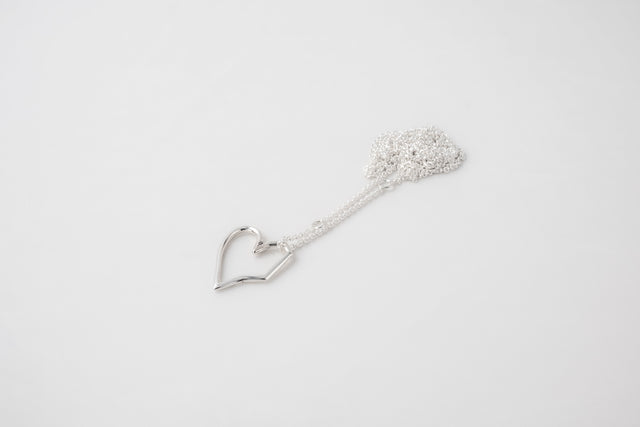
The difference between metal that darkened on its own and metal darkened by hand is easiest to see on one object: the surface of the Asymmetric Destroyed pendant is oxidized at the bench, so the dark tone is set before the piece is worn rather than grown from wear.
How do the three schools age differently?
| School | What happens in the first year | What it costs you |
|---|---|---|
| Bali, uncoated | visible darkening within weeks; many pieces are pre-oxidized so the patina is intentional | nothing, if you wanted the metal to age |
| Turkey, rhodium-plated | mirror finish holds 6–18 months; rings wear through in 6–12 because of friction, pendants and earrings hold far longer | replating, or a duller surface underneath |
| Thailand, near-pure | tarnishes more slowly than 925 and refreshes with a cloth | softness — the piece bends and scratches more easily |
STRUGA's Living Silver approach belongs to the uncoated tradition: no rhodium plating, each piece left to build its own surface map. Plated pieces are not lower-grade silver — they are silver with a layer between you and the metal, and that layer has a service life.
How can you check what you are buying?
- The 925 hallmark. Look inside a ring band, on the back of a pendant, inside a clasp. A genuine Bali, Turkish or Thai workshop stamps its work; tourist counterfeits usually skip it.
- Traces of handwork. Microscopic asymmetry — slightly different file marks, variations in surface texture, small irregularities at solder joints. Mass-stamped pieces are eerily perfect; hand-finished pieces are not.
- A maker who can explain the alloy. A serious workshop will tell you the copper-to-silver ratio, whether the piece is plated, and how the patina will develop. If the seller cannot answer, the piece probably did not come from a single accountable workshop.
- Weight against size. Silver is dense. A piece that looks massive and feels light is either hollow or not silver.
- A magnet. Silver is not magnetic. If a piece pulls to a magnet, the core is steel or another ferrous alloy under plating — this is the fastest check you can run at a market stall, and it costs nothing to carry one.
Why did STRUGA grow out of the Bali school?
We work in the Bali school because its casting tradition and the island's material access match our design language exactly. A thousand years of hand casting makes complex forms possible — from minimalist CODEX rings to the sharp Thorn amulets — and local stones such as aquamarine, tourmaline and meteorite give the RITUAL line its raw material. Carbon fiber entered the same way: as a material the school had no rules for.
The brand runs five worlds, each with its own angle:
- CODEX — asymmetric pendants, blades, signature rings.
- RITUAL — the dark line built around natural stones.
- LAB — experimental objects that do not exist in classical jewelry.
- DARK UNION — wedding and matching rings, made to order.
- ISLAND ARTIFACTS — the gift collection.
The Living Silver approach — 925 without rhodium plating, left to build patina through wear — comes directly from this school rather than from a brand decision. Read the school itself in our atlas chapter on Bali jewelry.
Where can you buy STRUGA silver?
- strugadesign.com — the full catalogue, shipped worldwide, made to order in the Bali workshop.
- In Bali — Hedonist Store and Barefoot Aristocracy, two concept stores that carry STRUGA. We have no showroom of our own.
- In Thailand — Soul Mate in Phuket. In the UAE — Poison Drop in Dubai Hills.
- Made to order — DARK UNION for wedding rings, Custom Order for any other form.
About STRUGA. STRUGA is a dark silver jewelry brand founded by Dmitry Strugovshchikov and Ekaterina Strugovshchikova, handmade together with Balinese and international master silversmiths. Most pieces are 925 sterling silver left uncoated, so they darken with wear; part of the range is oxidized at the bench. The darkening is part of the design. This is a brutalist object that reacts and changes through contact with its environment and its owner.
Frequently asked questions
Didn't find your answer — write to us, we reply personally.
Ask a question →01Is Bali silver the same as Turkish or Thai silver?+–
No. With an honest seller all three are genuine 925, but they are different schools, not different grades. Turkish silver leans to Ottoman ornament and is often rhodium-plated; Thai work runs from hill-tribe tribal to Chiang Mai minimalism; Bali is dark, architectonic and usually uncoated. The metal can be identical 925 and still produce three different objects.
02Is uncoated Bali silver just cheap silver that tarnishes?+–
No. Uncoated Bali silver is full 925, deliberately left without a rhodium layer, so the metal darkens through the ordinary reaction with air, sweat and skin — that is patina, not a defect. Many Bali pieces are intentionally pre-oxidized so the darkening is part of the design. Rhodium-plated silver is not higher quality; it is silver with a layer between you and the metal.
03Does a 925 hallmark guarantee handwork?+–
No. The 925 hallmark confirms the alloy is 92.5% silver and says nothing about how the piece was made. Handwork shows in microscopic asymmetry: slightly different file marks, small irregularities at solder joints. Mass-stamped pieces are eerily perfect; hand-finished pieces are not. Check the stamp for metal and the surface for handwork.
04Is near-pure Thai hill-tribe silver better than 925?+–
Purer, but not stronger — and not faster-tarnishing either, which is the common mistake. Hill-tribe silver (Karen, Hmong) is often 95–99.9% silver, and because tarnish is driven by the copper in the alloy, it darkens more slowly than 925. What it gives up is hardness: the metal is softer, so pieces bend and scratch more easily. For daily wear 925 is the more durable alloy.
05Which silver is best — Bali, Turkish or Thai?+–
All three are 925 if the seller is honest; the difference is school, not grade. Bali for dark architectonic design, Turkey for Ottoman ornament, Thailand for minimalism or tribal.
06Why is Bali silver more expensive than Turkish?+–
A more labour-intensive school and more complex design: a hand-finished Bali ring is hours of polishing, stone setting and surface work. Turkey saves on labour at a comparable silver weight.
07Should you buy silver at the Grand Bazaar in Istanbul?+–
Yes — if you check the 925 hallmark and bargain. The Grand Bazaar, Kapalıçarşı, is one market with several thousand shops, and legitimate Turkish silver is there, but on the tourist route silver-plated brass is regularly offered as the real thing. No hallmark, no purchase.
08How is Thai hill-tribe silver different from ordinary silver?+–
Higher purity — often near-pure, 95–99.9%. It tarnishes more slowly than 925 for that reason, but it is softer, so pieces deform faster. It stands out through massive hammered texture and tribal motifs, and reads as a collector's object rather than daily wear.
09Will Bali silver tarnish faster than Turkish?+–
Uncoated Bali silver darkens visibly within weeks. Rhodium-plated Turkish silver looks unchanged for six to eighteen months, then dulls as the plating wears — rings first, at six to twelve months, because of friction. Neither is better: Bali silver is made to age, plated Turkish silver is made to stay still.
10Can the same piece be made in all three traditions?+–
The basic form, yes; the character, no. One heart-shaped ring made in Istanbul, Chiang Mai and Celuk gives three different objects: ornament, tribal or minimalism, architecture. The school shapes the result more than the brief.
11Why does STRUGA work in the Bali school?+–
A match of school, material and design. A thousand-year casting tradition plus access to local stones and carbon is the base for the CODEX, RITUAL and LAB worlds.
12Can you buy STRUGA silver without coming to Bali?+–
Yes. strugadesign.com ships worldwide. In Bali the pieces are also at Hedonist Store and Barefoot Aristocracy, in Phuket at Soul Mate, and in Dubai Hills at Poison Drop.
If the Bali school speaks to you, the objects above are where it becomes a thing you can hold: the Bali silver collection, the atlas chapter on Bali jewelry, or Custom Order if the form you want does not exist yet.