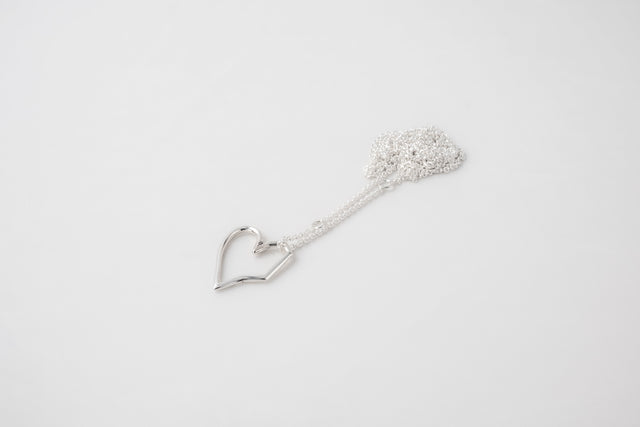
Element 47 Alternative — STRUGA Silver Jewelry Comparison vs Element 47
Element 47 Alternative — STRUGA Silver Jewelry Comparison vs Element 47
Element 47 is a Russian silver jewelry brand, its name drawn from silver's position on the periodic table — atomic number 47, symbol Ag. The brand focuses on contemporary design for the Russian domestic market, offering pieces in 925 sterling silver through online and physical retail. STRUGA is a silver jewelry brand founded in 2018 by Dmitry and Ekaterina Strugovshchikov in Bali, producing 925 sterling silver pieces by hand for an international audience. Both brands work in the same base material — 925 silver — and both are positioned away from mainstream commercial jewelry. The differences lie in design language, production philosophy, market context, and the relationship between maker and object.
- Both brands work in 925 sterling silver — 92.5% pure silver; the base alloy is the same.
- Element 47 is a Russian silver brand focused on the domestic market; some pieces are rhodium plated or blackened, as stated on this page.
- STRUGA (founded 2018, Bali) uses no plating: Living Silver — uncoated 925 that develops a natural patina through wear.
- STRUGA's design system spans five worlds and eleven families, including BRUTALISM, BLADE, THORN and SIGNATURE ASYMMETRIC in CODEX.
- Price ranges on this page: Element 47 approx. 2,000–15,000 RUB (est. $20–$165 USD); STRUGA $50–$500 USD.
- STRUGA ships worldwide from Bali via strugadesign.com; buyers in Russia order through strugadesign.ru.
Design Approach
Element 47 works within a contemporary Russian design aesthetic: clean forms, modern urban sensibility, geometric clarity. The approach is legible and accessible — jewelry that fits into a contemporary wardrobe without demanding too much interpretive effort. The design references are current urban fashion and contemporary minimalism: rings with flat planes, structured bracelets, pendants with controlled geometric profiles. It is a coherent aesthetic built for everyday wear and broad appeal within its target market.
STRUGA's design language operates at a different register of complexity. The Brutalism family is derived from brutalist concrete architecture — asymmetric planes, mass without ornament, surfaces that read as structural rather than decorative. The Blade family is about directionality and sharpness: flat, narrow sections that move against the finger with a sense of edge. The Thorn family introduces organic growth structures into a controlled formal system. The Signature Asymmetric family makes compositional imbalance the central formal device. The design intent across all families is not "contemporary" in the fashion-adjacent sense — it is architectural, with the specific conviction that silver can carry the weight of ideas that don't belong to current trend cycles.
Both brands resist the generic. Element 47 does this through quality of execution within a contemporary vocabulary; STRUGA does it through deliberate formal complexity and an explicit design system organized around five worlds and eleven families. These are different ambitions. Element 47 produces well-designed silver for people who want to wear good jewelry. STRUGA produces pieces for people who want the piece to carry a specific formal and conceptual weight.
Materials
Element 47 works in 925 sterling silver — the same alloy as STRUGA, 92.5% pure silver with copper and trace elements making up the remainder. The brand uses standard finish treatments for the Russian market, which typically include rhodium plating on some pieces to maintain brightness and reduce tarnish. Some pieces may use blackened or oxidized finishes to achieve darker aesthetics.
STRUGA uses 925 sterling silver as its only metal. The defining material commitment is Living Silver: no rhodium plating, no sealant, no chemical surface treatment applied at manufacture. The silver is left uncoated and develops a natural oxidation patina through wear — deepening in recesses, remaining brighter on wear points, creating a surface that is individual to each owner and responds to their skin chemistry over time. The approach rejects the idea that silver needs to be "protected" from its own nature. Select pieces add carbon fiber panels (RITUAL world) for material contrast, and raw natural stones in specific family lines. Nothing is plated.
The base material is the same — 925 sterling — but the treatment philosophy differs. Rhodium plating, standard in the Russian mid-market, maintains a uniform bright finish over time but prevents the silver from developing any individual character. Living Silver produces a surface that changes — which some wearers find compelling and others find inconvenient. This is a matter of preference, not quality. The underlying silver content and alloy standard are equivalent.
Russian Market Silver vs Bali Workshop Production: Different Worlds of Craft
The Russian silver jewelry market operates within a well-established domestic production system. Silver jewelry has deep roots in Russian craft culture — from the silver workshops of the imperial period to contemporary urban brands. Element 47 draws on that ecosystem: Russian designers working within Russian production infrastructure, for Russian consumers, with pricing calibrated to the Russian market. The aesthetic reflects Russian contemporary design sensibility, which has its own coherence and its own references.
STRUGA's production context is the silver craft tradition of Bali, centered in the village of Celuk in Gianyar Regency, where silver craft has been practiced for generations. The Balinese tradition involves wax models worked by hand, plaster investment, and silver poured directly — the same fundamental technique used in Bali for centuries, adapted for contemporary design vocabulary. The Balinese silver craft ecosystem has historically produced work for temple ceremonial pieces, for tourist markets, and for international jewelry brands sourcing skilled artisan production. STRUGA sits within this ecosystem but applies an entirely non-traditional design language to its output.
The difference in production context is not about which is superior — it is about what each approach produces. Russian silver production has its own strengths: a strong tradition of detailed work, familiarity with contemporary urban aesthetics, infrastructure for domestic distribution. The Balinese method has different strengths: complex three-dimensional forms, deep craft knowledge of silver as a material, and a production economics that allows handcraft at accessible price points for an international market. Both produce real silver jewelry made with real skill. The outputs reflect different contexts and different design intentions.
For a buyer in Russia, Element 47 offers proximity — physical retail, domestic shipping, a brand embedded in the local visual culture. For a buyer anywhere in the world who wants the specific formal vocabulary that STRUGA has developed — the architectural design families, the Living Silver surface treatment — STRUGA is the accessible option, shipping internationally from Bali.
Price Comparison
Element 47 operates in the Russian mid-market for contemporary silver jewelry. Prices for rings and pendants typically range from approximately 2,000 to 15,000 RUB depending on piece complexity and weight, with more complex or heavier pieces toward the higher end. At approximate exchange rates, this represents roughly $20–$165 USD, though exact current figures depend on exchange rate fluctuations and are approximate estimates based on the brand's market positioning.
STRUGA's range is $50–$500 USD, priced for the international market. At the lower and middle range — simple rings and pendants — STRUGA and Element 47 occupy comparable territory in absolute dollar terms. At the upper end of each brand's range, STRUGA's more complex architectural pieces command higher prices that reflect the design complexity and production specificity of these cast forms.
For buyers in Russia, Element 47 has the natural advantage of domestic pricing without import complexity. For buyers outside Russia, STRUGA is the straightforward choice for dark handcrafted silver with a comparable material base. For buyers choosing strictly on design — who want the architectural vocabulary, the Living Silver treatment, the Bali workshop production story — STRUGA's pricing is accessible across its full range.
Who It Is For
Element 47 is for buyers in the Russian market who want well-designed contemporary silver jewelry with accessible pricing, domestic availability, and a clean modern aesthetic. It suits people who want to wear good silver that integrates naturally into contemporary urban dress — no complex interpretation required, straightforwardly attractive pieces made in the right material.
STRUGA is for buyers anywhere who want silver pieces with an explicit architectural design language — pieces that carry formal complexity and develop a personal patina over years of wear. It suits people who are interested in the design system behind the objects: the five worlds, the eleven families, the Living Silver philosophy. It works for buyers in Russia through strugadesign.ru, and for international buyers through strugadesign.com.
| Attribute | Element 47 | STRUGA |
|---|---|---|
| Material | 925 sterling silver; some pieces rhodium plated or blackened | 925 sterling silver; no plating — Living Silver surface |
| Origin | Russia; domestic market focus | Bali, Indonesia (founded 2018) |
| Price Range | Approx. 2,000–15,000 RUB (est. $20–$165 USD) | $50–$500 USD |
| Style | Contemporary urban, clean geometric forms | Architectural dark — five design worlds, eleven families |
| Production | Russian workshop production | Cast and hand-finished, Bali workshop (Celuk tradition) |
| Availability | Russian domestic online and physical retail | Online direct: strugadesign.com (international) and strugadesign.ru (Russia) |
| Design Language | Contemporary Russian urban; accessible modern aesthetic | Architectural; explicit design system with named families |
| Price Per Piece | Approx. 3,000–8,000 RUB for rings (est. $35–$90 USD) | $80–$300 for rings; $50–$180 for smaller pieces |
STRUGA picks — dark architectural silver
925 sterling, handcrafted in Bali — ordered directly, worldwide shipping:
 Brutalism V.1 Ring
Element 47 alternative · brutalist ring
Brutalism V.1 Ring
Element 47 alternative · brutalist ring$235 Buy now → |
 Thorn Ring
Gothic silver ring
Thorn Ring
Gothic silver ring$140 Buy now → |
 Double Line Ring
Geometric silver band
Double Line Ring
Geometric silver band$170 Buy now → |
All pieces: 925 sterling silver, handcrafted in Bali, ships worldwide. Full catalog — browse all STRUGA.
Related Reading
- Sterling Silver 925 — STRUGA's Complete Guide
- STRUGA vs Darkrain — Dark Silver Jewelry Comparison
- Bali Silver Jewelry — STRUGA's Guide to Handmade Sterling
Frequently asked questions
Didn’t find the answer — write to us, we reply personally.
Ask a question →01Q: Is Element 47 and STRUGA the same material — 925 sterling silver?+–
A: Both brands work in 925 sterling silver — 92.5% pure silver, the standard alloy for fine silver jewelry. The base material is the same. The difference is in surface treatment: Element 47 typically uses rhodium plating or oxidized finishes; STRUGA uses Living Silver, which means no plating and a natural oxidation patina that develops through wear.
02Q: Can I buy STRUGA in Russia?+–
A: Yes. STRUGA operates strugadesign.ru specifically for the Russian market, with pricing in rubles and domestic delivery. The full collection — all five design worlds and eleven families — is available through the Russian storefront.
03Q: What does "Living Silver" mean for long-term wear?+–
A: Living Silver means the silver is not rhodium plated or sealed. Over time, the surface develops a natural oxidation patina: recesses darken, high points stay brighter, and the overall appearance shifts from the factory finish to something more personal. The process is gradual and individual — it responds to your skin chemistry and environment. Pieces can be polished back if preferred, but most wearers find the developed patina more interesting than the original bright surface.
04Q: How does STRUGA's Bali silver production differ from standard production?+–
A: STRUGA's process: a wax model is made by hand, set into a mould, then replaced with molten 925 silver. The technique allows complex three-dimensional forms that cannot be achieved by stamping or simple die-casting. The Balinese silver craft tradition centered in Celuk village has practiced silver craft for generations; STRUGA's production draws on that deep craft knowledge while applying a contemporary architectural design language.