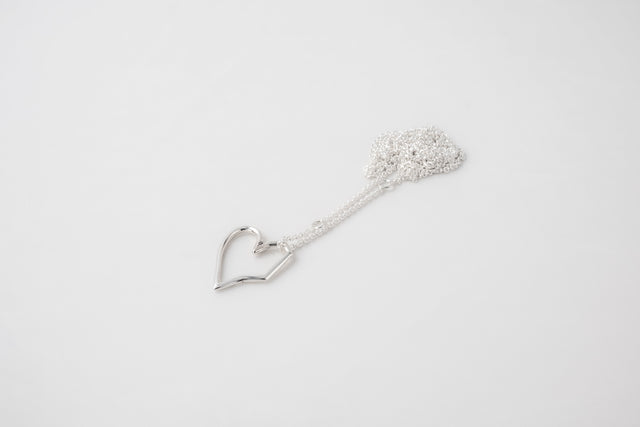
Silver vs Gold — Why 925 Sterling Silver Is the New Gold for Modern Jewelry
Twenty years ago the metal in a piece of jewelry was not a choice but a rank: gold if you had money, silver if you did not. That ranking held because jewelry was bought rarely and worn on occasion. Today jewelry is worn daily and several pieces at once, metals and stones and textures mixed — and the old ranking no longer explains what is happening. Below are six traits on which the two metals genuinely diverge. Every number was taken on the day this page was updated: market figures from the quotes, weights and prices from the catalogue itself.
- Sterling silver is 92.5% silver and 7.5% copper — the alloy runs through the whole object, with no plating on top.
- On 28 August 2026 gold costs roughly 65 times more than silver per gram of pure metal, and roughly 53 times more when working alloys are compared — 18k gold against 925 silver.
- The metal for a 95 gram bracelet costs about $200 in silver and about $10,500 in 18k gold. Mass in gold is not expensive — it is unavailable.
- Gold is harder: 130–150 HV against 60–80 HV for annealed sterling. Silver takes marks faster, and on a dark surface those marks work for the piece rather than against it.
- Living Silver is 925 silver without rhodium plating. It darkens on its own, and the patina can be removed and allowed to return whenever the owner wants.
- Gold remains the right choice for heirloom wedding bands, large stone settings and traditional pieces.
Where does silver beat gold, and where does it lose?
For a piece worn daily and rarely taken off, 925 silver wins on three of six traits and loses on two. It wins on the price of mass, on freedom of form, and on how the surface behaves. It loses on hardness and on holding raw-material value. On skin compatibility the two metals are close, and what decides it is the alloy, not the karat.
Put plainly: if a piece must outlive generations and rest in a box, buy gold. If it must be large, worn every day, and change along with its owner, buy silver. Each of the six traits is worked through with numbers below.
| Trait | 925 silver | 18k gold |
|---|---|---|
| Price per gram of alloy | about $2.10 | about $110 |
| Vickers hardness | 60–80 HV | 130–150 HV |
| Workable object mass | up to 95 grams | usually single grams |
| Surface behaviour | darkens on its own, patina reversible | does not darken, black gold is a coating |
| Raw-material value retention | low | high |
| Repair and rework | simple and inexpensive | costlier in proportion to the metal |
How much more expensive is gold than silver, really?
On 28 August 2026 a gram of pure gold costs about $147 and a gram of pure silver about $2.25. That is roughly 65 to one, and the figure is alive: in recent years it has travelled to 90 and back down to 60. The numbers on this page are tied to a measurement date deliberately — a metal comparison without a date goes stale silently.
Jewelry, though, is not made from pure metal. Alloys do the work: 18k gold is 75% gold, sterling silver is 92.5% silver. Across alloys the gap narrows to about $110 per gram of gold alloy against roughly $2.10 per gram of silver alloy — about 53 to one.
What that means for an actual object
A 53-fold gap does not matter while a piece weighs two grams. It becomes decisive the moment the form demands mass. The heaviest object in the catalogue is a bracelet of 95.2 grams. Its raw metal costs about $200 in silver and about $10,500 in 18k gold — before a single minute of work.
| Object | Mass | Metal in 925 silver | Metal in 18k gold |
|---|---|---|---|
| Ring | 11.0 g | about $23 | about $1,210 |
| Chain | 50.5 g | about $105 | about $5,570 |
| Bracelet | 95.2 g | about $200 | about $10,500 |
Which is stronger — 925 silver or gold?
Gold is harder, and the difference is measurable. The specification of patent US 9844249 B2 states that regular karat gold alloys run 130–150 Vickers in the annealed condition, while traditional sterling silver runs 60–80. Heat treatment lifts sterling to 100–110 HV, and gold still stays ahead.
In practice this means one thing: a silver piece takes the marks of wear faster. It does not lose its shape — the 925 alloy is stiff enough that a ring will not collapse on a finger. What changes is the surface.
And this is where a loss in numbers turns into a gain in meaning. On polished gold every scratch reads as a flaw in a mirror. On dark silver the marks of wear settle into the relief: recesses go darker, raised edges polish bright through friction, and the contrast grows year on year. The same piece on two different people looks different after a year, because skin chemistry differs.
Why is heavy jewelry made in silver rather than gold?
Because price rises with mass in a straight line while the presence of an object rises in a jump. A sculptural form needs volume: a thin version of the same silhouette reads as jewelry, a thick one reads as an object. In gold, volume hits the price of the metal long before it reaches the intent.
What the catalogue shows
The STRUGA catalogue holds 130 active objects, 111 of them made in 925 silver. The masses actually in work:
- ring — up to 11.0 grams;
- necklace set with Seymchan meteorite — 80 grams;
- choker chain — up to 80 grams;
- bracelet — up to 95.2 grams.
In 18k gold a bracelet of that mass would mean over ten thousand dollars of raw metal, and the piece would simply not exist. The difference is not that a gold bracelet is expensive: nobody orders one, so nobody designs one.
This is the real reason architectural and brutalist brands of the last decade work mostly in silver. Not the buyer's budget — the physics of the intent: the aesthetic demands mass, and mass demands silver.
How does dark silver differ from black gold?
Silver darkens by itself — a reaction between metal and air, and it is reversible. Gold does not darken at all, so its blackness is applied from outside, in one of three ways:
- electroplating with black rhodium or ruthenium — wears off and has to be reapplied;
- alloying with cobalt and then oxidising it under heat — holds longer than plating;
- treating the surface with a femtosecond laser — alters the structure of the surface itself.
The distinction matters, and the brand does not blur it. Living Silver is 925 silver without rhodium plating — a property of the material: the piece arrives bright and darkens over time. Oxidising is a technique: the surface is darkened at once, during the work. In the catalogue that finish is carried by 17 objects out of 134; the rest of the silver takes its patina on its own.
Patina is neither a flaw nor a verdict. Silver cleaning fluid removes it; on a matte surface an abrasive does, taking off the thin top layer and setting a new texture. The owner decides whether to keep the map of wear or start it over.
What should you choose if your skin reacts to metal?
In the overwhelming majority of cases the reaction is to nickel, not to a precious metal. The 925 alloy contains no nickel by composition: only silver and copper. Nickel does appear in gold alloys — particularly in white gold, where it works as a whitener — and separately under gold plating, where the coating eventually wears through to the base.
The practical rule follows from that. The risk lies in the specific alloy and in the presence of plating, not in the karat. Solid metal with no coating is predictable: there is nothing to wear through. Copper in the 925 alloy very rarely triggers a reaction in unusually sensitive skin, and that is worth knowing before a purchase rather than after.
The simplest test is time: wear the piece for a day and look at the skin underneath. Redness following the outline of the metal exactly points to the alloy; a patch wider than the outline usually means moisture and friction rather than an allergy.
One note about the catalogue: objects in the CARBON and MOSAIC families are not silver alone — carbon, meteorite, copper, brass and steel are set into them. Each object states its own composition on its page.
When does gold still make sense?
Three cases leave nothing to argue about:
- An heirloom wedding band. It has to outlive generations, and hardness together with resistance to tarnish serve exactly that task.
- A large valuable stone. The metal has to step back and not compete with the setting, and gold does that better.
- A traditional piece. Gold is part of the meaning itself, and nothing else will do.
In all three the piece is bought once and kept, and the price of the metal is diluted by time. As soon as a piece becomes everyday and replaceable, that logic stops working.
The brand does work in 18k gold for selected commissions through its Bali workshop. But an everyday architectural piece is silver's task, and that is not a compromise on budget — it is a different way of thinking about jewelry: the metal serves the form, rather than the form bending to the price of the metal.
There is a flip side. A gold piece gets worn less: it is protected, taken off, saved for an occasion. Jewelry that sits in a box does no work. Silver never poses that question.
How do you build a silver collection from nothing?
Start with one anchor object — a piece with mass that the rest will gather around. Smaller pieces come next, and they no longer compete with the anchor but hold it in place.
An order that works
- The anchor. A large ring or a heavy chain. From the BRUTALISM family — the V-1 ring at 9.6 grams, Rp 6,809,000 (about $382).
- The second layer. A pendant or a necklace at a different length, so the pieces do not argue across the chest.
- The upper point. An ear cuff on the edge of the ear — no piercing needed. From the BLADE family — the carbon cuff at Rp 1,690,000 (about $95), the lower bound of the catalogue.
- The stack. Two or three lighter rings around the anchor.
The silver line runs from Rp 1,690,000 to Rp 66,036,000 — 111 objects. Made-to-order production takes about two weeks for silver, hand-finished in the Bali workshop.
The most common mistake is starting small. Three thin rings read as an accident; one large piece sets a rule the rest attaches to. A ring at Rp 6,809,000 beside a cuff at Rp 1,690,000 reads as a system — four unrelated pieces at the same total do not.
How do you care for 925 silver, and can the patina be removed?
Daily care comes down to a soft cloth. The rest is four rules:
- polishing cloths and ultrasonic baths strip the patina — not damage as such, but they take the dark surface with them;
- chlorine speeds up darkening and attacks the copper in the alloy, so a piece comes off before a pool or cleaning;
- perfume and creams go on before the jewelry, not after;
- storing pieces separately protects the surface: silver scratches silver.
Patina is reversible in both directions, and that is what separates silver from a coating. Bright silver returns with cleaning fluid; matte silver is restored with an abrasive. The darkening then comes back on its own — again, but differently, because the pattern of wear belongs to each owner.
The workshop cleans and makes minor repairs to its own objects free of charge for as long as the piece is with its owner; shipping to us is on the owner. The patina is removed only on request: on its own it counts as a property of the material, not a defect.
On sizing: one ring resize is free, with shipping both ways on the owner. Reworking a finished piece is always quicker than making one — one more practical advantage silver holds over gold.
In short
| Question | Short answer |
|---|---|
| Which costs more | Gold — about 53 times, by working alloys, on 28.08.2026 |
| Which is harder | Gold: 130–150 HV against 60–80 HV |
| Which darkens | Silver — on its own and reversibly; gold only under a coating |
| Which allows mass | Silver: a 95 gram bracelet is real, in gold it is not |
| Which to wear daily | 925 silver |
| Which to pass down | 18k gold |
Related Reading
Frequently asked questions
Didn’t find the answer — write to us, we reply personally.
Ask a question →01Silver or gold — which is better?+–
For an everyday architectural piece, 925 silver: it allows a mass that gold cannot pay for, and its surface works for the piece over time. For an heirloom band or a large stone, 18k gold: it is harder and does not tarnish. The right metal depends on the task, not on a ranking where gold automatically sits higher.
02How much more expensive is gold than silver?+–
On 28 August 2026, roughly 65 times by pure metal and roughly 53 times by working alloys — 18k gold against 925 silver. The ratio is alive: it has travelled between 60 and 90 in recent years, which is why the figure on this page is tied to a measurement date.
03Which is stronger, 925 silver or gold?+–
Gold. Karat gold alloys run 130–150 Vickers in the annealed condition, traditional sterling silver 60–80. Silver takes the marks of wear faster, but it holds its shape: a ring will not collapse on a finger.
04Will sterling silver tarnish?+–
Yes — it is a reaction between metal and air. The patina is reversible: silver cleaning fluid removes it, and on a matte surface an abrasive does — a scotch pad or sandpaper. Living Silver is 925 silver without rhodium plating, so darkening is a property of the material rather than a defect.
05How does oxidised silver differ from Living Silver?+–
Living Silver describes a property of the material: 925 silver without rhodium plating darkens over time on its own. Oxidising describes a technique: the surface is darkened at once, during the work. In the catalogue that finish is carried by 17 objects out of 130 — the rest of the silver takes its patina on its own.
06What should you choose if your skin reacts to metal?+–
The reaction is almost always to nickel rather than to a precious metal. The 925 alloy contains no nickel by composition: only silver and copper. Nickel appears in white gold, where it works as a whitener, and under gold plating, where the coating eventually wears through to the base. Copper in the 925 alloy very rarely triggers a reaction in unusually sensitive skin.
07What is the difference between sterling silver and silver-plated?+–
Sterling silver is an alloy that runs through the whole object. Silver plating is a thin layer of silver over another metal, and it wears off within months or years. The STRUGA silver line is solid alloy with no coating on top; silver-plated metal appears only as an inlay in the carbon objects of the CARBON and MOSAIC families.
08Is silver good for engagement rings?+–
It suits couples who want a ring built around their everyday aesthetic rather than around tradition. Silver engagement and wedding sets are gathered in the Dark Union collection and are made for daily wear. For an heirloom meant to outlive generations, gold remains the more conservative choice.
09Can silver and gold be worn together?+–
Yes. The cool tone of silver and the warm tone of gold create contrast when layered, and mixing metals stopped being a mistake a long time ago.