Carries a Trace
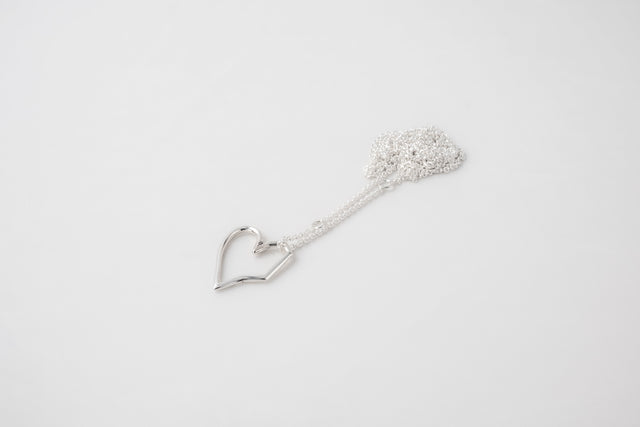
An amulet necklace in uncoated silver records how it was worn: the surface darkens in the recesses and brightens where it rubs against skin. The sulphide film starts from hydrogen sulphide already present in ordinary indoor air: the threshold is 86–600 parts per trillion. The pattern builds over months and comes out different on every wearer. That patina is surface physics, not a promise of protection.
- Meaning arrives through wear, not with the purchase
- The chain holds the form, it does not present it
- What the surface actually records
- Living Silver remembers the hand
- How long the pattern takes to build
- What brightens and what darkens
- Why two identical objects end up different
- Where the trace stops being a pattern
- What to choose
- Frequently asked questions
Meaning arrives through wear, not with the purchase
An amulet here promises nothing. It records.
An object becomes yours the moment you stop noticing it. After that the body takes over — collarbone, shirt collar, the habit of straightening the chain with the same hand. Six months in, the silver shows which hand that is.
STRUGA makes no claim of protection, healing or luck. There is nothing to claim.
The line between a symbol and an object runs here. A symbol works before wear: its meaning is assigned in advance and holds whether you put the piece on or leave it in the box. An object works through wear: while it lies there nothing happens, and a year later it carries a history it did not have at purchase.
We make the second kind.
The chain holds the form, it does not present it
On a short chain the pendant settles into the hollow above the collarbone and barely moves. On a long one it drops under fabric, swings with each step, wears against the shirt faster.
Same object. Two different things.
Chain lengths are standardised at 450, 500, 550, 600 and 650 mm (OST 117-3-002-95). The step from 450 to 500 is the step from «sits in the hollow above the collarbone» to «drops under the collar». Other lengths are made to order.
| Length | Where the pendant sits | Where friction happens |
|---|---|---|
| 450 mm | hollow above the collarbone, almost no travel | reverse of the pendant against skin |
| 500 mm | at the neckline, short travel with each step | pendant edge and the links at the nape |
| 550–650 mm | under the collar, free travel | pendant ridge against shirt fabric |
That is why chain and stone are chosen together in the AMULET family, not one after the other. A raw tourmaline pulls on a link differently than cast silver does.
What the surface actually records
The trace is not dirt and not paint. A sulphide film grows on uncoated silver, and the whole visible pattern is its thickness, uneven across the object.
Colour reads straight off that thickness. As the film grows from 10 to 100 nanometres the surface passes through yellow, red-brown and blue; past a hundred nanometres it stays black — the true colour of silver sulphide (Sheffield Assay Office). Interference does the work: part of the light reflects off the top of the film, part off the metal beneath it, and the two waves cancel each other more as the layer the beam crosses gets thicker.
- 10–100 nanometres — yellow, red-brown, blue; the stage where the surface still plays with tone.
- past 100 nanometres — black, the true colour of the sulphide; colour stops changing, only the contrast between zones does.
The threshold it all starts from is low. Sterling darkens at hydrogen sulphide concentrations of 86–600 parts per trillion — ordinary room air rather than a corrosive environment (Heritage Science, 2015).
Hence the straw, bronze and violet of the first weeks — and the graphite everything settles into later. One surface at different stages, not four different coatings.
Living Silver remembers the hand
Uncoated 925 reacts to air: a thin film of silver sulphide forms on the surface — the darkening that moves through straw, bronze and violet before settling into graphite.
Friction takes that film off. Raised edges, the ridge of a stone, the points that meet skin — these brighten. Recesses and the reverse side darken and hold the shadow.
The metal itself is soft: sterling measures 77 HV annealed and up to 170 HV after cold work (GOST 30649-99). Raised edges lighten before recesses do, because there the metal meets cloth and skin first.
The pattern writes itself. It cannot be repeated, even across two identical objects, because two different people wear them.
All of it is reversible: cleaning strips the patina back to bright, re-oxidising returns the contrast. The Living Silver guide has the detail.
How long the pattern takes to build
There is no fixed term. There are three conditions that move it.
- Humidity. At the same hydrogen sulphide concentration silver darkens faster as relative humidity climbs; below 50 % is taken as the norm for storage (Sheffield Assay Office). Humid coastal air and a dry flat in winter are two different speeds on the same object.
- Sweat. In a chloride environment — and sweat is exactly that — silver oxidises predominantly to the chloride (Frontiers in Chemistry, 2023). On someone who trains in the piece and keeps it on through summer, the pattern arrives earlier and lands differently than on someone who wears it with a shirt.
- Frequency. Worn daily, a piece brightens on the raised edges and darkens in the recesses within months. Left in the box it darkens too — but evenly, with no pattern: no friction, and so none of the difference a pattern is made of.
What brightens and what darkens
Two processes run at once: the film grows everywhere, friction removes it selectively.
- Contact points brighten — raised edges, the ridge of a stone, the face the piece rests on skin with, the inner side of a link where it bends. There the metal meets cloth and skin first, and the film never gains thickness.
- Sheltered places darken — recesses in the relief, the reverse of the pendant, the seam between setting and stone, the clasp links lying under hair. Friction does not reach them, and the film grows unchecked.
The difference between those zones is the contrast oxidising is done for. On a new piece the workshop sets it. A year later you set it — by fit, by movement, by how often the piece is on you.
Why two identical objects end up different
Even inside one family pieces behave differently, and the first reason is mass.
Thorn Amulet Necklace #1 weighs 12 grams, Thorn Amulet #2 weighs 9. Three grams change how the pendant hangs, how far it swings with a step and how hard it presses into fabric. Earrings in the same family run from 2.3 to 7 grams: a light stud barely moves in the lobe, a heavy earring works as a pendulum.
The second reason is the stone. Wild-growth tourmaline, aquamarine and quartz differ in cut and weight, pull on the link their own way and meet the skin their own way.
The third is the person. Height, the set of the collarbone, the type of collar, the hand you straighten the chain with. Another wearer's pattern cannot be repeated even on a copy of the object: the object copies, the body does not.
Where the trace stops being a pattern
The film is reversible, lost material is not. That is the one border worth holding in mind; the rest is taste.
- Reversible — darkening of any depth, an even dark tone, contrast gone flat. Cleaning strips the film back to bright metal, re-oxidising returns the pattern. After that the object starts collecting its trace again.
- Not reversible — a deep scratch, a crushed link, a chipped stone, an edge worn down. That is form rather than surface: it is settled in the workshop, not with a cloth.
The practical part is simple: dark silver is nothing to worry about, deformation is worth writing to us about. How to clean and when not to — in the Living Silver guide.
What to choose
A raw-stone amulet — when singularity matters: this cut, this fracture, this shade. There is no second one.
A cross — when you want a sharp form without a religious statement. STRUGA crosses are built from carbon with steel or silver set into it, and that changes the account: carbon neither darkens nor wears, so the trace runs only across the silver parts while the form stays as it was made.
| Object | When it is chosen | How the trace lands |
|---|---|---|
| Thorn Amulet, 9–12 g | volume and a form that is seen | deep relief gives contrast quickly |
| Classic Amulet with a stone | a restrained form | the trace is more even, gathering at the setting |
| Cross pendant, carbon | a sharp form, not a statement | carbon stays put, only the silver parts work |
Everything is made to order. Chain length, size and production time are on the object page or through Custom Order.
Frequently asked questions
Didn’t find the answer — write to us, we reply personally.
Ask a question →01Does STRUGA claim a pendant protects or heals?+–
No. We speak about form, material and how the object is made. What it means to you is yours, and we stay out of it.
02Why does the chain matter?+–
It sets the fit. Length decides whether the pendant rests in the hollow above the collarbone or drops under fabric — and that decides both the look and where the silver wears first.
03Will the silver keep changing?+–
Yes, and that is normal. Speed depends on your skin, humidity and how often you wear it. Cleaning brings the silver back to bright, oxidising brings the contrast back. The process runs both ways.
04How soon does the trace become visible?+–
A shift in tone shows within weeks, a readable pattern builds over months. Faster with daily wear and in humid air; slower in a dry room and with occasional wear.
05Can the process be sped up or stopped?+–
Wearing speeds it up. Stopping it is not possible, but rolling it back is: cleaning returns bright metal, and dry closed storage slows the film markedly.
06Do sweat and the gym ruin the piece?+–
They do not ruin it, they change the course: in a chloride environment the surface reacts differently and faster. The silver is not destroyed — the pattern simply arrives earlier.