Unique Men's Wedding Bands 2026 — Dark Silver Guide
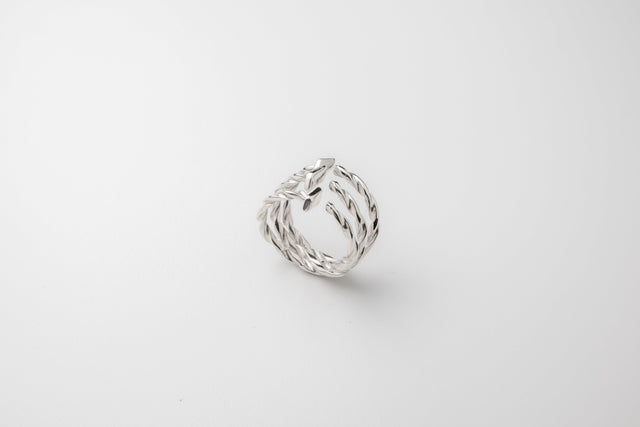
A silver wedding band can suit daily wear when you welcome a changing surface and are prepared to care for it. STRUGA rings are unisex: choosing for a man’s hand means finding the right size, weight and silhouette. Fit, construction and access to repair matter as much as colour. STRUGA’s Signature Links V.1 weighs 2.7–6 g, while Brutalism V.3 runs from 9.6 to 24 g. Both are sterling silver, with very different presence on the hand. This guide covers everyday fit, the difference between patina and coatings, and the details to confirm before ordering a pair.
Updated September 28, 2026
Sterling silver: fit and construction matter beyond colour. Six models span 2.1–24 g depending on size. Living Silver and workshop blackening call for different care. Confirm the price, finish and schedule for the particular ring.
Are silver wedding bands practical for daily wear?
They can be, when the ring suits your habits. Silver picks up scratches, its surface darkens, and contact gradually changes the contrast across the relief. For Living Silver, these changes belong to wearing the piece. If you want precisely the same shine and colour for years, this finish may ask for more attention than you expect. If you like an object recording its use, that change can be a reason to choose silver.
Begin with three questions: can you close your hand comfortably, will you remove the ring before work that puts load on your hands, and who can service this particular design? Width, the height of the relief and the inside profile all affect fit. Weight alone does not decide comfort: a light projecting edge can be more noticeable than a heavier smooth band.
A wedding pair does not have to be identical. Choose one form in two sizes, or two pieces that work for each of you. Assess the pair together with its fit: how the rings sit beside one another and how each sits on its own hand. Trying them on is more useful than a universal promise of everyday comfort.
Which weight and size should you choose?
STRUGA product options use inner diameter in millimetres. Check the ring sizing guide; a number from another country’s system cannot be carried across without conversion. The checked variants of six models have these ranges:
| Ring | Size, mm | Weight, g |
|---|---|---|
| Signature Links V.1 | 16–22 | 2.7–6 |
| Signature Links V.2 | 16–22 | 2.1–5.5 |
| Double Line | 16–22 | 6–13 |
| Thorn Ring | 16–22 | 4.7–12.7 |
| Brutalism V.1 | 15–22 | 9.6–24 |
| Brutalism V.3 | 15–22 | 9.6–24 |
These are catalogue ranges checked on September 13, 2026, rather than six fixed weights. Signature Links V.1 weighs 2.7 g in size 16 and 6 g in size 22. Brutalism V.3 runs from 9.6 g at size 15 to 24 g at size 22. Review the selected variant before ordering; weight for an individual design is confirmed separately.
For a first ring, compare a light and a substantial model on the hand. Notice contact with adjacent fingers, the relief above the band and the ordinary movement of a closed hand. Measure the particular finger that will wear it. A partner’s size, gender or a rough impression of hand size cannot replace that measurement.
Why does silver darken, and what does 925 mean?
The 925 mark denotes silver content: 92.5%. The remainder is alloying metal; copper is common in sterling silver. The number alone does not identify the complete alloy. GIA explains the mark in terms of purity. It does not stand for the weight of an English pound.
Tarnish forms at the surface. The Canadian Conservation Institute describes silver reacting with sulfur compounds to form a sulfide layer. The whole volume of the alloy does not turn black. The rate depends on the environment, so there is no single darkening calendar for every wearer.
Living Silver is STRUGA’s name for sterling silver without rhodium plating. It can begin as light metal. Blackening applied at the workshop is a separate finish that provides a dark surface on arrival. In both cases, contact and care affect the later appearance. Check the finish named in the product description instead of relying on a dark photograph.
Silver, PVD and black zirconium: what should you compare?
Compare the base material, the process that gives it colour and the maker’s service. PVD covers a family of thin-film deposition methods. Oerlikon Balzers uses these coatings for decorative jewellery surfaces. The process name alone does not give every ring the same thickness or wear life.
| Surface | Source of colour | Ask about |
|---|---|---|
| Living Silver | Patina develops on silver without rhodium | Keeping or lightening the finish |
| Blackened silver | Surface treated at the workshop | Restoring the dark finish |
| PVD | An applied thin coating | Composition, warranty, re-coating |
| Black zirconium | An oxide layer produced by heating | Care, scratches, service options |
Lashbrook describes heating zirconium so that a black oxide grows on its surface. The maker recommends removing its rings during harsh activities to avoid scratches. That describes its process and products; it cannot be applied to every black ring.
Restoration options vary too. For example, Titanium Rings includes re-coating black finishes and resizing within limits in its service. A blanket claim that coatings cannot be repaired is therefore wrong. Ask for the service terms of the chosen model and whether work keeps the original ring or replaces it.
Which STRUGA form suits your pair?
Signature Asymmetric is the brand’s first form. Its rings offer several versions of linked geometry. Signature Links V.1 holds a flatter line; V.2 has more pronounced facets and offset links. For everyday wear, compare how the construction moves and how high it sits above the finger. A shared family name does not make all its models feel the same.
Double Line develops the linked pattern into a wider composition. Its 6–13 g range helps compare it with the two Signature Links models, but a fitting remains necessary. A pair can share the origin of its form while differing in visual density: one person wears the finer line, the other the double arrangement.
Brutalism V.1 and V.3 are parallel versions of architectural relief. V.1 has light matte Living Silver; V.3 is darkened at the workshop. Both have sizes 15–22 mm. They offer a way to compare pronounced volume, although their weight of up to 24 g and projecting relief should be assessed on your own hand. See the wider selection in the Brutalism collection.
Carbon brings a different material and ordering process. Pieces using it are made individually, with the palette agreed for the order. For the Carbon family, repair advice for a solid silver ring cannot simply be transferred to a composite and its joints. Discuss the construction first, then size, finish and care.
Thorn Ring and an individual Dark Union commission
Dark Union has two routes. The family is the ready-to-buy line of objects of union, beginning with the Thorn Ring. The world of Dark Union covers individual wedding, paired and commitment rings. Choosing an existing model and creating a new form involve different decisions.
The checked Thorn Ring description specifies sterling silver, no stone and a Living Silver finish. Its faceted asymmetric form connects THORN and BRUTALISM; the selected variants weigh 4.7–12.7 g. Membership of Dark Union does not by itself prove that every piece is blackened in advance. Confirm the dark tone you want and the availability of the required size before ordering.
For an individual pair, open Dark Union and describe both rings: form, material, sizes, budget and the date you need them. Discuss materials and the details of the construction with the team. A person at STRUGA confirms feasibility and prepares an individual proposal. A reference photograph does not establish that the same insert is available now.
Price, engraving and lead times
Check the current price after choosing a size on your storefront. An old article’s range may no longer match the available variants. For a pair, compare the price of each selected size; an individual commission is quoted after the brief. A direct product link is more useful here than converting an overseas price at an arbitrary exchange rate.
Made-to-order production time depends on the model, the stone and the material. Carbon, individual commissions and Dark Union receive a schedule once the construction has been discussed. Shipping adds its own time. A finished piece in stock can be dispatched immediately; the team confirms the actual schedule and arrival date.
Discuss engraving before production: the wording, position and whether the chosen construction can accommodate it. A narrow, open or linked band has a different available area from a smooth wide ring. For a ceremony, give the date at the outset and agree both sizes before work starts. The STRUGA team can confirm availability, fit and cost.
How can you preserve the finish and access to repair?
Choose care for the actual piece. Begin with a soft dry cloth after wear and the instructions in its description. To retain dark recesses, avoid polishing the entire surface. A product that removes patina will also change deliberate blackening. For a ring with inserts or joints, confirm an appropriate cleaning method first.
CCI notes that removing tarnish also removes some silver. The practical principle is to clean according to condition and the finish you want. A fixed promise of five minutes a year cannot account for different finishes and wearing conditions.
STRUGA offers free cleaning and minor repairs while the piece remains with its owner; the owner pays shipping to the workshop. Patina is removed on request. A ring includes one free size adjustment, with shipping both ways paid by the owner. A particular adjustment must be confirmed after the construction is assessed: sterling silver does not make every relief, insert or joint equally serviceable.
If the ring has deformed, been damaged or developed a problem around an insert, send photographs to the team first. Such cases call for a repair assessment. For a broader material comparison, read the silver and gold wedding ring guide; for forms and combinations, see the dark wedding rings guide.
Frequently asked questions
Didn’t find the answer — write to us, we reply personally.
Ask a question →01Can I wear a silver wedding ring every day?+−
Yes, when its fit, form and changing surface suit you. Allow for scratches, patina and care. Remove it before work that puts load on your hands, and confirm repair options for the particular model.
02Are all dark STRUGA rings blackened in advance?+−
No. The checked Brutalism V.3 description specifies workshop blackening; Brutalism V.1 and Thorn Ring specify Living Silver. Confirm the tone you want before ordering.
03What does the 925 mark mean?+−
It denotes 92.5% silver in the alloy. The remainder is alloying metal, commonly copper. The number alone does not disclose the complete composition.
04How much do the rings in this guide weigh?+−
Signature Links V.1: 2.7–6 g; V.2: 2.1–5.5 g; Double Line: 6–13 g; Thorn Ring: 4.7–12.7 g; Brutalism V.1 and V.3: 9.6–24 g. These variant ranges were checked on September 13, 2026. See the product option for your size.
05Can a black coating or patina be restored?+−
It depends on the colour process and the manufacturer’s service. Some makers restore black coatings. For STRUGA, agree the desired finish with the workshop; a tarnish remover can also remove deliberate blackening.
06Should we choose Thorn Ring or an individual pair?+−
Thorn Ring is an existing model in the Dark Union line. An individual Dark Union brief suits your own form, combination of materials or paired design. Inserts and the feasibility of the construction are confirmed before production.
07Where can I find the price and lead time?+−
Select a size on your storefront. Production time depends on the model, stone and material, and for an individual Dark Union order on the construction; shipping adds its own time. The team confirms the actual schedule.
08Can the size be changed later?+−
STRUGA includes one free ring size adjustment; the owner pays shipping both ways. The workshop confirms the required change after assessing the particular construction. Do not stretch a complex or open band yourself.