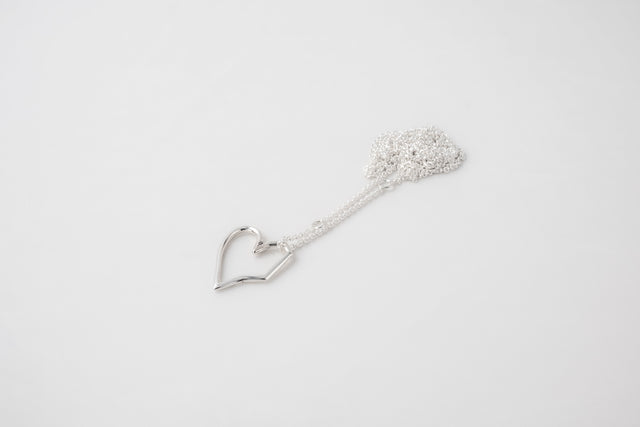
First Object
The way into the catalogue runs through behaviour, not through price or stock: to feel weight, to move as a module, to sit at the neck, or to collect the trace of wear. Behind those four behaviours stand 134 objects, and mass across them runs from 0.3 to 130 g — a spread of 434 times. Even the finished weight is live: the standard allows a deviation of up to 15 % from calculated mass.
In short. A first piece is chosen by how the object behaves, not by a catalogue section: compact structure, mass, a trace close to the body — and a commissioned object, when none of the three routes fits.
The compact route is the CODEX world — 51 objects, no stones and no inserts — and the BLADE family inside it: 20 objects, 0.3 to 110 g. The route of mass is the BRUTALISM family: 7 objects, 2 rings and 5 ear cuffs, 1.6 to 24 g. The route of trace is the RITUAL world, 69 objects, and the AMULET family inside it: 42 objects, 2.25 to 40 g.
Lead time follows the material, not the route. Silver takes about 2 weeks, silver with a stone about 3, carbon about 4 — and carbon always goes as a commission. Add roughly 7 days in transit. AMULET pieces are the exception: they already exist as one-of-one objects, so there is no production time at all.
A ring size on the millimetre scale is the inner diameter in millimetres, 15.0 to 22.5 in 0.5 steps; the international scale counts circumference instead, and size 51 corresponds to 16.23 mm. One ring, two different numbers.
- Start with how the object behaves
- If you want compact structure
- If you want weight
- If you want a trace close to the body
- What is made to order and what already exists
- If none of this fits
- First object — at a glance
- Frequently asked questions
Start with how the object behaves
A first piece does not have to represent the whole brand. It has to suit you.
Ask not "what should I buy" but "what do I want to feel on my hand a year from now". The answers usually come down to four: mass, movement, closeness, memory of wear. After that the map is simple — each answer has its route, and there are exactly as many routes as answers.
Catalogue sections answer a different question — what kind of thing it is: a ring, an ear cuff, a necklace, a bracelet. They are useful once the decision is already made. For a first object they help little: someone who has never worn silver does not know whether a ring or an ear cuff is what they want. What they do know is whether they want to feel the thing on them or forget about it.
There is no in-stock ranking here, and that follows from how the work is done: almost everything is made to order, and the catalogue is a list of forms rather than a list of remainders. Made to order has a direct consequence for weight. The industry standard allows non-weighted pieces to differ from calculated mass by up to ±15 % (OST 117-3-002-95): the finished weight is real, not catalogue, and two identical rings from neighbouring casts legitimately weigh differently.
If the piece is chosen for someone else rather than for yourself, the entry point changes — another person's size, another person's habits, and the question of exchange. That has its own article: choosing silver as a gift. This page is about choosing for yourself.
If you want compact structure
Double Line Ring and Blade Ear Cuff (S) are the short entry into the CODEX world. One works through repeated links, the other through a single flat line.
The difference in mass between them shows the range of the route better than any description. The ring runs in seven sizes, 16 through 22, and weighs 6 to 13 g: weight grows with size because the volume of metal grows. The ear cuff weighs 0.5 g. One language of form at its two extremes — a difference of 26 times.
The BLADE family, where the ear cuff belongs, holds that whole stretch: 20 objects from 0.3 to 110 g. BLADE is the second form of the brand, a CNC aesthetic in silver: a link with even planes, as if cut from sheet material. The CODEX world that contains BLADE holds 51 objects — 12 bracelets, 11 ear cuffs, 10 earrings, 7 rings, 6 necklaces, 4 chains and one choker. There are no stones and no inserts here at all: the structure holds the form by itself.
Neither piece needs breaking in. You can wear them on day one and forget they are there — which is the test of the compact route: if after a week you stop noticing the object, the route was chosen correctly.
A ring size on the millimetre scale is the inner diameter in millimetres — the series runs 15.0 to 22.5 in 0.5 mm steps, so "17" means 17.0–17.5 (OST 117-3-002-95). The international scale measures inner circumference instead: size 51 corresponds to a 16.23 mm mandrel (ISO 8653:2016). One ring, two different numbers — check which system a size refers to. How to take the measurement at home is covered separately: how to measure your ring size.
If you want weight
BRUTALISM rings register in the hand immediately. This is not an object you stop noticing: it reminds you with every movement.
The family is small and deliberately narrow: 7 objects, of them 2 rings and 5 ear cuffs, from 1.6 to 24 g. The upper bound holds the heaviest and most massive rings in the brand; the lower one shows that even the route of mass has a smaller way in. For comparison, the BLADE minimum is 0.3 g — 80 times lighter than the top of BRUTALISM. These are two different answers to one question about form, not "expensive and cheap".
BRUTALISM is the fourth form of the brand, architecture in silver: an exploration of Soviet brutalist aesthetics under the influence of Suprematism. The family is young — today it is rings and ear cuffs, and the range will grow.
That either suits you or it does not. There is no middle: a piece of twenty-odd grams either becomes part of the day or comes off in the second week and never goes back on. You can test this in advance, crudely but honestly — take any ring of similar volume and wear it a week straight, sleep and manual work included.
Read the form guide: it sets out how mass differs from plane, void and repetition as ways of holding a form. Then move to the family page with the specifications.
If you want a trace close to the body
The third route moves attention from the hand to the neck: the object travels across fabric, meets skin, and wears where it touches. This is the most personal of the routes — the piece changes according to how it is worn.
It has two different entrances, and they should not be confused. The AMULET family is earrings and necklaces built around raw, wild-growth stones — 42 objects: 36 earrings and 6 necklaces, from 2.25 to 40 g. The stone sets the form, so every amulet within a model is one-of-one. Cross V.4 Bloody is the other entrance: a 17 g necklace whose cross body is cut from carbon, with silver entering as the carabiner bail.
Both live in the RITUAL world — 69 objects: 37 earrings, 24 necklaces, 5 ear cuffs and 3 bracelets. RITUAL gathers objects with personal symbolic weight, and symbolic weight here means what the object means to its owner, not a promise of effect. STRUGA attributes no properties beyond the physical ones — not to a stone, not to meteorite, not to a cross.
The Carries a Trace page explains the physics of it: where the surface actually wears, why uncoated silver darkens in the recesses and brightens on the ridges, and how such a trace differs from damage.
What is made to order and what already exists
"Everything is made to order" holds for most of the catalogue but not for all of it, and the difference shows immediately in the lead time.
Plain silver takes about two weeks. Silver with a stone, about three. Carbon, about four — and carbon always runs as a commission: the material is demanding and its palette is chosen for the person. Transit adds roughly seven days to any of these.
AMULET pieces work differently: they already exist. They are one-of-one objects with no production time at all, and what is sold is not repeated — there will be no second piece, because there will be no second stone. Of the three routes, only this one runs on "there is or there isn't".
The consequence for a first object is plain. Choosing against a date — a birthday, a trip, an anniversary — count the material's lead time plus transit, and leave a margin. Choosing an amulet, there is nothing to wait for, but there is also not much time to think.
If none of this fits
Custom Order is not a way around the design system — it is the system continuing. It exists for when size, scale or combination cannot be resolved inside the current families: a hand outside the 15.0–22.5 mm series, a width that none of the 134 objects carries, or a form assembled from two different languages of the brand.
The route is longer than the catalogue one: a general guide of 3–6 weeks once the direction is agreed, plus transit. That is a frame, not a promised date. Parameters, material and timing are confirmed before payment.
Before asking, read the About page and the Living Silver guide: the first explains where the forms come from, the second why the silver here is left without rhodium plating and what happens to it over the first year. A conversation about a commissioned object starts from a shared language, otherwise it turns into scrolling through pictures.
First object — at a glance
| Property | Value |
|---|---|
| What decides the choice | How the object behaves — compactness, mass, trace at the body — not a catalogue section and not stock |
| How many routes | Three catalogue routes plus a commission, when none of the three fits |
| Compact structure | CODEX world, 51 objects with no stones or inserts. BLADE family — 20 objects, 0.3 to 110 g |
| Two extremes of the route | Double Line Ring — 7 sizes, 16 through 22, 6 to 13 g. Blade Ear Cuff (S) — 0.5 g. A difference of 26 times |
| Mass | BRUTALISM family — 7 objects: 2 rings and 5 ear cuffs, 1.6 to 24 g. The heaviest rings in the brand |
| Trace at the body | RITUAL world, 69 objects. AMULET family — 42 objects, 36 earrings and 6 necklaces, 2.25 to 40 g |
| Carbon | A separate entrance: Cross V.4 Bloody — a 17 g necklace, carbon body, silver carabiner bail |
| Lead time | Silver about 2 weeks, silver with a stone about 3, carbon about 4. Plus roughly 7 days in transit |
| What is not waited for | AMULET pieces — one-of-one objects: no lead time, and what is sold is not repeated |
| Weight tolerance | Up to ±15 % from calculated mass for non-weighted pieces (OST 117-3-002-95) — the finished weight is live |
| Ring size | Inner diameter 15.0–22.5 mm in 0.5 steps. ISO 8653:2016 counts circumference: size 51 = 16.23 mm |
| Commission | Custom Order — a guide of 3–6 weeks once the direction is agreed; parameters confirmed before payment |
Frequently asked questions
If the answer is not here, write to us — we reply personally.
Ask a question →01Is this a list of what is in stock?+–
No. Most of the catalogue is made to order, and the map is built by form and by how a piece is worn, not by remainders. There is one exception: AMULET pieces are one-of-one objects, and what is sold is not repeated.
02Which world should I start with?+–
CODEX if you are drawn to mass and modular geometry: 51 objects with no stones or inserts, where the structure holds the form by itself. RITUAL if a pendant, a raw stone and the trace of wear are closer: 69 objects, 24 of them necklaces.
03How long does a first object take?+–
The material sets the time, not the route: plain silver about two weeks, silver with a stone about three, carbon about four and always as a commission. Transit adds roughly seven days to any of these. AMULET pieces need no waiting — they already exist.
04Why does the finished weight differ from the catalogue figure?+–
Because the piece is cast, not stamped. The industry standard OST 117-3-002-95 allows non-weighted pieces to differ from calculated mass by up to fifteen per cent. A spread within those limits is normal making.
05Can a first object be commissioned?+–
Yes, when size, scale or combination cannot be resolved inside an existing family. The general guide is 3–6 weeks once the direction is agreed; parameters and timing are confirmed before payment.