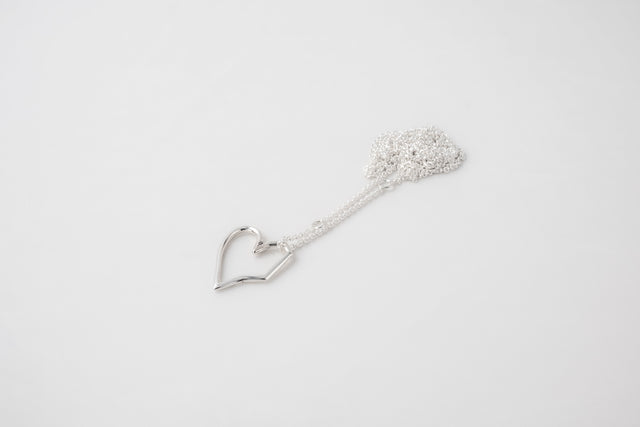
Art & Conceptual Jewelry as Object
Art jewelry is a piece that is first an object and a statement, and only then wearable. Designer or author jewelry is made by a named author with a point of view — not by an anonymous factory. The STRUGA art line holds 36 live objects across three families, from 2 to 130 grams.
The STRUGA art line lives in three families: EXPERIMENTAL — 13 pieces of jewelry plus 4 oversize silk costumes, MOSAIC — 20 objects, of which 18 are on the shelf today, and FUSED — 3.
EXPERIMENTAL and FUSED belong to the LAB world; MOSAIC belongs to the RITUAL world.
All 13 EXPERIMENTAL pieces are uncoated 925 silver — Living Silver, which darkens on the hand by itself.
MOSAIC is built the other way round: 8 of its 20 objects are carbon with no silver at all, 9 join carbon with silver, 3 are silver alone — so Living Silver is not a line-wide promise here.
One MOSAIC object, Signature Cross V.3, was darkened in advance on the bench: that is oxidation, a technique rather than a property.
FUSED is melted silver with no clear edges or angles; EXPERIMENTAL turns familiar objects (Triple Drills, Mushroom, Pills, BearRabbit) into jewelry.
Seymchan meteorite belongs to the MOSAIC material vocabulary, but both objects that carry it are in the archive today, so a meteorite piece goes through Custom Order rather than off the shelf.
A form outside stock or a personal one-off is made through Custom Order.
- What art and designer jewelry is
- Why form comes before function
- Which STRUGA forms belong here
- How to choose an art object
- Which objects the art line holds
- In short
- FAQ
What art and designer jewelry is
The line is thin, and worth drawing. Designer jewelry has a named author — a person or a brand with a point of view, not an anonymous factory; the emphasis falls on form and signature. Author jewelry is the same authored hand, read through the maker. Art jewelry — also called conceptual — goes further: here the piece is first an object and a statement, and only then worn.
| Term | What it names | Where the weight falls |
|---|---|---|
| Designer jewelry | a named author or brand with a point of view | form and signature |
| Author jewelry | the same authored hand, read through the maker | the hand and the brand behind it |
| Art, conceptual jewelry | a piece that is first an object and a statement | the idea; wearability follows it |
| Sculptural, wearable art | the same object read through three-dimensional form | volume, edge, negative space |
STRUGA is an author brand: craft by its own book of mastery, form before occasion. The art line lives in three families — EXPERIMENTAL, MOSAIC and FUSED. Not a separate "art" shelf, but the places where form stops serving function and starts to speak.
Why form comes before function
In ordinary jewelry the form serves a task: a ring sits on the finger, an earring holds in the ear. In an art object the order reverses — form and idea come first, wearability follows them. At STRUGA this is the EXPERIMENTAL family: a zone of pure creativity, where the familiar things around us are reimagined past recognition. This is how Triple Drills, Mushroom, Pills and BearRabbit appeared — an object that became jewelry, not the other way round.
Here STRUGA also steps beyond jewelry — into clothing and object design. It is a lab, not a catalogue: the form is allowed to be a prototype and argue with itself. So "conceptual" here is not a marketing word but a way of working.
Sculptural form and wearable art
The same objects answer to a second pair of names. Sculptural jewelry describes a piece read through three-dimensional form — volume, edge and the space left empty — rather than through a stone. Wearable art says the same thing from the other side: the object is art first and clothing second.
At STRUGA the difference is measured in grams. The art line runs from 2 grams — the One Display Techno bracelet in carbon — to 130 grams at the heaviest link of the Carabiner #2 Big Cross bracelet. Between those two numbers sit a 3-gram ring and a 60-gram bracelet of silver beads, and the weight decides how the object behaves on the body long before the form does.
Molten surfaces belong to this register too: FUSED has no straight edge anywhere, and a melted band reads as sculpture rather than as a setting for something else.
Which STRUGA forms belong here
Several STRUGA families answer the "art, designer, conceptual jewelry" search — each with its own node and live collection:
- Pure form: EXPERIMENTAL — the zone where a familiar object becomes a piece (Triple Drills, Mushroom, Pills, BearRabbit). Live collection — EXPERIMENTAL (17).
- Combined materials: MOSAIC — carbon, silver, meteorite, copper, brass and steel set into a single plane; a composition of materials. Live collection — MOSAIC (20).
- Molten metal: FUSED — a surface with no clear edges or angles, melted; sometimes all silver, sometimes spreading across another material. Live collection — FUSED (3).
EXPERIMENTAL and FUSED belong to the LAB world, the lab of form. MOSAIC belongs to the RITUAL world — an object with personal symbolic weight, but with no promise of effect. One thing runs through all three: the piece is first an object.
How to choose an art object
The choice goes by what pulls first. A reimagined form, a recognisable object turned into jewelry — that is EXPERIMENTAL. A seam of textures, carbon beside silver and meteorite — MOSAIC. A melted surface with not a single even edge — FUSED. It is a choice of statement, not a size chart.
The material comes before the form. In EXPERIMENTAL and in the silver half of MOSAIC it is uncoated 925 — Living Silver, which darkens on the hand by itself; in the other half of MOSAIC it is carbon, which stays exactly as it was bought. Size and fit are matched to the person. For a form outside stock or a single object of your own, STRUGA makes it through Custom Order.
Which objects the art line holds
Five objects carry the three families better than any description. Each is live in the catalogue, with its own weight taken from the shelf.
- Triple Drills Ring | STRUGA — 3.1 to 4.5 g depending on size, sizes 15–20, uncoated 925 silver. Three drill bits become a band: the shortest way to see what EXPERIMENTAL does to a familiar object.
- Signature Mushroom Necklace | STRUGA — 11 g of uncoated silver. A mushroom cast at the scale of a pendant, and the piece that gave the family its recognisable grammar.
- Fused Cross Ring | STRUGA — 3.7 to 9 g across sizes 16–21, silver alone. The whole of FUSED in one object: not a single straight edge, the surface left as the metal set.
- Signature Asymmetric Toxic | STRUGA — 5 g, carbon with no silver in it. The asymmetric silhouette that started the brand, here in the toxic palette — proof that MOSAIC is a composition of materials, not a silver line.
- Carabiner #2 Big Cross Bracelet | STRUGA — 95 to 130 g, carbon joined with silver. The heaviest object of the art line; weight here is the statement.
What the choice comes down to
Material decides first, weight second. Carbon stays exactly as it was bought — light, waterproof, unchanged; silver is alive and goes darker on the hand. A 5-gram pendant is forgotten by lunchtime, a 130-gram bracelet is felt all day. Size runs only matter for the two rings, 15–20 and 16–21.
In short
| Question | Answer from the live catalogue |
|---|---|
| Objects in the art line | 36 live, across three families |
| EXPERIMENTAL | 13 pieces of jewelry and 4 oversize silk costumes |
| MOSAIC | 20 objects, 18 of them on the shelf today |
| FUSED | 3 objects |
| Weight | 2 to 130 grams |
| Materials | uncoated 925 silver, carbon, meteorite, copper, brass, steel |
| Carbon without silver | 8 objects, all in MOSAIC |
| Darkened in advance | one object, Signature Cross V.3 |
| Meteorite | Seymchan, both objects archived; the route is Custom Order |
| Sizes | 15–20 and 16–21 on the rings |
Neighbouring sections of the Atlas read the same objects from other sides: EXPERIMENTAL, MOSAIC, FUSED, carbon, Living Silver and meteorite. The long answer about handmade silver and where these objects are made lives in the journal — Best Handmade Silver Jewelry in Bali. This section of the Atlas holds the definition and sends you on.
Frequently asked questions
Didn’t find the answer — write to us, we reply personally.
Ask a question →01How is author jewelry different from designer jewelry?+–
In substance, barely at all: both are made by a named author with a point of view, not an anonymous factory. "Designer" tends to stress form and signature, "author" the hand and the brand. STRUGA is an author brand — craft by its own book of mastery.
02What counts as art jewelry?+–
A piece that is first an object and a statement, and only then wearable. At STRUGA these are the EXPERIMENTAL, MOSAIC and FUSED families — where form matters more than function, not another variation on a ring.
03How is conceptual jewelry different from ordinary jewelry?+–
By order. In ordinary pieces form serves a task; in conceptual ones idea and form come first and wearability follows. STRUGA's EXPERIMENTAL is the zone where familiar things are reimagined past recognition.
04What does STRUGA make art objects from?+–
All 13 EXPERIMENTAL pieces are uncoated 925 silver — Living Silver. MOSAIC is a composition of materials: 8 of its 20 objects are carbon with no silver at all, 9 join carbon with silver, and 3 are silver alone. FUSED is melted silver with no clear edges. Stone and meteorite here are material and geology, with no promises.
05Can I order a single art object of my own?+–
Yes. A form outside stock, a special size, a personal one-off — that is Custom Order. Ready-made art forms live in the EXPERIMENTAL, MOSAIC and FUSED collections.