

This piece is sold. The stone is raw and no two repeat, so the exact piece cannot be remade. Press «Buy a similar one»: we make one close in look, size and finish, with its own pattern and tone. About two weeks.
One-of-one object — unique stone, unique character.
SPECIFICATIONS
| Article | N-0513 |
| Material | 925 Sterling Silver |
| Availability | Sold · one of one |
| Weight | 9.0 g |
| Finish | Living Silver |
| Technique | Wax model, 925 silver, hand finishing |
| Production | Handmade in Bali, Indonesia |
| World | RITUAL |
| Family | AMULET |
| Model | Thorn / E-0528 |
| Size Guide | How to choose chain length → |
| Shipping | Carrier rates, one exchange within 14 days |
| Care | Wipe with a soft cloth after wearing. Remove before water or chemicals |
THE STORY OF THIS PIECE
AMULET — STRUGA earrings and necklaces built around raw, wild-growth stones. The amulets of this family differ widely — from quiet and classic, a Japanese reading of minimalism, to large and declarative. The most expressive is the THORN amulet: a halved-torpedo form with a crystal grown inside; an homage to Daniel Arsham.
Read the AMULET form story→EXPLORE STRUGA
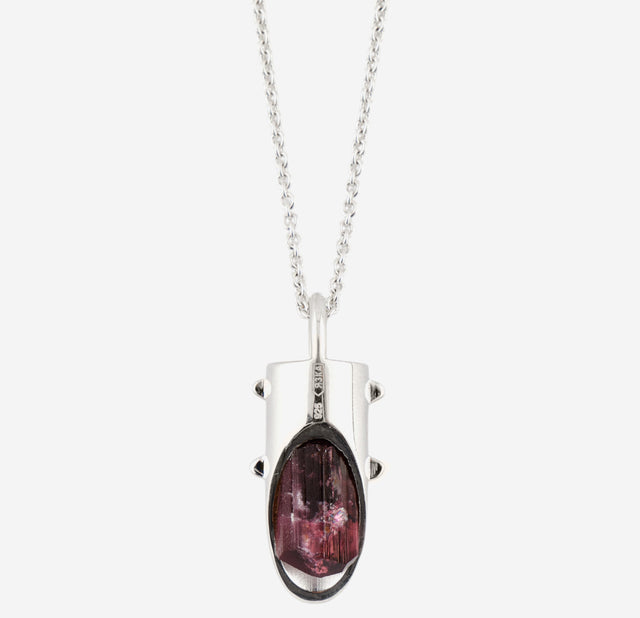
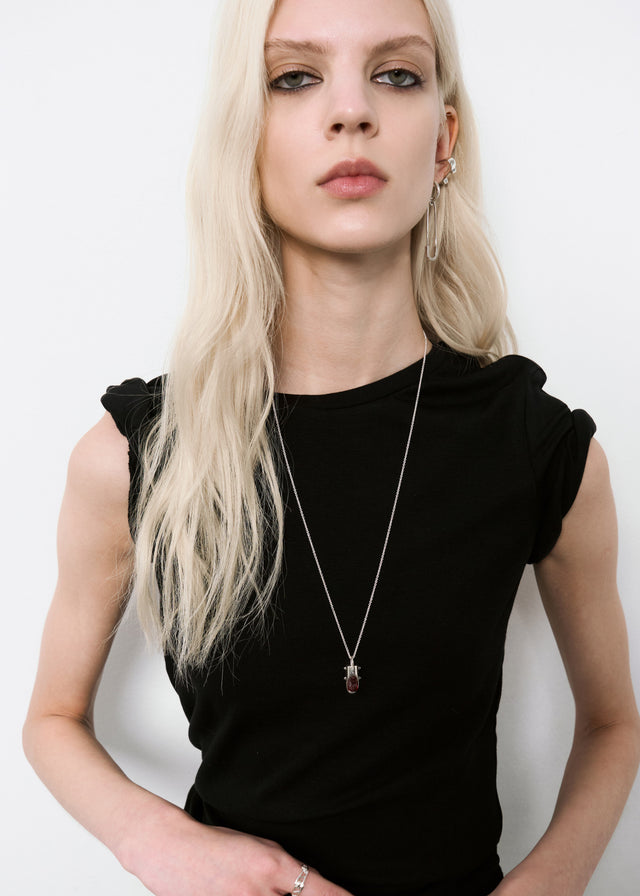
A 925 silver amulet necklace, 9 grams, unisex. The form is a torpedo split lengthwise with four thorns along its sides, and a raw pink stone is set into the opened face. On a 75 cm chain. Family AMULET, Thorn model — the RITUAL world.
Material: 925 sterling silver, no rhodium plating.
Family: AMULET — the RITUAL world, Thorn model (E-0528): the THORN form taken into volume.
Stone: raw, wild-growth, deep pink, held in the split face by four prongs. No two stones repeat.
Finish: Living Silver — the metal darkens on its own; patina is a property, not a defect.
Piece: one of one, N-0513. This one is sold, and it cannot be repeated exactly.
Care: soft cloth or silver-cleaning solution; avoid harsh chemicals and ultrasonic baths.
AMULET — STRUGA earrings and necklaces built around raw, wild-growth stones. The amulets of this family differ widely — from quiet and classic, a Japanese reading of minimalism, to large and declarative. The most expressive is the THORN amulet: a halved-torpedo form with a crystal grown inside; an homage to Daniel Arsham. The family holds 42 objects — 36 earrings and 6 necklaces — across two models: Classic (E-0530) and Thorn (E-0528). This is the second Thorn necklace, cast on its own: not a replica of the first, but a separate instance of the same form.
925 silver is 92.5% pure silver. The 9 g include the chain, so the object hangs low against the chest without pulling on the neck. The surface is Living Silver, uncoated. Silver darkens from air and skin: the recesses of the relief deepen, while friction lightens the raised edges. The four thorns on the body stay bright and the shadow gathers around the setting. Patina is a property, not a defect; care brings the metal back to the light.
The stone sits in the split face of the body, held by four prongs. It is uncut: deep pink shot through with darker veining, lighter and more translucent where the crystal thins out. A stone like this does not repeat — pattern, tone and depth belong to it alone, and that is why every amulet in the family is one of one. The stone is material, geology and form here, not a promise of any effect.
How it is made: the form is modelled first — in 3D or by hand in wax. A silicone mould is taken from the wax model and the silver is cast. A silversmith finishes the body by hand and sets the stone into it.
How this amulet differs from the other AMULET necklaces
Six objects in the AMULET family go on the neck, across two models. The difference is the body and the stone: Thorn opens a thorned torpedo, Classic holds the stone in a quiet setting.
| Object | Weight | Stone | Price |
|---|---|---|---|
| Thorn Amulet #2 — this piece | 9.0 g | raw pink | $250 |
| Thorn Amulet #1 | 12.0 g | raw green | $250 |
| Classic Amulet, green quartz | 9.0 g | green quartz | $1050 |
| Classic Amulet, clear quartz | 9.0 g | clear quartz | $850 |
The two Thorn necklaces are the most affordable of the family's necklaces and differ in stone and in weight: pink and 9 g here, green and 12 g in the first. The Classic necklaces cost three to four times more — a larger quartz and a different setting, a calm cylinder instead of a thorn. All four are 925 silver with a Living Silver finish on a 75 cm chain, and each is one of one. The rest of the family is earrings: the full AMULET collection.
Who it is for and when. An amulet is worn as a personal object rather than for an occasion: 9 g on a 75 cm chain drop below the sternum, disappear under a t-shirt or a shirt and stay out of the way. This is the lighter of the two Thorn necklaces, so it suits anyone who wants the form without much weight on the neck. The stone here is uncut and wild-grown, and it promises nothing: it is part of the form. Unisex, because chain length and body size are built to the body, not to gender. As a gift it lands with people who value singularity: this piece is one of one, its stone does not repeat, and no one else will own the same object. The surface follows daily wear — after a few months the shadow in the split runs deeper while the thorns stay bright.
About STRUGA. STRUGA is a dark silver jewelry brand founded by Dmitry Strugovshchikov and Ekaterina Strugovshchikova, made by hand in Bali by master silversmiths. Every piece is 925 sterling silver; this amulet carries a Living Silver finish — uncoated metal that darkens on its own, and the darkening is part of the design. It is a brutalist object that reacts and changes through contact with the environment and the wearer.

Frequently asked questions
Didn’t find the answer — write to us, we reply personally.
Ask a question →Frequently asked questions
How much does the Thorn amulet weigh and how long is the chain?
The amulet weighs 9 g of 925 sterling silver, chain included, and the chain is a single fixed length of 75 cm. The object has weight you can feel, and it sits low against the chest.
What stone is set in this amulet, and can it be repeated?
A raw, wild-growth pink stone, held by four prongs in the split face of the body. It is uncut: deep pink with darker veining, lighter where the crystal thins out. It cannot be repeated — pattern, tone and depth are unique to that stone, which is why this piece is one of one.
How does this second Thorn necklace differ from the first?
Same form, separate casting, different stone. This one weighs 9 g and holds a pink stone; the first weighs 12 g and holds a green one. Both are 925 silver on a 75 cm chain and both are one of one — this is a second instance of the form, not a replica of the first piece.
Why does the silver darken over time, and how do I care for it?
The surface is Living Silver — 925 sterling silver without rhodium plating. The object arrives light and darkens with air and skin: the recesses of the relief go dark, while friction lightens the raised edges. The patina is a property, not a defect. You can bring the metal back to the light with care — a soft cloth or a silver-cleaning solution. Do not use harsh chemicals or ultrasonic baths.
What is the AMULET family and how many pieces does it hold?
AMULET is a STRUGA family from the RITUAL world: earrings and necklaces built around raw, wild-growth stones. It holds 42 objects — 36 earrings and 6 necklaces — across two models, Classic (E-0530) and Thorn (E-0528). The pieces range widely, from quiet and classic to large and declarative. Every one of them is one of one, because no two stones repeat. Handcrafted in Bali, Indonesia.