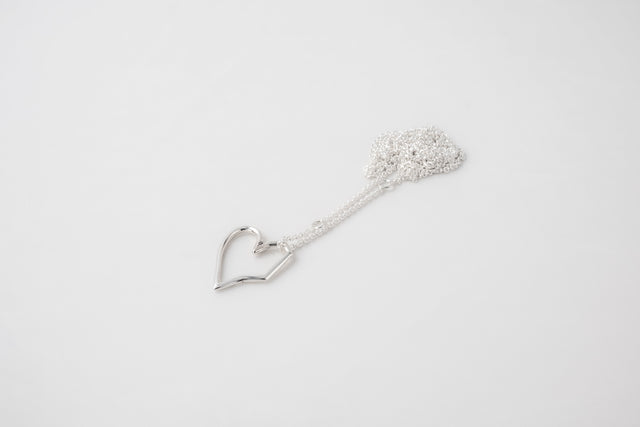
Tourmaline Jewelry: Colors, Meaning, and How to Choose
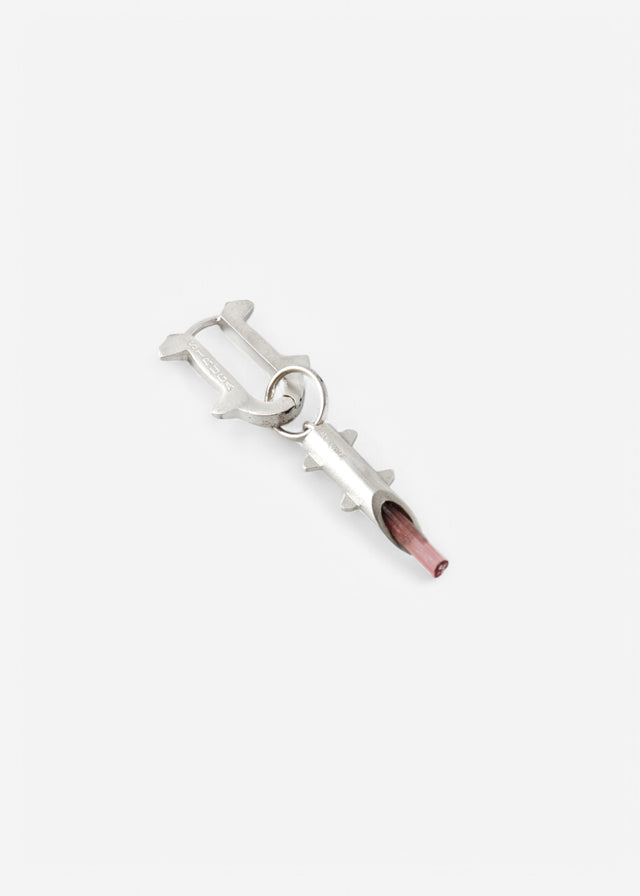
Tourmaline can show different colors when turned, and one crystal can carry several color zones. In jewelry, the stone’s shape is only part of the choice: look at the setting, the object’s weight and its treatment information. Tourmaline measures 7–7.5 on the Mohs scale but needs protection from knocks and sudden temperature changes. A raw crystal does not, by itself, prove an absence of heat or other treatment.
Updated October 9, 2026
Tourmaline is a mineral group; a color name does not identify the individual sample.
Hardness of 7–7.5 on the Mohs scale describes scratch resistance, not protection from impact.
Natural, raw and untreated are separate characteristics. Some treatments cannot be detected even by examination.
Archived AMULET pieces are sold, one-of-one objects. A similar amulet will have a different stone.
Clean with warm water and mild soap; avoid ultrasonic cleaning, steam and thermal shock.
What is tourmaline, and why does it have so many colors?
Tourmaline names a mineral group, rather than one fixed composition. The chemistry of an individual crystal influences its color and properties. Pink, green and black specimens belong to that group, but they do not all have the same transparency or appearance. A trade color name and a mineral species tell you different things about the material.
Color zoning is another part of the story. Watermelon tourmaline has a pink center surrounded by green; other crystals carry zones along their length. A cutter can expose that pattern with a slice or a faceted cut. A raw stone keeps its outer crystal form. GIA explains the range in its tourmaline description. Look at the actual stone rather than expecting every example of a named color to resemble the same photograph.
What do tourmaline’s properties mean in wear?
Hardness describes resistance to scratching, not resistance to breaking. Tourmaline ranks 7–7.5 on the Mohs scale, while GIA rates its toughness as fair. A hard stone still needs protection from impact. An exposed crystal tip can meet the edge of a table or catch against another object; the hardness number does not make that contact harmless.
Pleochroism means that color can look different from different viewing directions. Turn the object and compare the front and side views. Lighting also affects what you see, so daylight and indoor photographs are useful when choosing remotely. A photograph cannot measure refractive index or establish mineral identity. Laboratory properties help a gemologist identify a sample; they are not a set of measurements a buyer can recover from a screen.
What are the named varieties of tourmaline?
Trade color names and mineral species belong to different levels of description. Rubellite, indicolite and verdelite are color varieties; schorl is a mineral species. Paraíba needs a separate assessment of the stone’s composition. A color name does not automatically tell you where a stone was mined or whether it has been treated.
| Name | Appearance | What to check |
|---|---|---|
| Rubellite | Pink to red range | The individual stone’s actual hue |
| Verdelite | Green | Transparency and saturation |
| Indicolite | Blue or greenish blue | Color in different lighting |
| Watermelon | Pink center, green rim | The arrangement of zones |
| Schorl | Usually black | Mineral identification |
| Paraíba | Vivid blue-green range | Copper-bearing composition |
How does a raw tourmaline shape its silver amulet?
In AMULET, the raw stone’s natural shape guides the object. Classic Amulet leaves a restrained frame around it; Thorn Amulet reveals the crystal within a split, solid form. AMULET belongs to RITUAL. A stone-set Thorn Amulet and the THORN family without a stone are different entities, even when their forms share a starting point.
The archive lets you compare Classic Amulet #26 — Achroite, Thorn Amulet #14 — Grey Tourmaline and Thorn Amulet #9 — Pink Tourmaline. These are sold, one-of-one objects, rather than samples for an exact repeat. For a different object in the same direction, use Request similar. The new crystal is discussed separately.
How do natural, raw and untreated stones differ?
Natural describes the material’s origin. Raw describes its form. Untreated concerns interventions that alter color or other properties. One description does not establish the others. An irregular surface cannot reveal a stone’s entire history, and visible inclusions do not prove that it was never heated.
Tourmaline can undergo heating, irradiation and other treatments. Some leave no detectable evidence. GIA discusses those limits in its research on tourmaline’s internal features. A setting made for an uncut crystal does not establish the stone’s treatment history; ask about the individual stone. A laboratory conclusion also needs to be read within its scope: identifying the mineral and detecting every possible treatment are different questions. Neither the silhouette of the crystal nor the design of its frame answers both.
What does an examination establish?
Specify the question: material identification, treatment detection or geographic origin. These are separate tasks. A mounting can restrict access to the stone and limit measurements. Ask the laboratory what it can examine in that state and whether removal is necessary. Do not remove the stone yourself.
How do you read color in the finished object?
Against dark silver, pink and green stand out as color; grey and colorless stones sit closer to the metal. This is a visual choice. The exposed area of crystal, its transparency and the amount of light blocked by the setting all affect the result. A long crystal and a short fragment of the same color can change the proportions of the entire object.
Look at the whole piece first, then move closer to the stone. Where does the silver edge remain visible? Does the crystal project beyond it? How different are its light and dark sides? Those questions are more useful than a ready-made list of color meanings. STRUGA describes stones through material, color and form. A stone’s name does not promise a health effect or a protective property.
Black tourmaline or obsidian — how do you tell them apart?
A shared black appearance does not make these materials related. Tourmaline is crystalline. Obsidian is volcanic glass: molten material cooled without forming a crystalline structure. The U.S. Geological Survey explains that origin.
| Feature | Tourmaline | Obsidian |
|---|---|---|
| Material | Tourmaline-group mineral | Volcanic glass |
| Structure | Crystalline | Glassy |
| Finished jewelry | Appearance is a clue | Appearance is a clue |
| Confirmation | Gemological identification | Gemological identification |
Once a stone is polished and mounted, surface appearance alone is insufficient. Do not scratch it or heat it as a test. Uncertain material calls for an instrumental examination, rather than an experiment on the jewelry. The purpose is to identify the stone while keeping the object intact.
How should you choose tourmaline jewelry?
Start with the format: one object on the ear, a pair, an object at the neck or another fit. Then compare the stone’s area with the silver around it. A small crystal can hold color as a short accent; a long crystal changes the whole form. A size letter in the name belongs to a model, so check the individual object’s measurements as well.
Confirm that the photograph shows the exact piece being offered and read its status. Archive does not mean that the same crystal can be made again. A new amulet can follow a similar direction, but its stone will differ in color, growth and surface. Discuss the form and fit before choosing a crystal. If weight matters to the fit, use the figure on the individual product page, rather than estimating it from a photograph.
What should you confirm before choosing the crystal?
- The object’s format and fit: one amulet on the ear, a pair or another way of wearing it.
- The individual piece’s dimensions and weight, alongside its S, M or L designation.
- Photographs of the chosen crystal from different sides and in different lighting.
- Known identification and treatment information; a lack of information is not proof of an absence of treatment.
What can the Tourmaline archive tell you?
The Tourmaline selection preserves stones and forms from existing objects. An archive page keeps the photographs of the sold piece. It is useful for comparison: the frame, crystal length and mass remain visible. It does not promise stock or manufacturing from the same photograph.
| Archived object | Listed weight | Status |
|---|---|---|
| Classic Amulet #26 — Achroite (S) | 2.5 g | Archive |
| Thorn Amulet #14 — Grey Tourmaline (M) | 4.9 g | Archive |
| Thorn Amulet #9 — Pink Tourmaline (L) | 5.9 g | Archive |
Those figures belong to those objects and cannot be transferred to a new similar amulet. A request starts with the form and your preferences; the next stone is confirmed separately. For the international market, STRUGA objects are made in Bali. The location describes production, not the geological origin of every crystal.
How should you care for tourmaline jewelry?
Warm water with mild soap is suitable for cleaning the stone. Ultrasonic and steam cleaning are not recommended. Heat and sudden temperature changes can damage tourmaline. These limits are set out in GIA’s care guide.
Choose silver care with the mounted crystal in mind. Do not polish aggressively across the stone to brighten its setting. Take the object off for activities involving impacts or catches, and store it separately from other jewelry. If the stone moves, stop wearing it and contact STRUGA. Do not tighten the silver or glue the stone back yourself. First establish why the fit has loosened and what work the object needs.
When the setting needs attention
Tell the person cleaning or repairing the object that it contains tourmaline. A method suitable for silver alone may be unsuitable for a mounted crystal. Preserving the dark surface and checking the fit are separate questions. Send photographs of the whole object and the affected area.
Why is Paraíba tourmaline expensive?
The value of fine Paraíba tourmaline reflects its color, the rarity of suitable material and the quality of the individual stone. Origin is a separate question from the variety’s name. A vivid blue appearance alone does not establish copper-bearing tourmaline, or prove that the stone came from Brazil.
GIA’s quality guide explains how color and rarity affect value. Compare the stone’s identity, its characteristics and the finished object’s price separately; the setting and work also contribute to a piece of jewelry. An archived pink or grey STRUGA crystal does not become Paraíba by comparison with a costly variety. For an expensive purchase, the description should concern the actual sample, rather than rely on a general story about the name.
How do raw and faceted tourmaline differ?
Faceting introduces new planes and controls the path of light through a stone. A raw crystal retains its natural outer form. These are different ways of presenting the material, and neither confirms identity by itself. A good cut does not make a natural stone artificial; an uneven surface does not rule out imitation or treatment.
In AMULET, the original crystal form is part of the object’s design. Its frame follows that form instead of assuming a series of identical stones. A familiar model can therefore continue in a new object, while the exact sold amulet cannot be repeated. Compare the fit, proportions and available stone information. Dividing all jewelry into right and wrong choices based only on whether it has facets loses the question the wearer needs to answer.
How can you tell real tourmaline from fake?
A photograph can flag inconsistencies, but cannot confirm mineral identity. Color, striations and inclusions need to be assessed alongside measurements. One visual match is insufficient. For an expensive or uncertain stone, discuss an independent gemological examination of the actual sample, including what the result can and cannot establish.
GIA explains that an identification report describes material and detectable treatments; an origin report is also available for Paraíba tourmaline. This is a separate laboratory service, rather than a promise of paperwork from STRUGA. STRUGA does not include authenticity certificates or origin cards in the package. Read GIA’s explanation of tourmaline reports. Do not test jewelry by scratching, flame or heating: identification should not damage the object.
Frequently asked questions
Didn’t find the answer — write to us, we reply personally.
Ask a question →01What is tourmaline?+–
It is a mineral group with varying compositions and colors. Jewelry can contain different species and color varieties; a color name does not replace identification of the individual sample.
02Is tourmaline precious or semi-precious?+–
Those trade descriptions do not give a single quality grade. Tourmaline is a gemstone whose value depends on the individual sample. The category does not identify treatment, color or cut quality.
03Is tourmaline heated, or can it be untreated?+–
Both occur. Heating, irradiation and other treatments are used, and some cannot always be detected. Raw form and visible inclusions do not prove an absence of treatment.
04Is watermelon tourmaline a separate species?+–
No. The name describes color zoning within a crystal: a pink center surrounded by green.
05Can blue color alone identify Paraíba?+–
No. Composition matters to that identification. A similar hue does not prove copper content or a country of origin.
06How should I clean tourmaline?+–
Use warm water with mild soap. Ultrasonic cleaning, steam and sudden temperature changes are not recommended; consider the setting material as well.
07Can I buy the same amulet shown in the archive?+–
The exact sold piece cannot be repeated. Request similar lets you discuss a different object in the same direction; the individual stone and possibility of an offer are confirmed separately.
08Does STRUGA provide a stone-origin certificate?+–
The package does not contain an authenticity certificate, origin certificate or similar paperwork. Independent examination is a separate question, rather than part of standard packaging.
09What if the stone starts moving?+–
Take the object off and contact STRUGA. Do not tighten the setting or glue the stone yourself.
10How can I discuss another object or a stone-set ring?+–
Use Request similar for a similar amulet. Custom Order is the route for an individual object; Dark Union is for wedding and paired rings. A STRUGA person confirms feasibility, stone, price and timing.