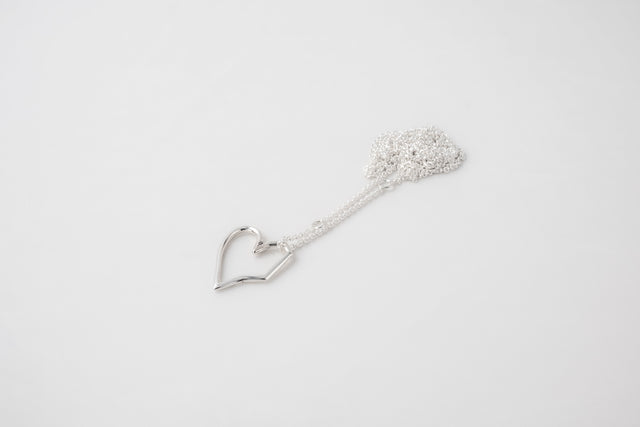
Engagement Ring Without a Diamond: Stones and Forms
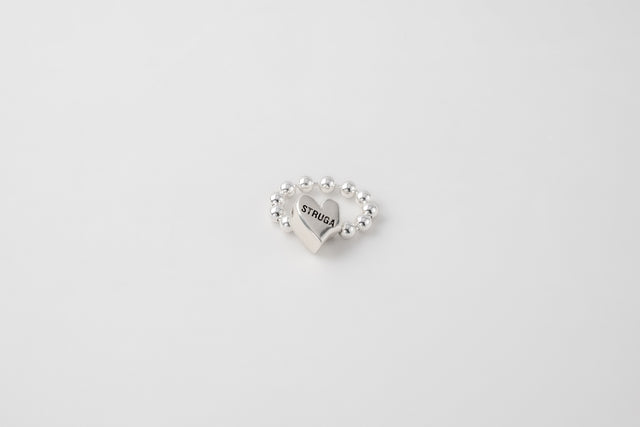
An engagement ring without a diamond can use a coloured stone, a raw crystal or silver alone. Compare the stone’s care needs with the ring’s shape on the hand. Heart Lock Ring shows the last route: silver beads and a working heart clasp.
- Start with the wearer’s preference: colour, a natural crystal, or a ring with no stone.
- Sapphire and ruby are strong candidates for daily wear, but treatments and the condition of each stone matter.
- Mohs hardness measures resistance to scratching. It does not promise resistance to every impact.
- A coloured centre can still have diamond accents. Check every insert if the brief excludes diamonds entirely.
- For STRUGA, compare catalogue rings with the DARK UNION commission route. A personal quote follows the brief; production and delivery are separate estimates.
Updated September 14, 2026
Why choose an engagement ring without a diamond?
The choice can begin with a colour someone already wears, the shape of a raw crystal, or a preference for metal against the hand. Ask what they enjoy wearing before deciding which stone should stand for the proposal. A ring chosen together can carry the same commitment as a surprise.
The familiar advertising line has a date: De Beers’ own chronology credits Frances Gerety with creating “A Diamond Is Forever” in 1947. That fact explains the slogan’s origin. It cannot set a rule for what an engagement ring must contain.
Separate two briefs at the start: a different centre stone, or no diamonds anywhere in the ring. Halo and side-stone designs may combine a sapphire or emerald with small diamonds. Read the complete materials description, including the shoulders and any hidden accents, before treating a product as a match.
Which stones can replace a diamond?
Sapphire, ruby, emerald, morganite, aquamarine, tourmaline and opal offer different approaches to colour and care. This is a selected comparison, not an inventory of every gemstone or STRUGA’s catalogue. The numbers below describe the mineral; a jeweller still needs to assess the actual stone, any treatments and the mounting.
| Stone | Mohs | What to check before choosing |
|---|---|---|
| Sapphire | 9 | A strong daily-wear candidate. Ask about filling, dyeing and diffusion treatments. |
| Ruby | 9 | Durable corundum; glass-filled stones need more careful handling and cleaning. |
| Emerald | 7.5–8 | Fractures and fillers matter. Avoid ultrasonic and steam cleaning. |
| Morganite | 7.5–8 | Protect against scratches and hard knocks; inclusions affect cleaning choices. |
| Aquamarine | 7.5–8 | Protect against hard knocks and heat; check for fractures or filling. |
| Tourmaline | 7–7.5 | Avoid heat and sudden temperature changes; no ultrasonic or steam cleaning. |
| Opal | 5–6.5 | More vulnerable to scratching and breakage; heat and thermal shock can damage it. |
Tourmaline need not be a single colour or stop at two. GIA documents multicoloured zoning within crystals. Look at the particular stone in ordinary light, including its side view: a mineral name will not tell you the colour distribution of the object you are buying.
Moissanite is another option: GIA identifies it as silicon carbide, a different material from diamond. Discuss the actual stone and design with the maker; the name does not establish availability in a particular catalogue.
How hard does a stone need to be for daily wear?
There is no single Mohs number that makes every ring safe for everyday use. Hardness concerns scratching; toughness concerns resistance to breaking, and stability concerns the effects of heat, light and chemicals. Those are different questions. An attractive number in a table cannot answer all three.
For frequent wear, start the discussion with sapphire or ruby, then ask what has been done to the particular stone. A filled ruby and an unfilled ruby require different care. For emerald or opal, discuss the restrictions before ordering, while the setting and intended use can still be changed.
Describe an ordinary day to the jeweller: work with tools, sport, gloves, gardening, or long periods at a desk. Plan when the ring comes off and where it will be kept. If the owner prefers no gemstone, compare the angular silver form of Thorn Ring. A stone-free design still needs a comfortable fit and care for the metal.
Which materials does STRUGA use?
STRUGA works with 925 silver, raw stones including tourmaline, aquamarine, quartz and heliodor, and materials such as Seymchan meteorite and carbon. These are different design possibilities. The condition and availability of a particular insert must be confirmed for the object being discussed.
AMULET is a place to explore raw crystals and belongs to the RITUAL world. Heart Lock and Signature Links below are forms from CODEX. The DARK UNION world covers engagement, wedding and paired rings; a personal design can also involve the Custom Order route. Begin with the idea, then agree the material and construction with STRUGA.
A raw crystal has its own outline. Ask to see the selected specimen and discuss how much will remain exposed above the metal. “Raw” describes the form; the crystal can still be damaged. A meteorite insert likewise needs care instructions for that particular construction and surface; do not apply a general oil or lacquer routine to a finished ring.
For a first comparison, look at the rings below. They show existing silver forms, without implying that every one belongs to DARK UNION or that all can be adapted to any stone.
What does an engagement ring with no stone look like?
A stone-free ring can concentrate on an outline, a repeated element or a working mechanism. The useful question is what feels right on the hand when the ring is worn for more than a photograph.
- Thorn Ring: angular silver planes and a thorn-like outline; a catalogue reference for the DARK UNION ring line.
- Heart Lock Ring: silver beads with the SIGNATURE HEART clasp. The clasp is part of the object’s construction.
- Triple Drills Ring: three silver drill forms brought together in one ring, with grooves and smooth shafts.
- Signature Links V.2 Ring: an open ring of linked silver elements. Compare its moving construction with a continuous band.
Try opening and closing the hand, holding a handle and putting on a sleeve. Check the space between neighbouring fingers and the position of any open ends. Two rings with similar face-on photographs can feel quite different because their undersides, profiles and movement differ.
Removing the stone removes a stone-setting concern. It does not make silver maintenance-free: the band can still show wear, and a clasp or moving connection remains a part to inspect. Choose the construction you want to live with.
How does the setting change the choice?
A setting secures the stone; a style describes the composition. GIA’s guide to ring settings separates these terms.
| Term | Meaning |
|---|---|
| Bezel | A rim surrounds the edge; a partial bezel leaves sections open. |
| Prongs | Metal tips hold the stone; their arrangement follows the design. |
| Cluster | A group of stones, whose individual settings still need assessment. |
Ask to see the side profile as well as the top. Discuss how high the stone sits, which areas are exposed and how the ring feels under a sleeve. Try the proposed form with the clothes and any other ring it will meet. A setting name alone does not settle those choices.
How does silver change the ring?
Silver opens a different visual direction: broad surfaces, linked forms, sharp planes or dark recesses. Triple Drills Ring uses the contrast between smooth shafts and cut grooves; Heart Lock uses a sequence of beads. The material and the construction work together.
The four rings described above use 925 silver without rhodium plating. Its surface can darken and develop patina. Decide whether you want to keep brighter areas light or let the surface change, then follow the instructions for that object. A cleaner suitable for plain silver may not suit a stone, an insert or a deliberately darkened finish.
Compare real dimensions and listed weights in the same size. The metal name does not tell you how a wide ring will fit, what a repair will cost or whether a particular design can be resized. Those questions need the actual ring in view.
How much does a commissioned ring cost?
A STRUGA commission starts with a brief and a personal offer from the team. Describe the form, material, size, budget and intended date. The quote should identify the proposed object and what the agreed amount includes. There is no useful total to infer from the stone’s name alone.
When comparing proposals, keep the same brief in front of you. A different stone, a new construction or more work on the surface changes the comparison. Ask which choices can be adjusted within the budget, and confirm any advance payment and how it counts towards the total before paying.
For an existing catalogue ring, use the current product page and the selected size. A listed catalogue price and a quote for a new object describe different orders.
How do you commission a ring without a diamond?
- Send the idea through Custom Order: the intended use, material, size if known, budget and date. Include a photograph or product link that explains the direction.
- Agree the proposed stone or stone-free form. If you already own a family stone, ask for an assessment before assuming it can be reused.
- Review the design, specification, personal quote and payment terms with the team.
- Confirm the production plan. Around 3–6 weeks is an indicative frame for individual work; confirm the arrival date separately.
- Confirm shipping separately. International STRUGA orders are made on Bali and dispatched from there; destination, delivery time and cost are checked for the order.
If the date is fixed, say so in the first message. Ask what can realistically be completed and delivered by then. If there is a ring to wear alongside it, share its profile and dimensions while discussing the new design.
Which mistakes are worth avoiding?
- Choosing from carat weight alone. Ask to compare the actual stones, their dimensions, appearance and condition.
- Buying a loose stone before checking the proposed mounting. Have the jeweller assess compatibility first.
- Confusing origin with material. A laboratory-grown diamond is still diamond. It does not meet a brief that excludes diamonds altogether.
- Assuming one cleaning method fits every insert. GIA recommends gentle warm soapy water for emerald and advises against ultrasonic and steam cleaning; the whole ring may have additional restrictions.
- Measuring a convenient finger instead of the intended one. Confirm the size for the hand and design that will actually be worn.
If a stone looks dull, ask for an assessment before aggressive cleaning. A surface deposit, abrasion or a change in a treatment requires a different response. Avoid a promise that any coloured stone will remain unchanged indefinitely.
Do you need a separate wedding band?
You can use one ring for both occasions or choose a second ring for the ceremony. If you want to wear two together, try them as a pair: check the gap, contact between the profiles and comfort when the fingers bend. The colours and textures can match, or the difference can be intentional.
For the distinction between the two occasions, see the engagement and wedding ring comparison. For an existing form to discuss, return to Thorn Ring; for a new pair, start with DARK UNION and the brief. The next decision is the form you want to wear.
Frequently asked questions
Didn’t find the answer — write to us, we reply personally.
Ask a question →01What are the options for an engagement ring without a diamond?+–
You can choose a coloured stone, a raw crystal or a ring made from metal without a stone. Compare care needs, the setting and the fit. If you want no diamonds anywhere, check smaller accents as well as the centre.
02Which coloured stones suit frequent wear?+–
Sapphire and ruby are strong candidates. Both have Mohs hardness 9, but treatment and condition matter. Hardness describes resistance to scratching; it does not measure resistance to impact.
03Is a bezel the same as a prong setting?+–
No. A bezel uses a metal rim, while prongs hold the stone with metal tips. Either setting can leave areas exposed or catch on clothing.
04Which materials does STRUGA use?+–
STRUGA works with 925 silver, raw stones such as tourmaline, aquamarine, quartz and heliodor, as well as Seymchan meteorite and carbon. Confirm the actual insert, its availability and construction for the proposed object.
05Can I choose morganite or opal instead of sapphire?+–
Yes, but discuss the care limits first. Morganite needs protection against hard knocks; opal is more vulnerable to scratching and breaking. Decide whether those limits fit the way the ring will be worn.
06How much does a commissioned engagement ring cost?+–
STRUGA prepares a personal offer after discussing the form, material, size, budget and date. Confirm what the quote includes and how any advance payment counts towards the total before paying.
07Can moissanite replace a diamond?+–
Moissanite can be used as an alternative stone. It is silicon carbide, not diamond. Ask the maker to confirm the particular stone, design and care requirements; this does not establish its availability at STRUGA.
08Will a coloured stone become cloudy over time?+–
Its appearance can change through surface deposits, wear or changes in a treatment. Ask for an assessment before cleaning aggressively. Follow guidance for the specific stone and the complete ring.
09Can I commission a ring using a family stone?+–
Ask STRUGA to assess it before confirming the design. Condition, dimensions and the proposed mounting need to be considered. Acceptance, handling, cost and timing are agreed for the actual stone; they are not automatic.