Men's Engagement Ring: Tradition, Sizing, Forms
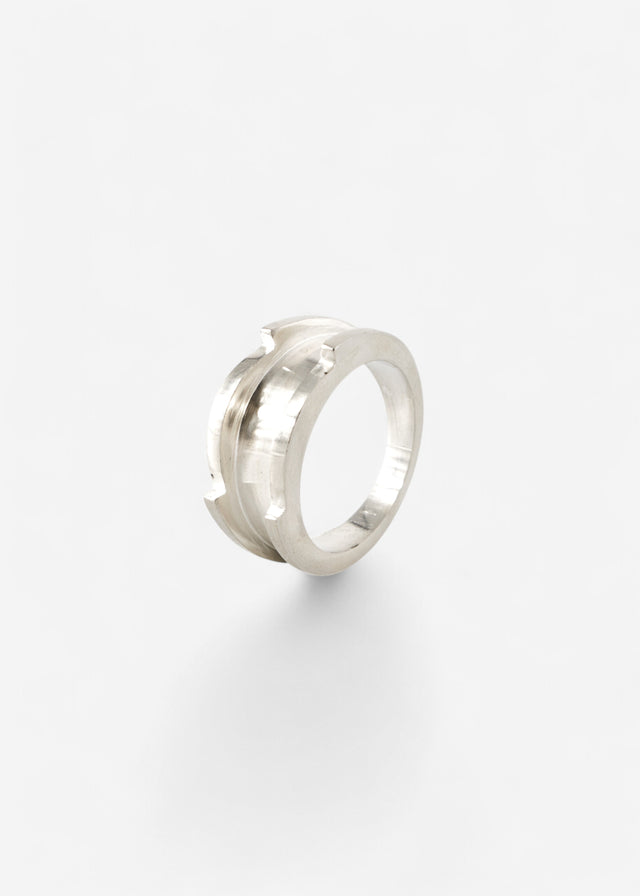
A men's engagement ring is not a scaled-down version of a woman's ring, and not the wedding band — it is the ring a man begins wearing from the moment of engagement, a worn promise of marriage that comes before the wedding band, not in place of it. It marks status, not gender: if a couple wants both partners visibly marked as engaged, both wear one. The symmetric form — both partners receiving a ring at the moment of commitment — is the historical norm across Scandinavian, German-speaking, Latin American and Eastern European traditions; the "ring only for the bride" template is a twentieth-century narrowing. STRUGA makes them hand-cast in oxidised 925 sterling silver, $180–$650.
A men's engagement ring is older than its 2010s "discovery" suggests. Symmetric engagement rituals — both partners receiving a ring at the moment of commitment — exist across multiple traditions: Scandinavian, German-speaking Europe, much of Latin America, and several older Eastern European customs that predate twentieth-century Western marketing. The "ring only for the bride" template that dominates the US and UK is a twentieth-century narrowing. Today couples are returning to the symmetric form, and this guide is the complete walkthrough: why a man takes an engagement ring, how to size it, six dominant forms, and why oxidised silver works on a man's hand more often than gold. STRUGA makes men's engagement rings in our Bali workshop, hand-cast in oxidised 925 sterling, $180–$650.
- A men's engagement ring is the ring a man begins wearing from the moment of engagement — a worn promise of marriage that comes before the wedding band, not in place of it; it marks status, not gender.
- STRUGA makes them hand-cast in oxidised 925 sterling silver, priced $180–$650 for catalogue work, up to $1,200 custom, and up to $2,500 for paired engagement-and-wedding sets.
- Men's sizing runs 17–22 mm inner diameter, with most men at 19.5–20.5 mm; minimum band width is 5 mm, 6–7 mm reads as average, 8–10 mm is a confident large band.
- Six dominant forms: flat band, domed band, signet with engraving, textured band, single-stone band (sapphire, black diamond, onyx or meteorite), and a paired engagement-and-wedding system — the territory of Dark Union.
- Beyond silver: Seymchan meteorite (a pallasite found on the Kolyma River in 1967) as a 1–2 mm inlay adds $200–$500, and the six-tone Carbon Graphite palette (Classic, Bloody, Arctic, Winter, Fused Graphite, Toxic).
- Lead times: 2–4 weeks for a standard catalogue size, 4–6 weeks with engraving or a non-standard size, and 4–8 weeks for a paired set; STRUGA offers one free resize after delivery.
Key takeaways
- What it is: a ring a man begins wearing from the moment of engagement — a worn promise of marriage. The proposal can be a surprise or a joint decision; both routes are common.
- When it fits: when the couple wants a symmetric ritual — both partners marked. Not as a replacement for the wedding band, but as the engagement-period ring that comes before it.
- Finger and hand: the same finger and hand that will later carry the wedding band. Left ring finger in most of the West; right in much of Northern, Central and Eastern Europe.
- Sizing: men's range is 17–22 mm inner diameter, most at 19.5–20.5 mm. Home measurement is paper strip around the finger base, length divided by 3.14.
- Forms: flat band, domed band, signet with engraving, textured band, single-stone band, paired engagement-and-wedding system.
- Budget: mass silver $40–$120; designer silver $180–$650; mass gold $400–$1,200; designer gold $1,500–$5,000+. STRUGA $180–$650 for catalogue work, up to $1,200 custom.
- Where to look: silver rings, paired sets in Dark Union, custom briefs through Custom Order.
Why a man takes an engagement ring
The most common question we hear: "isn't this a women's ritual?" The short answer is no. An engagement ring marks status, not gender. If the couple wants both partners visibly marked as engaged, both wear a ring. If only one — only one. It's the couple's decision, not a rule.
When a man needs an engagement ring
The motivations couples articulate most often:
Symmetry. If you propose and give a ring, why are you yourself unmarked? Engagement is a mutual step, and the visible sign of it can be mutual too.
A long engagement. If the wedding is six to eighteen months away, the man between proposal and ceremony reads as unattached — visually and ritually identical to a single man. A ring solves that: he is engaged, and it shows.
The proposal direction. If the proposal comes from her, or if the couple decides together rather than via a one-sided gesture, the "box with a ring for her" template doesn't fit. Engagement rings for both partners are the natural response.
The cultural baseline. In Scandinavia, German-speaking Europe, Brazil, Argentina, and several Eastern European traditions, men wear engagement rings as a matter of course. The "ring only for her" version is regionally specific, not universal.
The men's engagement ring vs. the wedding band
The engagement ring goes on at the moment of commitment. The wedding band goes on at the registration or ceremony. Between those two events — anywhere from a month to a couple of years — the engagement ring carries the role.
At the wedding three options are common:
- Replace. Take the engagement ring off, put the wedding band on the same finger. Simple, common in countries where men's engagement rings have only recent traction.
- Stack. Both rings live on the same finger from the wedding onward. Works only if the two rings were designed to sit together.
- Split between hands. Wedding band on the conventional ring finger, engagement ring on the opposite hand or repurposed onto a different finger.
Wearing both rings on one finger
Option two — stacking — is the strongest visual outcome, but only if the engagement ring and wedding band were designed as a single system. If you know in advance that both rings are coming, commission them as a pair. STRUGA's Dark Union line is built specifically for this: paired engagement-and-wedding rings designed to read as one diptych. Full walkthrough in our complete dark wedding rings guide.
How to choose a men's engagement ring
1. Decide together or surprise
The first and most consequential choice. Men's engagement rings are more often picked together than women's — the sole-proposal-and-surprise format is more associated with the female version. If you do go the surprise route, you need his finger size and a basic read on his preferences. If he's never worn a ring, choose the most neutral minimal form.
If you choose together, the conversation often surfaces something the surprise wouldn't: how strongly the man wants the ring once asked, what form actually fits his hand and his life, and whether a paired set with hers is the right move.
2. Size the finger
Men's finger size measures the same way women's does — the inner diameter in millimetres — but the range is wider. The men's diameter range is 17–22 mm, with most men sitting at 19.5–20.5 mm. To measure at home:
- Take a paper strip about 5 mm wide. Wrap it around the base of the ring finger on the hand the ring will sit on.
- Mark the point where the end of the strip meets its own start.
- Measure the length with a ruler. That's the circumference in millimetres.
- Divide by π (3.14). The result is the inner diameter — the ring size.
Measure in the evening. Fingers swell slightly through the day; a ring sized off a morning measurement will feel tight by night. When in doubt, round up by half a millimetre rather than down. STRUGA offers one free resize after delivery, so a small mistake is fixable.
3. Choose the metal
925 sterling silver. The right starting point for most men's engagement rings, especially for men without a habit of wearing jewelry. Silver is light, doesn't catch on clothing, doesn't draw attention in an office, and handles physical work without complaint. STRUGA uses oxidised 925 silver — darker than untreated silver, visually quieter, and shows scratches less readably than polished gold.
14k or 18k gold (the market default). The classic Western choice, but not STRUGA's material — the brand works in 925 silver, carbon and meteorite, not gold. Gold is mentioned here only for comparison: it doesn't darken and costs $800–$2,500 for a men's ring, several times the price of an author silver piece. The downside beyond cost: it reads as conventional where silver reads as a decades.
Platinum. For very large budgets and maximally conservative design. Heavy, expensive, hard-wearing. Usually overkill for an engagement ring; more often a wedding-band material.
Carbon and silver. For men who don't wear jewelry but still want a worn mark. STRUGA's Carbon family combines a carbon-fibre band with a 925 silver inlay or core. The result reads more like a technical object than a ring — it sits well on men who would otherwise refuse anything jewelry-shaped. (See the carbon and meteorite guide for the material story.)
4. Choose the form
Six dominant forms for men's engagement rings:
Flat band. The most universal choice. 4–8 mm wide, no decoration, smooth surface. Suits everyone. When uncertain, take this form.
Domed band. A band with a convex outer profile. A touch more presence than flat without crossing into ornamental. Reads well on a larger hand.
Signet ring. A flat top plate intended for engraving — a date, initials, a monogram, a family motif. The strong choice for men who value lineage and continuity. Look at the wider CODEX rings for signet-shape work.
Textured band. A surface with a natural pattern: meteorite striations, the imprint of bark, the trace of a worked tool. STRUGA casts many men's rings from wax models that retain the texture from the original — every ring slightly different at the level of finish.
Single-stone band. One sapphire, black diamond, onyx, or a meteorite inlay set into a smooth band. For men ready for a small accent without wanting "a diamond ring like a woman's."
Paired engagement-and-wedding system. The men's engagement ring designed in dialogue with hers — common texture, common metal, different scales and proportions. The peak of the ritual: a single design language carried in two forms. This is the territory of Dark Union.
5. Set the budget and lead time
Realistic ranges for a men's engagement ring:
- Mass silver, chain retailers: $40–$120. A standard rolled form, no character. Production runs into the thousands per design.
- Designer silver from a named workshop: $180–$650. Hand-cast, oxidised, defined visual identity. Batches of 8–12.
- Mass gold: $400–$1,200. A thin 14k band, no decoration.
- Designer gold: $1,500–$5,000. Author form, engraving, signet with stone.
- Platinum and large diamonds: $5,000+. Rare in men's engagement rings.
STRUGA lead times: 2–4 weeks for a standard size from the catalogue, 4–6 weeks if engraving or a non-standard size is required. A paired engagement-and-wedding set: 4–8 weeks.
How a men's commission usually goes
Most men's commissions start the same way: a form (flat, domed, signet), a size, a budget, a date. Some men come with a clear picture — an engraving, a paired set with a partner; others bring only a direction and let the sketches narrow it down.
The brief is short, and the ring is built around one decision the man cares about: the form that sits right on his hand, the engraving that means something, the finish he'll wear every day. Start with a short brief on the Custom Order page.
If you would rather start from a form that already exists, Brutalism V.1 is the first ring of the BRUTALISM family — a signet read as architecture, where the seal plate becomes a stepped, multi-level relief and the tool marks are left in place. Around 10 g in 925 sterling silver, finished as Living Silver: silver without rhodium plating, so the surface darkens as the ring is worn. The same code has two neighbours: Brutalism V.3 is its dark version, where black oxidation sinks into every recess and pulls the architectural form forward by contrast alone, and Thorn takes the form of a thorn — sharp, plane-faceted, cleanly edged.
How much should a men's silver ring cost?
| Budget | Where | What you get |
|---|---|---|
| $40–$80 | Mass-market chain stores | A 4 mm silver band, stamped, no character. Production runs in the thousands. |
| $100–$180 | Mid-tier mass-market | 925 silver, standard form, sometimes machine-engraved. |
| $180–$350 | STRUGA catalogue, designer ateliers | Author ring, hand-cast, oxidised silver, recognisable form. Batches of 8–12. |
| $350–$650 | STRUGA custom commission | A particular form, engraving, paired set, choice of finish. |
| $650–$1,500 | Mass 14k gold | A thin band of yellow or white gold, no decoration. |
| $1,500–$5,000 | Designer gold, signet with stone | Author form, 18k gold, sometimes a centre stone. |
It's worth saying plainly: silver in a men's engagement ring is not the "budget" alternative. It's a separate aesthetic. Oxidised 925 silver is darker and quieter than gold, handles daily wear and physical work better, and looks deliberately understated rather than understated by default. For a man who works with his hands — or simply doesn't gravitate to shine — silver beats gold regardless of price.
Materials beyond silver
STRUGA's men's engagement rings sometimes step outside silver alone. The two materials worth knowing:
Seymchan meteorite. A pallasite — a stony-iron meteorite — found on the Kolyma River in 1967. Cut and acid-etched, it reveals the Widmanstätten pattern, a crystalline geometry formed in the slow cooling of the parent body over millions of years. (See Seymchan meteorite on Wikipedia.) Used as an inlay in select men's engagement rings — a 1–2 mm strip between silver. Adds $200–$500 to a base ring.
Carbon Graphite palette. STRUGA developed a six-tone carbon-fibre palette branded Graphite: Classic, Bloody, Arctic, Winter, Fused Graphite, Toxic. Each tone reads differently on the hand. Used as the body of a ring (carbon-fibre band) or as an inlay strip in a silver band. The full palette walkthrough is in the Carbon collection.
What to avoid
Don't buy a men's ring as a "scaled-up women's ring." A man's hand is proportionally different. A 4 mm band that reads beautifully on a woman's finger looks like a thin thread on a man's. Minimum for a men's ring is 5 mm; 6–7 mm reads as average; 8–10 mm is a confident large band.
Don't pick a high-set stone for daily wear. A man's hand handles more physical contact than a woman's on average. A high prong setting on a men's ring is a guarantee that the stone will scratch or come loose within a year. If the ring needs a stone, set it bezel or flush — recessed, level with the band.
Don't buy without measuring. Men's sizing is harder to guess than women's because the range is wider and the differences between sizes are larger. Measuring without a ruler typically introduces a 1–2 mm error, which is the difference between a ring that fits and a ring that doesn't. Either order a sizing kit from the workshop or visit a jeweler for a free fitting before placing the order.
Where men wear engagement rings by default
Scandinavia (Sweden, Norway, Finland, Denmark). Both partners wear engagement rings by default — usually plain silver or gold bands without a stone. Of the regional models, this one sits closest to STRUGA's approach.
Germany and Austria. Historically the engagement ring and the wedding band are one ring: partners exchange rings at the engagement, wear them on the left hand, and after the wedding move them to the right.
Brazil and Argentina. The scheme is close to the German one: the couple exchanges rings at the engagement.
Russia and the CIS. The historical tradition was symmetric — both partners exchanged rings. From the 1990s the Western "ring only for the bride" scheme took over, but the symmetric variant is regaining ground.
The US and the UK. The classic "Hollywood" scheme: a ring only for the bride, usually a diamond in a high setting. The men's engagement ring became a mass practice there only in the 2010s.
FAQ
Is a men's engagement ring the same as a wedding band?
No. The engagement ring goes on at the moment of commitment; the wedding band goes on at the registration or ceremony. Between those two events — anywhere from a month to a couple of years — the engagement ring carries the role. They are two rings for two stages, not one in place of the other. At the wedding a man either replaces the engagement ring with the band, stacks both on one finger, or splits them between hands.
Is a men's engagement ring just a scaled-up women's ring?
No. A man's hand is proportionally different, so a men's ring is not a women's ring made bigger. A 4 mm band that reads beautifully on a woman's finger looks like a thin thread on a man's. The minimum for a men's ring is 5 mm; 6–7 mm reads as average; 8–10 mm is a confident large band.
Is oxidised silver the "budget" version of a gold engagement ring?
No. Silver in a men's engagement ring is not the budget alternative to gold — it is a separate aesthetic. Oxidised 925 silver is darker and quieter than gold, handles daily wear and physical work better, and looks deliberately understated. It does run roughly five to ten times less than the gold equivalent of the same design, but the choice is about character, not price.
Do men wear engagement rings?
Yes. A men's engagement ring is not a women's ritual — it marks engagement status, not gender. If the couple wants symmetry, both partners wear a ring from the moment of commitment until the wedding. In Scandinavia, German-speaking Europe and Brazil this is the norm; in Russia and much of Eastern Europe the symmetric exchange is the older custom, and couples are returning to it.
Is a men's engagement ring a recent 2010s invention?
No. A men's engagement ring is older than its 2010s "discovery" suggests. Symmetric engagement rituals — both partners receiving a ring at the moment of commitment — exist across Scandinavian, German-speaking, Latin American and several older Eastern European traditions that predate twentieth-century Western marketing. The "ring only for the bride" template that dominates the US and UK is the regionally specific narrowing, not the universal rule.
Does a man need an engagement ring?
A man needs an engagement ring when the couple wants a symmetric ritual — both partners carrying the visible sign of the engagement. It is not mandatory; it is the couple's choice. It earns its place most clearly in a long engagement of six to eighteen months, and in scenarios where the proposal comes from her or the decision is made together.
Can a man wear an engagement ring before and after the wedding?
Yes. After the ceremony a man either replaces the engagement ring with a wedding band or wears both — on one finger stacked together, or one on each hand. STRUGA makes design-coordinated paired engagement-and-wedding sets in the Dark Union line for exactly this scenario.
On which finger does a man wear an engagement ring?
On the same finger his eventual wedding band will sit. Most of the West uses the left ring finger; much of Northern, Central and Eastern Europe uses the right. Choose by the regional convention or by personal preference and stay consistent through the engagement.
What size is a typical men's engagement ring?
The men's range is 17–22 mm inner diameter; most men sit at 19.5–20.5 mm. To measure at home: wrap a 5 mm paper strip around the base of the finger, mark where the ends meet, measure the length, and divide by 3.14. Measure in the evening — fingers swell slightly through the day.
Which form fits a men's engagement ring?
Six dominant forms: a flat band (the most universal), a domed band (slightly more presence), a signet (with engraving), a textured band, a single-stone band (sapphire, black diamond, onyx, meteorite), or a paired engagement-and-wedding system designed together. For a man without a habit of wearing rings, start with the flat or domed band.
Should a men's engagement ring be silver or gold?
For most men, silver. Oxidised 925 silver sits quieter on the hand, doesn't catch light at the office, handles physical work, and runs roughly five to ten times less than the gold equivalent of the same design. Gold suits men who already wear gold and want classical permanence.
What is the price range for a men's engagement ring?
Mass silver bands $40–$120; designer silver $180–$650; mass gold $400–$1,200; designer gold $1,500–$5,000+. STRUGA author work in oxidised silver runs $180–$650, with custom commissions up to $1,200 and paired Dark Union sets up to $2,500.